The practice of crypto treasury management has rarely been as publicly tested as it is right now. On October 5, 2026, Compound DAO’s governance became the stage for a live stress test of the rules that control how decentralized organizations move their own money. Proposal 612, submitted by delegate Ugur Mersin on October 2, asks token‑holders to grant themselves the power to cancel pending treasury timelock operations outright — and to extend those timelocks from two days to ten. The outcome will shape not just one protocol, but the playbook for every DAO finance lead trying to balance speed, security, and legitimacy.
Table of Contents
- What Just Happened: Compound’s Treasury Timelock Proposal
- Why This Matters for Crypto Treasury Management
- The Background: How DAO Treasuries Operate
- Implications and Recommended Actions for Finance Leads
- What to Watch Next and Open Questions
- Key Takeaways
What Just Happened: Compound’s Treasury Timelock Proposal
As reported by Cryptonews.net on October 5, 2026, Compound’s Proposal 612 was active and had amassed approximately 1.75 million $COMP in favor, 921,000 against, and no abstentions. A wallet that governance researcher Blockful associates with the pseudonymous figure Humpy cast all 1.75 million supporting votes — enough to single‑handedly surpass the 400,000‑$COMP quorum. The proposal would rewrite several parameters of Compound’s Treasury Timelock Controller: the waiting period before treasury transactions execute would jump from two days to ten, and token‑holders would gain explicit authority to cancel any pending operation during that window.
This directly challenges the operational authority of the Treasury Management Committee (TMC), a group already entrusted with moving funds under the DAO’s old constraints.
The Core Dispute: Speed vs. Control
Mersin’s argument is simple: the current two‑day waiting period is shorter than the roughly one‑week voting cycle, so by the time a governance vote could stop a treasury action, the funds have already moved. Today’s backstop is the Community Multisig, a separate set of signers who can intervene but are not directly accountable to a token‑holder vote in real time. Extending the timelock to 10 days and giving governance a cancellation button, Mersin contends, would close that gap.
The Compound Foundation disagrees sharply. Its position is that a 10‑day delay would impede routine treasury operations and, paradoxically, empower concentrated voting positions like Humpy’s. That is the tension: the very mechanism designed to protect the DAO from a malicious actor may hand a blocking veto to a whale.
Why This Matters for Crypto Treasury Management
The Compound vote reveals that many DAOs operate with treasury controls designed for an earlier era — when smaller, aligned groups could rely on social consensus as a safety net. Today, billion‑dollar treasuries are administered by committees under protocols that rarely get stress‑tested until a governance battle forces the issue. A single address casting more votes than the quorum on October 5 illustrates that on-chain governance can concentrate power as easily as it distributes it.
If the proposal passes, the TMC could face a 10‑day pause between authorizing a payment, swap, or bridge and its execution. For a team needing to react to market conditions — moving stablecoins ahead of a depegging event, rebalancing collateral, or paying vendors — that lag is an eternity. Alternatively, if it fails, the treasury will continue operating with a 2‑day window and a Community Multisig as the primary circuit breaker, raising questions about whether token‑holders have enough oversight. The immediate takeaway: crypto treasury risks are no longer just about technical hacks; they include governance‑driven paralysis or capture. A treasury can be perfectly secure from an external attacker and still fail because an internal veto power blocks legitimate payments. Short timelocks also make it tempting to skip proper governance review for expediency, gradually eroding the legitimacy of decentralized treasury operations.
The Background: How DAO Treasuries Operate
Crypto treasury management encompasses the policies, processes, and tools used to safeguard, allocate, and report on a decentralized organization’s digital assets. It spans multi‑signature wallet configuration, cold storage, liquidity management across decentralized exchanges, stablecoin holdings, and on‑chain governance controls. A 2021 Citibank guide on cryptocurrencies for treasuries noted that while digital assets offer 24/7 markets and programmability, they demand an entirely new control framework to match the oversight standards of traditional treasury departments.
Traditional treasuries operate inside corporate entities with clear legal mandates, bank‑grade custody, and audit trails anchored in a single fiat‑currency system. A DAO treasury, by contrast, is a set of smart contracts controlled by token‑holder votes, with funds held in non‑custodial wallets. DAOs lack a CFO with unilateral authority; spending is governed by on-chain governance proposals. Reporting must account for multiple blockchains, volatile asset prices, and a stakeholder base that can change minute to minute — dynamics that a Fortris guide on bitcoin treasury management highlights as requiring real‑time transparency tools.
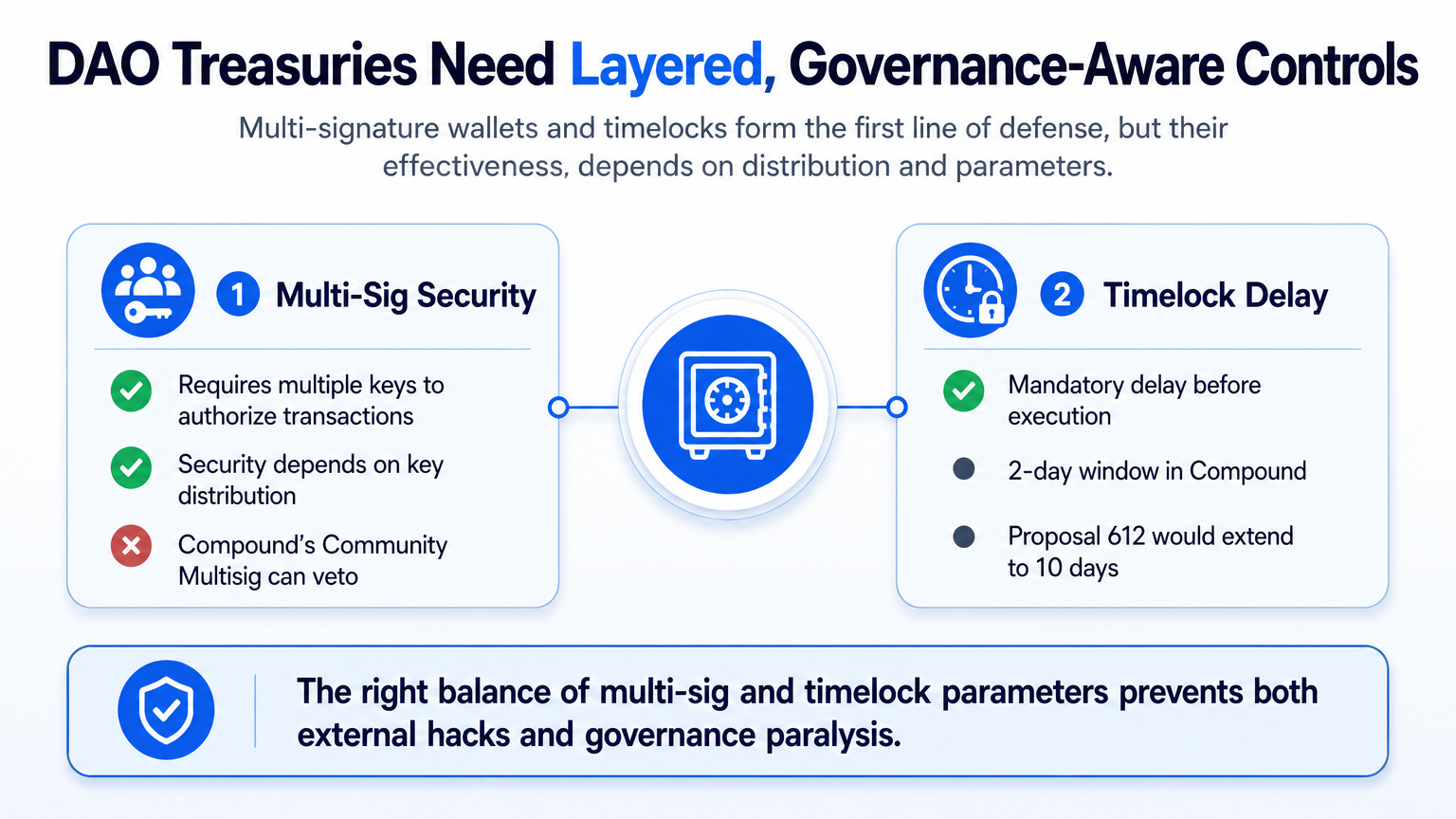
A multi‑sig (multi‑signature) wallet requires a predefined number of private keys — held by separate individuals or devices — to authorize a transaction. In DAOs, multisigs are the most common first line of defense. However, as Chainlink’s explainer on DAO treasuries points out, multisig security depends on the distribution of keys. If signers share a hosting provider or are socially co‑opted, the security guarantee collapses. Compound’s Community Multisig can stop transactions, but its composition is separate from token‑holder voting, creating the governance gap Proposal 612 aims to address. The treasury timelock sits alongside multi‑sig as a second layer, imposing a mandatory delay between transaction submission and execution, giving monitors a window to cancel. The length of that window is where the fight begins.
Implications and Recommended Actions for Finance Leads
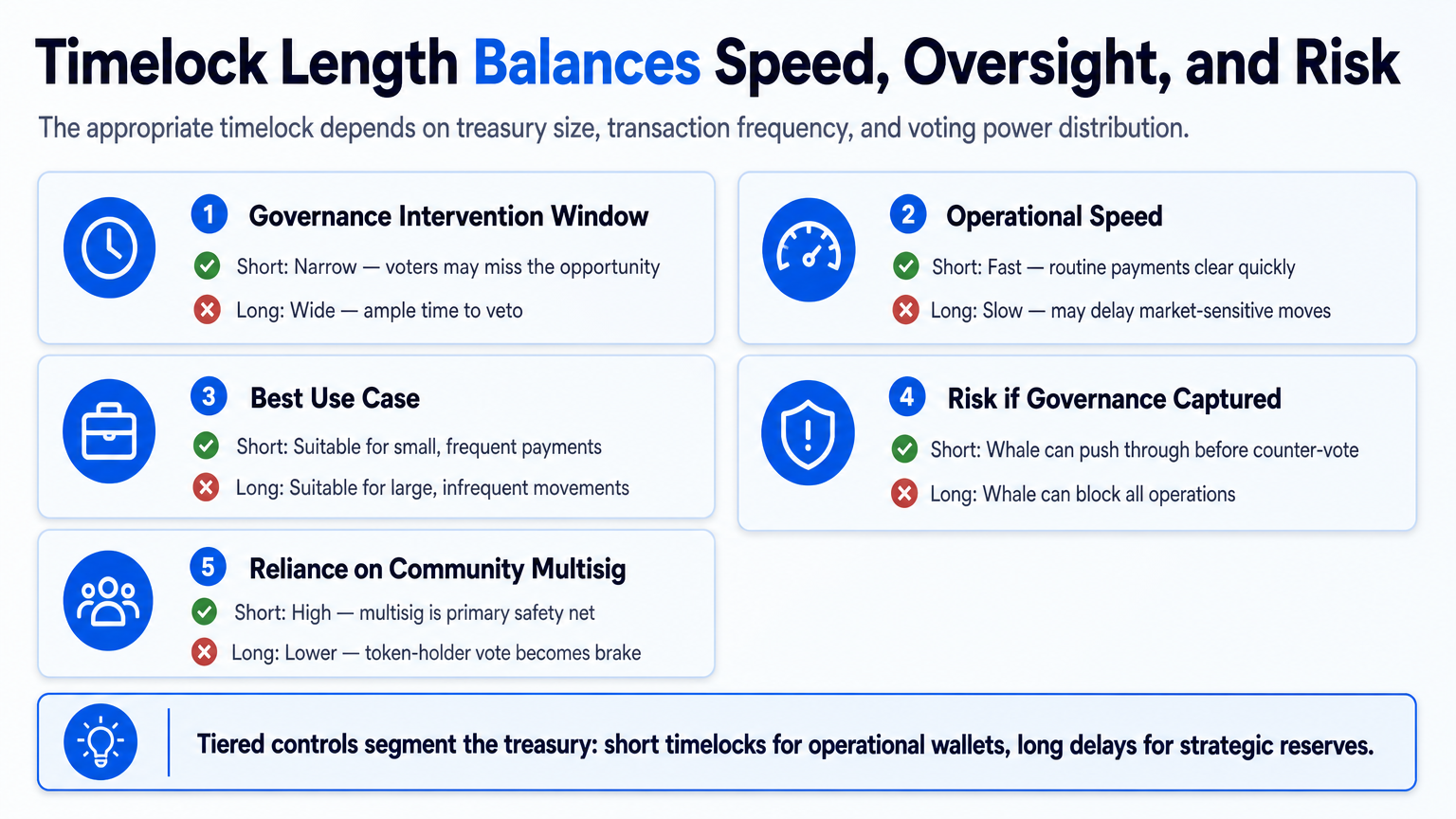
There is no universal “safe” timelock. The right number depends on the size of the treasury, the frequency of transactions, and the distribution of voting power. The table below offers a starting framework.
| Decision Factor | Short Timelock (2–3 days) | Long Timelock (7–10 days) |
|---|---|---|
| Governance intervention window | Narrow — voters may miss the opportunity | Wide — ample time to veto |
| Operational speed | Fast — routine payments clear quickly | Slow — may delay market‑sensitive moves |
| Suitable for | Small, frequent payments under strict operational controls | Large, infrequent treasury movements |
| Risk if governance is captured | Whale can still push through transactions before a counter‑vote | Whale can block all operations, causing paralysis |
| Reliance on Community Multisig | High — multisig is the primary safety net | Lower — token‑holder vote becomes the direct brake |
Tiered Controls and Integrated Platforms
The answer to securing assets without sacrificing speed lies in tiered controls. Segment the treasury into hot, warm, and cold tiers, with progressively longer timelocks and higher governance thresholds for larger amounts. Smaller operational wallets, funded weekly, can retain rapid movement, while the bulk of assets in a crypto asset custody vault may require a 7‑ or 10‑day delay and a majority token‑holder vote to cancel. This avoids the false choice between “fast and insecure” and “slow and safe.”
Integrated fiat‑crypto platforms reduce the pressure for on‑chain speed. When a DAO can pay fiat invoices and convert USDC within a single interface, the fiat leg is pre‑funded, eliminating the need to rush a large bridge transaction through a 2‑day window. OneSafe, for instance, provides Fireblocks‑grade custody, multi‑currency accounts, and role‑based access controls, so teams execute necessary fiat payments while the bulk of crypto reserves remain under longer timelocks. This is not a sales pitch; it’s a recognition that crypto financial operations become safer when real‑world payment rails minimize the urgency to move large amounts on‑chain.
Building robust controls begins with a simple checklist:
- Map all treasury wallets by function — operational, reserves, grants — and assign each a transaction size limit.
- Set timelocks proportionally — 2‑day delays for amounts under a defined threshold, 10‑day delays for large movements.
- Document emergency intervention paths — specify who can cancel a transaction (multisig, token vote, or both) and under what conditions.
- Implement view‑only dashboards so any community member can monitor pending transactions.
- Segregate operational fiat flows from governance‑controlled crypto reserves via an integrated banking and crypto platform to reduce the blast radius of a governance dispute.
What to Watch Next and Open Questions
Compound is not the first DAO to wrestle with timelocks, but it is the most prominent to put a 10‑day extension to a direct vote in 2026. If it passes, similar proposals will likely appear in MakerDAO, Aave, and Uniswap governance forums within weeks. Even if it fails, the close margin (1.75M for vs. 921k against) signals that a significant segment of stakeholders wants stronger brakes. Watch whether future proposals avoid granting a single whale a veto by requiring cancellation votes to meet a separate, high quorum.
Beyond any single vote, the Compound episode accelerates the maturation of DAO treasury governance from ad‑hoc signer groups to codified rulebooks. The next iteration is likely programmable governance, where timelock parameters adjust dynamically based on transaction size or asset type. The recent FinCEN surveillance rule withdrawal reinforced that crypto treasury operations fall into a gray zone, making internal controls even more critical for organizational legitimacy (see Crypto Treasury Management After Surveillance Rule Withdrawal). For DAOs that must interact with traditional banking, selecting a partner that understands both worlds becomes a compliance necessity — not just a convenience (explore options in Which Bank Is Best for Crypto? (Business & DAO Guide)).
The vote also revives a deeper question: if a single large holder can block every treasury move, is the DAO truly decentralized? The Limechain team’s observation that governance structures must prevent single‑actor capture or indefinite immobilization is the precise balancing act Proposal 612 forces the community to perform.
Key Takeaways
- A 2‑day timelock leaves token‑holders almost no time to intervene, making the Community Multisig the de facto control point.
- Extending timelocks to 10 days improves oversight but risks a governance choke point if a concentrated voter can veto all operations.
- Finance leads should segment treasury funds by use case, applying short timelocks to small operational wallets and longer delays to strategic reserves.
- Integrated fiat‑plus‑crypto platforms handle routine payments off‑chain while large crypto moves remain under governance‑aware review.
- The Compound vote is a live demonstration that crypto treasury management must evolve beyond simple multisigs toward layered, governance‑aware control frameworks.
For DAOs and global businesses building a financial operating system that bridges crypto and fiat seamlessly, visit OneSafe’s unified platform to manage your treasury with the security and flexibility that modern governance demands.