Monday morning arrives with 40 payroll deposits queued, three contractors waiting in different countries, and a vendor asking why yesterday's wire still hasn't landed. The problem usually isn't the payment instruction itself. It's that payroll, accounts payable, treasury, and crypto operations are using different rails, different approval habits, and different definitions of “verified.”
A workable direct deposit setup is a company payment plan, not just an employee form. You need to decide which payees belong on ACH, domestic wire, SWIFT, or USDC, then control the details that make each rail succeed. Direct deposit is now the normal payroll expectation in the United States, with nearly 92.7% of U.S. workers receiving wages by direct deposit in 2025, compared with 3.3% paid by paper check, according to Nacha's direct deposit survey. The same discipline can support contractor payouts, international transfers, and digital-asset treasury movements.
Table of Contents
- Week one builds the foundation
- Week two verifies the recipients
- Week three runs the controls in parallel
- Week four moves to production
Why Your Company Needs a Direct Deposit Setup Plan
The first decision is not which bank form to send. It's which payment rail fits each payee and obligation. U.S. payroll normally belongs on ACH. An urgent domestic vendor payment may justify a wire. A contractor without a suitable local USD account may need SWIFT or USDC, subject to your compliance and tax requirements.
That choice determines the information you collect, the approval path, and the failure mode you need to monitor.
Match the rail to the obligation
- ACH: Use it for recurring U.S. payroll and contractor payments where the recipient has a checking or savings account that accepts ACH credits.
- Domestic wire: Reserve it for time-sensitive U.S. payments where finality matters more than price.
- SWIFT: Use it for cross-border bank transfers when the recipient needs traditional banking infrastructure.
- USDC: Consider it for crypto-native contractors or treasury movements where the recipient has a verified wallet and your legal, tax, and compliance framework permits the payment.
The cost categories matter even before you compare providers. ACH generally carries a per-transaction fee. Wires usually carry a flat outgoing fee. SWIFT adds foreign-exchange spread and may involve intermediary-bank deductions. USDC introduces network fees, conversion spreads, custody costs, and operational risk around wallet addresses.
Practical rule: Don't promise a payee a settlement date until you've confirmed the rail, cutoff, account type, approval queue, and receiving institution.
The infrastructure is substantial. The ACH network processed 35.2 billion payments valued at $93 trillion in 2025, while direct deposits represented 8.74 billion payments worth $16.49 trillion, according to Nacha's ACH network statistics. Your company doesn't need to reproduce that infrastructure, but it does need a controlled operating process.
A unified environment such as a business account setup that connects fiat and crypto workflows can reduce system switching, but it doesn't remove the need for KYB, payee verification, approvals, and reconciliation. The platform is only one part of the control design.
ACH, Wire, SWIFT, and USDC Explained for Finance Teams
ACH is the domestic workhorse. A payroll system generates an ACH file that must follow the receiving bank's implementation requirements, including correct company identifiers, service class, effective entry date, and other NACHA formatting fields. The SEC code also matters. PPD is common for consumer payroll, CCD is used for corporate credits, and WEB applies to eligible internet-initiated entries.
Same-day ACH can help with urgent domestic payments, but your provider's submission windows and bank cutoffs control whether “same day” is available. Returns also need operational ownership. Codes such as R01 for insufficient funds and other R-series returns identify why an entry failed, but your team still has to correct the underlying account or authorization issue.
Domestic wires are faster and more final than ACH, but that convenience comes with a higher flat fee and less room for correction. A wire sent to the wrong beneficiary may not be recoverable, so dual approval and callback verification are essential for changed instructions.
SWIFT is the conventional cross-border route. It can involve correspondent banks, intermediary instructions, beneficiary-bank requirements, and foreign-exchange conversion. When a payment is delayed, the operations team needs the transaction reference and a bank trace, not another email asking whether the recipient checked their account.
USDC changes the mechanics. The recipient is identified by a wallet address and blockchain network rather than an ABA routing number and account number. The payment record includes an on-chain transaction hash, but that transparency doesn't protect you from sending funds to the wrong address.
The following matrix keeps the choice practical:
ACH vs Wire vs SWIFT vs USDC
| Rail | Settlement | Typical Cost | Best For |
|---|---|---|---|
| ACH | Provider and bank cutoff dependent | Per-transaction fee | U.S. payroll and recurring contractor payments |
| Wire | Often same-day when submitted before cutoff | Flat outgoing fee | Urgent domestic vendor payments |
| SWIFT | Cross-border bank processing and correspondent routing | Transfer fee plus FX and possible intermediary costs | International contractors and vendors using bank accounts |
| USDC | Blockchain confirmation dependent | Network fee, conversion spread, and custody considerations | Crypto-native payouts and treasury movements |
A practical comparison of bank rails is available in this ACH versus SWIFT guide for payment operations. Use it to frame the decision, then validate the actual pricing and cutoffs in your provider agreement.
Preparing Your Company for Onboarding and KYB
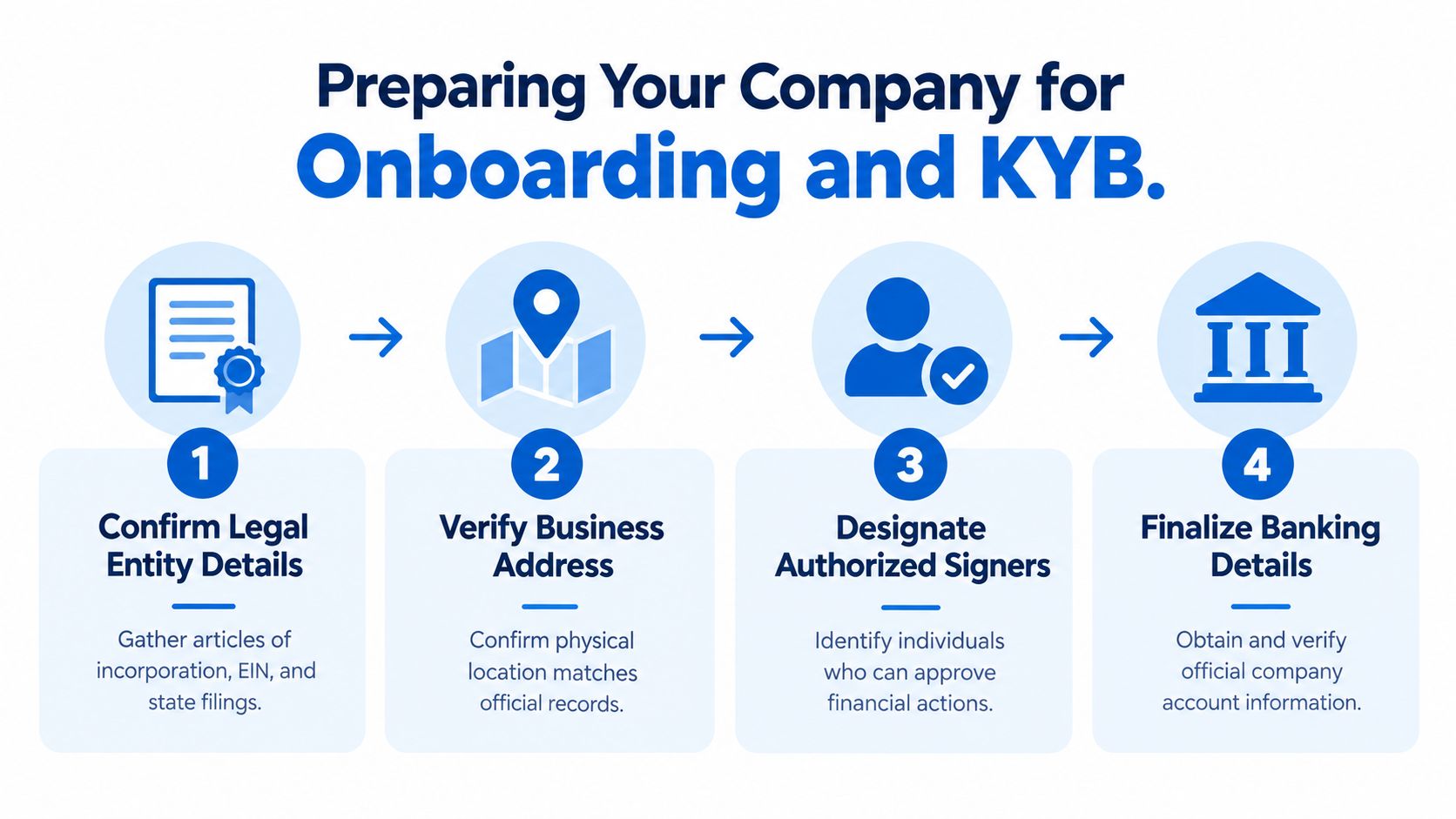
KYB should happen before you ask dozens of payees for payment details. A missing beneficial-owner document or inconsistent registered address can delay the account that will originate payroll, leaving your finance team with a spreadsheet full of verified employees and no production rail.
Finish the entity file first
Collect the articles of incorporation, EIN or local equivalent, registered-address evidence, and ownership information for ultimate beneficial owners above the applicable threshold. Make the legal name consistent across the formation documents, tax records, bank profile, payroll account, and payment platform.
Address mismatches are a common bottleneck. So are incomplete ownership charts and tax letters that no longer reflect the current entity. If a provider asks for a recent EIN letter or equivalent, don't assume an old PDF will pass review. Confirm the provider's current document policy before submission.
Then designate the funding account and operating rails:
- A U.S. bank account for ACH origination.
- A multi-currency account for international bank transfers.
- A custodial or self-custody wallet structure for USDC, with documented ownership and access controls.
Put approvals around the money
Separate payment initiation from approval. Require dual approval above your internally defined threshold, and document who can release payroll, change a beneficiary, approve a wire, or authorize a wallet transfer. Screen the company, owners, payees, and relevant counterparties against the sanctions lists your compliance program uses, including OFAC, EU, and UK sources where applicable.
Your payment policy should state which rail applies to employees, U.S. contractors, international contractors, and vendors. It should also define exceptions, escalation owners, evidence retention, and the response to a rejected or recalled payment. Teams improving the broader client or vendor intake process may find this guide on how to improve your advisory onboarding process useful for structuring ownership and documentation.
For the compliance layer, keep your operating procedure aligned with AML and KYC procedures for payment workflows. Before go-live, produce a signed payment policy, an approved user-access list, and a complete KYB evidence folder.
Collecting and Verifying Payee Bank Details
Don't collect routing numbers through unstructured email. That process creates duplicate records, unclear consent, and an easy path for a fraudster to impersonate a contractor or alter instructions in an existing thread.
Use a separate intake form for employees, U.S. contractors, international contractors, and vendors. Each form should capture the payee's legal name, account type, country, tax classification, and preferred payment rail. For ACH, collect the ABA routing number and account number. For cross-border bank transfers, request the SWIFT or BIC code, intermediary details where required, beneficiary address, and local account identifiers. For crypto payouts, capture the asset, wallet address, and exact network.
Verify before the first live payment
A voided check, bank letter, or authenticated banking screenshot can support account verification, but document what your provider accepts. One payroll implementation guide recommends written or authenticated electronic authorization, verification of routing and account numbers, optional prenote testing, retention of consent records for at least two years, and confirmation of split allocations before the first live deposit. Those controls are summarized in ADP's direct deposit setup guidance.
For ACH, a micro-deposit process can send small test credits and require the recipient to confirm them. Instant verification can instead use a credentialed account lookup. Either method is stronger than accepting a typed number without independent confirmation.
Check the returned account-holder name against the payee's legal record. A mismatch can indicate a typo, a joint-account issue, a personal account being used for a company obligation, or an attempted substitution.
Keep the payee directory clean
Require a second reviewer for payments above your defined threshold. Treat a bank-detail change as a high-risk event, especially when the request arrives shortly before payroll or comes from a new email address. Confirm the change through an existing channel, not through the same message that supplied the new instructions.
| Payee Type | Required Fields | Verification Method |
|---|---|---|
| Employee | Legal name, account type, ABA routing number, account number, authorization, split allocation if applicable | Payroll authorization plus voided check, bank letter, screenshot, prenote, or instant verification |
| U.S. contractor | Legal name, tax classification, account type, ABA routing number, account number, payment authorization | Account verification and name reconciliation |
| International contractor | Legal name, country, bank address, SWIFT or BIC, local account details, intermediary information if required | Beneficiary confirmation, bank-detail review, and controlled test payment |
| Crypto contractor | Legal entity or individual name, asset, wallet address, blockchain network, custody status | Independent address confirmation, small test transfer, and transaction-hash reconciliation |
Re-verify high-risk or infrequently used payees periodically. An annual review is a reasonable policy baseline, but your risk assessment should determine the actual cadence.
Running Direct Deposit on OneSafe vs a Traditional Bank
A traditional bank gives you depth. It may provide lending, treasury advice, established cash-management products, and a relationship manager who understands your broader balance sheet. It may also require more setup coordination before your company can originate ACH, support payroll files, or add a new international payment workflow.
A fintech platform can reduce the number of systems finance staff use, particularly when the company pays U.S. employees, global contractors, and crypto-native counterparties. The trade-off is that regulated banking services may be delivered through partner institutions, so you still need to understand the provider's coverage, account structure, permitted jurisdictions, safeguarding model, and support process.
Compare the operating experience
| Dimension | OneSafe | Traditional Bank |
|---|---|---|
| Account model | Multi-currency business accounts with fiat and crypto workflows in one interface | Banking products commonly separated by account, currency, and treasury service |
| Payment rails | ACH, domestic and international wires, SWIFT, and USDC functionality | ACH, domestic wires, and international wires, with crypto support varying by institution |
| Onboarding | KYB-oriented onboarding for startups and web3 entities | Bank-specific underwriting and treasury onboarding |
| Payee management | A unified directory can support multiple payout rails | Payee records may be split across payroll, treasury, and banking tools |
| Controls | Roles, approvals, limits, and MFA | Mature bank controls, often configured across separate modules |
| Trade-off | Confirm partner-bank arrangements, supported jurisdictions, and crypto policies | Expect more process depth, while gaining relationship and credit capabilities |
OneSafe offers multi-currency accounts, ACH and wire payments, SWIFT transfers, corporate cards, and USDC deposits and withdrawals through one interface. Its published materials also describe KYB onboarding, approval controls, and crypto-to-fiat workflows. Those features make it a relevant option for companies that need both bank rails and digital-asset operations, but they don't replace legal, tax, sanctions, or payroll review.
A bank may be the better fit when credit facilities, complex cash pooling, or institutional treasury services drive the decision. A unified platform may fit a leaner finance team that values a single payee directory and cross-border visibility. Choose based on payment mix, control requirements, jurisdiction, and support quality, not on the label attached to the provider.
Adding USDC and Crypto-Native Direct Deposits
Direct deposit doesn't have to mean ACH. For a global contractor who already operates on-chain, a verified USDC payout can avoid correspondent-bank routing and provide a transaction hash that both parties can inspect.
That doesn't make crypto a casual substitute for payroll. A company must confirm that the payment is legally permitted, correctly classified for tax purposes, and supported by its accounting and compliance controls. USDC also isn't the same as an unrestricted bank deposit. Custody, network selection, redemption, sanctions exposure, and counterparty arrangements all matter.
Build a separate crypto payout control
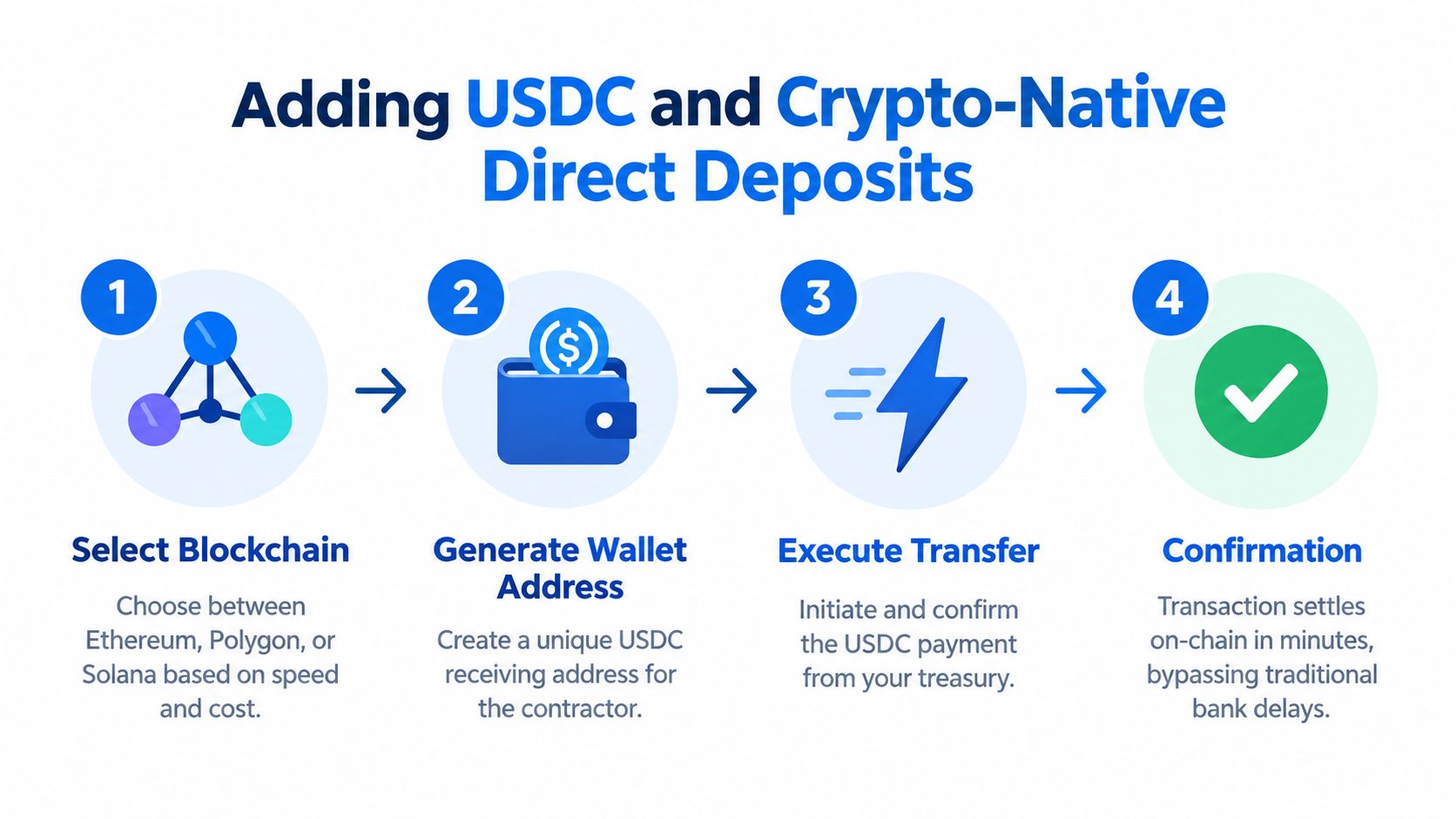
Start by choosing the supported blockchain. Ethereum, Base, Polygon, and Solana can have different fee, liquidity, custody, and operational characteristics. The contractor's wallet must use the exact network your platform supports. A correct address on the wrong network can still produce an unrecoverable payment.
Tie each wallet to a verified contractor record. Confirm the address through an independent channel, lock changes behind a second approval, and maintain a custody policy that states who can access signing credentials and how recovery works. Then send a small test amount before approving a larger payout. Reconcile the transaction hash, asset, network, recipient, amount, and invoice or payroll record.
Address-substitution attacks are the obvious risk, but they aren't the only one. A contractor may provide a wallet they don't control, an exchange may delay a deposit, or a non-USDC asset may introduce price volatility that the recipient didn't expect. Treat USDC as a parallel payment rail with its own exception queue and incident playbook.
The operational test is simple: can someone other than the initiator verify the beneficiary, network, amount, approval, and on-chain result before the payment is released? If not, the process isn't ready for production.
Your 30-Day Direct Deposit Setup Roadmap
A rollout works best when every week ends with an evidence package, not just a meeting. The following schedule gives finance, payroll, compliance, and treasury a shared sequence.
Week one builds the foundation
Finalize the legal-entity file, ownership evidence, registered address, tax documentation, and authorized-user list. Open or designate the funding accounts and decide which payee classes use ACH, wire, SWIFT, or USDC.
Deliverable: an approved rail policy, completed KYB package, funding-account confirmation, and user-access matrix.
Week two verifies the recipients
Send structured intake forms to employees, contractors, and vendors. Collect authorization records, tax forms appropriate to the worker classification, bank details, wallet information where relevant, and split-deposit instructions. Run account verification or micro-deposits, and independently confirm any changed instructions.
Deliverable: a payee directory with verification status, signed authorizations, tax documentation, and unresolved exceptions assigned to named owners.
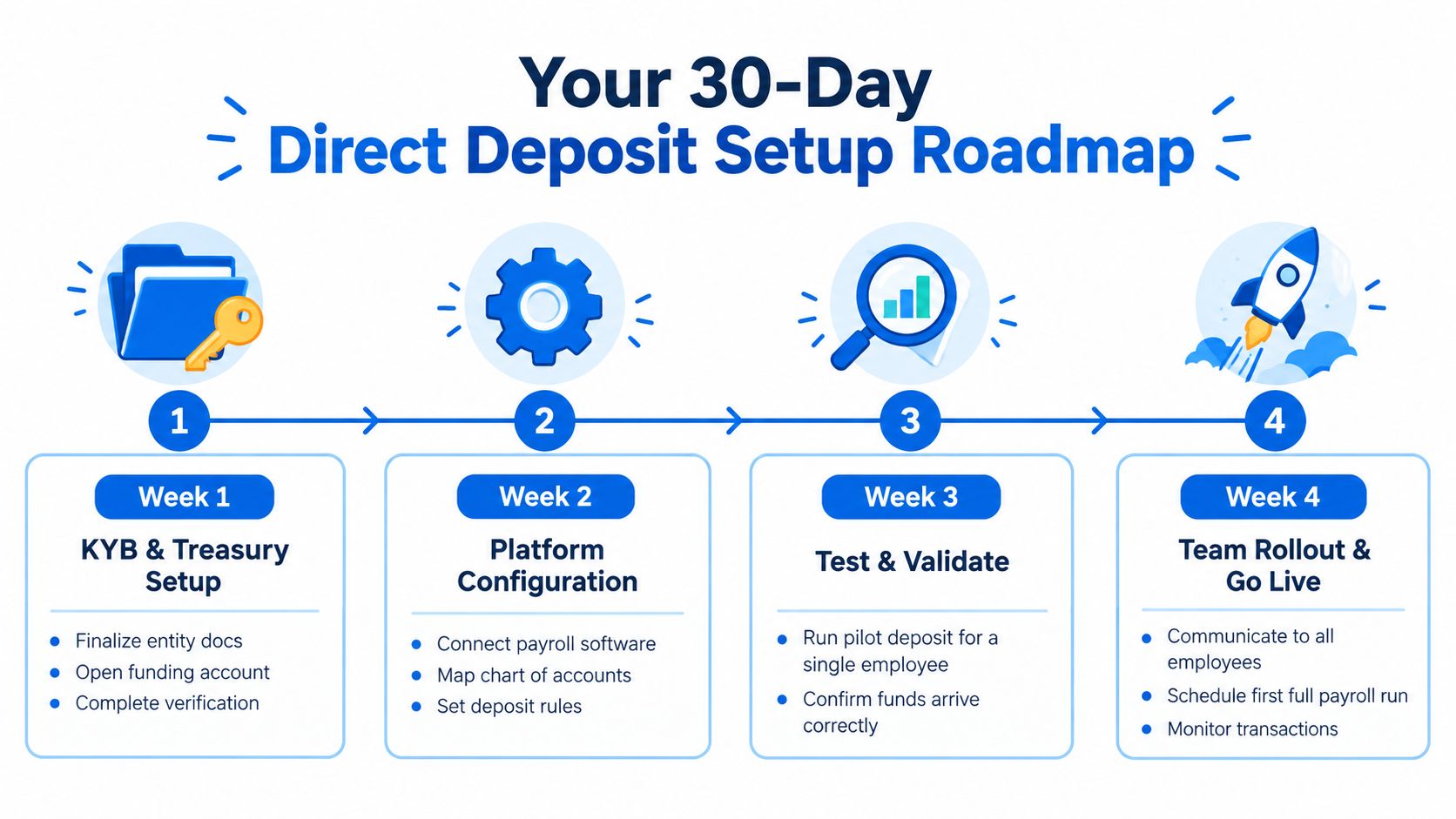
Week three runs the controls in parallel
Process a pilot payroll or controlled payment cycle. Validate the payroll file, account mappings, approval queue, cutoff handling, split allocations, and reconciliation report. For crypto payouts, match each transaction hash to the approved record and confirm that the selected network is correct.
Create a bank-return reference card for common ACH failures and define who handles a rejected credit, duplicate payment, wrong account, delayed wire, or failed wallet transfer.
Deliverable: a signed test-run report, exception log, cutoff checklist, and USDC wallet custody policy.
Week four moves to production
Set dual approval, enable return and payment alerts, restrict beneficiary edits, and publish the employee and contractor communication. Schedule the first full payroll run only after unresolved high-risk exceptions have an owner and documented decision.
Deliverable: production sign-off, incident playbook, payroll calendar, escalation contacts, and post-run reconciliation checklist.
Direct deposit setup is complete when the first payment arrives. It's complete when your team can explain why it was sent, who approved it, which details were verified, how it settled, and what happens if it fails.
OneSafe brings multi-currency business accounts, ACH, wires, SWIFT, USDC workflows, approvals, and payee operations into a single interface for companies paying across fiat and crypto rails. Review how OneSafe can fit your company's direct deposit setup, contractor payout, and treasury workflow, then confirm the supported jurisdictions and controls with your finance and compliance teams.