On October 8, 2026, the European Securities and Markets Authority (ESMA) issued a directive that dramatically reshapes stablecoin regulation in the European Union. The ruling gives crypto-asset service providers (CASPs) exactly three months—until January 8, 2027—to eliminate any residual exposures to non-compliant stablecoins. The new supervisory expectations go far beyond earlier trading restrictions, extending to custody, transfer services, investment advice, and portfolio management. For global businesses, Web3 startups, and DAOs that rely on stablecoins for payments, treasury, and DeFi liquidity, this changes the compliance calculus overnight. What follows is a clear-eyed breakdown of the development, its implications, and a concrete action plan.
Table of Contents
- What Just Happened: EU Tightens Stablecoin Regulation
- Why This Matters for Global Businesses and DAOs
- The Stablecoin Regulation Landscape (Background)
- Concrete Implications and Recommended Actions
- What to Watch Next: Open Questions and Future Trends
- Turning Regulation into Opportunity
- Key Takeaways
What Just Happened: EU Tightens Stablecoin Regulation
ESMA’s October 8 Directive
On Thursday, October 8, 2026, ESMA published updated supervisory guidance concluding that any use of non-compliant stablecoins—even in custody or advisory services—violates MiCA’s investor protection standards. The directive explicitly bans CASPs from facilitating any activity involving unauthorized stablecoins, including custody arrangements, portfolio management, and the transfer of such assets on behalf of clients. Regulators did leave a narrow window: national authorities may permit temporary withdrawals and conversions of non-compliant stablecoins during the transition period, but only on a case-by-case basis to protect investors.
KuCoin News, reporting on the ESMA directive on October 8, 2026, confirmed that the rule covers “trading, custody, transfers, and investment services,” and set the hard compliance deadline of January 8, 2027. The move intensifies the EU’s earlier position, which had already restricted certain exchange-related activities under the Markets in Crypto-Assets Regulation (MiCA). For a deeper dive into how MiCA’s broader framework classifies and authorizes stablecoins, Coinbase’s What is MiCA (Markets in Crypto Assets Regulation)? breaks down the requirements that issuers and service providers must satisfy to operate in the EU.
This October 2026 tightening also follows a broader pattern. ESMA’s decision extends restrictions beyond trading to custody, transfers, and advisory services, a step that Sumsub’s guide to MiCA Regulation and EU Crypto Rules had flagged as a logical next phase as the regulator enforces full-scope compliance across all CASP activities.
Key Dates and Immediate Actions
- October 8, 2026: ESMA tightens stablecoin regulation, announcing the three-month wind-down.
- January 8, 2027: Full EU stablecoin deadline—any remaining non-compliant stablecoin exposures in EU-regulated entities must be resolved.
- Ongoing until deadline: Firms may apply for temporary conversion permissions from their national competent authority.
The takeaway: businesses cannot wait. The clock started on October 8.
Why This Matters for Global Businesses and DAOs
What does the new EU stablecoin regulation mean for my business?
For any company that holds, receives, or sends stablecoins through an EU-regulated entity, the directive directly affects operations. Even if you are not an EU-licensed CASP, you may be indirectly impacted because your banking or custody partners that operate in the EU will be forced to reject transactions involving non-compliant stablecoins. This can freeze payments, delay treasury settlements, and complicate cross-border workflows.
For DAOs, the impact is particularly acute. Many DAO treasuries hold large positions in stablecoins like USDT, which as of October 2026 is not MiCA-compliant. DAOs that rely on EU-based exchanges, custodians, or on/off-ramp platforms will find those services cut off unless they transition to compliant assets such as USDC (which Circle has already aligned with MiCA requirements). DAO stablecoin management now demands immediate governance action to ratify asset swaps and update treasury policies.
The End of Non-Compliant Stablecoin Use
Non-compliant stablecoins are being forced out of the EU’s regulated sphere. You cannot simply “pause” them until 2027 and resume later; the directive mandates proactive resolution. EU-regulated entities must identify, segregate, and convert or exit all such exposures. For businesses that use stablecoins as core working capital, this means either moving to a compliant issuer, shifting to fiat through a compliant on-ramp, or relocating all crypto operations outside the EU—none of which is trivial.
The Stablecoin Regulation Landscape (Background)
What are stablecoins and how do they work?
Stablecoins are digital tokens designed to maintain a stable value, typically pegged to a fiat currency like the U.S. dollar or euro. The most common are fiat-collateralized, where each token is backed 1:1 by reserves held in regulated accounts. Other types include crypto-collateralized and algorithmic stablecoins. Under MiCA, only stablecoins that meet strict reserve, redemption, and prudential requirements can be offered to EU residents or used by CASPs. A granular breakdown of those authorization steps appears in EU MiCA regulation explained: a guide for crypto businesses, which walks through the licensing process and ongoing obligations for issuers. This regulatory clarity is welcome, but it draws a sharp line between compliant and non-compliant issuers.
How do global approaches to stablecoin regulation differ?
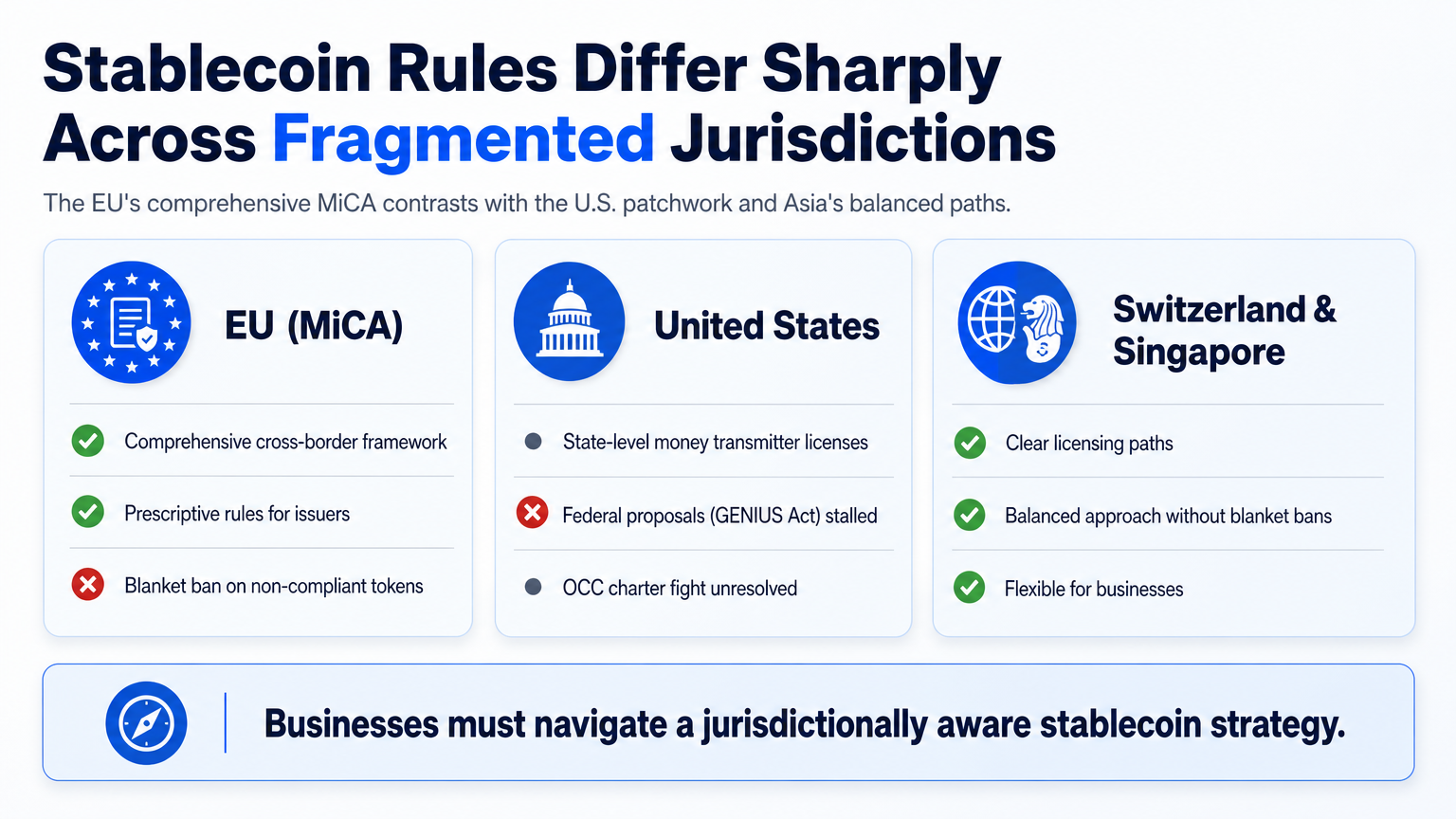
Global stablecoin regulations are fragmenting. The EU’s MiCA provides a comprehensive, cross-border framework that will likely become the world’s most prescriptive regime. In contrast, the United States still operates a patchwork of state-level money transmitter licenses, with federal proposals like the GENIUS Act stalled in Congress. The U.S. OCC’s crypto banking charter fight (OCC Crypto Banking Charter Fight Hits New Peak) illustrates the uncertain ground. Switzerland and Singapore have taken more balanced approaches, offering clear licensing paths for stablecoin issuers and service providers, but without the EU’s blanket prohibitions on non-compliant tokens. For global businesses, this means stablecoin for business strategies must now be jurisdictionally aware: using a compliant asset in the EU might be fine, but the same token could face different treatment in other markets.
Concrete Implications and Recommended Actions
What risks do non-compliant stablecoins pose?
Beyond regulatory enforcement, holding non-compliant stablecoins inside the EU-regulated perimeter carries immediate operational risk. Custodians may freeze them; exchanges may delist them without notice; payment rails that rely on those tokens may break. There is also reputational risk—counterparties and auditors increasingly flag non-MiCA-compliant assets as high-risk. Ultimately, non-compliant stablecoin positions could become illiquid onshore, forcing last-minute conversions at unfavorable rates or resulting in forced write-downs.
How do I audit my stablecoin exposure for non-compliant assets?
Begin with a structured internal audit. Use this checklist to scan every touchpoint:
- Map all wallets and accounts: Identify every address, exchange account, custodian, and treasury multisig that holds stablecoins—whether on EU platforms or non-EU services with EU counterparties.
- Classify each token by compliance status: Check whether the stablecoin issuer has been granted MiCA authorization. As of October 2026, USDC has pursued compliance; USDT has not. Verify directly against ESMA’s register.
- Inventory all smart contracts and DeFi positions: Many DAOs hold stablecoins in lending protocols, liquidity pools, or bridge contracts. These positions, though decentralized, may still be subject to the directive if managed via EU-based infrastructure.
- Assess dependence on EU-regulated service providers: Any CASP you use—even for custody or advice—must now refuse to handle non-compliant assets. Contact each provider and request written confirmation of their compliance posture.
- Quantify the value at risk: Sum the total exposure to non-compliant stablecoins across all categories. Prioritize liquidating or converting the largest positions first.
What steps must I take before January 8, 2027?
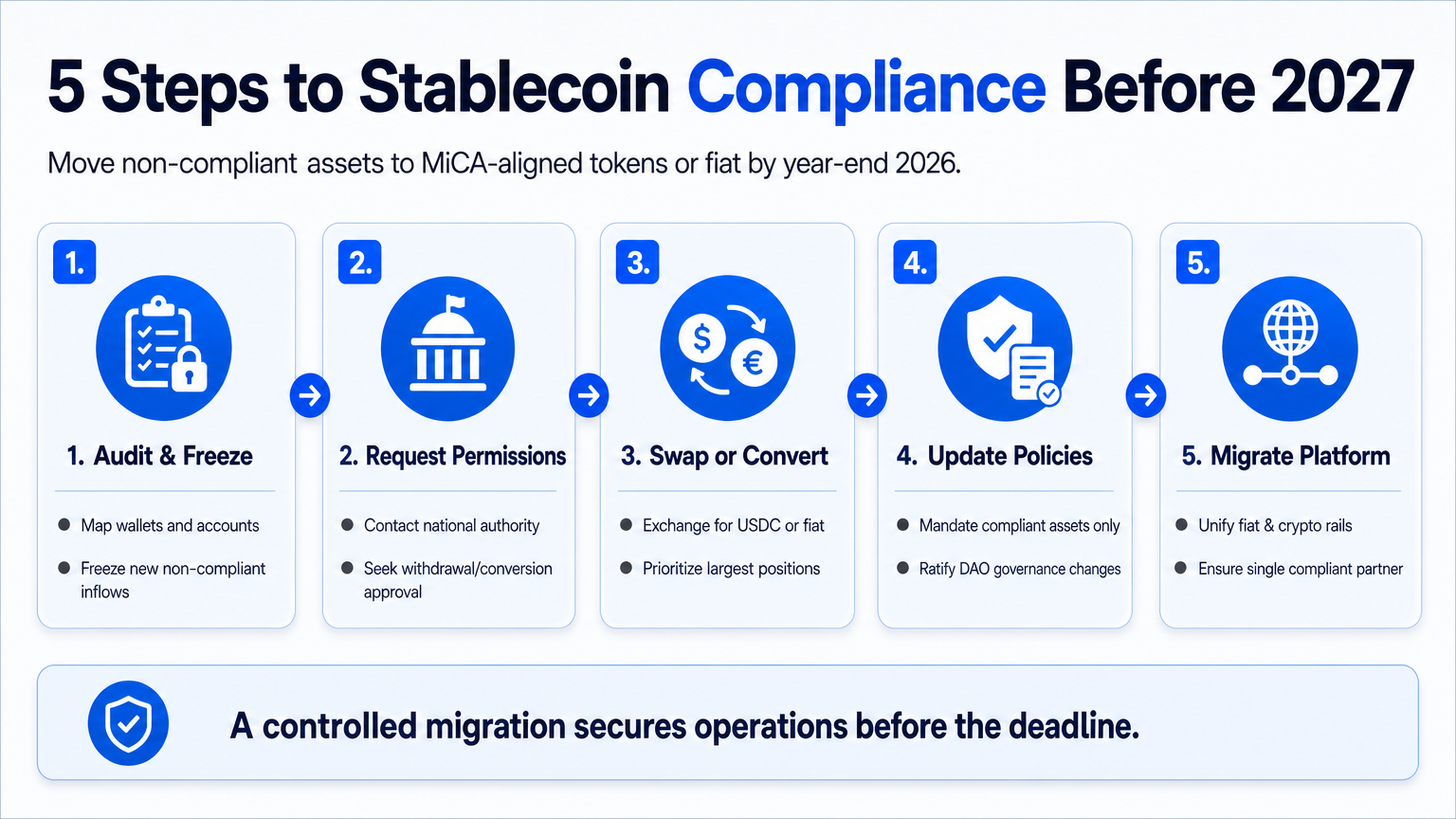
Your roadmap to stablecoin compliance 2027 in under three months:
| Step | Action | Timeline |
|---|---|---|
| 1 | Complete the audit and freeze all new inflows of non-compliant stablecoins. | Within 2 weeks |
| 2 | Engage your national competent authority to request permission for withdrawal/conversion if needed. | Before December 2026 |
| 3 | Swap non-compliant holdings for MiCA-compliant stablecoins (e.g., USDC) or convert to fiat. | By end of December 2026 |
| 4 | Update treasury and governance policies—especially for DAOs—to mandate compliant assets only. | Through January 2027 |
| 5 | Migrate operations to a compliant banking and custody partner that can handle both fiat and compliant crypto in a single platform. | As soon as possible |
This sequence eliminates non-compliant stablecoins from your operations before the EU stablecoin deadline hits. The faster you move, the less exposure you have to rushed conversions and potential service disruptions.
How can a platform like OneSafe help maintain compliance?
A neo-banking stablecoin solution bridges the gap. OneSafe is a financial technology company that provides a single interface for multi-currency fiat accounts and compliant crypto transactions. For businesses that need to off-ramp non-compliant stablecoins, convert to fiat, and then on-ramp into MiCA-aligned tokens, the platform offers built-in crypto-to-fiat conversions (and vice versa), multi-currency accounts in USD, EUR, and CAD, and international wire support. DAOs can use customizable roles and permissions to enforce treasury policies, while custody of digital assets is secured on Fireblocks. All crypto deposits and withdrawals in USDC are free, and fiat conversion fees are transparent (0.15% for deposits/withdrawals, $25 for wire withdrawals). By consolidating crypto business compliance workflows into one regulated environment, firms can reduce the operational chaos that a fragmented banking relationship creates. (Banking services are provided through partner institutions; OneSafe is not a bank.) For more on how neo-banking meets regulatory scrutiny, see Are Neobanks Safe for Business? A 2026 FAQ.
What to Watch Next: Open Questions and Future Trends
Even after the January 8 deadline, several uncertainties remain. First, how will ESMA enforce the directive against non-EU firms that serve EU clients? Extraterritorial reach could pull in global exchanges and DeFi protocols. Second, will other major stablecoin issuers like Tether pursue MiCA authorization before the deadline? The market needs clarity, and without it, USDC may capture a near-monopoly in the EU. Third, U.S. legislation could reshape the global landscape: if the GENIUS Act passes or the OCC charter fight resolves, the pressure on stablecoin issuers to comply with multiple frameworks simultaneously will increase.
Circle’s SAP Move Signals Shift in Crypto Treasury Management demonstrates how compliant stablecoins are embedding into enterprise ERPs. The trend is clear: regulation is pushing stablecoins deeper into traditional finance, which in turn legitimizes their use for treasury operations. DAOs and startups that want to access these rails must align early.
Turning Regulation into Opportunity
The EU’s hard line should be seen not just as a cost but as a chance to streamline operations. Companies that proactively switch to MiCA compliance will be better positioned to partner with banks, auditors, and institutional counterparties. They will also have a simpler treasury structure—fewer token types, clearer jurisdictional coverage, and a single on/off-ramp provider. For DAOs, the directive is a governance forcing function: it’s time to adopt formal treasury policies that can be executed with the same automation that powers the organization. A platform that unifies fiat and compliant crypto rails turns what could be a frantic scramble into a controlled, audit-ready migration.
Key Takeaways
- ESMA’s October 8, 2026 directive mandates that all EU-regulated crypto firms must eliminate exposures to non-compliant stablecoins by January 8, 2027.
- The ban covers trading, custody, transfers, advice, and portfolio management—making it impossible to passively hold non-compliant stablecoins within the EU perimeter.
- Global businesses and DAOs should immediately audit every wallet, exchange, and DeFi position, then convert non-compliant assets to MiCA-compliant stablecoins or fiat before year-end 2026.
- A unified fiat-crypto platform strips out complexity: it provides compliant custody, instant conversion, and multi-currency accounts in a single, transparent environment.
- The regulatory trend is clear—jurisdictional fragmentation means only compliant stablecoins will survive as mainstream settlement instruments.
To start your migration securely, open an account with OneSafe and manage both fiat and compliant crypto in one place.