Table of Contents
- description: "Are neobanks safe? Business FAQ covering FDIC pass‑through insurance, Synapse collapse, crypto custody risks, DAO banking safety, and a verification checklist."
- Are neobanks safe?
- What makes a neobank different from a traditional bank when it comes to safety?
- How does pass‑through FDIC insurance work?
- What happens if a neobank or partner bank fails?
- What did the Synapse bankruptcy reveal about fintech safety?
- What risks do businesses face with neobanks?
- Are neobanks safe when holding crypto assets?
- DAO banking safety: What should DAOs and Web3 startups look for in a safe neobank?
- Red flags: When is a neobank not safe enough for your business?
- Are neobanks safer than traditional banks?
- Key Takeaways
description: "Are neobanks safe? Business FAQ covering FDIC pass‑through insurance, Synapse collapse, crypto custody risks, DAO banking safety, and a verification checklist."
Are Neobanks Safe for Business? A 2026 FAQ
Are neobanks safe? For business owners moving six‑figure wires or holding treasury in stablecoins, the answer demands scrutiny beyond consumer platitudes. In 2026, fintech banking risks have been reshaped by the Synapse collapse and new regulatory pushes, but the core tension remains: neobanks offer speed and multicurrency flexibility, yet deposit insurance passes through partner banks, crypto assets lack federal backing, and operational freezes still happen. This FAQ cuts through the noise with concrete, step‑by‑step guidance on neobank security and business neobank safety for global businesses, startups, and DAOs—so you can operate confidently without betting your working capital on a promise.
Are neobanks safe?
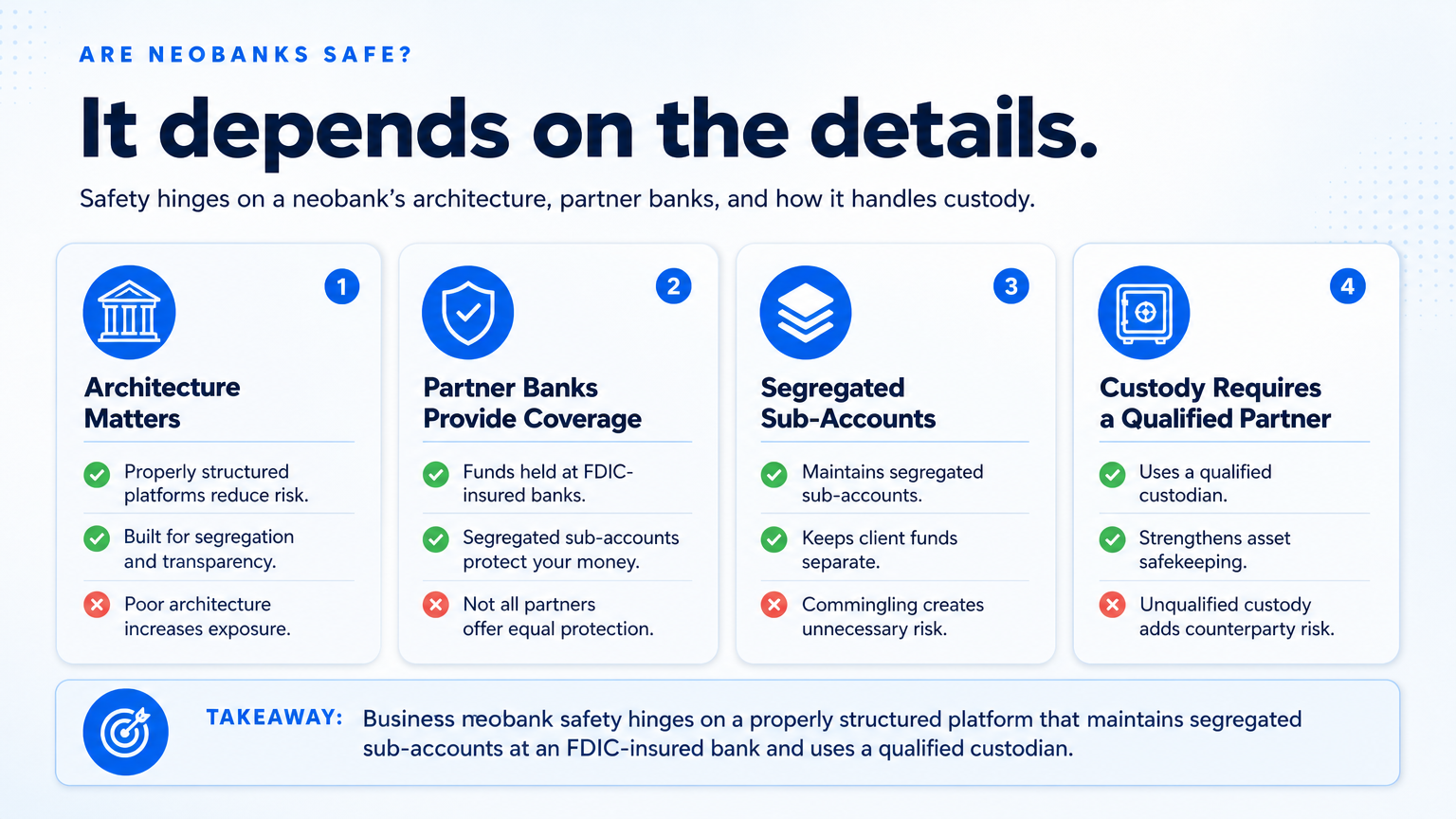
The short answer: it depends entirely on the neobank’s architecture, its partner banks, and how it handles custody. Business neobank safety hinges on a properly structured platform that maintains segregated sub‑accounts at an FDIC‑insured bank and uses a qualified custodian for crypto, which can be as safe as a direct bank account—for balances up to the $250,000 insurance limit. But the Synapse bankruptcy neobank blowup demonstrated that even with pass‑through FDIC insurance, operational gaps can freeze funds for months. For businesses that need reliable access to large working capital, pairing a neobank with a traditional, directly‑insured bank account is the safest practice.
A 2026 framework for evaluating business neobanks—including crypto support and fee structures—has been compiled by OneSafe in their Neobank USA 2026: The Business Guide to Digital‑First Banking, which stresses the importance of transparent partner bank relationships and direct sub‑accounting.
What makes a neobank different from a traditional bank when it comes to safety?
A neobank is a financial technology company, not a chartered bank. It builds the app, manages the user experience, and holds the customer relationship, while actual deposits sit at a licensed partner bank, as Plaid explains. Bankrate notes that this partnership model means your money is legally at the partner bank, but the neobank controls the ledger. Safety therefore depends on two layers: the partner bank’s FDIC insurance and the neobank’s record‑keeping and cybersecurity, both of which can vary widely.
Traditional banks, by contrast, hold a federal charter and are directly supervised by a primary regulator (like the OCC or Fed). They carry FDIC insurance in their own name, and you can walk into a branch to resolve a problem. The trade‑off is often higher fees and little to no native crypto support.
How does pass‑through FDIC insurance work?
When you deposit money into a neobank, your funds are placed in a custodial or FBO (for the benefit of) account at a partner bank. The FDIC insures each individual depositor for up to $250,000 per account ownership category, per bank, provided the neobank’s records clearly identify you as the owner. This is called pass‑through insurance.
The practical catch: if the neobank’s ledger is messy—or if the neobank itself goes bankrupt—the partner bank may not be able to quickly separate your funds from others’ or from the platform’s own cash. You could be locked out while records are untangled, even though insurance exists in theory. Many business neobanks use sweep programs that spread large balances across multiple partner banks to increase total coverage, but those sweeps add another record‑keeping layer that can fail, exactly as happened in the Synapse case.
What happens if a neobank or partner bank fails?
If the partner bank itself fails, the FDIC steps in and, assuming records are accurate, repays insured deposits within days or weeks. Funds above the $250,000 limit remain at risk.
If the neobank platform goes bankrupt, the situation is messier. Funds are still held at the partner bank, but the neobank’s failure can trigger a freeze while the bankruptcy court determines how to map internal accounts to the actual bank sub‑accounts. Businesses can experience months of inaccessible cash, even when they are the rightful owner. To protect yourself, keep your own transaction statements and know exactly which partner bank(s) hold your money and under what account identifiers.
What did the Synapse bankruptcy reveal about fintech safety?
Synapse, a banking‑as‑a‑service middleman, filed for bankruptcy in 2024. Its partner banks, unable to reconcile ownership records, froze millions of dollars. Customers—many of them businesses—couldn’t touch their own funds for months. The Synapse bankruptcy neobank wake‑up call demonstrated that pass‑through FDIC insurance is legally sound, but operational gaps in record‑keeping can completely nullify timely access.
Regulators have since moved to tighten the rules. In 2025 and 2026, the FDIC proposed requirements that fintechs maintain real‑time, auditable end‑user account ledgers and provide partner banks with direct access for resolution. When evaluating a neobank, ask whether it maintains segregated sub‑accounts directly identifiable at the partner bank. The Neobank USA 2026 guide stresses that only neobanks with transparent sweep tracking and sub‑account architecture are worth a business’s serious consideration.
What risks do businesses face with neobanks?

Are my funds frozen more often with a neobank?
Yes—statistics point to a higher incidence of account freezes with digital‑only platforms. Fingerprint’s research notes that neobanks rely heavily on automated fraud detection, and Unit21’s data shows that without physical branch support, resolving a freeze can be slower. Businesses that depend on uninterrupted cash flow should keep a backup account at a traditional bank.
What if I need to send or receive money internationally?
Neobanks often excel at multicurrency accounts and cheap FX, but international wires may face extra compliance checks from intermediaries, causing delays. Purpose‑built business neobanks have designed their infrastructure for cross‑border speed. For example, platforms like OneSafe (which is a technology company, not a bank) offer FX at 0.25% or the prevailing rate and same‑day ACH. Still, a large SWIFT transfer can be held for review, so plan for buffer time. For a deeper comparison of global payment options, see free online business bank accounts that support international operations.
How do I verify a neobank’s safety?
Step‑by‑step verification is the only way to separate solid platforms from risky ones. Use this checklist:
| What to Check | Why It Matters | How to Verify |
|---|---|---|
| Partner bank FDIC status | Ensures deposits are covered up to $250k | Search bank name on FDIC BankFind |
| Deposit sub‑account structure | Prevents commingling and eases recovery | Request the deposit sweep agreement from the neobank |
| Crypto neobank custody solution | Determines theft protection; not insured | Confirm use of a qualified custodian (Fireblocks, Coinbase Custody, etc.) |
| Money transmitter licenses | Compliance with state laws for sending money | Look up the neobank’s licenses on NMLS Consumer Access |
| SOC 2 Type II report | Validates security controls and audit practices | Ask support for the latest report; legitimate platforms share it |
| Support responsiveness | Quick, human help prevents prolonged freezes | Test the support channel before committing large sums |
The verification can be done in under an hour, and it will spare you the kind of months‑long ordeal the Synapse bankruptcy created. For additional context on business‑grade accounts, see the business bank accounts for small businesses guide.
Are neobanks safe when holding crypto assets?
Crypto assets held through a neobank receive no FDIC insurance and no SIPC protection (unless the platform is a registered broker‑dealer, which is rare). Neobank crypto protection rests entirely on the neobank’s custody architecture. The questions below break down the key concerns.
What protection do I have if the crypto goes down in value?
None. The neobank does not insure against market loss. If you hold volatile tokens, the full downside risk is yours. This is identical to holding crypto on any exchange or wallet.
Where are the private keys stored?
This is the linchpin. The most secure crypto neobank custody uses institutional‑grade custody that combines cold storage (offline) with multi‑party computation (MPC) wallets that split key shares across geographically distributed machines. Common custodial backbones are Fireblocks, Anchorage, and BitGo. For example, OneSafe secures digital assets on Fireblocks and mandates MFA, making it substantially harder for a single point of failure to compromise funds. However, it’s still a centralized model—the platform, not you, holds the keys. For DAOs and Web3 startups that need full self‑custody, a multisig wallet where the organization retains the keys through governance is safer, with the neobank used only for fiat on‑/off‑ramp.
Does regulation cover crypto custody?
State money transmitter licenses require that neobanks safeguard crypto they hold for customers, but there is no federal insurance. The SEC’s proposed custody rule aims to tighten requirements for institutional custodians, but as of October 2026 it is not final. In Europe, MiCA sets a higher regulatory floor for crypto custody. For an overview of the evolving landscape, see stablecoin regulation in 2026. And for an example of how crypto‑fiat bridges carry hidden risk, the situation described in Crypto Banking: Why 1,000 SOL Holders Are Testing Bank Payments illustrates the complexities of off‑ramp security.
DAO banking safety: What should DAOs and Web3 startups look for in a safe neobank?
DAO banking safety requires a platform that doesn’t demand full surrender of control. For a safe neobank for startups, look for these features:
- Segregated on‑chain treasuries: Support multisig wallets directly on the blockchain, not just an exchange‑style omnibus pool.
- Granular permissions: Assign roles for treasury signers, payment approvers, and view‑only members—mirroring on‑chain governance.
- Automated fiat‑crypto conversion: Pay contributors in stablecoins, settle vendor invoices, and move between fiat and crypto instantly.
- Stablecoin invoicing and payroll: This is becoming standard; the trend toward B2B stablecoin payroll is accelerating, as detailed in crypto payroll gets a boost from Visa’s stablecoin surge.
- Regulatory awareness: With rules shifting—the US dropping certain mixer‑related surveillance proposals, as noted in crypto treasury management shift—a savvy neobank should help you stay compliant without freezing operations.
OneSafe, a platform serving over 1,000 global businesses and DAOs, includes customizable roles, Fireblocks custody, and automated payment workflows that address many of these needs. Still, the most cautious DAOs will combine a neobank with an on‑chain multisig wallet where they retain control of the signing keys.
Red flags: When is a neobank not safe enough for your business?
Watch for these danger signs:
- The neobank won’t disclose its partner bank(s) or the exact FDIC pass‑through structure.
- It makes vague promises of “FDIC insured” without clarifying that the insurance is through a partner and subject to record‑keeping.
- Crypto assets are held in exchange‑owned hot wallets, with no mention of a qualified custodian or cold storage.
- There’s no sweep program for business balances exceeding $250,000, leaving the excess uninsured.
- The revenue model is opaque, relying on high fees or undisclosed FX margins that could incentivize risky behavior—see How Do Neobanks Make Money? 2026 FAQ (Sep 30, 2026) for a breakdown of the incentives behind interchange, FX margins, and custody fees.
- Multi‑factor authentication is optional or absent, and there is no SOC 2 report available.
If a neobank shows any of these flags, it’s not worth the risk, no matter how attractive the user interface.
Are neobanks safer than traditional banks?
There’s no universal “safer.” Traditional banks provide direct, government‑backed FDIC insurance, physical dispute resolution, and a long history of careful oversight. Britannica notes that they may be slower and more expensive, but the safety net is clearer. Neobanks counter with stronger mobile security, lower fees, built‑in crypto capabilities, and the ability to hold multiple currencies natively—many invest in cybersecurity that surpasses smaller community banks, according to S‑pro’s guide to neobank regulation.
For a business, the answer is a hybrid: use a thoroughly vetted neobank for daily operations, international payments, and crypto treasury, while maintaining a core operating account at a directly‑insured traditional bank for liquidity you absolutely cannot afford to lose.
Key Takeaways
- Verify the partner bank and sub‑account structure—FDIC passthrough is worthless if the neobank’s records don’t survive a bankruptcy.
- Keep cash balances above $250,000 only in sweep programs that you’ve confirmed spread funds across multiple FDIC‑insured banks.
- For crypto assets, demand a qualified custodian (like Fireblocks) and segregated wallets; remember that no federal insurance covers market losses.
- DAOs should insist on on‑chain multisig controls and granular permissions, using the neobank as a fiat bridge, not the sole custodian.
- Run the verification checklist against any platform before committing significant working capital, and maintain a directly‑insured bank account as a backup.
Explore how OneSafe helps global businesses and DAOs streamline both fiat and crypto operations with transparent, secure infrastructure at onesafe.io.