In the latest stablecoin news, Mastercard’s CEO told Bloomberg on October 9, 2026 that cross-border payments are the clearest use case for stablecoins — and where the card giant is seeing the most traction. For finance teams and DAO treasury managers, that single statement turns crypto payments for business from a speculative sideline into an operational priority. Here’s what the Mastercard stablecoin stance means, why it matters now, and how to integrate stablecoin payments without rebuilding your financial stack.
Table of Contents
- What Just Happened: Mastercard’s Stablecoin Bet on Cross-Border Payments
- Why This Matters Now for Global Businesses and DAOs
- Stablecoin Payments 101: What a Newcomer Needs to Know
- Turning Momentum Into Action: A Practical Playbook for Your Business
- What to Watch Next: The Road Ahead for Stablecoin Payments
- Key Takeaways
What Just Happened: Mastercard’s Stablecoin Bet on Cross-Border Payments
On October 9, 2026, Bloomberg reported that Mastercard’s chief executive identified cross-border payments as the clearest use case for stablecoins and the area where Mastercard is seeing the most traction for the new form of digital money, according to the report. The network has long published plain-language explainers on how stablecoins work and spent years positioning itself as a bridge between card rails and blockchain settlement. What changed now is specificity: naming cross-border as the near-term winner narrows where businesses should look for usable infrastructure.
Why Cross-Border Stands Out Among All Stablecoin Use Cases
Card networks already move domestic money efficiently. The pain — and the margin to improve — lives in international rails, which route through correspondent banks, carry opaque fees, and settle over days. Stripe’s cross-border payments explainer documents those intermediary hops and the unpredictability they create. McKinsey’s research on tokenized cash frames stablecoin infrastructure as enabling a next generation of payment operations. Stablecoins collapse the hop count; that structural difference is why cross-border — not retail checkout — leads.
Why are cross‑border payments the top stablecoin use case right now?
Because the legacy alternative is measurably worse. A cross-border wire can take 2–5 business days to settle, while a stablecoin transfer settles in minutes, 24/7, at a cost set by network fees rather than intermediary margins. For businesses paying global contractors or suppliers, that delta compounds every month. The recent Anchorage-Routable deal adds further evidence that settlement infrastructure is institutionalizing.
Why This Matters Now for Global Businesses and DAOs
The Infrastructure Is Here — It’s No Longer an Experiment
Circle’s payments team describes stablecoin payments as entering “the next phase of digital commerce.” That claim is backed by behavior: incumbents have shipped acceptance APIs and settlement rails, and the Mastercard CEO’s remarks confirm institutional attention. For DAO treasury operations and stablecoin banking, “not experimental” means you no longer need an in-house blockchain team — you need a counterparty, a custodian, and a compliant off-ramp. Stablecoin integration into business workflows is now a matter of choosing the right banking partner, not building from scratch.
The Cost-and-Time Equation That Changes International Payments
The shift is simple: fewer hops, faster settlement, lower visible fees. A unified fiat-and-crypto account collapses treasury, FX, and payments into one ledger, so a USDC receipt can pay a EUR invoice without a separate exchange account. The trade-offs are real — custody risk, compliance overhead, and conversion fees — but the operating math increasingly favors fiat crypto payments via stablecoins for cross-border volumes.
Stablecoin Payments 101: What a Newcomer Needs to Know

What Stablecoins Are and How They Move Value
A stablecoin is a blockchain-based token pegged to a fiat currency, usually the U.S. dollar, designed to minimize volatility. USDC and USDT dominate liquidity. Value moves when a sender transfers tokens on a blockchain (Ethereum, Solana, Tron, or a layer-2) to a receiver’s wallet. Conversion to local fiat happens through an exchange or a platform off-ramp.
How the Current Rails Compare: Ethereum, Solana, and Major Issuers
- Ethereum: deepest USDC liquidity, strongest institutional custody support; gas fees fluctuate, layer-2s like Base and Arbitrum reduce cost.
- Solana: sub-second finality, low fees, now with meaningful USDC depth.
- Issuers: Circle (USDC), Tether (USDT), Paxos lead regulated issuance.
Why “Not a Bank” Can Be an Advantage for Crypto-Native Finance
OneSafe is a financial technology company, not a bank; its banking services are delivered through partners. That distinction matters because traditional banks often treat crypto activity as an exception to be de-risked — restricted wires, frozen accounts, slow reviews. A neo-banking for crypto platform built for fiat and crypto from day one treats stablecoins as a core payment rail, while pairing that with institutional-grade custody via Fireblocks and mandatory Multi-Factor Authentication. The warning: funds are not FDIC-insured, so due diligence on custody and banking partners is non-negotiable.
Turning Momentum Into Action: A Practical Playbook for Your Business
Step 1: Choose a Banking Partner That Unifies Fiat and Stablecoins
The costly default is fragmentation: one bank for fiat, one exchange for crypto, one tool for payroll, one FX desk. For crypto payments for business, a neo-banking for crypto platform where an invoice can be paid in USD and settled in USDC without leaving the account eliminates reconciliation work. Multi-currency accounts (USD, EUR, CAD), corporate cards, and on/off-ramps should be default features. The Banking for Web3 Accounts: The 2026 Definitive Guide walks through the evaluation criteria.
What’s the practical difference between a stablecoin API and a full banking platform?
A stablecoin API lets you programmatically accept or send on-chain payments, but it does not provide accounts, cards, payroll, invoicing, or reconciliation. A full banking platform wraps those rails with compliance, multi-currency accounts, FX, and bookkeeping. If you have engineers and want to embed payments, an API may work; if you need to run payroll, pay vendors, and close books, a platform is faster. Most growing businesses that need fiat and crypto in the same ledger choose the platform.
Step 2: Onboard Your Business and Set Up Multi-Currency Accounts — in Days, Not Months
Onboarding should be fully digital, completed within a week, and require standard KYB documents: business formation papers, a government-issued photo ID, and — for U.S. companies — an EIN. Confirm before you start that the platform supports your entity type and jurisdiction; availability is worldwide except OFAC-sanctioned countries and certain U.S. states.
How can my business start using stablecoin payments today?
- Confirm your legal entity and KYB documents are ready (formation papers, EIN for US companies, photo ID for beneficial owners).
- Open a business account on a platform that runs fiat and stablecoins in one ledger.
- Set up multi-currency accounts (USD, EUR, CAD) to hold both rails.
- Fund the account — via fiat wire/ACH or a free USDC deposit — then run one small test conversion.
- Pay a real, non-critical vendor or contractor with stablecoins, then reconcile before scaling.
Most neo-banking for crypto platforms complete onboarding in under a week; the initial application can often be started in under 10 minutes.
What fees, FX rates, and conversion steps are involved?
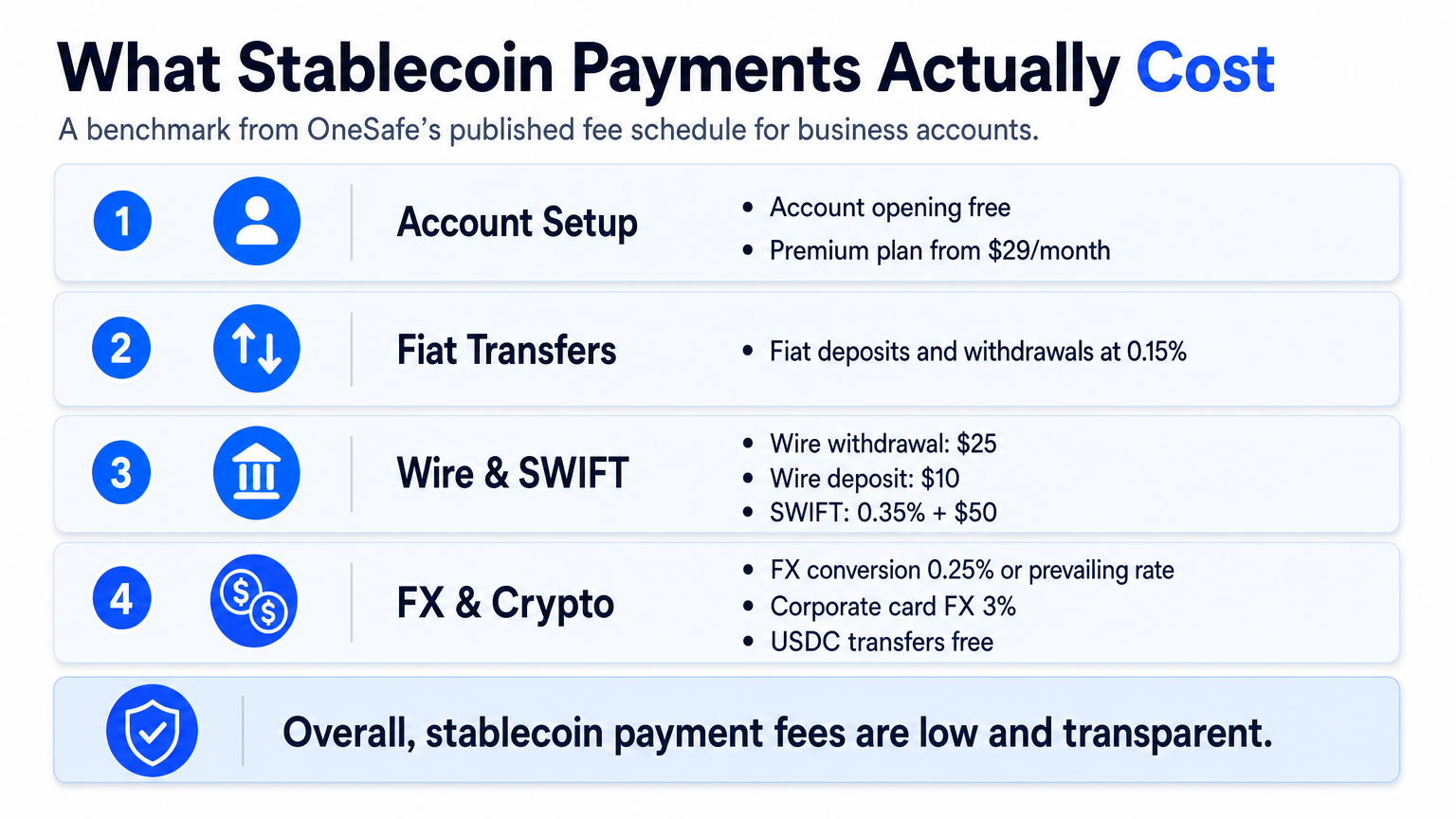
On OneSafe, the published fee schedule gives a concrete benchmark:
| Item | OneSafe rate or fee |
|---|---|
| Account opening | Free |
| Premium plan | From $29/month |
| Fiat deposit / withdrawal | 0.15% |
| Wire withdrawal | $25 |
| Wire deposit | $10 |
| SWIFT deposit / withdrawal | 0.35% + $50 |
| FX conversion | 0.25% or prevailing FX rate |
| Corporate card FX | 3% |
| USDC crypto deposits / withdrawals | Free |
The conversion step: receive USDC → convert to fiat inside the platform (near-instant via exchange partners) → pay a vendor via ACH, wire, or card. FX conversion costs 0.25% or the prevailing FX rate; corporate card foreign exchange costs 3%, which matters if you use a card abroad.
Step 3: Plug Stablecoin Payments Into Your Core Workflows (Vendors, Payroll, Invoicing)
Vendors: Pay international suppliers in USDC for same-day settlement, or issue virtual cards at no extra cost for recurring software. Payroll: stablecoin payroll is strongest for cross-border contractors; Crypto Payroll Gets a Euro IBAN Boost from Bringin shows euro-denominated payroll rails maturing. Invoicing: issue invoices in fiat and stablecoins, then reconcile in a single ledger.
Can I pay vendors, run payroll, and send invoices in stablecoins?
Yes — with one boundary: the counterparty. You can pay any vendor or contractor who provides a compatible wallet address. For vendors who only invoice in USD or EUR, the platform off-ramp converts on your side. Cross-border contractor payroll in USDC works well; full-time local employees still need fiat rails. The operational rule: settle in the asset your counterparty prefers, and let the platform handle conversion.
Which stablecoins, blockchains, and countries are supported for business payments?
USDC is the workhorse for business settlement; USDT retains liquidity in non-U.S. corridors. Blockchains with real business adoption: Ethereum plus layer-2s (Base, Arbitrum), Solana, and Tron for USDT-heavy corridors. The platform discussed here offers free USDC deposits and withdrawals, crypto on/off-ramps, and fiat accounts in USD, EUR, and CAD, with more currencies coming. Geographic availability is worldwide except OFAC-sanctioned countries and certain U.S. states. Before committing, confirm your token-chain pair is supported in both directions.
Do stablecoin payments have chargebacks or refunds — and how are they managed?
No. Stablecoin transfers are final by design; there is no card-network chargeback. Refunds are manual: the receiver sends funds back to the originating wallet address. That shifts fraud liability to the sender and makes address verification critical. Manage it by whitelisting known counterparties, sending a small test transaction first, and keeping written refund policies for every stablecoin vendor you onboard.
Step 4: Lock Down Compliance, Accounting, and Treasury Management
Compliance starts at onboarding (KYB) and continues on every transfer with sanctions screening. Accounting needs a consistent valuation policy — most businesses treat 1:1 USD-pegged stablecoins as cash equivalents. Treasury should keep near-term working capital in fiat and hold operational stablecoin balances for cross-border, avoiding concentrated custody. Circle’s SAP Move Signals Shift in Crypto Treasury Management shows ERP-grade treasury tooling arriving.
How do I handle accounting and compliance when mixing fiat and crypto?
Use a platform with accounting integration and real-time transaction tracking. Record stablecoin receipts at their fiat settlement value; pegged tokens won’t create material FX gain or loss, but you still need a fixed valuation policy and a separate sub-ledger or tag set for crypto-denominated vendors. Document the purpose of every transfer, screen counterparties against sanctions lists, and keep KYB files current. Every on-chain transfer should have an attached invoice, contract, or payroll record — missing documentation is the largest avoidable audit exposure in fiat crypto payments.
What to Watch Next: The Road Ahead for Stablecoin Payments
Regulatory Clarity and Institutional Adoption on the Horizon
The EU’s 2027 compliance deadline under MiCA-driven rules will shape issuer requirements and travel-rule obligations — OneSafe has tracked the timeline in Stablecoin Regulation: EU Deadline and What’s Next. In the U.S., the ongoing OCC crypto-banking charter dispute affects which institutions can hold crypto directly. The signal to watch: reserve-asset standards at the national level, which would turn corporate stablecoin integration from optional to default.
New Currencies, Chains, and Features That Will Shape the Next 12 Months
Expect more fiat-pegged stablecoins (EUR, CAD, GBP), lower-cost layer-2 settlement rails, and platform features like scheduled payments and granular DAO treasury roles. OneSafe’s coverage of a Samsung-Solana partnership putting stablecoin payments on 82 million phones suggests consumer demand feeding business volume. Combined with Circle’s enterprise integration work, the next 12 months will be about distribution, not proof of concept. This stablecoin news wave, anchored by the Mastercard stablecoin bet, shows the rails are ready.
Key Takeaways
- The Mastercard CEO’s October 9, 2026 statement makes cross-border the benchmark use case for stablecoin payments — act while traction is fresh, not after competitors standardize on it.
- Cross-border wires settle in days with multiple fee layers; stablecoin transfers settle in minutes at network-cost pricing, with finality built in.
- Starting does not require an API or engineering team: open a fiat-plus-crypto business account, convert a small USDC amount, and pay one real vendor.
- The two numbers to watch are FX conversion cost (0.25% or the prevailing rate at a unified platform) and the absence of chargebacks — document every transfer and whitelist every counterparty.
- Regulatory timelines, especially the EU’s 2027 stablecoin deadline, will determine which platforms and reserve arrangements are safest for business use of stablecoin banking and neo-banking for crypto.
When you’re ready to run fiat and stablecoin rails in one account, open a unified cross-border payments account.