Most global finance accounts reviews stop at a feature checklist—currencies, onboarding speed, corporate cards. This guide goes further. It gives founders and finance leads a fee-and-compliance autopsy for global finance accounts, using the Financial Stability Board’s fresh resolution‑backstop warning (9 October 2026) and a documented walkthrough of OneSafe’s actual fee schedule and DAO controls to separate operational security from deposit insurance and hidden costs.
Table of Contents
- Executive summary
- What a global finance account is (and is not)
- Core concepts
- How global finance accounts work
- Options and tradeoffs
- A practical review framework: the 8‑point checklist
- OneSafe review: applying the checklist
- Mistakes, myths, limitations, and next steps
- Key Takeaways
Executive summary
You can open a crypto-friendly business account with multi‑currency support in minutes, move money across borders, and pay contractors in stablecoins—all from one dashboard. But the real difference between a safe, cost‑effective global finance account and a source of nasty surprises lives in the fee stack, the legal structure, and the resolution backstops. This buyer’s guide unpacks:
- The full anatomy of international business account fees—monthly, wire, SWIFT, card FX, and crypto spreads—that most reviews obscure.
- Where your money really sits and why “segregated” and “Fireblocks custody” don’t mean “insured.”
- The overlooked regulatory gap flagged by the FSB on October 9, 2026: incomplete public‑sector backstop funding mechanisms that can affect any account tied to a partner bank.
- A practical 8‑point checklist you can run against any provider, with an OneSafe review applying it.
By the end, you’ll evaluate global finance accounts like a corporate treasury lead.
What a global finance account is (and is not)
A global finance account holds, sends, and receives multiple fiat currencies—and increasingly crypto—without opening a separate banking relationship in every jurisdiction. It’s not a personal account, payment processor, or brokerage. Legal structure matters more than feature lists.
Fiat multi‑currency vs fiat+crypto hybrid accounts
A vanilla multi‑currency business account handles USD, EUR, CAD wires and supplier payments. A hybrid adds an on‑ramp/off‑ramp for stablecoins. The hybrid cuts one intermediary but adds crypto custody risk, regulatory uncertainty, and extra fee layers. For Web3 payrolls or on‑chain treasury, the trade‑off makes sense; for simple euro payments, a fiat‑only account may suffice.
Neobank, fintech platform, or bank: the legal distinction
A neobank is a front‑end; a licensed bank holds the deposits. OneSafe, for example, is a financial technology company, not a bank. Banking services are provided by partners. So your fiat sits at a regulated bank, and FDIC insurance depends on the partner bank’s structure—not the fintech’s brand. Operational security (encryption, MFA) is separate from deposit safety.
If a provider says your money is “safe” because of encryption, you’re only hearing the operational half. The other half is what happens when the partner bank fails and resolution funding isn’t fully in place.
Core concepts
- On‑ramp / off‑ramp: Converting fiat↔crypto inside the platform.
- Segregated accounts: Client funds held at partner banks separate from operating funds. Protects if the fintech fails, not the asset’s value.
- Custody: OneSafe uses Fireblocks; similar vaults protect against theft, not market loss.
- KYB: Business verification (documents, ownership, sometimes source of funds).
- MFA (Multi‑Factor Authentication): Non‑negotiable.
FDIC insurance vs crypto custody
FDIC covers deposits at insured banks up to $250,000 per depositor if the bank fails, not the fintech or crypto. Crypto assets carry no such protection.
The FSB’s new peer review sharpens this: incomplete backstop funding (Key Attribute 6) could delay access even to insured fiat. That’s why resolution‑regime protection must be evaluated separately from operational security.
How global finance accounts work
Onboarding and verification
Digital KYB—formation papers, photo ID, EIN for US entities. Fintechs like OneSafe activate accounts within a week; the application takes 10 minutes. “Fast onboarding” doesn’t mean no documents.
Payment rails
- ACH: Domestic US, low/no fee, 1–3 days.
- Domestic wire: Same‑day, $10–$25.
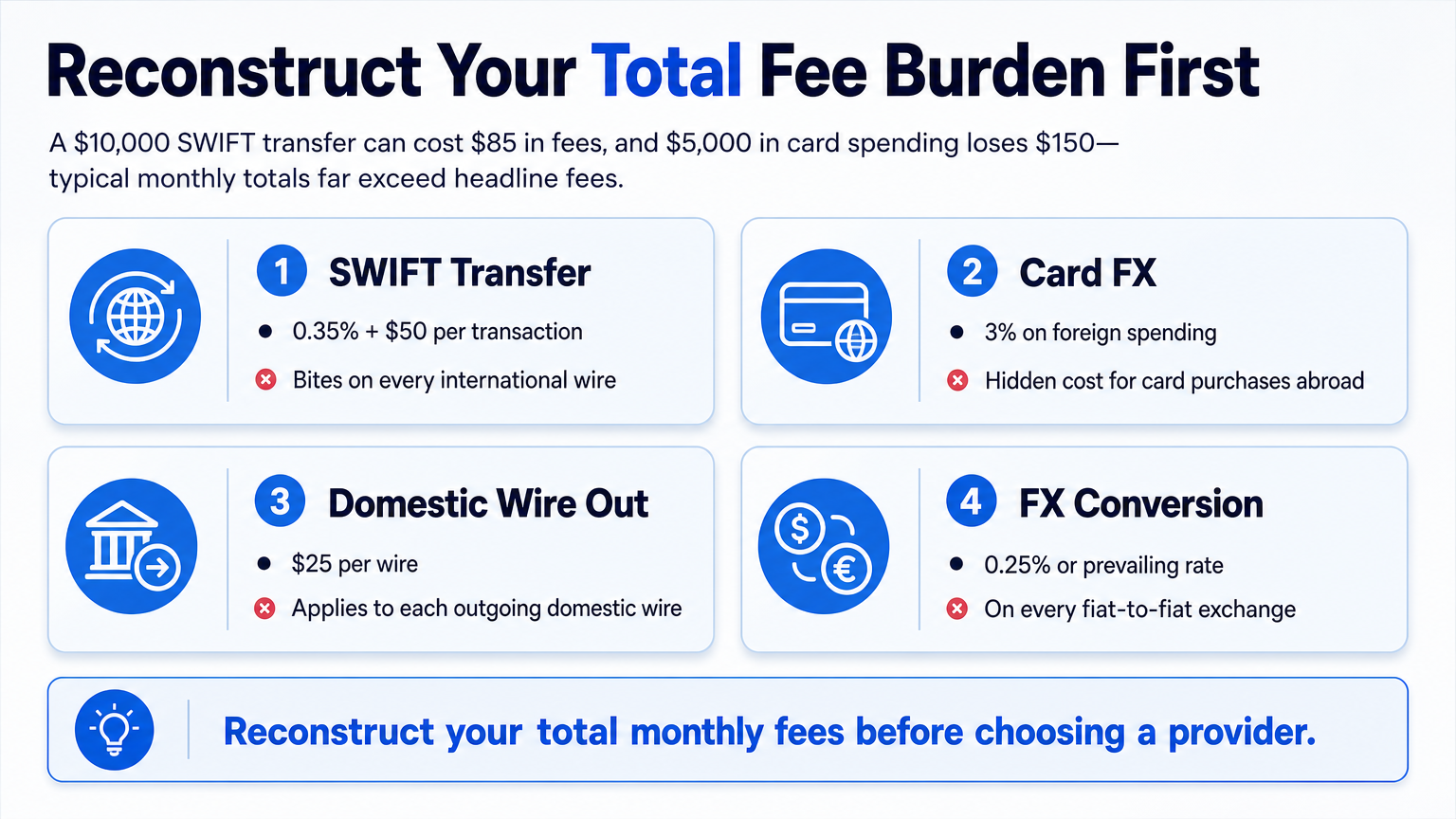
- International wire (SWIFT): Slower, OneSafe charges 0.35% + $50.
- Crypto conversions: USDC on/off‑ramp (often free), avoiding correspondent‑bank delays.
The account acts as a cross-border payment account, unifying fiat and on‑chain rails. For an example of stablecoin adoption, see Stablecoin payments hit 82M phones: Samsung-Solana deal.
The fee stack: international business account fees uncovered
| Fee category | OneSafe example | When it bites |
|---|---|---|
| Monthly subscription | $0 (free) or $29+ (premium) | Higher limits needed |
| Fiat deposit/withdrawal | 0.15% | On every fiat move |
| Wire withdrawal | $25 | Domestic wire out |
| Wire deposit | $10 | Incoming wires |
| SWIFT transfer | 0.35% + $50 | Every international wire |
| FX (currency conversion) | 0.25% or prevailing rate | Fiat‑to‑fiat conversions |
| Corporate card FX | 3% | Spending in foreign currency |
| Crypto deposit/withdrawal (USDC) | Free | Stablecoin on/off‑ramp |
A $10,000 SWIFT transfer costs $85 in fees before FX markup; $5,000 in card‑FX spending loses $150. Reconstruct your typical monthly total before choosing.
Options and tradeoffs
- Incumbent banks (Chase, HSBC): Full FDIC, broad branches, high fees, slow onboarding, no native crypto.
- Fintech platforms (OneSafe, Mercury, Brex): Digital‑first, multi‑currency, crypto‑friendly; partner‑bank fiat storage.
- Crypto‑native platforms (Kraken, Coinbase Commerce): Deep crypto liquidity, limited fiat.
A fiat‑only account is simpler with clearer coverage. A hybrid adds instant cross‑border settlement via USDC and treasury diversification, ideal for a business account for global startups and Web3 teams, but introduces custody risk and compliance overhead.
Regulatory backdrop: FSB’s Key Attribute 6 review and cross‑border dollar access
Financial Stability Board, 9 October 2026: The thematic peer review finds incomplete backstop funding mechanisms weaken authorities’ ability to resolve systemic banks, potentially delaying access to partner‑bank fiat.
CNBC: The House China committee urged the Fed to review Hong Kong’s dollar‑liquidity access. A reevaluation could disrupt Hong Kong‑dollar clearing.
Together, these signals underline: where your fiat is banked matters as much as the fintech front‑end. For stablecoin regulatory context, read Stablecoin Regulation: USDT’s 90-Day EU Countdown.
A practical review framework: the 8‑point checklist
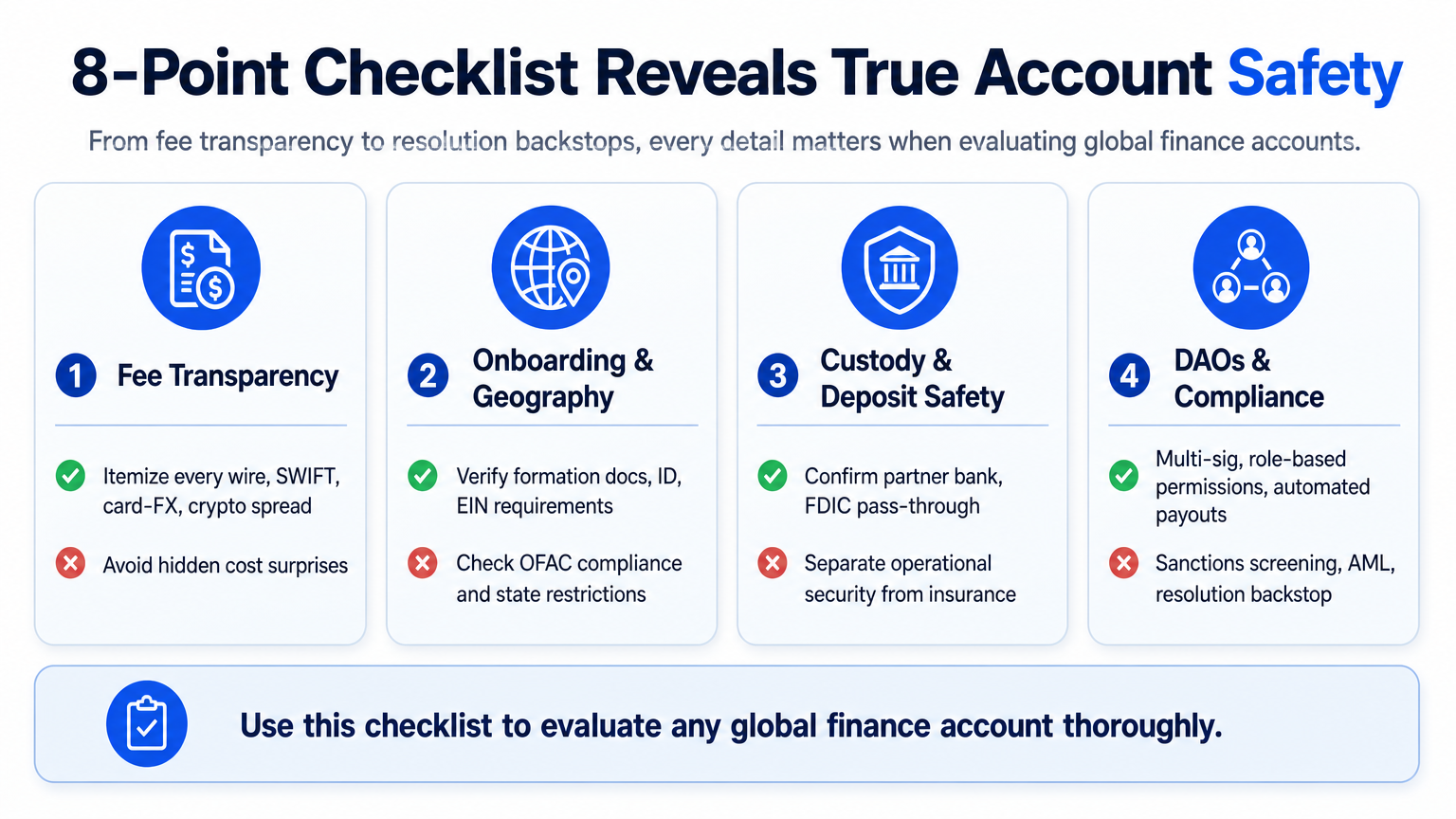
| # | Checkpoint | What to verify |
|---|---|---|
| 1 | Fee transparency | Every wire, SWIFT, card‑FX, crypto spread. |
| 2 | Onboarding requirements | Formation docs, ID, EIN, KYB timeline. |
| 3 | Geographic eligibility | Countries served, US state restrictions, OFAC. |
| 4 | Fund segregation & custody | Partner bank, FDIC pass‑through, crypto custody. |
| 5 | Fiat–crypto rails | Supported on/off‑ramps, stablecoin inventory, conversion speed. |
| 6 | DAO/Web3 controls | Multi‑sig, role‑based permissions, automated payouts. |
| 7 | Regulatory posture | Licenses, sanctions screening (OFAC, AML). |
| 8 | Operational vs deposit safety | Encryption, MFA, custody vs insurance and resolution backstop. |
Document requirements and geographic availability
Most require certificate of incorporation, beneficial owner’s photo ID, EIN (US), and sometimes proof of activity. OFAC‑sanctioned countries are blocked; some US states are excluded. Confirm your jurisdiction before onboarding.
DAO and Web3 treasury controls
For a DAO, a simple checking account won’t work. A DAO banking platform like OneSafe provides multi‑sig approvals, role‑based permissions, and native stablecoin holdings—replacing a quorum‑mail‑then‑wire process with an auditable, permissioned dashboard.
OneSafe review: applying the checklist
This OneSafe review tests the framework, not a promotion. OneSafe is a financial technology company, not a bank, offering fiat and crypto accounts for global businesses, Web3 startups, and DAOs. It serves 1,000+ businesses across 30+ countries.
Fee transparency walkthrough
- Monthly: Free tier; premium from $29/month.
- Fiat movement: 0.15% deposit/withdrawal; domestic wire $10 in, $25 out.
- International: SWIFT 0.35% + $50.
- FX: 0.25% or prevailing rate; corporate card FX 3%.
- Crypto: USDC free.
The schedule is public and granular. The 3% card‑FX fee is the biggest hidden sting—pay vendors directly via wire or stablecoin instead.
Security, onboarding, and support
- Security: MFA mandatory, Fireblocks custody, encrypted data.
- Onboarding: Digital, typically within a week, with required documents.
- Support: 24/7, support@onesafe.io.
Common questions (answered)
What is OneSafe and who is it for?
OneSafe is a crypto‑friendly business account built for global startups, Web3 companies, and DAOs managing fiat and crypto operations on one platform.
How does OneSafe differ from traditional banks?
It’s a fintech platform integrating multi‑currency fiat accounts, instant crypto‑to‑fiat, and DAO controls—all digital, no branches. Banking services are delivered by partners.
Who can open an account?
Any registered business worldwide, excluding OFAC‑sanctioned countries and certain US states. Requires formation papers, ID, EIN for US entities.
What transactions can I perform?
ACH, domestic/international wires, bill payments, instant crypto‑to‑fiat, and crypto payments—serving as a cross-border payment account.
Is my money safe in a neo‑banking platform?
Operationally, yes: encryption, MFA, Fireblocks custody protect against theft. But fiat safety depends on the partner bank’s deposit insurance and resolution regime. The FSB’s 2026 warning shows even insured deposits can face delays. Crypto assets have no value‑loss insurance.
How quickly can I open an account?
Within a week; the online application takes under 10 minutes with ready documents.
How does OneSafe handle currency conversion?
Near‑instant conversions via exchange partners; 0.25% or prevailing rate. Card foreign currency spending costs 3%.
Is OneSafe available worldwide?
Yes, except OFAC‑sanctioned countries and certain US states. Verify your jurisdiction.
Mistakes, myths, limitations, and next steps
Common mistakes and myths
- Mistake: Assuming all fees are shown. Always request the full fee schedule.
- Myth: Big banks are safer because of asset size. Safety comes from insurance, segregation, and access speed, not market cap.
- Myth: Crypto‑friendly equals less compliance. KYB and sanctions screening apply; fintechs ignoring them lose banking partners.
- Mistake: Not testing with a small wire before moving the treasury.
Limitations
No single account covers every currency, country, or rail. Hybrid accounts introduce volatility and custody risk. The FSB gap means even insured fiat isn’t immune to resolution‑related freezes.
Next steps
- Assemble formation documents, EIN, and ID.
- Shortlist two or three platforms matching your geography and currency needs.
- Run the 8‑point checklist on each.
- Open a free‑tier account and send a small test transaction.
- Map your monthly flows to the real fee schedule—choose the lowest total cost, not the lowest headline fee. For foundational business strategies, consult What Are the 7 Basic Business Principles? - OneSafe.
Key Takeaways
- Global finance accounts reviews must itemize every fee layer—SWIFT, card FX, crypto spreads.
- Operational security and deposit insurance are fundamentally different; never conflate them.
- The FSB’s 2026 backstop gap means you must verify which partner bank holds your fiat and its insurance.
- An 8‑point checklist—fees, onboarding, geography, segregation, rails, DAO controls, regulation, safety duality—turns a casual review into treasury‑grade evaluation.
- Test any platform with a small transaction before committing operating cash.
For teams ready to open a multi‑currency, crypto‑friendly business account bridging fiat and on‑chain finance, explore OneSafe’s onboarding and try the free plan.