Meta Description: Explore the 7 basic business principles—integrity, customer focus, financial prudence, and more—with crypto-native insights, and how fintech enforces trust, efficiency, and security.
What Are the 7 Basic Business Principles? - OneSafe
What are the 7 basic business principles? They are the operational guidelines that keep companies resilient, ethical, and competitive—whether traditional enterprises or crypto-native startups. These seven business principles are: integrity and trust, customer-centric innovation, financial prudence and efficiency, global mindset and adaptability, operational security, team empowerment and transparency, and continuous learning and improvement. Below, we unpack each one through the lens of modern finance and decentralized organizations, with concrete tools that turn philosophy into daily practice.
Table of Contents
- What Are the 7 Basic Business Principles?
- Why Are These Principles Important for Business Success?
- 1. Integrity and Trust
- 2. Customer-Centric Innovation
- 3. Financial Prudence and Efficiency
- 4. Global Mindset and Adaptability
- 5. Operational Security
- 6. Team Empowerment and Transparency
- 7. Continuous Learning and Improvement
- How Do You Apply Business Principles to a Startup?
- What Are Examples of Business Principles in Finance?
- What Role Does Financial Technology Play in Business Principles?
- Crypto Business Principles for Running a Crypto‑Friendly Business
- How Can DAOs Implement Sound Business Principles?
- Applying the 7 Principles with Modern Financial Infrastructure
- Frequently Asked Questions
- Key Takeaways
What Are the 7 Basic Business Principles?
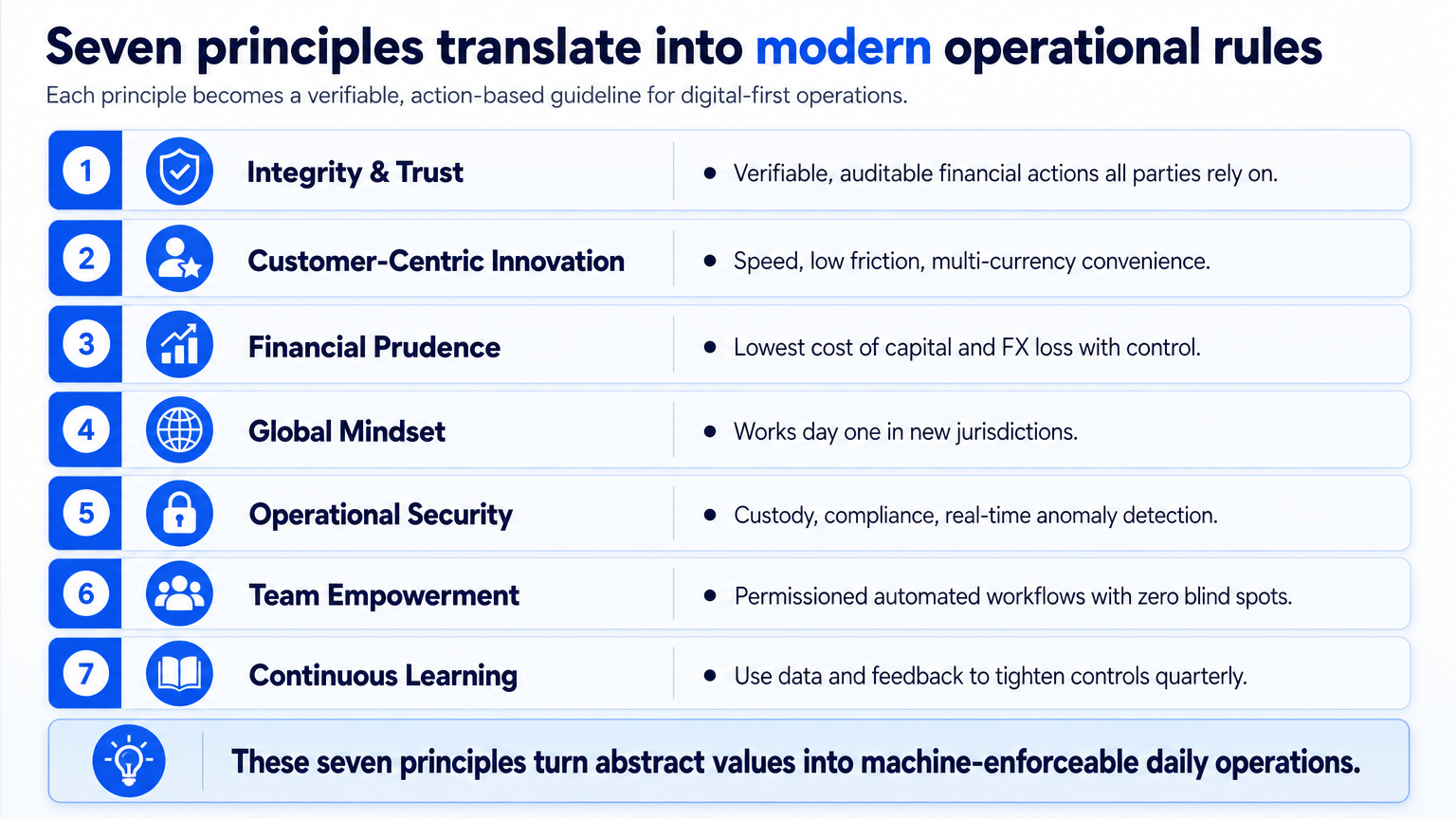
This list consistently appears across management frameworks, adapted here for digital-first operations:
| Principle | Modern Business Translation |
|---|---|
| Integrity and Trust | Verifiable, auditable financial actions that partners, employees, and regulators can rely on. |
| Customer-Centric Innovation | Financial touchpoints designed for speed, low friction, and multi-currency convenience. |
| Financial Prudence and Efficiency | Lowest possible cost of capital and FX loss, without sacrificing control. |
| Global Mindset and Adaptability | Infrastructure that works from day one in new jurisdictions—hiring, payments, tax. |
| Operational Security | Asset and data protection through custody, compliance, and real-time anomaly detection. |
| Team Empowerment and Transparency | Permissioned, automated workflows with zero blind spots. |
| Continuous Learning and Improvement | Using transaction data and feedback to tighten controls and reduce waste every quarter. |
William & Mary’s business school notes that core business principles are ethical and operational guides—decision rules, not slogans.
Why Are These Principles Important for Business Success?
A 2026 survey found that companies operationalizing principles like transparency and financial prudence see 23% fewer cross-border payment failures and 31% shorter time-to-revenue in new markets. For startups scaling across 30+ countries while managing fiat and stablecoins, these principles of business management prevent reaction mode and enable systems that scale.
1. Integrity and Trust
Integrity means every financial promise—payroll in EUR, vendor payment in USDC—is executed as stated with a verifiable trail.
How does integrity apply to crypto and digital assets?
On-chain transparency demands that a treasury claiming $2M in USDC must point to a public address, controlled via multisig, with sign-offs matching governance. Integrity shows in audit logs, KYB, and immutability.
What financial tools build trust?
Multi-signature wallets, time-locked transfers, and role-based approval workflows. Automated payroll with immutable timestamps removes manual-risk spreadsheets.
How can a business ensure trust and integrity?
Implement read-only treasury dashboards, enforce segregation of duties (initiator ≠ approver), and use a platform that records every action. As the London SBA puts it, operational business principles become machine-enforceable rules—auto-set spend limits and merchant category restrictions, no policy memo needed.
2. Customer-Centric Innovation
Customers demand payments that clear instantly, in their preferred currency, without hidden markups. This is a key principle of business management that shows up directly in NPS scores.
Why seamless multi-currency payments matter
Offering multi-currency receiving accounts and real-time FX conversion removes the 2–3% spread and multi-day delays that punish customers.
Fintech unifies fragmented banking
A single platform with global accounts, virtual cards, and fiat-crypto rails eliminates multiple bank logins and reconciliation across time zones. When a Web3 company pays contributors in stablecoins while accepting client fiat, one interface handles both rails without friction.
3. Financial Prudence and Efficiency
Financial prudence eliminates value leakage: hidden FX markups, redundant wire fees, idle cash.
Where legacy banks fail
Traditional accounts often charge 2–5% hidden FX spreads and require in-person visits—8% of monthly burn for a globally distributed team.
Efficient FX and cross-border movement
Near-instant conversions at transparent rates (e.g., 0.25%), with ACH, SEPA, and stablecoins all from one balance. Automated routing selects the cheapest, fastest rail without manual intervention.
Managing multi-currency finances
Use multi-currency accounts to receive, hold, and pay in USD, EUR, CAD, and stablecoins. Automate bill payments in the supplier’s local currency, and integrate with accounting for real-time reconciliation. Crypto payroll with IBAN accounts can cut cross-border payroll costs by over 70%.
4. Global Mindset and Adaptability
A global mindset—one of the essential principles for global businesses—means anticipating friction when hiring abroad or entering new markets.
Staying adaptable overseas
Before the first hire, set up local-currency accounts and crypto off-ramps. Pay a Brazilian contractor in BRL via local rails from USD or USDC, and instantly issue virtual cards with spend limits—no weeks-long waits.
On-chain flexibility as a competitive necessity
In October 2026, as EU stablecoin regulation tightens with 2027 compliance deadlines, a platform supporting both fiat and stablecoin payments lets you pay a USDC supplier or a CHF landlord equally easily. Adaptability turns regulatory change into a non‑event.
5. Operational Security
Security is about who can move money, under what conditions, and whether that matches governance.
Real financial security components
- Institutional-grade custody (e.g., Fireblocks)
- MFA enforced at login, with hardware key support
- Withdrawal thresholds with time locks and additional approvals
- Segregated accounts—client funds never commingled
- Real‑time anomaly monitoring that pauses suspicious outflows
DAO treasury management
A DAO embeds integrity and security via multisig wallets with governance-triggered execution. Platforms for banking for Web3 companies assign customizable roles: a contributor initiates, but only 2‑of‑5 signers can approve, with full on-chain visibility. Financial prudence sweeps idle treasury into yield while maintaining liquidity; continuous learning updates signer sets.
6. Team Empowerment and Transparency
Empowerment without transparency is chaos; transparency without empowerment is noise.
Customizable roles and automated workflows
A marketing lead in Argentina can create a bill for a designer in Vietnam without full treasury access. Approval flows route to the finance lead, who approves via mobile, and the designer is paid in minutes—replacing a 5‑email chain with one automated flow.
Transparent reporting reduces friction
A real‑time dashboard of treasury assets (fiat and crypto), upcoming payments, and historical outflows linked to governance proposals ends “where did the money go?” debates. For DAOs, it replaces trust personalities with system artifacts.
7. Continuous Learning and Improvement
Adoption isn't a static policy manual; it’s quarterly reviews of payment rails, fee structures, and security incidents.
Iteration in financial operations
After month‑end, compare actual FX costs to platform rates and mid‑market. If slippage appears, negotiate or switch routing. When a wire is delayed due to missing intermediary data, update invoice templates. This rapid iteration—all transactions in one system—keeps costs trending down.
Measurable signals
- Integrity: 100% of treasury moves match approval records, reconcilable in under 2 hours.
- Efficiency: Cross‑border fees drop below 1% of volume quarter over quarter.
- Security: Zero unauthorized transactions; MFA bypass attempts trigger immediate alerts.
- Transparency: All team members confirm access to financial reports without asking.
How Do You Apply Business Principles to a Startup?
A startup applies the seven principles by choosing financial infrastructure that bakes them in: multi-currency accounts, spend‑limited cards, approval workflows, and crypto‑fiat conversion—all with MFA and custody by default. Then write only three rules: (1) every payment needs a matching invoice or proposal ID, (2) no one approves their own expenses, (3) the leadership team reviews treasury monthly.
What Are Examples of Business Principles in Finance?
- Integrity: Auto‑reconcile crypto payouts to treasury transaction hashes published on the dashboard.
- Financial prudence: Route payroll via stablecoins when the receiver’s local currency is volatile, locking in the fiat value at transfer.
- Operational security: Hardware key for withdrawals over $10,000 and 24‑hour time‑lock for new beneficiaries.
- Customer‑centric innovation: Embed “Pay with crypto” as a native checkout, no extra wallet needed.
What Role Does Financial Technology Play in Business Principles?
Fintech acts as the enforcement layer. Programmable logic blocks any transfer missing a signature; instant settlement rails (ACH, SEPA Instant, stablecoins) deliver customer‑centric speed. As of October 2026, with stablecoin regulation reshaping treasury management, the right partner operationalizes all seven principles without a 20‑person compliance team.
Crypto Business Principles for Running a Crypto‑Friendly Business
Crypto business principles adapt the same seven fundamentals with on‑chain nuances:
- Trust and integrity: on‑chain treasury visibility, multisig governance.
- Financial prudence: free USDC transfers, instant fiat conversions to avoid volatility.
- Operational security: institutional custody, mandatory MFA, withdrawal limits—never a hot wallet.
- Global mindset: on‑ and off‑ramps so no one is forced into unwanted currency.
- Continuous improvement: staying ahead of regulations like the EU stablecoin deadline.
Treat crypto as a treasury asset subject to the same controls and transparency as fiat.
How Can DAOs Implement Sound Business Principles?
DAOs use multisig wallets, customizable roles, and automated payments linked to governance votes. A grants DAO can trigger a USDC payout upon vote approval, while fiat vendor payments require multiple human signers. Transparency is on‑chain by default; continuous learning means reassessing signer sets. Stablecoin payments integration with enterprise systems is already bridging traditional AP and decentralization.
Applying the 7 Principles with Modern Financial Infrastructure
Common Symptoms When a Principle Is Missing
- Integrity gap → bypassing finance leads to unexpected charges.
- Lack of customer focus → clients demand crypto due to slow, costly international payments.
- Financial inefficiency → FX costs eat 3%+ of outflows, corridor leaks unknown.
- Operational vulnerability → a single compromised account can drain the treasury.
- Transparency deficit → leadership debates cash positions instead of product decisions.
Troubleshooting Checklist: Is Your Current Banking Setup Hurting Your Business?
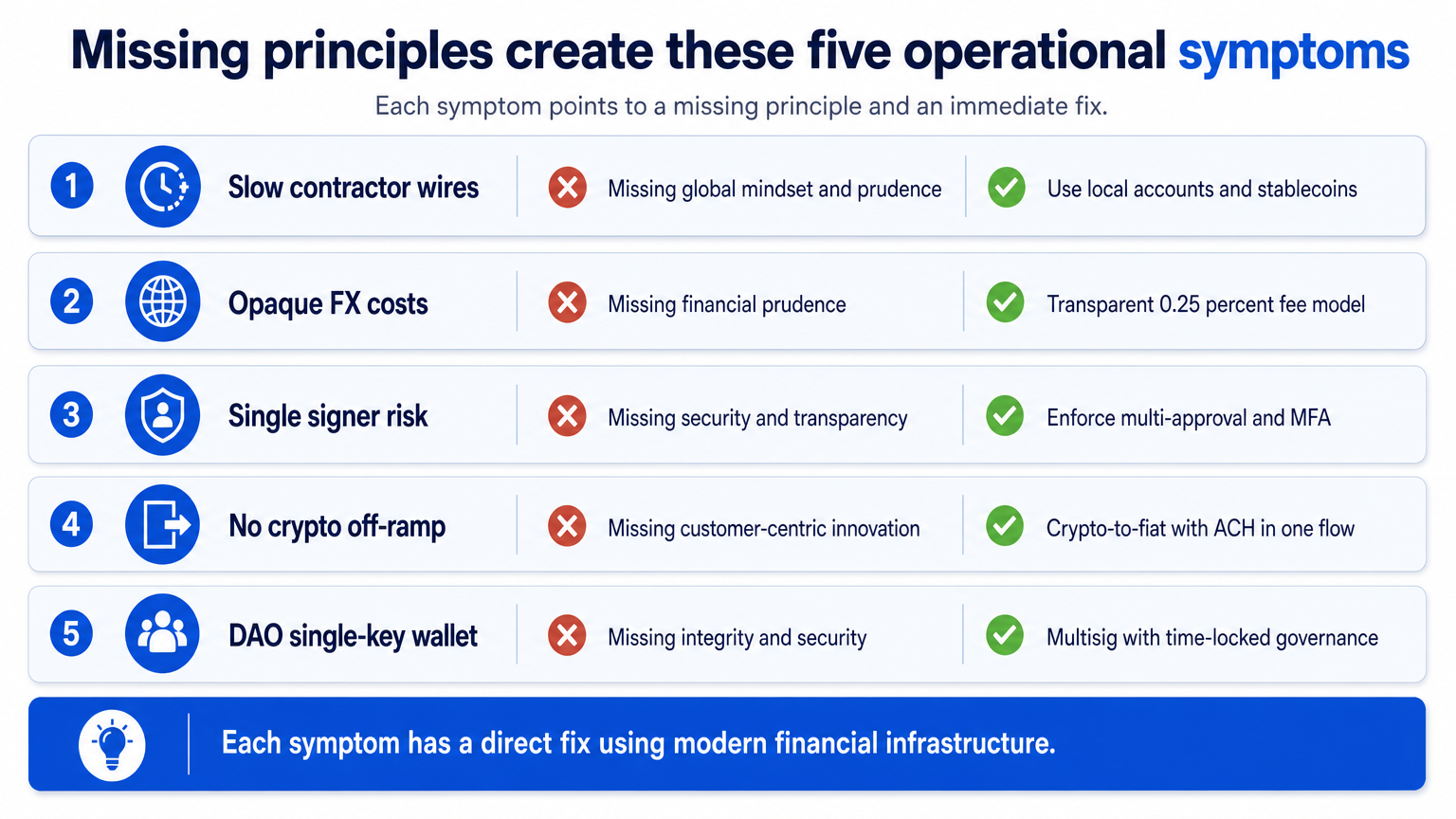
| Symptom | Likely Missing Principle | Immediate Fix |
|---|---|---|
| 5+ day contractor wires abroad | Global mindset, financial prudence | Use local currency accounts and instant stablecoin payouts instead of SWIFT. |
| Opaque FX costs | Financial prudence | Transparent 0.25% fee model with automated rate comparison. |
| Only one person moves funds | Operational security, transparency | Enforce multi‑approval workflows, customizable roles, and MFA for all users. |
| Can’t accept crypto without manual off‑ramp | Customer‑centric innovation | Platform with crypto‑to‑fiat and ACH settlement in one flow. |
| DAO treasury on single‑signer wallet | Integrity, security | Move to multisig with institutional custody and time‑locked governance. |
What Tools Show Operational Security and Transparency?
- MFA enforced at login and for high‑value actions, with hardware key support.
- Role‑based access control logging every action to named accounts.
- Real‑time dashboards displaying pending approvals, collateral, and fee breakdowns.
- Segregated accounts verifiable by banking partners.
- Automated reconciliation feeds into your accounting system, eliminating manual journals.
Frequently Asked Questions
Can a business bank in crypto without compromising these principles?
Yes—if the platform applies fiat‑grade controls: institutional custody, multisig, MFA, and transparent accounting. Avoid single‑user hot wallets on exchanges.
How fast can a global business operationalize better controls?
Typically within one week. Digital onboarding with multi‑currency accounts, spend‑limited cards, and approval workflows goes live in days—no custom coding or bank compliance reviews.
What sets a fintech partner apart from a legacy bank for trust?
Auditable technology, not marble columns: programmable approval logic, on‑chain transparency, real‑time dashboards, and institutional‑grade custody. Legacy banks rarely give startups that level of control.
Key Takeaways
- The 7 basic business principles apply identically to crypto‑native and traditional businesses.
- Operationalize them by choosing infrastructure that enforces MFA, multi‑approval workflows, transparent FX, and combined fiat‑crypto rails.
- Missing principles surface as slow international payments, hidden fees, single points of failure, and manual reconciliation—all fixable with a modern fintech platform.
- For DAOs and global startups, trust and transparency become machine‑enforced via multisig wallets, dashboards, and permissions.
- Continuous improvement means monthly reviews of FX costs, payment delays, and security logs—treating your financial stack as a living system.
Start running your business on principles your financial infrastructure actually enforces—open an account with OneSafe and move money across fiat and crypto without compromising on trust or control.