
The most popular advice about cashing out crypto is also the least useful: just press sell and withdraw the money. That describes the trade, not the operation. The process includes choosing the right asset, passing compliance checks, selecting a payout rail, measuring the all-in cost, and preserving records that explain where the fiat came from and how its tax basis was calculated.
For a trader, a direct sale may be enough. For a web3 company paying contractors, settling invoices, or moving treasury funds across borders, the difficult part starts after the blockchain transaction confirms. The bank transfer can take longer than the token transfer, a beneficiary review can stop settlement, and an apparently attractive exchange rate can be overwhelmed by withdrawal and foreign-exchange charges.
Table of Contents
Why Stablecoins Became the Bridge to Fiat
Converting crypto to fiat usually isn't a single sale. It's a sequence in which a volatile token becomes a more stable settlement asset before the value reaches a bank account. That distinction explains why stablecoins became the default bridge for many businesses and traders.
The Federal Reserve's discussion of stablecoins in 2025 reported aggregate stablecoin market capitalization of $317 billion by April 6, 2026, more than 50% above early-2025 levels. Independent market research cited in the same conversion-trends context found global fiat-backed stablecoin supply exceeded $273 billion in March 2026, compared with $6.8 billion in March 2020, roughly 40 times higher. Those figures point to an infrastructure shift, not merely a popular trading pair.
A company holding ETH or another volatile token faces price exposure while the platform processes the sale and the bank completes the payout. Moving first into USDC or USDT creates a dollar-linked pivot asset, then the business can begin the fiat leg with less exposure to the token's price movement.
Why direct selling creates operational risk
Direct spot selling still has a place. It can make sense when the platform supports the asset, the quote is competitive, and the fiat payout is available immediately. The problem appears when execution and settlement happen on different clocks.
A blockchain transfer can confirm quickly, while the fiat payout waits for an exchange review, a banking window, or an international rail. During that interval, a volatile token can move materially. Stablecoins don't remove every risk, including issuer, reserve, chain, and depeg risk, but they reduce the specific problem of carrying a non-stablecoin price between trade execution and cash settlement.
Stablecoins also standardize treasury workflows. Payroll, contractor payments, vendor settlement, and internal balance management can pass through a dollar-linked asset before the final conversion to bank money. This is why the question isn't only “how to convert crypto to fiat,” but also “which asset should carry the value during conversion?”
Practical rule: Choose the settlement asset before you choose the withdrawal button. The token you hold during processing determines much of your volatility exposure.
Transaction activity reinforces that role. A 2026 report estimated stablecoin transaction volume at $28 trillion in Q1 2026, a 51% quarter-over-quarter increase, while another tracked $33 trillion across 2025. The Federal Reserve source also notes that stablecoins represented 75% of all crypto trading volume in one 2026 market report. For an operator, the message is straightforward: the stablecoin route is now a normal settlement path, not an unusual workaround.
Businesses comparing stablecoin structures should also consider who controls issuance, reserves, redemption, and access. The discussion in whether stablecoins are just corporations in disguise is useful background because the bridge asset carries its own governance and counterparty questions.
Three Paths for Converting Crypto to Fiat
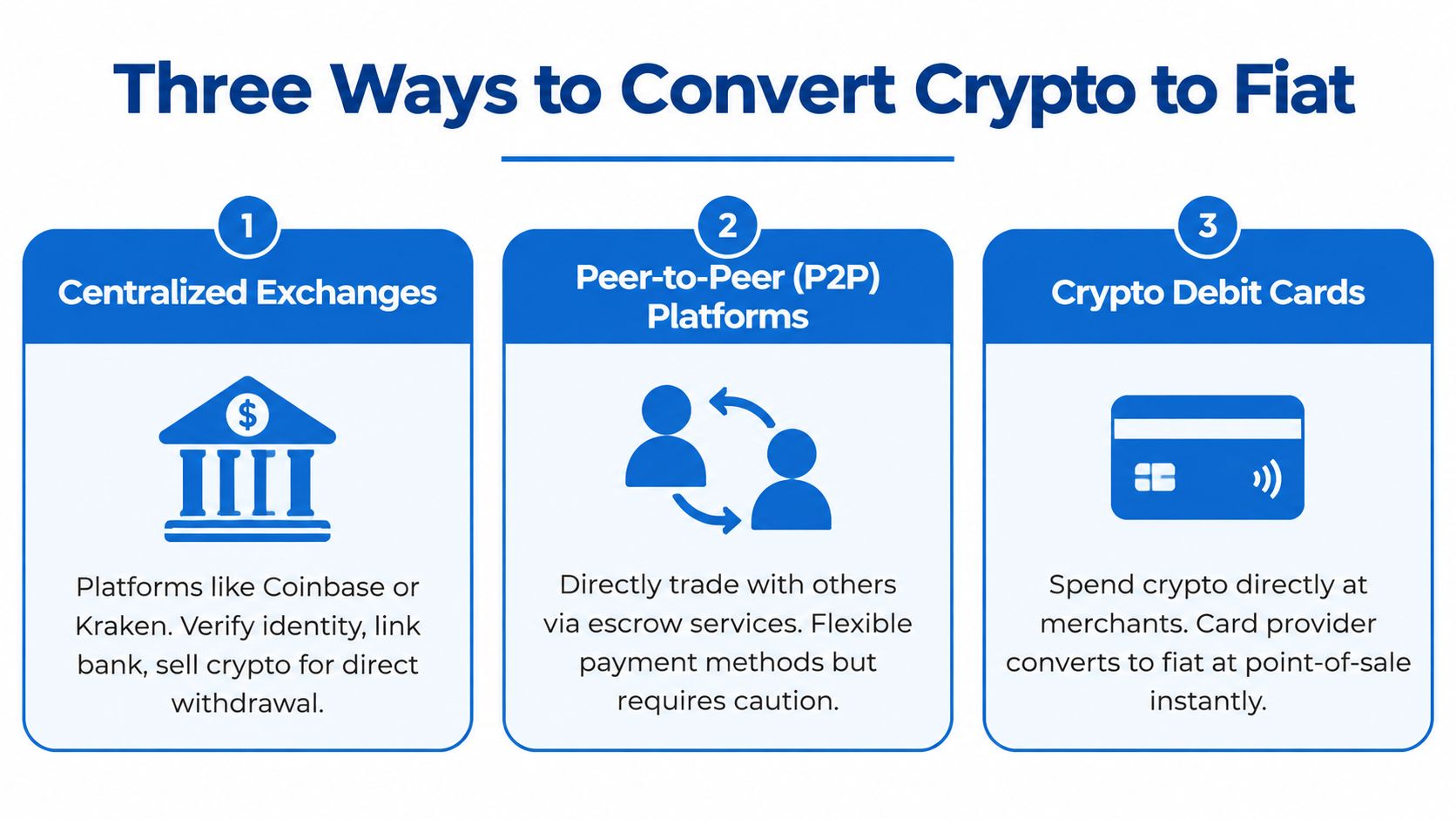
Most users choose among three routes: a centralized exchange, an over-the-counter desk, or a platform that combines crypto conversion with banking rails. Peer-to-peer marketplaces and crypto debit cards also exist, but they solve different problems and shouldn't be confused with a controlled business off-ramp.
Centralized exchanges
Coinbase, Kraken, and similar exchanges are familiar because they separate the trade from the bank withdrawal in a clear interface. You deposit crypto, sell it for a supported fiat currency, and request a transfer to a linked bank account.
This route works well for individuals and companies that need market liquidity, support for a specific token, and a conventional trading screen. The trade-off is fragmentation. You may need one provider for execution, another for banking, and a separate accounting process to reconcile the proceeds. Jurisdiction restrictions, account reviews, network support, and variable withdrawal charges can also interrupt an otherwise simple transaction.
Over-the-counter desks
An OTC desk is designed for negotiated execution rather than a public order book. It can be useful when a large block would create visible slippage on an exchange, or when the buyer needs a customized settlement process.
The cost isn't limited to the quoted price. OTC onboarding can require extensive source-of-funds and business documentation, and the desk may serve only approved jurisdictions or assets. A smaller user may find that the minimum size and onboarding effort outweigh any execution benefit.
Integrated crypto and banking platforms
A unified platform combines the crypto deposit, conversion, fiat balance, and payout process. That structure can reduce the number of handoffs for web3 companies, particularly when the same account needs to receive USDC, hold fiat, pay vendors, issue cards, or send wires.
OneSafe publishes a model that includes free USDC deposits and withdrawals, multi-currency accounts, crypto-to-fiat conversion, and payment rails such as ACH, wires, and SWIFT. It's one option for teams that prefer to keep conversion and treasury activity in one interface rather than reconcile several providers.
The right choice depends on transaction size, jurisdiction, asset support, payout currency, approval controls, and the cost of switching systems. A person learning how to start trading crypto in ZA may prioritize exchange access and local payment methods, while a global startup may care more about KYB, beneficiary controls, and repeatable treasury operations.
A product walkthrough can help clarify the difference between a trade interface and a full settlement workflow:
Preparing Your Wallet and Compliance Setup
A failed conversion often begins before the user enters an amount. The wallet may send an unsupported token standard, the receiving platform may not support the chosen network, or the business may lack the documents required for a payout review.
Start with the receiving platform, not the sending wallet. Confirm the supported asset, chain, deposit address, minimum amount, network fee treatment, and whether the platform accepts transfers from self-custody wallets. Send a small test transaction when the amount is material or the chain selection is unfamiliar. A confirmed blockchain transfer can't be reversed because the recipient selected the wrong network.

Make the account reviewable
Individuals typically need identity information and proof of address. Businesses should expect KYB materials such as incorporation documents, beneficial ownership details, business activity descriptions, and evidence connecting the entity to its funds.
The 2026 PwC crypto regulation review covers more than 50 jurisdictions and identifies stablecoin issuance, reserves, and redemption as major policy themes. Other industry reporting cited in the supplied data says 68 countries have enacted or proposed crypto-specific legislation. The practical result is that the same wallet transaction can face different requirements depending on the company's incorporation country, the bank's location, and the service provider's licensing model.
Before transferring funds, prepare:
- Identity and entity records: Keep current identification, incorporation files, ownership information, and address evidence in an accessible folder.
- Source-of-funds support: Preserve wallet histories, exchange statements, invoices, and prior transaction records that explain the origin of the assets.
- Beneficiary details: Match the legal name, bank account, address, and payment purpose exactly. Incomplete beneficiary data can delay the fiat leg.
- Rail confirmation: Check that ACH, SEPA, Faster Payments, PIX, SWIFT, or the required domestic wire route is available for your account and currency.
The Travel Rule may also require originator and beneficiary information above applicable jurisdictional thresholds. The supplied compliance guidance identifies a $3,000 U.S. threshold and zero-threshold treatment under EU transfer rules. Requirements can change, so use the provider's current compliance instructions and obtain professional advice where the transaction is material. Resources explaining the verification flow compliance process can help teams understand why providers request specific information.
For a deeper review of identity controls and transaction screening, see the AML and KYC procedures guide. The objective isn't to produce paperwork for its own sake. It's to make the transaction understandable to the platform and the bank before the money moves.
Executing the Conversion and Withdrawing to Bank
A practical crypto-to-fiat off-ramp follows five stages. The sequence is predictable, but the timing isn't, because each stage hands responsibility to a different system.
The five-stage workflow
First, deposit the crypto on-chain. Copy the platform's deposit address and confirm the network. The receiving system may wait for network confirmations before crediting the balance, even when the transfer appears complete in a wallet.
Second, convert the asset. You can sell directly into fiat, or move a volatile token into a supported stablecoin and then convert that stablecoin into the target currency. The intermediary route is often preferable for treasury operations because it separates the volatile-token trade from the bank payout.
Third, clear compliance checks. A provider may review wallet exposure, source of funds, transaction purpose, beneficiary details, or sanctions-related information. If the account is already fully onboarded, these checks can run alongside the transaction. If not, the funds may remain pending after the on-chain transfer succeeds.
Fourth, send the fiat through the selected rail. ACH, SEPA, Faster Payments, PIX, domestic wires, and SWIFT don't provide the same delivery experience. The banking rail controls when the recipient can use the money.
Fifth, reconcile the transaction. Record the crypto sent, conversion details, fees, fiat received, bank reference, and accounting treatment. Reconciliation should happen while the evidence is available, not during a later audit or tax filing.
Blockchain speed isn't bank speed
The supplied settlement guidance describes blockchain settlement as typically taking seconds, while fiat delivery can range from near-instant on RTP or FedNow-style rails to one to five business days on SWIFT. It also cites published per-transfer costs of around $15 to $30 for Fedwire and $20 to $50 or more for SWIFT. These are rail-level reference points, not guaranteed quotes.
For a company paying a contractor, “confirmed on-chain” doesn't mean “available in the contractor's bank account.” Build the payout calendar around bank cutoffs, weekends, holidays, compliance review, and correspondent-bank processing.
The operational deadline is the bank receipt, not the wallet confirmation.
A business account that connects fiat banking and crypto workflows can reduce handoffs. For teams evaluating that structure, business bank account setup for fiat and crypto integration provides relevant context. Whatever provider you choose, run a small end-to-end payout before making the workflow part of payroll or vendor operations.
Fees, Timing, and the Hidden Costs of Off-Ramping
The exchange rate displayed on the conversion screen is only one line in the cost calculation. The final amount can also reflect a trading fee, spread, network cost, fiat withdrawal charge, intermediary-bank deduction, foreign-exchange fee, and monthly platform subscription.
A useful comparison starts with the route rather than the brand. An exchange may show a competitive trading quote but charge separately for the bank withdrawal. An OTC desk may improve execution on a large block while adding onboarding friction. An integrated platform may publish a flat withdrawal fee but still require you to examine the FX rate and account plan.
Compare the complete charge stack
| Method | Trading Fee | Withdrawal Fee | Estimated Total Cost |
|---|---|---|---|
| Centralized exchange | Varies by provider, asset, and volume tier | Varies by payout rail and destination | Trading charge plus spread and withdrawal charge |
| OTC desk | Negotiated execution cost or spread | Depends on the agreed settlement route | Quoted execution cost plus banking and FX charges |
| Integrated banking and crypto platform | Published conversion or platform pricing | Depends on currency and rail | Conversion charge, account pricing, and payout charge |
| SWIFT payout | May include conversion spread or trading charge | Often includes a fixed charge and possible intermediary deductions | Conversion cost plus SWIFT charge, FX, and bank deductions |
OneSafe's published pricing includes free USDC deposits and withdrawals, a 0.15% fiat deposit or withdrawal fee, $10 wire deposits, $25 wire withdrawals, and SWIFT priced at 0.35% plus $50. It also lists a 3% FX fee on cards and plans starting at $29 per month. Treat those as the provider's stated prices, then verify the current schedule and eligibility before initiating a transfer.
Timing has a financial cost
A delayed payout can create more than inconvenience. It can force a company to borrow working capital, miss a vendor deadline, or keep volatile assets exposed while waiting for settlement. Even a low-fee rail can be expensive if it fails to meet the payment deadline.
Calculate the all-in result before sending funds:
- Start with the crypto amount and the quoted conversion rate.
- Subtract trading charges, spread, and network costs.
- Subtract the fiat withdrawal fee.
- Add any account, wire, SWIFT, or intermediary-bank cost.
- Apply the relevant FX rate if the receiving account uses another currency.
- Compare the final bank credit with the amount the recipient needs.
Don't compare a platform's headline fee with another provider's final receipt. Compare net fiat received, expected delivery time, and the risk of a review delay. A transparent schedule helps, but transparency doesn't automatically make one route cheaper. The right answer depends on currency, rail, size, and whether the transaction is a one-off withdrawal or a repeatable business process.
Best Practices to Minimize Slippage and Risk
A reliable conversion workflow treats every payout as a treasury transaction. The operator needs a clear asset route, a verified destination, an approved beneficiary, a defined settlement deadline, and a complete evidence trail.
Start by deciding whether the payment requires a volatile asset sale or a stablecoin bridge. For most business payouts, routing through USDC or USDT before the fiat conversion reduces the period in which the value is exposed to market movement. It doesn't eliminate execution risk, and it introduces stablecoin and platform considerations, but it gives the treasury team a more controllable intermediate balance.
Use a repeatable pre-flight checklist
- Confirm the asset and chain: Match the sending network to the receiving address and verify support before broadcasting.
- Check the live quote: Review the rate, spread, conversion fee, minimum, and expiry window before approving the transaction.
- Verify the beneficiary: Compare legal names and bank details character for character, especially for international wires.
- Set the timing expectation: Separate blockchain confirmation from fiat delivery and account for bank cutoffs.
- Approve the transaction: Use internal roles, spending limits, and a second reviewer for material company payouts.
- Reconcile immediately: Save the wallet transaction hash, platform statement, rate, timestamps, fees, bank reference, and final receipt.
Near-instant conversion can reduce the exposure window, but speed shouldn't override controls. A fast transaction sent to an unsupported rail is still a failed payment. Likewise, a cheap route that requires manual intervention every time may cost more in staff time and delay than a published fee suggests.
Treat tax records as part of settlement
The tax gap is where many cash-out guides fall short. A conversion can create a reportable disposal or taxable event depending on the jurisdiction, even when the user sees it as moving money between accounts. Preserve the acquisition date, cost basis, amount disposed of, proceeds, fees, wallet addresses, transaction identifiers, and the purpose of the transfer.
For U.S. users, the supplied White House digital-assets report notes that brokers must report gross proceeds for digital-asset sales on or after January 1, 2025, and basis for certain sales on or after January 1, 2026. PwC's 2026 review also shows that tax treatment continues to change across 58 jurisdictions. These rules don't replace individualized tax advice, but they do make casual recordkeeping a poor operating practice.
A 2026 U.S. survey of 3,000 crypto users found that most wanted to comply but still struggled with taxable events and cost-basis tracking. The practical response is simple: export records after each conversion, map every disposal to its acquisition lot, and ask a qualified adviser how local rules treat stablecoin swaps, card spending, fees, and cross-border transfers.
The path of least resistance is rarely the button labeled “sell.” It's a controlled workflow that locks value appropriately, confirms the payout rail, prices every fee, and leaves an audit-ready record.
OneSafe brings multi-currency business accounts, crypto-compatible USDC transfers, near-instant crypto-to-fiat conversion, ACH, wire, and SWIFT payment options into one operating interface. If your team wants to reduce provider handoffs while keeping conversion and payout records together, visit OneSafe and review whether its account and compliance model fits your jurisdiction.