Your bank confirms a $45 international wire fee, so the payment looks inexpensive. Then your German supplier says the invoice arrived short, your reconciliation team starts tracing the route, and the exchange rate doesn't match the figure you saw on a public currency converter. The advertised fee was only the visible entry point.
The cost of moving money across borders usually includes the sender's charge, correspondent-bank deductions, a receiving-bank fee, and an exchange-rate margin. The World Bank's Remittance Prices Worldwide data tracks both explicit fees and exchange-rate margins, and its latest reported global average cost was 6.36% in Q3 2025, down from 6.49% in Q1 2025. Banks remained the most expensive provider type at 14.99%, making bank pricing impossible to evaluate from the outgoing fee alone.
Finance teams should stop asking, “What does this wire cost?” Ask instead, “How much will the beneficiary receive, in their currency, after every deduction?”
Table of Contents
The Hidden Cost Behind a $25,000 Wire
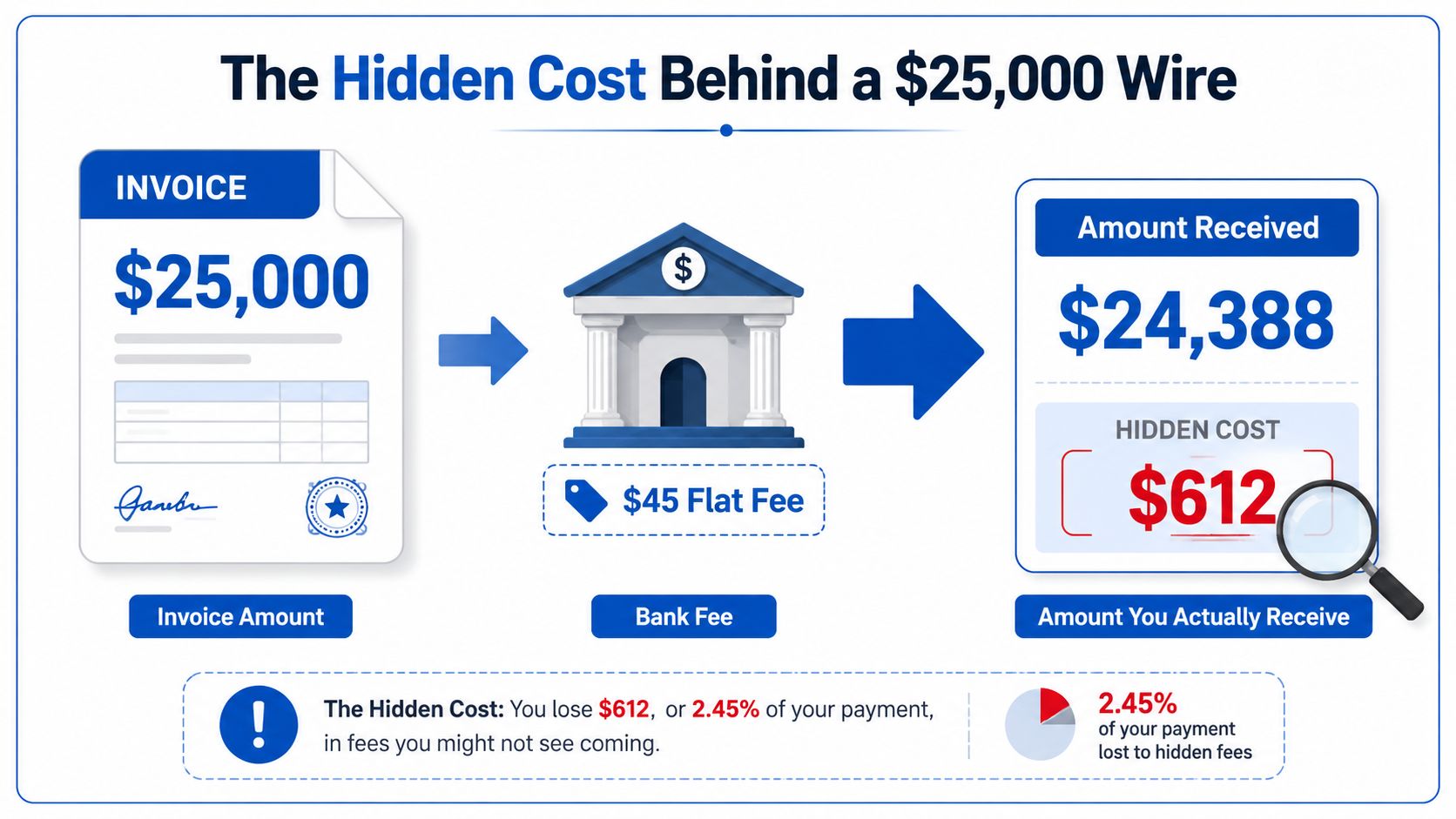
At month-end, a finance operations manager opens the reconciliation report and sees a problem. The company approved a $25,000 payment to a German supplier, but the beneficiary account credited only $24,388 in value. The bank confirmation displayed a flat $45 outgoing fee, which made the transfer appear routine.
The investigation finds four separate leaks:
- Sender fee: The bank charged $45 to release the payment.
- Correspondent deduction: An intermediary bank removed $78 while routing the funds.
- Beneficiary-bank charge: The German bank applied a $14 receiving fee.
- Foreign-exchange loss: The bank's euro conversion delivered roughly $475 less than a competitive rate would have produced.
That creates total leakage of $612, or 2.45% of the principal. The sender saw $45. The supplier experienced a much larger shortfall.
The receipt rarely tells the whole story
The bank's outgoing confirmation normally highlights the amount sent and the sender's fee. It may not identify every correspondent deduction, and it often doesn't translate the exchange-rate margin into a separate dollar figure. That forces the AP team to compare the original instruction, the settlement record, and the supplier's credited amount.
This isn't an unusual structure. Independent industry guidance describes a sender-bank charge, intermediary deductions, and a beneficiary-bank charge as separate components, with explicit bank fees potentially reaching roughly $40 to $100 before foreign-exchange spread is included (OhMyFin's explanation of SWIFT costs). A separate 2026 business payment guide places major-bank outgoing wires around $25 to $65, intermediary charges around $10 to $50, and FX markups around 2% to 5% (Corpay's wire-transfer fee guide).
Finance rule: Never approve a cross-border payment from the sender fee alone. Approve it against the expected landed amount.
The practical fix is diagnostic discipline. Record the sending amount, quoted rate, charge code, expected recipient currency, and final credited amount for every material payment. Once those fields are visible in one report, the “mystery” shortfalls become negotiable costs rather than unavoidable surprises.
What an International Wire Transfer Actually Is
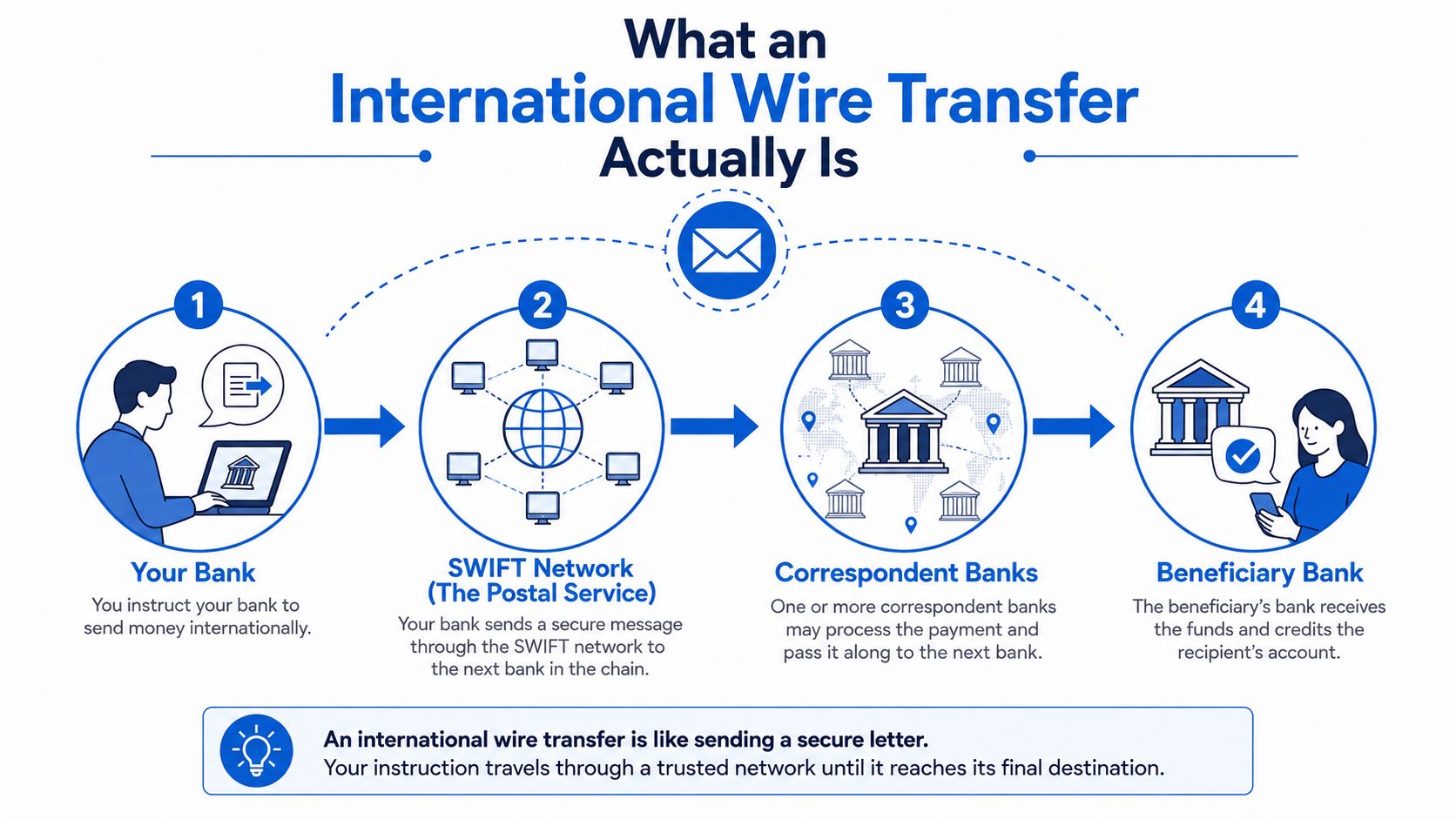
An international wire transfer is an electronic payment instruction that travels between financial institutions, often through the SWIFT network. SWIFT primarily provides a secure messaging system for banks. It doesn't function like a single global account that instantly moves the funds from sender to recipient.
The postal-service analogy is useful. Your bank is the local post office where you hand over the payment instruction. SWIFT is the postal network carrying the message. Correspondent banks are sorting hubs that help route the instruction when the sending and receiving banks don't maintain direct accounts with each other. The beneficiary bank is the final post office that credits the recipient.
Banks in different countries often rely on correspondent relationships because they don't hold direct settlement accounts everywhere. Each institution in the chain may process compliance checks, exchange instructions, or settle through its own account structure. That extra handling creates opportunities for deductions and delays, especially when the payment needs currency conversion.
Where the money changes value
The payment instruction can begin in one currency and arrive in another. A US company might send dollars, while the supplier's account is denominated in euros. Conversion can occur at the sending bank, through a correspondent, or at the receiving bank, depending on the instructions and account setup.
That distinction matters because the quoted exchange rate determines how much the beneficiary receives. A bank can advertise a modest wire fee while embedding its margin inside the currency conversion. The World Bank's international transfer pricing methodology is useful because it separates the explicit fee from the exchange-rate margin rather than treating them as one charge.
For a broader explanation of how companies can structure cross-border payment flows, see OneSafe's guide to B2B cross-border payments. The foundational vocabulary is simple: sender, message network, correspondent route, beneficiary bank, and conversion point. Those five details determine where the payment can lose value.
The Four Layers of Wire Transfer Fees
A $25,000 international wire can lose value in four places. The advertised wire fee is only the first line. Review the sender, intermediary, receiver, and foreign-exchange costs separately, then confirm who bears each charge under the selected instruction code.
| Fee Layer | Typical Range (USD) | Who Charges It | Who Bears It |
|---|---|---|---|
| Sender fee | $20 to $50 | Sending bank | Usually sender |
| Intermediary deduction | $10 to $30 per bank | Correspondent bank | Sender, receiver, or payment principal, depending on instructions |
| Receiver fee | $10 to $25 | Beneficiary bank | Usually receiver |
| Foreign-exchange spread | Variable, added to the rate | Bank or payment provider | Sender through a less favorable conversion |
The ranges above come from independent guidance on SWIFT routing and international wire pricing, including OhMyFin's SWIFT cost breakdown. Use them to map the cost stack, not to predict an exact quote for a specific bank or corridor.
Sender charges
The sender fee appears on the bank confirmation and is the easiest cost to compare. Traditional banks usually charge a fixed outgoing amount. Digital providers may combine a lower account fee with a conversion margin, or charge through both. OneSafe and similar fintech alternatives can reduce the visible transfer charge, but compare the full delivered amount before switching.
Check the outgoing fee before submitting the payment. Confirm whether online initiation, branch assistance, currency choice, account tier, or urgent handling changes the price. If your team is assessing regulated payment infrastructure, information about registering with Chern & Co under PSD2 can clarify the difference between payment agents and payment institutions.
Correspondent deductions
A correspondent bank enters the route when the sending and beneficiary banks cannot settle directly. It may deduct a charge from the payment before the funds reach the beneficiary. The sender may receive no separate invoice, while the supplier reports that the payment arrived short.
The charge code sets the intended allocation. OUR generally instructs the sender to bear applicable charges, SHA shares charges between sender and recipient, and BEN deducts charges from the amount received. Banks can apply these codes differently by corridor, so confirm the operational treatment with both banks before using them for recurring payments.
Receiver fees and FX
The beneficiary bank can charge for receiving an international payment even after the sender has paid an outgoing fee. Ask the supplier which account receives the funds and whether that institution applies an incoming-payment charge. If the supplier must receive a fixed amount, include that requirement in the payment instructions and reconciliation process.
The FX layer often creates the largest leak. Compare the provider's quoted rate with a live mid-market reference, then calculate the recipient-currency difference before approval. A fintech account may lower the sender fee while still applying a wide spread. If the provider will not disclose its rate or margin, treat that opacity as a pricing risk and move the payment flow to a provider with clearer pricing.
Why the FX Spread Costs More Than the Fee Itself
A foreign-exchange spread is the gap between the reference market rate and the rate your provider gives you. Banks often package their margin inside the quote instead of presenting it as a separate conversion fee. That design makes the payment look cheaper than it is.
Consider a US company sending $50,000 to a German supplier. At a mid-market rate of 0.9200 EUR/USD, the conversion would produce €46,000. At a bank-quoted rate of 0.9048 EUR/USD, the supplier receives €45,240. The difference is €760, which is equivalent to a 1.65% markup on the dollar principal using the stated rates, or approximately $825 in value at the reference conversion.
| Component | Mid-Market Rate (0.9200) | Typical Bank Rate (0.9048) | Difference |
|---|---|---|---|
| Rate applied to $50,000 | €46,000 | €45,240 | €760 less |
| Implied conversion impact | Reference | Lower beneficiary value | Approximately 1.65% |
| Approximate dollar value of gap | Reference | About $825 in lost value | About $825 |
The bank's sender fee is not the main issue in this example. The FX gap is approximately 18 times the $45 sender fee used in the comparison. That relationship is why a finance team can negotiate a lower wire charge and still leave most of the payment cost untouched.
Why public rates mislead
Google, XE, and other public currency tools generally show a reference or mid-market rate. That rate helps you benchmark the quote, but it isn't automatically the rate a bank will provide to a business customer. The bank may add a margin based on currency, payment size, account relationship, execution method, and risk controls.
Correspondent institutions can also affect the final outcome if the payment moves through a route that includes additional handling or conversion. The provider's confirmation may show the rate it applied, but it won't necessarily show every downstream adjustment in an easy-to-reconcile format.
Ask this instead: “What EUR amount will the beneficiary receive, and what rate produced it?”
For every material payment, capture the reference rate, provider rate, converted amount, and all fixed charges. That lets you compare a bank quote against a transparent alternative on the only basis that matters, the final amount credited.
Real Cost Scenarios From Bank to Fintech
A side-by-side comparison makes the economics clearer. Take a $10,000 US-to-Germany payment where the Munich beneficiary receives the same destination-currency amount in both scenarios. The difference comes from how each channel routes the payment and prices the conversion.
The major-bank route uses SWIFT with SHA instructions. It includes a $45 sender fee, a $25 intermediary deduction, a $20 receiving-bank fee, and a 1.6% FX spread worth $160. The total cost is $250, or 2.5% of the transfer.
The fintech route uses a multi-currency platform such as OneSafe and assumes the payment travels through a local rail rather than a correspondent-heavy SWIFT path. The scenario includes no sender fee, no intermediary deduction, no receiver fee, and an FX spread between 0.15% and 0.30%, worth $15 to $30. The total cost is therefore $15 to $30, or 0.15% to 0.30%.
| Cost Line Item | Major US Bank (SWIFT/SHA) | Fintech Platform (e.g., OneSafe) |
|---|---|---|
| Sender fee | $45 | $0 |
| Intermediary deduction | $25 | $0 when local routing applies |
| Receiver fee | $20 | $0 |
| FX spread | $160 | $15 to $30 |
| Total cost | $250 | $15 to $30 |
| Share of $10,000 transfer | 2.5% | 0.15% to 0.30% |
The lesson isn't that every fintech quote will match this illustration. Route availability, account currency, beneficiary details, compliance review, and provider pricing all matter. The lesson is that rail selection changes the cost stack. A payment that avoids unnecessary correspondent handling can remove several deductions before the exchange rate is even considered.
For founders weighing payment infrastructure alongside financing decisions, a practical Credit for Startups debt guide for founders provides useful context on preserving cash while selecting operational tools. Payment savings compound through recurring runs because each avoided fixed charge and each improved conversion applies repeatedly.
For a more detailed comparison of bank pricing and alternative settlement models, see OneSafe's Bank of America wire transfer fees versus crypto costs guide. Keep the comparison apples-to-apples: same principal, same beneficiary currency, same delivery requirement, and the same assumption about who pays downstream charges.
Seven Strategies to Reduce International Wire Transfer Fees
A $25,000 supplier payment can lose value through several charges before it arrives. The outgoing fee is only one line. Reduce the sender charge, correspondent deductions, receiver fee, and FX spread together.
Switch the rail when the corridor allows it. Platforms such as OneSafe can combine multi-currency accounts with ACH, domestic payments, international wires, and SWIFT access. Compare the full landed cost, including the exchange rate and downstream deductions, rather than choosing the lowest displayed transaction fee.
Hold destination currency before you need it. A multi-currency account lets the company receive, retain, and pay from a balance denominated in the supplier's currency. That can remove a conversion from the payment path. Set a treasury policy for when currency is purchased, how much is held, and which payments must use the balance.
Choose OUR, SHA, or BEN deliberately. For smaller payments, OUR can protect the supplier from receiving less than the invoice amount. For larger payments, SHA or BEN may reduce the sender's immediate burden, but the contract must identify who absorbs deductions and the beneficiary must accept the resulting amount.
Batch recurring payouts. Combine approved supplier payments into a controlled payment run instead of initiating separate wires throughout the week. Batching can reduce repeated fixed charges and gives treasury one review point for the route, rate, and payment data. Companies also need to weigh payment infrastructure against financing needs. A Credit for Startups debt guide for founders offers context for preserving cash while selecting operational tools.
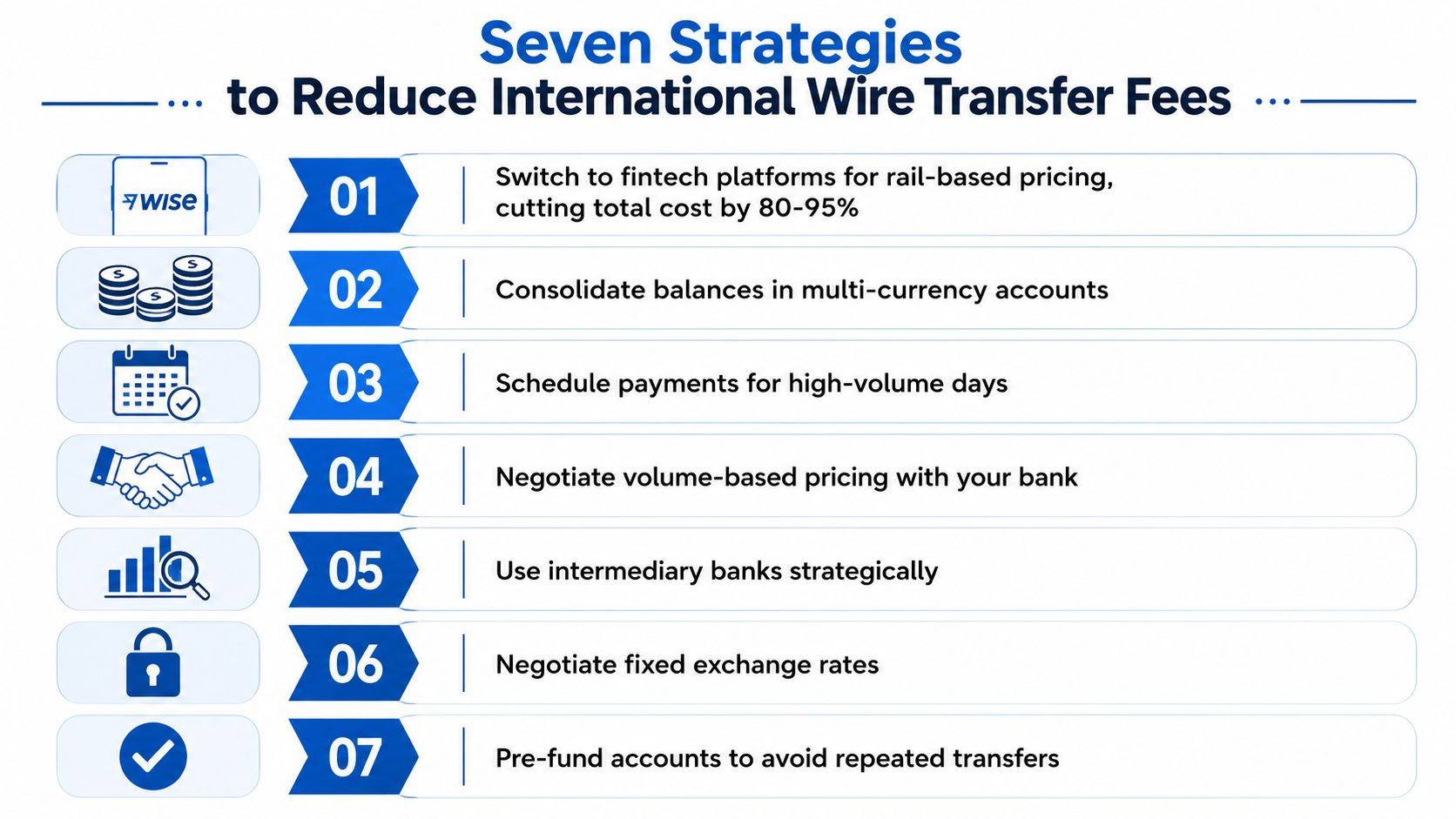
Negotiate once volume becomes meaningful. Ask the bank for a pricing review when monthly cross-border volume exceeds $250,000. Negotiate the visible fee, FX margin, intermediary treatment, and reporting support as one package. A lower wire fee alone leaves the larger cost leaks untouched.
Use local rails where they fit. SEPA, ACH, and Fedwire can be preferable to SWIFT when the corridor, currency, beneficiary account, and settlement requirement support them. Confirm the receiving format before changing the route. An incompatible rail creates failed payments, delays, and rework.
Schedule with operational discipline. Avoid sending at the last possible cut-off, and confirm how weekends, holidays, and urgent processing affect the quoted rate or delivery promise. Timing will not repair a poor FX spread, but it can prevent avoidable exceptions and expedited handling.
- Rate visibility: Is the applied exchange rate displayed before authorization?
- Route clarity: Does the quote identify the rail and possible intermediaries?
- Recipient certainty: Can you predict the amount the beneficiary will receive?
- Reconciliation: Will the platform return payment status and remittance data?
- Total economics: Does the provider show fixed fees and conversion costs together?
- Pull a live reference rate. Compare the current mid-market benchmark with the bank's quoted rate. Calculate the destination-currency difference, not just the apparent percentage.
- Request an itemized quote. Ask the sending bank to separate its outgoing charge, conversion rate, expected intermediary treatment, and any urgency or handling fees.
- Check the route. Use the beneficiary bank's SWIFT details and ask whether the bank expects to insert a correspondent institution. Don't assume the shortest-looking form creates the shortest route.
- Select the charge code intentionally. Confirm whether OUR, SHA, or BEN matches the commercial agreement and the amount the supplier must receive.
- Calculate the landed amount. Convert the principal at the quoted rate, subtract known deductions, account for receiver charges, and record the expected credited amount before releasing funds.
For a practical review of account structures that can reduce bank charges, consult this guide to banks with no wire transfer fees. Score each provider on these operating requirements:
Audit Your Next Wire in Five Minutes
The published wire fee is a marketing line. The actual cost lives in the route, the exchange rate, and the amount that reaches the beneficiary. A five-minute pre-flight check gives your team enough information to reject an expensive quote before the payment becomes irreversible.
Use this checklist:
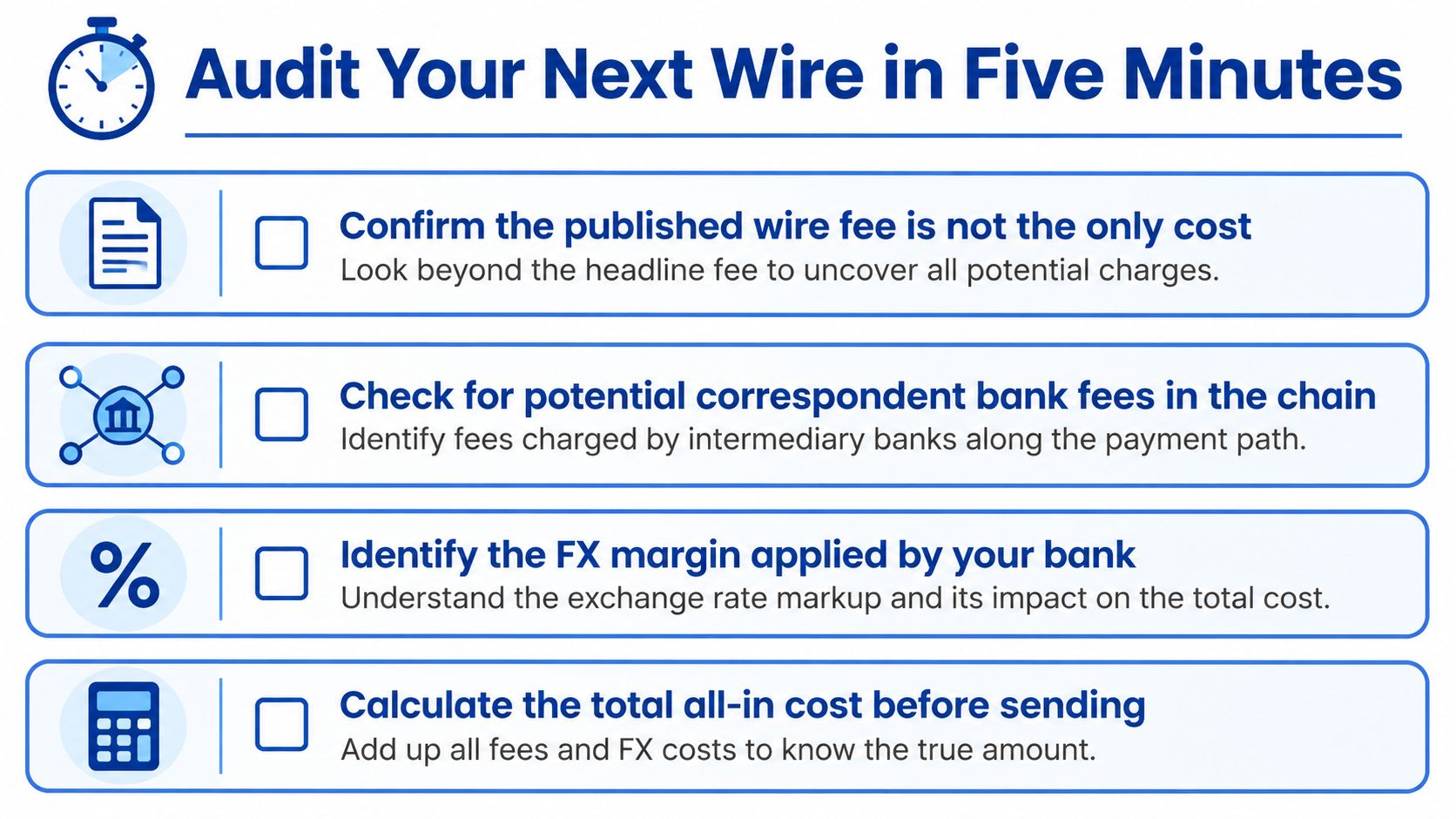
Approval standard: If your team can't explain the expected beneficiary credit in one line, the quote isn't ready for approval.
Run this process on the next payment, then save the result beside the bank confirmation. After several payment cycles, you'll have a corridor-level record of sender charges, intermediary deductions, FX gaps, and reconciliation exceptions. That evidence gives you the power to renegotiate, reroute payments, or adopt a multi-currency platform for recurring flows.
OneSafe offers multi-currency business accounts, global payment options, corporate cards, and fiat-to-crypto workflows through one interface, with published pricing for selected wire and FX services. Visit OneSafe to evaluate whether its account and payment structure fits your recurring international supplier and treasury flows.