The stablecoin industry has spent 2026 building faster rails for institutions, yet the people who might benefit most from stablecoin payments — freelancers, small importers, and remittance senders — are still treated as spectators. A new commentary from Deborah Tan-Pink, published in Asian Business Review on October 13, 2026, argues that the conversation loops between banks and protocol developers, rarely landing with the everyday user who actually needs cheaper cross-border money movement.
Table of Contents
- The Stablecoin Conversation Is Leaving Out the People Who Need It Most
- Why the Absence of Everyday Users Hurts Businesses Right Now
- What the Current Stablecoin Payment Landscape Gets Right and Wrong
- Closing the Gap: A User-Centric Model
- What to Watch Next in Stablecoin Regulation and Competition
- Summary Table: Key Facts and Options
- Key Takeaways
The Stablecoin Conversation Is Leaving Out the People Who Need It Most
Tan-Pink's commentary, “The stablecoin conversation is missing the everyday user,” is blunt: institutions mostly talk to each other, then at everyone else. Her point is not that the technology lacks product-market fit. It is that the go-to-market strategy — enterprise settlement, treasury use, bank-grade custody — leaves little room for the person sending $300 to a family member in Manila or a freelance developer invoicing a client in Singapore.
On paper, Asia should be the clearest market for adoption. The World Bank estimated that in 2024, East Asia and the Pacific received US$88 billion in remittances excluding China, while South Asia received US$207 billion. Yet the beneficiaries of those flows are still “left out of the conversation.”
The mismatch is starkest in corridors with high remittance volumes and fragmented banking access. Stablecoin rails can technically settle in seconds and cost less than a dollar in gas fees, but the last mile — getting local fiat into a recipient's hands — still runs through banks, money transmitters, and cash agents. When stablecoin products are built as institutional settlement tools, they do not connect to local cash-out networks.
Onboarding often requires an existing crypto wallet, private key management, or at minimum a threshold of risk tolerance that most small businesses and individuals do not have. Compliance costs are amortized over large clients, so serving the “long tail” of everyday users looks unprofitable on paper. Product teams optimize for the few large accounts rather than the many small ones. This echoes the broader pattern described in McKinsey's research on stablecoin payments infrastructure, which focuses heavily on institutional rails, with consumer use cases treated as a future phase.
Why the Absence of Everyday Users Hurts Businesses Right Now
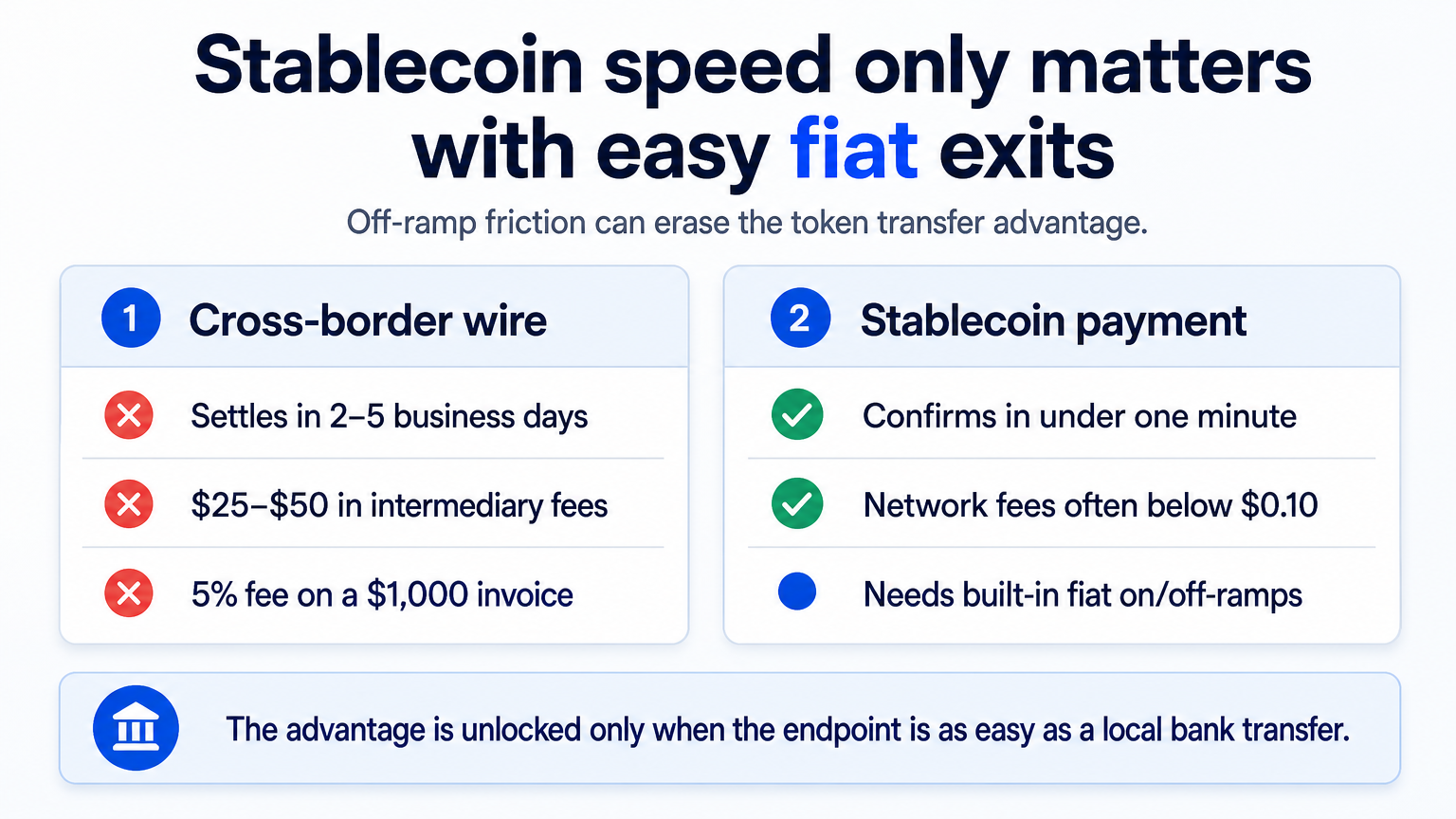
The absence of everyday-user products is not a future problem; it is a current cost. Cross-border payments via wire can take two to five business days, cost $25 to $50 in intermediary fees, and require full bank details, SWIFT codes, and intermediary banks. For a freelancer charging $1,000, that is a 5% fee and a week of float. A stablecoin payment settles in minutes, but only if both parties can move in and out of fiat without friction.
In principle, stablecoins remove three layers of cost: correspondent bank fees, foreign exchange spread, and settlement delay. But these benefits only materialize if the stablecoin can be spent, converted, or off-ramped easily. Without that bridge, the benefit is theoretical.
Even when a business is willing to accept stablecoins, the recipient often cannot. A supplier in Vietnam may not have a crypto exchange account, may not trust a self-custody wallet, and may not want to explain cryptocurrency on a tax return. Payment processors like Paystand report that stablecoin payments can cut cross-border fees by up to 90%, but only when both sides operate on the same integrated platform. If the recipient has to manually convert via a retail exchange, the savings evaporate in spread and hassle.
A USDC transfer from one wallet to another confirms in under a minute for network fees often below $0.10. But if the recipient then pays 1–2% to convert USDC to fiat on an exchange, withdraws to a bank, and waits one business day, the total cost and time may match a low-fee transfer service. The advantage is not in the token transfer itself; it is in the absence of intermediary banks. That advantage is only unlocked when the endpoint is as easy as sending a local bank transfer.
What the Current Stablecoin Payment Landscape Gets Right and Wrong
The institutional stack is impressive. Paxos, Circle, Fireblocks, and major banks have built robust stablecoin payment infrastructure with deep compliance integration. Visa and Mastercard now offer stablecoin settlement. Citi and Coinbase announced a checkout integration in October 2026, covered in our analysis of their new checkout product. But these are enterprise products requiring API integration, legal review, and often minimum volume commitments. A five-person agency cannot simply sign up and start paying a freelancer in USDC tomorrow morning.
The missing layer: seamless fiat-crypto financial operations
What the market lacks is a unified layer that handles both fiat banking and stablecoin payments in a single interface. A business stablecoin account should hold USD, EUR, and USDC together, pay a vendor via ACH or wire, and receive a stablecoin payment that automatically converts to fiat at settlement. This is where platforms like OneSafe position themselves. OneSafe is a financial technology company — not a bank — that provides multi-currency accounts, ACH and wire transfers, corporate cards, and USDC on/off-ramps. Its account structure covers fiat to crypto natively, with free USDC deposits and withdrawals, and crypto custody secured via Fireblocks. That kind of integration is what the everyday user actually needs: no private key management, no separate exchange account, no manual conversion.
OneSafe is one of a small number of neobanks and fintech platforms combining fiat banking with stablecoin on/off-ramps. It offers business accounts with multi-currency support (USD, EUR, CAD), ACH and international wires, bill payments, and free USDC deposits/withdrawals, all managed through a single dashboard. Traditional banks are exploring similar services, but most still operate through segregated crypto desks that preserve a hard line between fiat and digital assets.
Closing the Gap: A User-Centric Model
Practical steps businesses can take today without deep crypto expertise
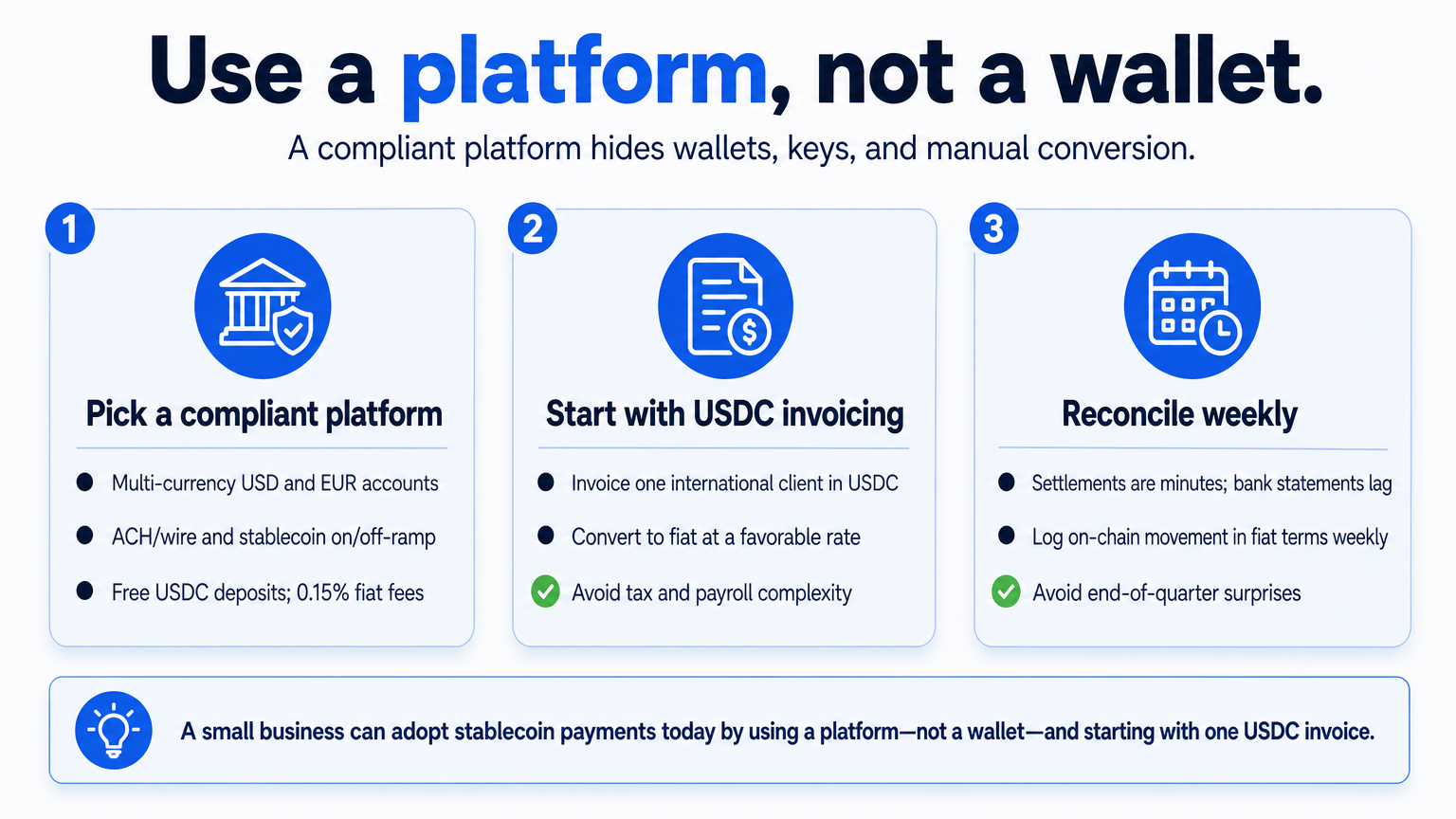
A small business does not need to become a crypto expert to start using stablecoin payments. The decision rule is simple: use a platform, not a wallet. A wallet requires you to manage private keys, understand gas fees, and handle custody. A platform handles all of that behind the scenes.
Step 1 — Pick a compliant platform with fiat and crypto in one account. Look for multi-currency fiat accounts (at least USD and EUR), ACH and wire transfer support, and a stablecoin on/off-ramp that settles to fiat automatically or with one click. OneSafe fits this pattern with free USDC deposits/withdrawals and 0.15% fiat deposit/withdrawal fees.
Step 2 — Start with invoicing in USDC, not payroll. Invoice one international client in USDC to test the flow. The client sends USDC to your platform account; you convert to fiat when the rate is favorable and withdraw to your local bank. This avoids tax and payroll complexity while still capturing the speed and cost benefit.
Step 3 — Reconcile weekly, not monthly. Stablecoin transactions settle in minutes, but bank statements may lag. Use the platform's transaction export or accounting integration to log every on-chain movement in fiat terms weekly. This keeps tax reporting manageable and avoids end-of-quarter surprises.
Why integrated compliance and custody are non-negotiable for mass adoption
Everyday users will not adopt stablecoin payments if they have to think about private keys, transaction hashes, or exchange counterparty risk. The path to mass adoption runs through integrated compliance and professional custody. Platform-level KYC/KYB means the user is verified once and can transact across both fiat and crypto without re-verification at every step. Professional custody (via partners like Fireblocks) removes the fear of losing funds to a phishing attack or a forgotten seed phrase. This is the difference between a product that a small business owner will actually use and one that only a crypto-native team will tolerate.
What to Watch Next in Stablecoin Regulation and Competition
Regulation is moving, but it is not yet built for the everyday user. The GENIUS Act and FASB's cash-equivalent proposal are steps toward clarity, but they are written with institutional balance sheets in mind. As discussed in our analysis of the FASB cash-equivalent proposal, treating stablecoins as cash equivalents could make them more attractive for corporate treasuries — but that says nothing about a sole proprietor's ability to accept USDC without tax complexity. The next regulatory phase must address consumer protections, disclosure requirements for stablecoin payment products, and anti-money-laundering rules that do not impose enterprise-grade burdens on micro-businesses. Stablecoin regulations should include calibrated KYC — identity verification sufficient for small transfers, escalating only at higher thresholds.
The fastest pressure for change may come not from regulators but from neobanks that treat fiat and crypto as a single product. When a small business can open an account in a week, receive USDC for free, and pay a vendor via wire from the same balance, the old model — separate bank and exchange — starts to look broken. The success of platforms like OneSafe (over $800 million in transaction volume from more than 1,000 businesses across 30+ countries, per company data) suggests demand is real. If that demand continues to grow, incumbent banks will be forced to offer similar integrated services or lose the small business stablecoin segment entirely. Our guide to neobank crypto for businesses maps this competitive dynamic in more detail.
Tan-Pink ends her commentary with uncertainty about the old institutional-first thesis. The gap is not in the technology but in the go-to-market. Stablecoin user experience must hide the blockchain — no wallets, no seed phrases, no gas fee anxiety. Fiat on/off-ramps must be built into the payment flow, not added as an afterthought. Compliance must be embedded and risk-tiered. Accounting tooling must import stablecoin activity natively. None of these are technical breakthroughs; they are product decisions.
Summary Table: Key Facts and Options
| Area | Current State | Recommended Path |
|---|---|---|
| Institutional adoption | Polished enterprise products (Paxos, Circle, Fireblocks); Citi–Coinbase checkout integration (Oct 2026) | Not portable to everyday users; requires API integration and volume commitments |
| Cross-border wires | 2–5 days, $25–$50 in fees, 5% cost on $1,000 invoice | Stablecoin transfer confirms in under 1 minute for <$0.10 network fee, if fiat endpoints are integrated |
| Remittance volumes | East Asia/Pacific: US$88B (2024, ex-China); South Asia: US$207B | Stablecoin rails could serve these flows if last-mile cash-out networks are connected |
| Platform option | OneSafe: multi-currency accounts (USD, EUR, CAD), ACH/wires, free USDC deposits/withdrawals, Fireblocks custody; $800M+ volume, 1,000+ businesses, 30+ countries | Use a platform, not a wallet; start with USDC invoicing before payroll |
| Fees (OneSafe) | Free USDC deposits/withdrawals; 0.15% fiat deposit/withdrawal | Avoids exchange conversion spreads of 1–2% |
| Compliance | Enterprise-grade KYC/AML burdens micro-businesses | Calibrated KYC with tiered verification; platform-level KYB covers both fiat and crypto |
Key Takeaways
- Stablecoin payments remain institution-to-institution, leaving freelancers and small businesses out of the product design loop, despite clear savings potential in cross-border remittances and invoicing.
- The last-mile problem — converting stablecoins to local fiat at the recipient's end — is the primary barrier, not the blockchain rails themselves.
- A small business can adopt stablecoins today by choosing a compliant platform with integrated fiat and crypto accounts, avoiding wallets and private key management entirely.
- Integrated compliance and professional custody are the non-negotiables for everyday-user adoption, not optional add-ons.
- The competitive pressure to serve everyday users will come from neobanks that unify fiat and crypto, not from incumbent banks or protocol-level solutions.
For a platform that turns this analysis into an account you can use, sign up at OneSafe.