
On October 12, 2026, the Central Bank of Russia added Sberbank to its authorized cryptocurrency exchange register under the country’s new digital asset rules, according to CoinGape. The state-controlled lender says its first crypto products will arrive December 1, 2026, through existing banking platforms. For business leaders watching the slow convergence of traditional finance and digital assets, this is more than a Russian headline: it is a measurable step in regulated crypto banking moving from experiment to infrastructure.
Table of Contents
- The Sberbank Approval: A Milestone for Crypto Banking
- Why This Matters Now for Global Business Leaders
- Background: Crypto Banking’s Slow Swing from Fringe to Mainstream
- Implications for Cross-Border Payments and Corporate Treasury
- Recommended Actions: Preparing Your Business for the Crypto Banking Era
- What to Watch Next: From Russia to the World?
- Key Takeaways
The Sberbank Approval: A Milestone for Crypto Banking
The reported fact is narrow. On October 12, 2026, CoinGape reported that Russia’s Central Bank had approved Sberbank to offer cryptocurrency exchange services under the country’s new digital asset regulations. Under Russia crypto regulation, the approval places Sberbank in an authorized register; reporting does not state it received a license for custody, lending, or all-purpose crypto banking services. That distinction matters, because “crypto exchange services” and “crypto banking” are not the same.
What it does signal is that a systemically important state bank now has a sanctioned path to handle digital asset trading for its customers. Previous coverage of Sberbank’s crypto ambitions pointed toward this moment; the October 12 decision converts intention into regulatory standing. For context, see Sberbank’s Crypto Banking Win: What It Signals.
Sberbank plans to introduce its first crypto products on December 1, 2026, through existing banking platforms, according to the same reporting and AIBC World. That is operationally significant: the bank is not building a standalone consumer app from scratch. It is attaching digital asset exchange capability to platforms customers already use. For businesses, that distribution choice compresses the time it takes for crypto access to feel ordinary. It also suggests first products will be basic exchange functions, not a full corporate treasury suite. The Sberbank crypto exchange approval is thus a regulatory milestone, not a product launch.
The analytical read is that a major state bank entering digital asset exchange marks a shift in institutional acceptance. It does not mean Russia’s rules map cleanly to other jurisdictions, and it does not erase sanctions or compliance concerns. But it tells founders and finance leads that regulated crypto services are being folded into domestic banking systems.
Why This Matters Now for Global Business Leaders
Crypto banking has moved from niche to infrastructure. Sberbank’s approval comes from the center of a national banking system, changing the question from “can a bank offer crypto?” to “which banks will be left behind?” The trend is not limited to Russia. Partnerships like Fibank’s move with Bitpanda show incumbents in other markets testing crypto banking through regulated partners; see Crypto Banking: Fibank’s Bitpanda Partnership, Explained.
The real impact is on corporate treasury, not retail speculation. If major banks offer digital asset exchange, corporate treasurers gain more on-ramps and off-ramps, reducing friction in paying contractors in stablecoins, holding multi-currency balances, or converting revenue between fiat and crypto. The Sberbank decision does not by itself give global businesses a new treasury tool, but it adds another signal that business crypto banking is becoming standard infrastructure for global business banking.
For startups and DAOs, the practical consequence is that the gap between traditional banking and crypto-native treasury is narrowing. Teams that manage both fiat and digital assets on a unified platform have an operational template. Teams that still hold crypto in one place and fiat in another will face rising costs and slower execution as the market matures. DAO banking needs only widen that gap.
Background: Crypto Banking’s Slow Swing from Fringe to Mainstream

Crypto banking generally refers to financial services that let customers hold, move, convert, or transact in both fiat currency and digital assets. NerdWallet describes it as banking-like services that connect traditional money and cryptocurrency. The term is loose: a crypto exchange is not automatically a bank, and a bank that offers crypto exchange is not necessarily a full crypto bank.
At the business level, crypto banking services typically include multi-currency fiat accounts, crypto custody or exchange access, fiat-to-crypto conversion, cross-border payments, and corporate cards. They do not always include lending, interest-bearing accounts, or deposit insurance. Many fintech platforms that describe themselves as a neobank for crypto are technology companies using partner banks; they are not licensed banks themselves. That affects how funds are held and what happens in a failure.
The regulatory arc is clear: early crypto banking was built outside banking regulation, then regulators licensed specialized digital asset banks, and now they are approving existing banks to offer crypto services. Infrastructure includes banking-as-a-service and custody providers, as Lightspark explains in its overview of crypto banking as a service. What is new is the speed at which a state bank can enter once the regulatory switch flips.
Consumer crypto banking is about buying and selling bitcoin or stablecoins with a simple app. Business crypto banking—and DAO banking—is different: multi-currency accounts, payable and receivable workflows, payroll, tax reporting, and treasury controls. Sberbank’s first products will likely look more like retail exchange services; the business opportunity is adjacent.
Safety depends on structure, not the word “crypto.” Core risks are custody, counterparty solvency, regulatory status, and operational security. Institutional services mitigate some risks by using regulated custodians and compliance controls; Sygnum, for example, operates as a regulated digital asset bank with custody and banking services. But regulatory approval is not zero risk. The practical test for corporate funds: who holds the assets, what happens if the intermediary fails, and whether the platform separates operational funds from custody.
Implications for Cross-Border Payments and Corporate Treasury
The most direct implication of a major state bank entering crypto is that regulated crypto rails become harder to ignore for international payments. Crypto-based settlement can move value across borders without the correspondent banking chain that slows wires. If more banks offer exchange services, more endpoints can convert fiat to crypto and back. That does not mean every cross-border payment will suddenly run on-chain; compliance, liquidity, and regulatory fragmentation remain real.
Large banks bring deep liquidity and perceived trust. A state bank entry gives the local market a sanctioned venue for fiat-to-crypto conversion, and businesses that previously avoided crypto due to banking risk may reconsider. That shift can increase stablecoin payment volume and make settlement more reliable. But liquidity and trust are local; a Russian bank’s approval does not create a global payment rail.
The longer-term picture is a hybrid system: fiat accounts for balances, stablecoins for settlement, and bank-grade on/off-ramps at the edges. That is already visible in experiments around USDT and SWIFT-style hybrid flows, as explored in Web3 Payments Go Hybrid: Russia’s USDT-SWIFT Gambit. A regulated exchange at a major bank makes that hybrid model more practical for cross-border suppliers, contractors, or subsidiaries.
For a startup or DAO managing USD payroll alongside stablecoin payments, the worst operational position is a fragmented stack: one bank for fiat, one exchange for crypto, manual conversions in between. As crypto banking matures, that fragmentation becomes more expensive. A Web3 treasury with multi-currency needs can use platforms that handle fiat and crypto in one place. For a practical look at how treasury tools are evolving for tokenized operations, see Crypto Treasury Management Must Evolve for Tokenized Future.
Recommended Actions: Preparing Your Business for the Crypto Banking Era
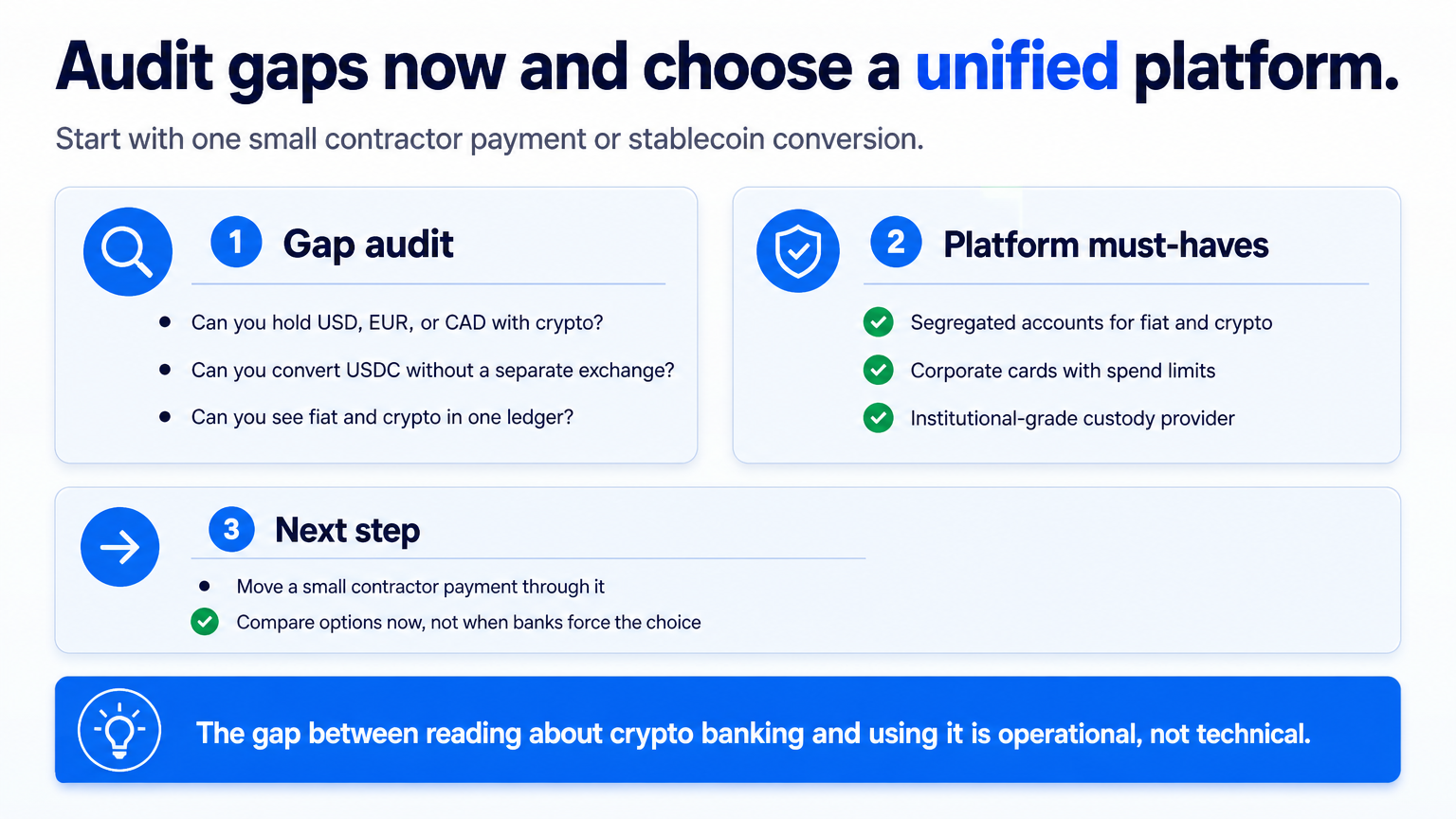
A business can start by choosing a platform that supports both fiat and crypto natively, completing onboarding with standard business documents, and moving a small portion of operational flow—such as a contractor payment or stablecoin conversion—through it. The gap between reading about crypto banking and using it is operational, not technical.
Before adding anything, run a gap audit. Can you hold USD, EUR, or CAD in segregated accounts alongside crypto? Can you convert USDC to fiat without a separate exchange? Can you send international wires or crypto payments from one interface? Do you have role-based permissions and automated payment workflows? Can you see fiat and crypto activity in one ledger? If the answer is no, look for a business-focused platform.
Evaluate platforms built for business crypto banking, not personal trading apps. Look for segregated accounts, fiat and crypto payment rails, corporate cards with spend limits, and custody through an institutional-grade provider. Fees should be evaluated against workflow cost. OneSafe, a financial technology company that provides neo-banking services through partner banks, is one example: it supports fiat and crypto transactions, corporate cards, and on/off-ramps, built for Web3 startups, DAOs, and global businesses. It is not a bank, but it represents the category of unified business crypto banking tools that Sberbank’s move indirectly validates.
Don’t wait for your local bank to announce a crypto service. The infrastructure for business crypto banking exists today. The Sberbank approval should prompt you to compare options, not sit still.
What to Watch Next: From Russia to the World?
Once a state bank receives formal approval, other domestic institutions often follow. Expect Russian banks with large retail bases to seek similar authorization, and regulators elsewhere to note the template. The useful question is which jurisdictions will move next and whether they will permit stablecoin settlement as well as exchange.
The Sberbank reporting does not answer several questions that matter for international businesses. Will the platform support stablecoin-based payments or only exchange of crypto assets? How will sanctions and correspondent banking relationships affect access for non-Russian companies? Will the central bank’s register eventually include custody, settlement, or cross-border payment services? These are open questions, not obstacles. Businesses should watch for explicit statements from the Central Bank of Russia and Sberbank, rather than assuming the December 1 launch will include everything.
If Sberbank’s entry is followed by explicit approval for stablecoin settlement or corporate crypto accounts, it could push other jurisdictions to move faster. No finance team wants to be the last to access a faster, cheaper settlement rail. That dynamic—not ideology—is what tends to accelerate regulatory competition. For a deeper look at how stablecoin accounting and treasury rules are changing, see Stablecoin Regulation: FASB’s Cash-Equivalent Proposal.
Key Takeaways
- On October 12, 2026, Russia’s Central Bank approved Sberbank to offer cryptocurrency exchange services, with first products planned for December 1, 2026.
- The approval is a regulatory signal that crypto banking is moving from startup niche to incumbent infrastructure, even if the first products are exchange-focused.
- The biggest practical impact is on business crypto banking and cross-border payments, not retail speculation.
- Finance teams should audit their crypto-fiat gaps now and test a unified platform before local banks force the choice.
- Watch for stablecoin, sanctions, and international access details; those will determine whether Sberbank’s move becomes a global catalyst or a local story.
Ready to put your business on a crypto banking platform built for global operations and DAOs? Open a OneSafe account today.