Open a Business Bank Account with No Minimum Balance
Opening a no-minimum business account now means you can get a business checking no minimum balance account entirely online, with multi-currency and crypto support. CNBC (Sept 24, 2026) reports online banks offer free business checking with no minimum balance as part of a digital shift. Forbes (Sept 29, 2026) notes online banks lead in customer satisfaction and fee transparency. The real leap is platforms that fuse fiat, crypto, and standard payment rails in one dashboard, eliminating the need to juggle multiple providers.
Table of Contents
- What It Means to Open a Business Account with No Minimum Balance
- The Traditional Path: How Legacy Banks Handle No‑Minimum Accounts
- The Modern Alternative: Neo‑Banking Platforms and Crypto‑Native Finance
- How to Open a Business Bank Account Online with No Minimum Balance
- Features That Go Beyond Free Checking
- Security
- Common Misconceptions
- Limitations and Next Steps
- Key Takeaways
- Sources
What It Means to Open a Business Account with No Minimum Balance
A business bank account separates company funds from personal assets, supporting payments, payroll, and cross-border transfers. It can sit with a chartered bank or a fintech platform that partners with banks for the same core services. A true no-minimum, no-fee business checking account keeps working capital free—no dead deposit needed to avoid monthly fees. For a Web3 startup or DAO that holds treasury in stablecoins, a zero-balance threshold eliminates constant fiat top-ups.
The Traditional Path: How Legacy Banks Handle No‑Minimum Accounts
Traditional banks ask for government-issued ID, formation documents, EIN (for US entities), and sometimes a business license. Non-US founders often face in-person requirements. Many accounts advertise $0 to open but impose a minimum daily balance—PNC’s basic business checking, for example, waives its $10 monthly fee only with a $1,500 average collected balance. A truly free business checking no minimum balance account (no monthly fee, no balance hang) is rare at brick-and-mortar institutions. NerdWallet’s roundup of best free business checking highlights digital-first and credit union options.
The Modern Alternative: Neo‑Banking Platforms and Crypto‑Native Finance
Neobank business accounts live entirely online. The lack of physical branches means faster onboarding, transparent pricing, and multi-currency support with built-in FX. Platforms like OneSafe add crypto custody directly—a DAO can hold USD, EUR, CAD, receive ACH, pay a contractor via SWIFT, and convert USDC to fiat inside one dashboard. Onboarding takes under 10 minutes; KYB checks run digitally, with approval typically within days, not weeks. See neobank accounts for global fiat and crypto enterprises.
How to Open a Business Bank Account Online with No Minimum Balance

- Prepare documents: formation certificate (LLC, incorporation, DAO wrapper), government-issued photo ID for each beneficial owner, EIN for US entities. Non-US entities need registration documents and passports.
- Complete the online application: enter business details, upload documents, and designate owners. Compliance checks run digitally. Some platforms let you configure multi-signature permissions later.
- Activate and fund: once approved, you get segregated account details for the currencies you need. Initial deposit can be $0. Pay vendors, issue virtual cards, and convert currencies immediately—no ongoing minimum balance. For an LLC-specific walkthrough, see our neobank workflow guide.
Features That Go Beyond Free Checking
Unified fiat and crypto: receive USDC on-chain, then convert to USD for payroll—no separate exchange. The reverse works too: off-ramp stablecoins when it suits your treasury. Multi-currency accounts: hold, receive, and pay out in USD, EUR, CAD (more planned). FX costs are 0.25% or the prevailing rate; wire fees are $25 outgoing, $10 incoming, SWIFT 0.35% + $50. USDC transfers are free. DAO-friendly controls: assign roles (Treasury, Trusted) with custom spending limits and multi-approval workflows—native governance, not a consumer account rebadged. Global payments transparently priced: ACH, domestic and international wires, plus corporate cards (3% foreign exchange fee). All fees are published; no hidden blended FX markups.
Security
Digital assets are held with Fireblocks, a qualified custodian using MPC-based key management and hardware isolation. Fiat balances sit in segregated accounts at partner banks. Multi-factor authentication is mandatory. Crypto assets are not FDIC insured; the security model guards against unauthorized access and platform failure, not market risk. For more on custody models, see the digital asset banks guide.
Common Misconceptions
- “No minimum balance means no fees”: transaction, wire, and FX fees still apply. A zero balance simply avoids a monthly penalty. Compare total cost.
- “Neobanks are less secure”: security depends on custody and encryption, not branch count. Fireblocks-grade custody and segregated fiat accounts often exceed small-bank IT.
- “You need a U.S. Social Security Number”: a US entity needs an EIN, and beneficial owners provide a passport—no SSN required. Global platforms accept foreign tax IDs.
Limitations and Next Steps
OneSafe is not a bank; it doesn’t offer loans, credit lines, interest-bearing deposits, or FDIC coverage on fiat (though fiat is held at insured partner banks). It’s unavailable in OFAC-sanctioned countries and certain US states. If you need a branch for cash deposits, a fintech-only setup won’t suit you.
Checklist:
- You operate in multiple currencies or settle in stablecoins.
- You want to open a business bank account online without visiting a branch.
- Your team is distributed and needs role-based permissions.
- You prefer transparent per-transaction fees over opaque monthly charges.
- You don’t need lending or credit products from the same provider.
Gather formation documents and ID, choose a platform that publishes fees and separates digital asset custody, and apply. The value is in no longer holding a balance just to avoid a fee.
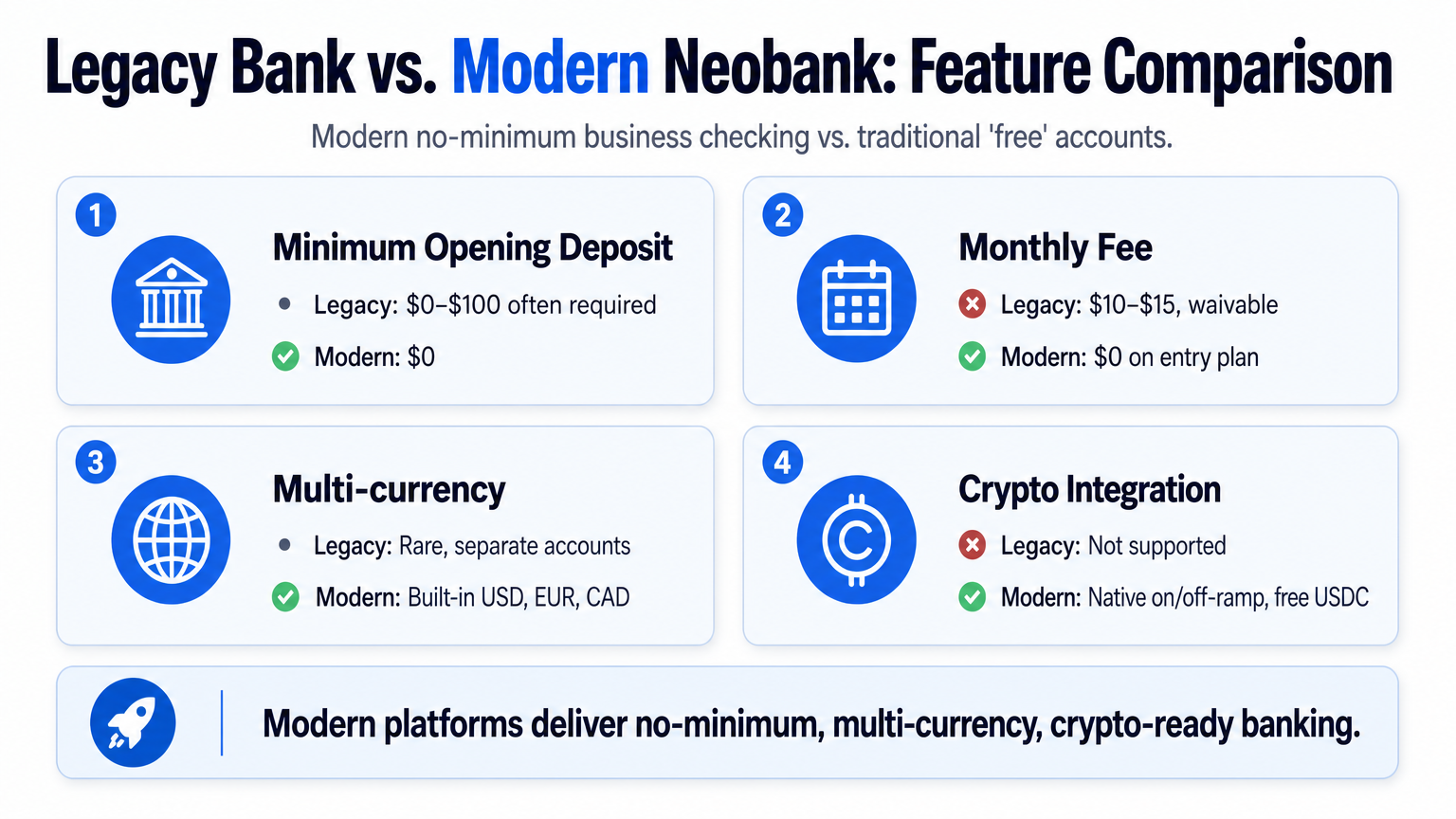
| Feature | Typical Legacy Bank “Free” Checking | Modern No‑Minimum Neobank Platform |
|---|---|---|
| Minimum opening deposit | $0–$100 often required; balance requirements to waive fees | $0 |
| Monthly maintenance fee | $10–$15, waivable with avg. balance or activity | $0 on entry plan; premium tiers from $29/mo |
| Multi-currency sub-accounts | Rare, separate foreign-currency accounts needed | Built-in: USD, EUR, CAD (more planned) |
| Crypto integration | Not supported | Native on/off-ramp, free USDC transfers |
| Onboarding time | Days to weeks, often in-branch | Digital, typically within a week |
| Wire fees | Variable, often $25–$45 | $25 outgoing, $10 incoming |
| FX rate | Hidden markups common | 0.25% or prevailing rate, clearly stated |
| DAO/governance controls | No | Customizable roles and permissions |
| Digital asset custody | None | Fireblocks custody, MFA enforced |
Key Takeaways
- “No minimum balance” doesn’t mean no fees—assess total cost: wire charges, FX spread, crypto conversion.
- A neobank that handles both fiat and crypto eliminates separate bank and exchange relationships.
- DAOs and Web3 startups gain treasury controls (multi-approval, roles) not possible in legacy business checking.
- Onboarding is fully digital, often completed within a week with formation papers and ID.
- Verify that digital assets are held by a qualified custodian; enforce MFA on all accounts.
If your business spans borders or blockchains, explore how OneSafe streamlines global fiat and crypto operations.
Sources