Table of Contents
- Executive Summary: What a Digital Asset Bank Means for Business in 2026
- What is a digital asset bank?
- How Digital Asset Banking Works
- Options and Approaches for Businesses
- Practical Implementation
- Mistakes, Myths, and Limitations
- The 2026 Outlook
- Next Steps
- Key Takeaways
Executive Summary: What a Digital Asset Bank Means for Business in 2026
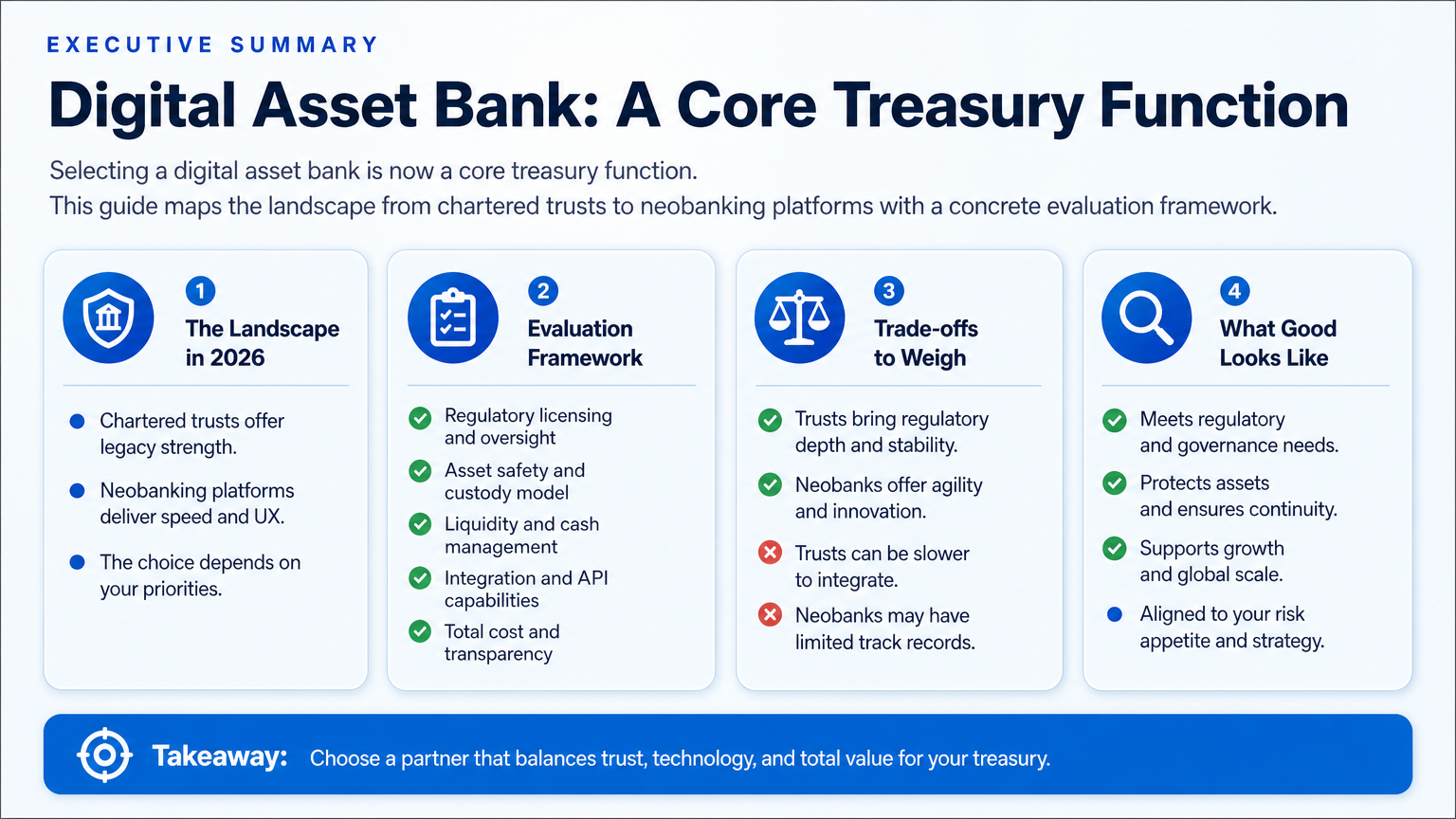 Selecting a digital asset bank is now a core treasury function. This guide maps the landscape from chartered trusts to neobanking platforms with a concrete evaluation framework.
What is a digital asset bank?
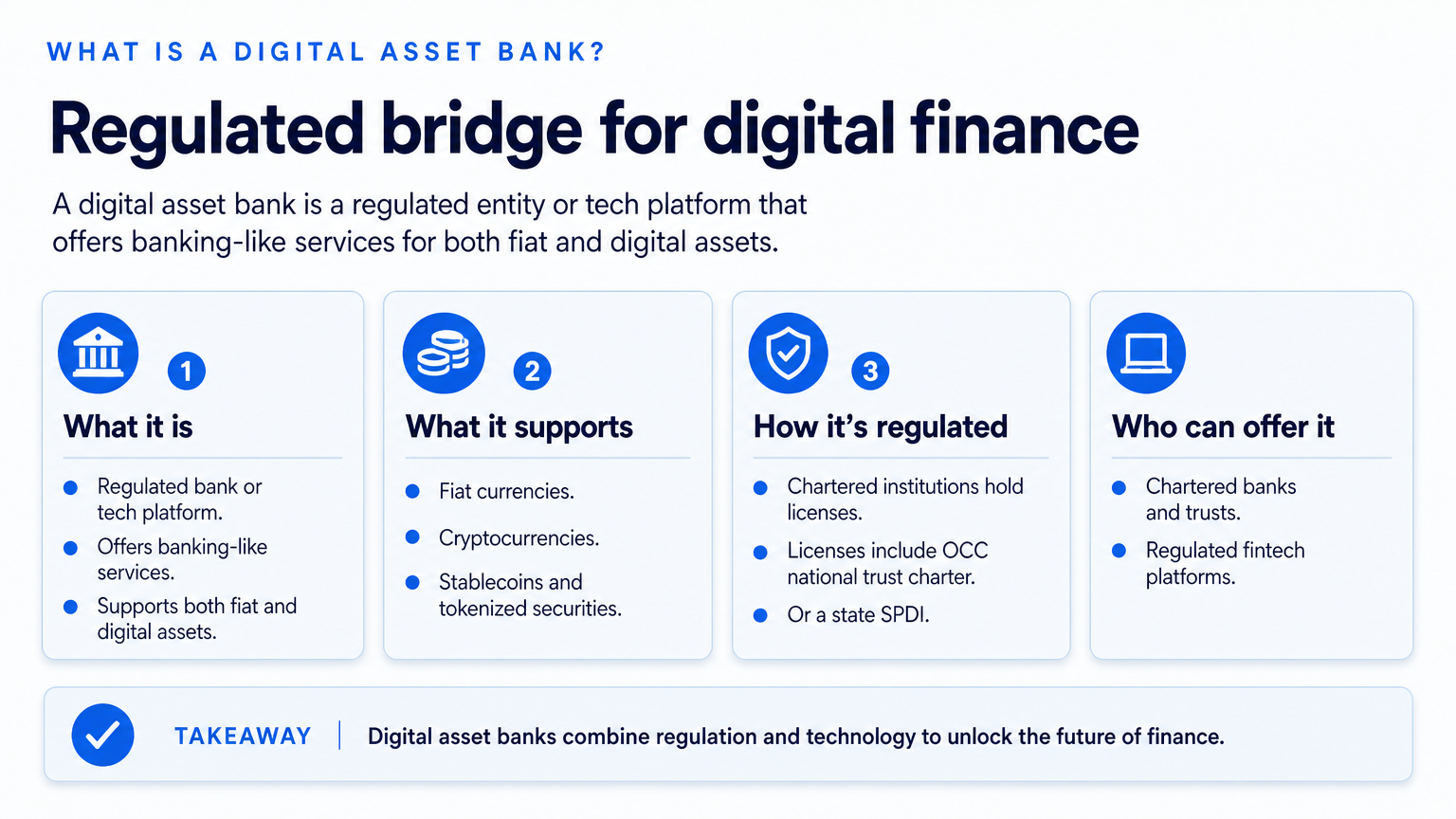 A digital asset bank is a regulated entity or tech platform that offers banking-like services for both fiat and digital assets (cryptocurrencies, stablecoins, tokenized securities). Chartered institutions hold licenses like an OCC national trust charter or a state SPDI; fintechs integrate with licensed banks to deliver custody, payments, and accounts. All provide a unified interface with compliance built for digital asset risks.
How does it differ from a traditional bank?
Traditional banks rely on FDIC deposit insurance and well-defined resolution. Digital asset banks add cryptographic key management, blockchain interactions, and segregation of on-chain assets. FDIC insurance does not cover digital assets—safety depends on the custodian’s tech, controls, and insurance, not a federal backstop.
Digital Asset Bank vs. Neobank
A digital asset bank may hold a charter (e.g., Anchorage Digital) or partner with banks. A neobank is tech-first and usually unlicensed. Some neobanks now include crypto rails (e.g., OneSafe), blurring the line. The distinction affects regulatory protection and how assets are handled.
Services offered
- Custody & wallets: segregated, multi-signature institutional wallets
- Fiat on/off ramps: instant USD, EUR, stablecoin conversions
- Multi-currency accounts: hold and transact in fiat and crypto under one roof
- Payment rails: ACH, wires, crypto-native settlement
- Corporate cards: real-time conversion between fiat and crypto
- Compliance: automated KYC/KYB, transaction monitoring, travel rule
The Spectrum of Services
Pure custodians like Fireblocks or BitGo secure assets and integrate with banking partners. Chartered crypto business banks (Anchorage Digital) offer qualified custody, fiat accounts, and payments. Crypto-neobanks (OneSafe) bundle partner-bank fiat, Fireblocks custody, and operational tools. Match service breadth to complexity: a DAO paying contributors needs multi-sig treasury; a startup might only need a simple on‑ramp.
How Digital Asset Banking Works
Safety
Safety is a function of charter type and custody architecture. No FDIC insurance covers crypto, but platforms using Fireblocks’ MPC, hardware security modules, and theft insurance can provide robust protection. Chartered trust banks add capital and audit requirements. The risk is manageable with thorough evaluation.
Security and Compliance
- Cold storage & MPC: majority of funds offline with distributed signing
- Multi-factor auth & access controls: role-based limits, approval workflows
- Real-time compliance screening: blockchain analytics before settlement
- Audited smart contracts: if on-chain components are used
Regulations
The U.S. patchwork is converging. A digital asset bank might operate under:
- State trust license (e.g., Wyoming SPDI)
- OCC national trust charter — conditionally granted to three firms on Sept 18, 2026 (OCC announcement)
- Money transmitter licenses for non-bank crypto payments
Internationally, the EU’s MiCA and frameworks in Singapore, Japan, and Hong Kong are raising standards. The OCC’s conditional approvals mark a shift toward federal trust banks as the benchmark for institutional services.
Technology Stack
Digital asset banking layers core banking ledgers, blockchain nodes, and a custody layer. On Sept 24, 2026, IBM announced Swift ledger integration for tokenized deposits and on‑premises Digital Asset Haven. Two days earlier, Oracle expanded its Digital Assets Data Nexus with ISO 20022, Swift Ledger, and AI risk analysis. These moves let traditional banks offer tokenized money on existing infrastructure.
Options and Approaches for Businesses
Institution-Focused Crypto Banks (e.g., Anchorage Digital)
Chartered trust banks offer qualified custody, fiat accounts, and staking for institutions. High regulatory assurance comes with higher minimums and longer onboarding.
Blockchain-Native Accounts (e.g., Telcoin)
Mobile-first, blockchain-native apps focus on remittances and user-owned financial identities. Suited for consumer-facing on‑chain businesses.
Neobanking Platforms (e.g., OneSafe)
For global businesses, startups, and DAOs, OneSafe provides a unified operating system: partner-bank fiat accounts (USD, EUR, CAD), Fireblocks custody, corporate cards, and automated workflows. It has processed $800M+ across 1,000+ businesses in 30+ countries, with onboarding typically within a week. DAOs get customizable roles, multi‑sig treasury, and on‑chain bill payments. Not a chartered bank, but it eliminates fragmentation.
DIY via Custodial Solutions and Banking Partners
Manually combining a qualified custodian and a crypto-tolerant bank offers maximum flexibility but demands in‑house expertise for reconciliation, compliance, and operations.
Fees
Compare total cost using all expected transaction types. Below is a representative comparison based on public data.
| Pricing Component | Traditional Bank + Custodian | Neobanking Platform (e.g., OneSafe) | Chartered Trust Bank |
|---|---|---|---|
| Account opening | Varies; often free but requires in‑person | Free ($150 early access) | Higher minimums |
| Monthly maintenance | $0–$50+ | $0 (free plan) or $29+/month | Typically higher |
| Fiat deposit/withdrawal | Free or $0–$15 | 0.15% | Negotiable |
| Wire transfer (domestic) | $15–$30 outgoing | $25 outgoing, $10 incoming | Negotiable |
| SWIFT transfer | $30–$50 + FX spread | 0.35% + $50 | Varies |
| Crypto deposit/withdrawal | Not typical; separate custodian | USDC free | May charge bps |
| FX conversion | 1%–3% spread | 0.25% or FX rate | Negotiable |
| Corporate card FX | 1%–3% | 3% | Varies |
| Hidden costs | Compliance reviews, minimum balance | Early access fee if applicable | Opaque setup & custody fees |
The hidden cost is operational complexity. In a DIY setup, your finance team’s time reconciling platforms is the real expense.
Unified Fiat and Crypto
Yes, a modern blockchain banking platform shows USD, EUR, crypto, and stablecoins side by side with instant conversion. Avoid banks that “add a crypto wallet” as a separate silo—look for native ledger integration.
Eligibility
- Legal entity (LLC, corp, DAO with wrapper)
- Government‑issued IDs, formation documents
- U.S. EIN; not in OFAC‑restricted jurisdictions
- Transparent UBO structure
Global startups and DAOs often face hurdles with traditional banks; platforms like OneSafe are built for them and support DAO treasury management.
Practical Implementation
Opening an Account
- Prepare docs: registration, EIN, operating agreement, ID for controllers
- Submit digital application (business model, volumes, crypto touchpoints)
- Complete KYB/KYC (may include video verification)
- Integrate, set roles, test small transactions
- Migrate balances and route payments
OneSafe can onboard within a week; chartered banks may take weeks. Clean, transparent documentation avoids delays.
5‑Step Evaluation Framework
- Regulatory clarity: charter or bank partner, jurisdiction
- Custody architecture: key holders, insurance, independent audit
- Asset coverage: fiat/stablecoins supported, instant conversion
- Operational fit: DAO support, multi‑sig, role permissions
- Total cost of ownership: model all fees for 12‑month projected volume
Common Pitfalls
- Assuming acceptance: not all crypto‑friendly banks accept every business; disclose full activity early.
- UBO for DAOs: DAOs need identified individuals; obtain a legal wrapper if necessary.
- Skipping tests: always test with a small payment before moving large balances.
Mistakes, Myths, and Limitations
- “FDIC insured” — Digital assets are never FDIC insured. Safety derives from custody and insurance, not deposit guarantees.
- “Only for crypto‑native companies” — 75% of U.S. banks now have digital asset programs. E‑commerce firms can use stablecoin payments to cut card fees.
- “Onboarding is instant” — Business KYB takes days to weeks; plan accordingly.
- “All providers support DAOs and multi‑sig” — Only a few platforms (like OneSafe) offer role‑based permissions, on‑chain multi‑sig, and automated payroll. Most chartered trust banks do not yet serve unincorporated DAOs.
The 2026 Outlook
IBM and Oracle Pave the Way
IBM’s Swift integration and on‑prem Digital Asset Haven, plus Oracle’s ISO 20022 and AI‑driven Data Nexus, mean traditional banks can operationalize digital money without a forklift upgrade. Within two years, the line between a digital asset bank and a regular business bank will blur as most mid‑sized banks offer tokenized money services.
OCC’s Conditional Approvals
The OCC’s conditional national trust charters on Sept 18, 2026 extend the vision of the Digital Asset Banking Act of 2026. A national trust charter now signals a higher, more consistent compliance bar—though custody due diligence remains essential.
With 75% of Banks Active, What’s Next?
Competition will lower fees and increase noise. The differentiator will be how well a platform integrates fiat and crypto without manual work. Expect the next wave to focus on stablecoin ramps and real‑time settlement, reducing reliance on correspondent banking for cross‑border payments.
Next Steps
- Audit payment flows for stablecoin opportunities.
- Clarify regulatory exposure and document tax treatment.
- Pilot a unified platform like OneSafe to test fiat‑crypto operations with real data.
- Monitor federal charter developments for expanded custody options.
Key Takeaways
- A digital asset bank spans OCC‑chartered trusts to fintechs with bank partners; no FDIC coverage for crypto forces reliance on custody technology and insurance.
- IBM and Oracle infrastructure moves signal that traditional banks will soon absorb digital asset services—making integrated platforms the efficient choice today.
- Evaluate providers on total operational cost, not just fees; pilot before scaling.
Explore a unified fiat and crypto account designed for global businesses at OneSafe.