Samsung Stablecoin Payments Put USDC on 82M Phones—Now What?
On October 11, 2026, TechBullion reported that Samsung plans to add USDC transfers on Solana to its Wallet for eligible U.S. Galaxy users—putting stablecoin payments in front of up to 82 million devices. The launch window is the last week of October, and it immediately changes the calculus for any business that moves money across borders. A consumer mobile wallet that ships with a Solana-based USDC on-ramp doesn’t just normalize crypto payments; it puts a settlement rail inside a device that already handles boarding passes, loyalty cards, and everyday checkout. For global startups, Web3 teams, and DAOs, the question isn’t whether stablecoin payments are coming—it’s whether their back-office infrastructure can accept, convert, and bank those flows without fragmenting across five platforms.
Table of Contents
- What Just Happened: Samsung Puts Stablecoin Payments in 82M Pockets
- Why This Matters for Business Adoption of Stablecoin Payments
- The Background: Stablecoin Payments Before the Samsung Signal
- Concrete Implications: What Global Businesses and DAOs Should Do Now
- Is my business ready for stablecoin payments after Samsung’s move?
- How do I launch a stablecoin payments strategy that connects to my fiat operations?
- What does the Samsung USDC wallet mean for cross-border settlement speed and cost?
- Which banking platform lets me hold and move both USDC and multi-currency fiat in one place?
- What to Watch Next and Open Questions
- Key Takeaways
What Just Happened: Samsung Puts Stablecoin Payments in 82M Pockets

The USDC-on-Solana launch window and geographic reach
According to the October 11 TechBullion piece, Samsung Wallet and Samsung Pay will support USDC on Solana, with the feature expected for eligible U.S. Galaxy users in the last week of October 2026. The Solana Foundation describes distribution across up to 82 million eligible Galaxy devices, with cross-border transfers to recipients in more than 60 supported destinations. That means a U.S. user could send USDC on Solana to a recipient in, say, Mexico or the Philippines directly from their phone’s native wallet, potentially bypassing traditional correspondent banking chains. For more on the announcement itself, see OneSafe’s initial breakdown.
This is not a crypto-exchange app buried in a submenu. It sits inside Samsung Wallet, the same surface users already tap for Samsung Pay at retail. Integrating USDC on Solana at the OS level (or as a preloaded wallet update) removes the largest adoption hurdle for stablecoin payments: the friction of downloading a separate crypto app and managing seed phrases.
Remittix’s PayFi pilot turns crypto payouts into bank-account settlements
The same TechBullion report highlights Remittix’s PayFi product, which has entered testing for 1,000 invited RTX holders. PayFi is designed to convert supported crypto into fiat delivered to compatible bank accounts, with initial EUR and USD routes, ahead of its token debut on November 24, 2026. Remittix flips the Samsung use case on its head: while Samsung puts a stablecoin sender in consumers’ pockets, Remittix builds a consumer→bank-account off-ramp that mirrors a remittance corridor. Together, they signal that both the front-end (sending) and back-end (converting to bank deposit) pieces of the stablecoin payments stack are maturing almost simultaneously.
Why This Matters for Business Adoption of Stablecoin Payments
Closing the gap between on-chain value and everyday checkout
Stablecoin payments have long been a B2B and treasury tool, moving millions in value between institutions that understand on-chain settlement. What’s missing was the consumer interface—the moment when a dollar-pegged token becomes as easy to send as a text message. The Samsung Wallet USDC integration closes that gap. A freelancer in Argentina can now receive USDC directly from a U.S. client’s Samsung phone; an e-exporter can embed a QR-code USDC payment option knowing millions of potential shoppers already hold a wallet that speaks Solana stablecoin.
For businesses, this shifts stablecoin settlement from a niche crypto-native option to a consideration in mainstream payment-mix planning. It’s not just about lower fees; it’s about meeting customers where they already transact—now including inside their default smartphone wallet.
When 82 million phones become a stablecoin rail: volume and settlement implications
Distribution matters in payments. U.S. Galaxy devices numbering in the tens of millions represent a installed base that dwarfs the total monthly active wallets of most DeFi protocols. Even a modest conversion rate—say, 5% of eligible users trying a USDC transfer in the first quarter—would produce a volume of cross-border stablecoin flows that quickly surpasses many existing remittance corridors. Each transfer that settles on Solana instead of SWIFT represents near-instantaneous finality and a fee measured in fractions of a cent rather than the $25–$50 typical of a cross-border wire. The Mastercard stablecoin payments primer notes that stablecoins can “unlock real-time, low-cost value transfer” without the delays of traditional banking batches. When that capability lands inside Samsung Wallet, the volume signal becomes loud enough that payment processors and SME gateways will need to support receiving and settling USDC on Solana natively.
The Background: Stablecoin Payments Before the Samsung Signal
USDC, Solana, and the B2B flows already humming below the surface
Before Samsung’s announcement, USDC on Solana was already a workhorse for high-speed, low-cost B2B settlement. Circle’s USDC is the largest regulated digital dollar, with over $50 billion in circulation at peak, and Solana reliably processes thousands of transactions per second for sub-penny fees. Firms like Stripe have built stablecoin payments APIs that allow merchants to accept USDC and settle in fiat, while Fireblocks’s glossary defines stablecoin payments as “blockchain-based value transfer using tokens pegged to a fiat currency, designed to maintain stable value.”
What was largely missing was the consumer-to-business leg at scale. Shopify, for example, supports USDC payments, but the addressable market of users who hold USDC in a wallet they already use daily was small. Samsung changes that distribution math overnight. More background on the steady build-up of stablecoin payments in B2B contexts can be found in OneSafe’s analysis of the Mastercard CEO’s cross-border stablecoin vision.
The regulatory arc: GENIUS Act to bank-fintech partnerships
Regultory clarity has been the other missing piece. The U.S. GENIUS Act, which moved through Congress in2025 and was signed in early2026, creates a federal framewwork for payment stablecoin issuers, establishing reserve requirements and operational guardrails. That legislative foundation gave banks and fintechs the confidence to custody and transact in payment stablecoins like USDC without fear of arbitrary enforcement. Parallel EU regimes, like MiCA, have set deadlines that forced exchanges to delist noncompiliant tokens, as covered in OneSafe’s breakdown of stablecoin regulation deadlines. The net effect is that when Samsung pushes USDC to millions of phones, the legal grey zone has already been narrowed to manageable compliance work—not existential risk.
Concrete Implications: What Global Businesses and DAOs Should Do Now
Map your cross-border stack against the stablecoin advantage—fee reality check
For a business sending or receiving international payments, the fee gap between a traditional wire and a stablecoin payment routed through a modern neo-banking platform is material and immediate. The table below compares a typical U.S. bank’s international wire with a USDC-on-Solana settlement paired with OneSafe’s fiat off-ramp pricing, using real figures where available:
| Step | Traditional SWIFT Wire (Typical U.S. Bank) | Stablecoin Payment (USDC on Solana + OneSafe) |
|---|---|---|
| Sending fee | $25–$50 per wire | $0 (USDC deposit free on OneSafe) |
| FX spread | 3–5% of amount above interbank rate | 0.25% FX fee or prevailing rate |
| Intermediary bank fees | $10–$30 per transaction | None |
| Receiving bank charges | $10–$15 incoming wire fee | 0.15% fiat withdrawal fee (minimal for large amounts) |
| Settlement time | 1–3 business days | <5 seconds on-chain; fiat conversion instant |
| Total cost on a $10,000 cross-border payment | $75–$150+ | $15 (0.15%) + $25 wire withdrawal if sent as ACH/wire after conversion |
The difference is not marginal—it’s a 80–90% cost reduction, with same-day availability versus multi-day settlement. For a DAO paying contributors across time zones, or a startup with suppliers in Southeast Asia, that spread directly improves runway. More context on the business case for crypto-fiat banking is in OneSafe’s guide to business accounts that bridge Web3 and traditional finance.
Pick a banking layer that treats USDC and fiat as first-class citizens: why a platform like OneSafe changes the calculus
A global business that now wants to accept or pay in USDC faces a fragmented tool chain: a crypto-exhange for custody, a separate bank for fiat operations, a treasury spreadheet to reconcile both, and a payment processor for cards and wires. That fragmentation erases the speed and cost advantage of stablecoins.
OneSafe is a financial technology platform (not a bank; banking services are provided by its partners) that gives startups, DAOs, and global businesses a single interface to hold multi-currency fiat accounts (USD, Euro, CAD, with more coming) alongside USDC and other crypto assets. USDC deposits and withdrawals are free, crypto-to-fiat conversions are instant, and fiat payouts can be made via ACH, domestic wire, or international wire. Virtual corporate cards with spend limits can be topped up in crypto. That means a DAO receiving a USDC invoice from a contributor can receive the tokens, convert them to USD, and pay a vendor in fiat—all from one dashboard, without moving funds across three different platforms.
Key operational specifics for businesses considering this path:
- Onboarding is fully digital, typically completed within a week (requires business formation documents and government ID).
- Crypto assets are secured via Fireblocks, with mandatory MFA upon signup.
- Segregated accounts keep client funds distinct from operating capital.
- The platform supports automated payments, invoicing in fiat and stablecoins, and customizable roles for DAOs.
For the full pricing breakdown, see OneSafe’s fee schedule: fiat deposits/withdrawals at 0.15%, wire withdrawals $25, wire deposits $10, and SWIFT at 0.35% + $50. These are the real numbers you can plug into the comparison above.
Dos and don’ts for DAOs and Web3 startups when gradding to consumer-scale flows
- Do establish a dedicated business bank account that natively supports stablecoin custody—commingling personal and business crypto is a compliance and audit nightmare. (See why a business account is non-negotiable.)
- Don’t assume that a consumer-grade wallet with no KYC/AML controls will work at scale when client funds are involved. The Samsung Wallet integration still operates under existing U.S. Money Transmitter rules, and businesses receiving large volumes will need proper onboarding and transaction monitoring.
- Do map every payment flow that crosses a border and ask: Could this be a USDC on Solana transfer instead? The answer is almost always yes if the recipient can off-ramp efficiently.
- Don’t ignore regulatory triggers. A business offering stablecoin payments acceptance to U.S. consumers may need state-level money transmitter licenses or partner with a licensed platform. OneSafe’s compliance frameework handles much of this on the back end, but businesses should consult counsel.
- Do watch developments like Remittix’s PayFi, which could provide a ready-made off-ramp for consumer→bank-account delivery directly from crypto. Read more on Remittix and crypto banking convergence.
Is my business ready for stablecoin payments after Samsung’s move?
Readiness isn’t just about technical capability; it’s about whether your payment stack can convert stablecoin inflows into operational fiat without manual intervention. If you currently answer “no” to any of these, you have a gap:
- Can you receive USDC into a business-controlled address and automatically credit it to your accounting ledger?
- Is there a direct, documented path from that USDC balance to a USD or EUR bank account that feeds payroll and supplier payments?
- Are your compliance procedures updated to treat stablecoin payments the same as electronic funds transfers for KYC/AML?
- Do you have a banking partner that supports both crypto and fiat in the same interface, or are you managing separate exchange, wallet, and bank logins?
If the answer is “no,” the Samsung launch is a forcing function to close that gap before customer demand arrives. The infrastructure exists; configuring it is a matter of weeks, not months.
How do I launch a stablecoin payments strategy that connects to my fiat operations?
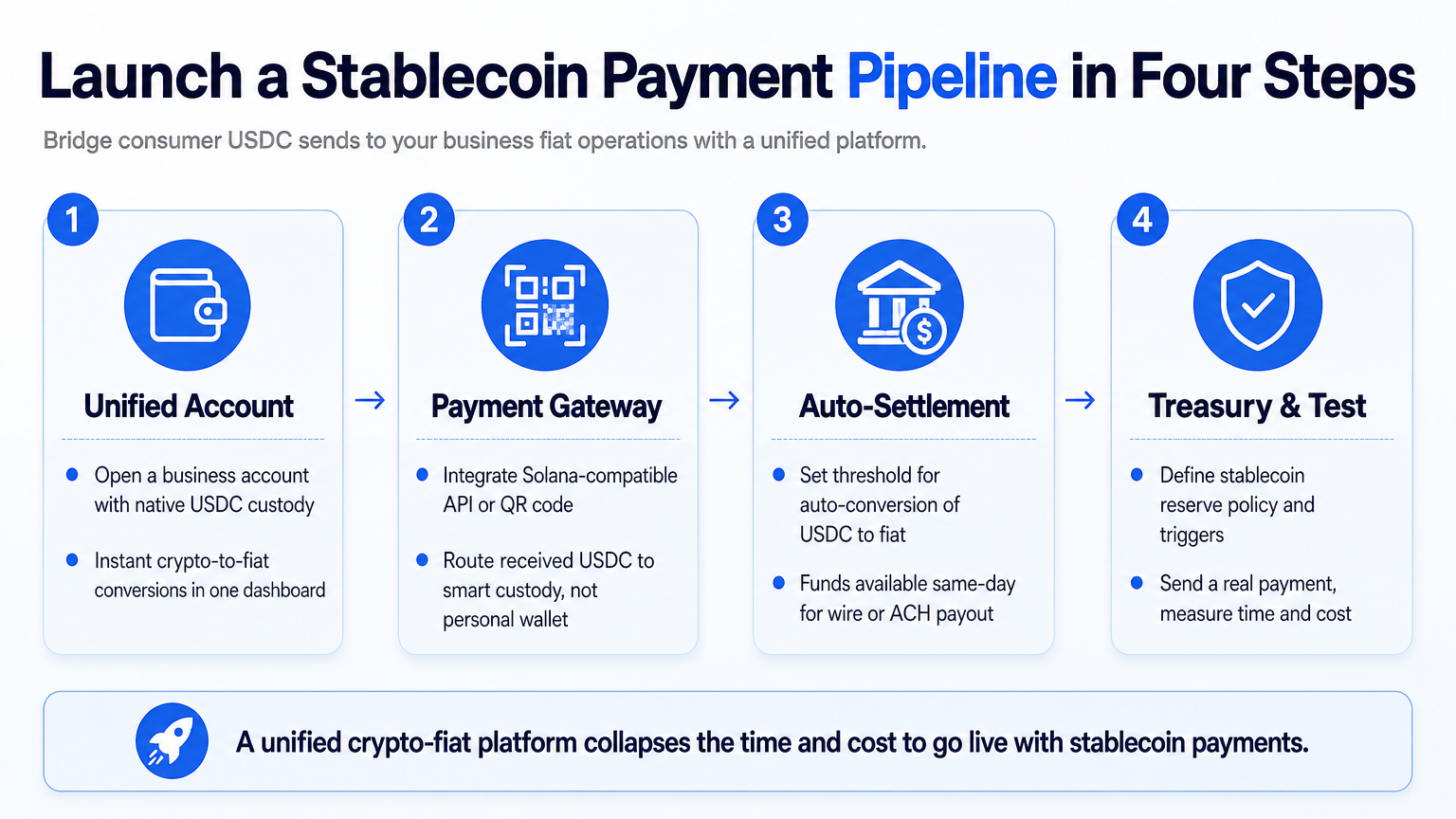
- Open a business account that bridges crypto and fiat. Choose a platform like OneSafe that provides native USDC custody, instant crypto-to-fiat conversion, and multi-currency fiat accounts. This eliminates the need for a separate exchange+wallet+bank triad.
- Integrate a Solana-compatible payment gateway or invoice system. For e-commerce, APIs from providers like Stripe (already supports USDC) can generate Solana payment links. For service billing, many invoicing tools now let you add a Solana address with a QR code. The key is to route received USDC to your OneSafe smart custody, not a personal wallet.
- Automate the settlement. Set rules so that incoming USDC above a threshold is automatically converted to fiat and swept into your operational checking account. OneSafe’s dashboard allows crypto-to-fiat conversions that are near-instantaneous, with funds available for same-day wire or ACH.
- Update your treasury policy. Decide what percentage of reserves you’ll hold in stablecoins versus fiat, and document the conversion triggers. The goal isn’t to speculate—it’s to shorten the cash conversion cycle.
- Test with a small cross-border payment. Send a real USDC payment from a Samsung Wallet (once live) to your business’s receiving address, convert to fiat, and verify the funds land in your bank account. Measure the end-to-end time and cost; use it to renegotiate existing correspondent banking relationships.
What does the Samsung USDC wallet mean for cross-border settlement speed and cost?
It means that for the first time, a sender can initiate a cross-border USDC transfer from a default phone app that settles on-chain in under 5 seconds at a fee of about $0.00025 (Solana’s typical base fee). The recipient—if equipped with a business stablecoin integration—can convert that USDC to fiat same-day and avoid the intermediary bank fees that made small-to-medium cross-border payments unprofitable. At scale, this shifts the floor for what’s considered “fast” in international payments. The Mastercard stablecoin primer notes that stablecoins allow “near-instant settlement”—Samsung just gave that capability a consumer-grade button.
The cost comparison table earlier quantifies the business-side savings. For a consumer sending $500 to a family member, the difference is even starker: perhaps $0 in network fees vs. $25+ via Western Union. As legacy corridors face pricing pressure, businesses that offer USDC payment options will capture a share of the $8 trillion+ global cross-border payments market that currently pays legacy tolls.
Which banking platform lets me hold and move both USDC and multi-currency fiat in one place?
OneSafe is a financial technology platform that combines traditional and Web3 financial services in a single interface. It provides segregated multi-currency accounts (USD, EUR, CAD) alongside USDC custody and instant on/off-ramps. Corporate cards, ACH, domestic and international wires, and bill payments all operate from the same dashboard that holds your crypto balance. This means a business can:
- Receive a USDC payment from a client’s Samsung Wallet.
- Convert it to USD instantly within OneSafe.
- Pay a European supplier in EUR using the virtual card or a wire, with competitive FX (0.25% fee or prevailing rate).
- Issue a virtual card to a team member with a spend limit, topped up from crypto or fiat balances.
Because USDC deposits and withdrawals are free, the cost of moving money into the platform is negligible. The platform is available worldwide except in OFAC-sanctioned countries and certain U.S. states. For specific availability, contact support@onesafe.io.
For a deeper look at how a unified fiat-and-crypto account can replace a fragmented banking setup, see this guide to business banking that meets Web3 needs.
What to Watch Next and Open Questions
Will Samsung Pay expand stablecoin settlement to physical POS?
The October 2026 announcement covers wallet-to-wallet transfers, not merchant point-of-sale. But Samsung Pay already supports NFC contactless payments at millions of terminals. The natural extension is to allow a user to tap and pay with USDC at any terminal that accepts contactless—either natively via a stablecoin settlement network or through a Visa/Mastercard-enabled stablecoin card. The integration of USDC into a card spending surge was already documented when stablecoin-linked card spending crossed $1 billion, as analyzed in OneSafe’s coverage of that milestone. A Samsung Pay/USDC POS integration would turn every Galaxy phone into a stablecoin spending device, forcing acquirers and payment processors to adapt.
Fed stablecoin signals and the timeline for traditional bank entry
The U.S. Federal Reserve has indicated it will issue a report on a potential FRB-based settlement token in Q1 2027, and several large U.S. banks are piloting internal stablecoin ledgers. The GENIUS Act’s passage means regulated banks can custody and issue payment stablecoins. The moment a major U.S. bank launches its own dollar stablecoin or partners with Circle to offer on-chain settlement, the line between “crypto payment” and “bank transfer” will blur permanently. Businesses should watch for Fed pilot announcements in early 2027; these will determine whether stablecoin payments become an extension of the banking system or remain an alternative rail.
Key Takeaways
- Samsung’s USDC-on-Solana launch puts stablecoin payments on up to 82 million U.S. Galaxy phones, creating a mainstream consumer sender base that businesses must prepare to accept.
- The operational gap is no longer technical—it’s the fragmentation between crypto custody and fiat banking; a platform that unifies both, like OneSafe, collapses the cost and complexity of stablecoin settlement.
- Real cost comparisons show an80–90% reduction versus traditional wires when routing a $10,000 cross-border payment through USDC and a neo-banking off-ramp.
- DAOs and global startups should immediately audit their cross-border payables for stablecoin compatibility and ensure compliance frameeworks treat stablecoin inflows like any other electronic funds.
- Watch for Samsung Pay POS expansion and Fed stablecoin pilots in2027—both will accelerate the consumer-to-business stablecoin flywheel.
Explore how OneSafe could help your business accept, convert, and bank stablecoins alongside multi-currency fiat in a single platform at onesafe.io.