
126,265 OFAC Specially Designated Nationals and Blocked Persons entries were in the consolidated database snapshot dated 2026-08-20, yet the biggest operational problem isn't list size alone. It's false-positive overload, which can bury genuine matches under a volume of alerts that reviewers can't investigate well.
The popular advice is to screen more aggressively, against more lists, with lower matching thresholds. That sounds safer, but it often produces a process that blocks legitimate customers, slows payments, and trains analysts to clear alerts mechanically. A sanctions screening process works when it balances sensitivity, precision, speed, and explainability, then improves through measured feedback rather than guesswork.
A useful screening program therefore asks two questions at once. Did the system identify a prohibited party, and did the team reach that decision reliably, consistently, and quickly enough to defend it? The difference matters for banks, fintechs, payment platforms, DAOs, and any business that handles cross-border money or digital assets. Strong AML and KYC procedures provide the wider control framework, but sanctions screening needs its own calibration discipline.
Table of Contents
Understanding the Real Problem With Sanctions Screening
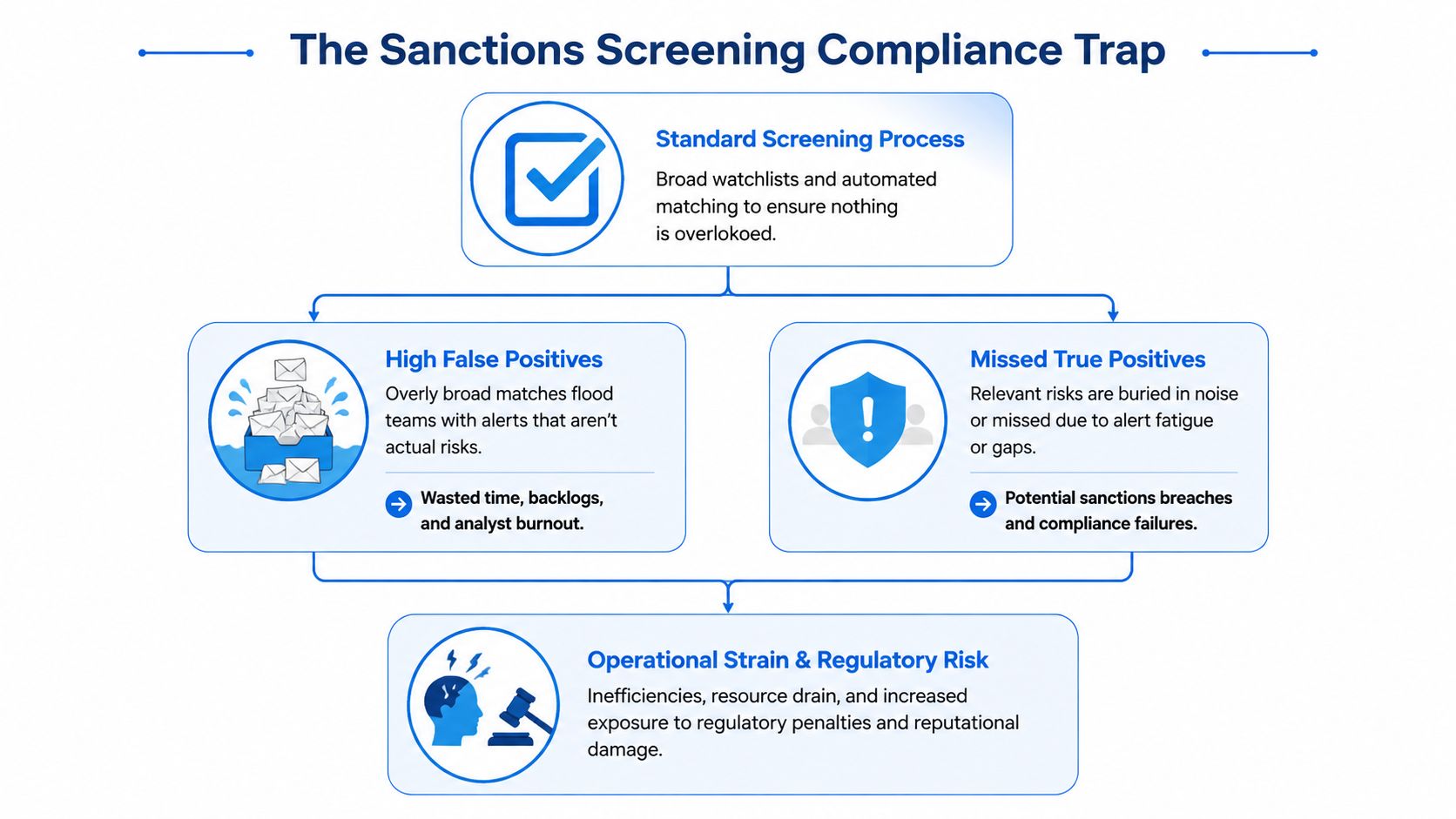
More coverage doesn't automatically mean better compliance. A team can load every relevant list, screen every customer and payment, and still operate a weak control if its matching logic creates unmanageable noise or if analysts can't explain why alerts were closed.
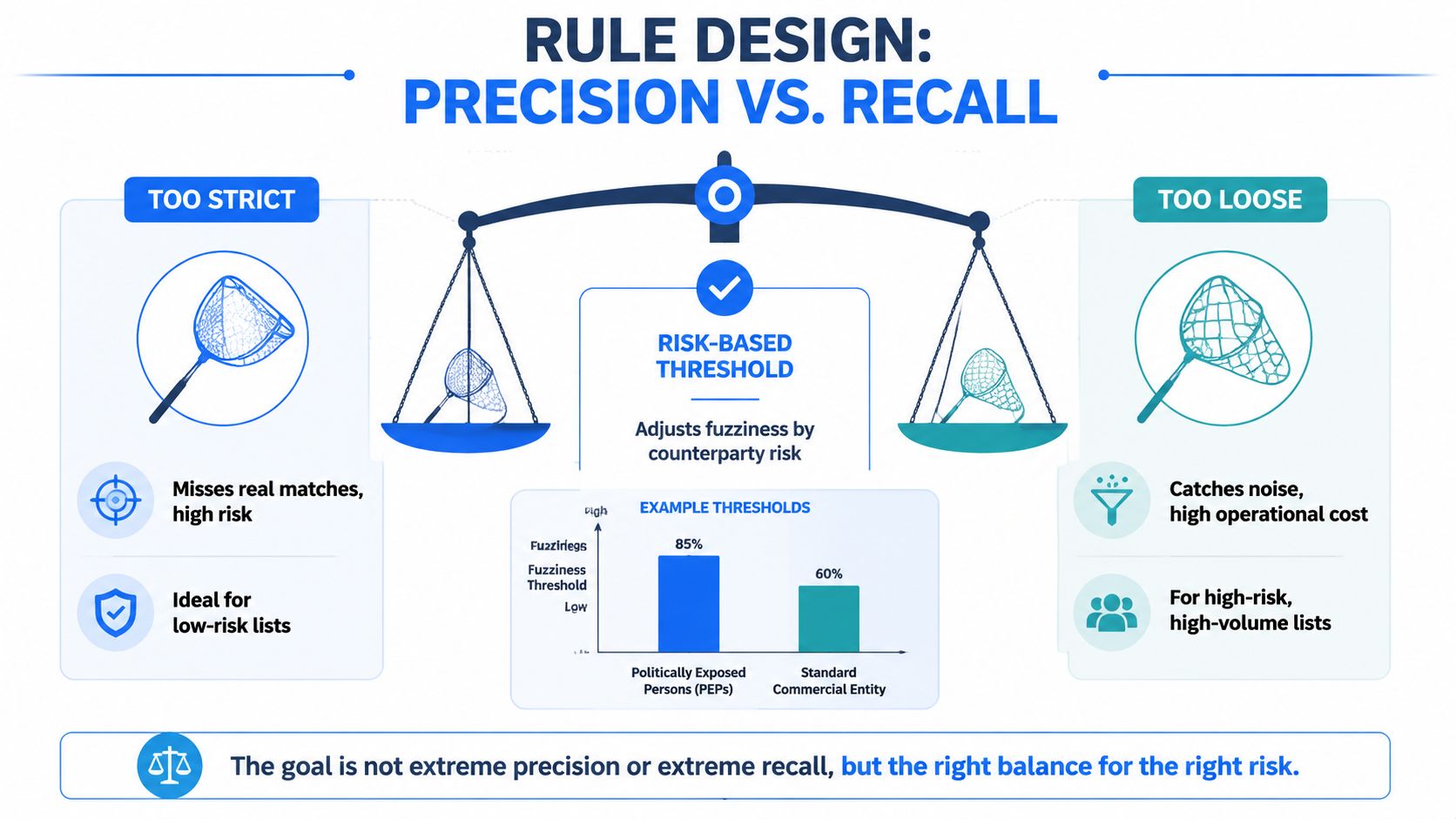
The practical failure is usually a calibration problem. A low threshold catches more spelling variations, transliterations, aliases, and partial matches, but it also sends more unrelated names to review. A high threshold improves precision, yet it can miss a sanctioned party whose data is incomplete, transliterated differently, or hidden behind an indirect relationship.
Screening coverage is only the starting point
The useful question isn't “Are we screening?” It's “Can we show that our screening reliably identifies relevant risk without exhausting the people responsible for resolving it?”
A 2024 supervisory analysis from Sweden illustrates why effectiveness matters. Correctly spelled names produced average customer-screening effectiveness of 86.3%, while transaction screening averaged 96.1%. No bank achieved 100% effectiveness in customer screening, and the median customer-screening result was 99.3%. The analysis also reported 11 banks clustered between 99.31% and 99.96%, with a global average of 95.8% for correctly spelled-name customer screening. These results appear in the Swedish supervisory analysis of sanctions screening.
Those figures aren't a target you can copy blindly. They demonstrate that institutions need outcome testing, not just evidence that a query ran. Your process should measure missed matches, unnecessary escalations, review consistency, list freshness, and the time between a designation and effective screening coverage.
Practical rule: Treat every threshold as a control decision with a measurable consequence, not as a permanent vendor setting.
Sourcing and Maintaining Regulatory Lists
A screening engine is only as current as the data it receives. Start with the authoritative sources that govern your exposure, then use an aggregator when you need normalization, broader jurisdictional coverage, or operational resilience. A commercial provider can reduce integration work, but it shouldn't become a black box that prevents your team from tracing a result to an original designation.
The scale is already substantial. The OFAC Specially Designated Nationals and Blocked Persons list reached 126,265 entries in the consolidated database snapshot dated 2026-08-20. The same snapshot listed 25,944 BIS entries and 4,640 OFAC consolidated list entries. A separate global benchmark in that source covered more than 320 sanctions lists and over 1.38 million screened entities. See the consolidated sanctions list totals for the stated snapshot and benchmark.
Build a source hierarchy
Use a simple hierarchy:
- Authoritative government publication: Identify the official list owner for each jurisdiction and preserve the original record, identifier, designation date, aliases, addresses, and program information.
- Normalized ingestion layer: Convert inconsistent fields into a common schema. Keep names, scripts, aliases, dates, addresses, countries, identifiers, vessel data, wallet addresses, and source metadata in separate fields.
- Independent validation: Compare provider updates against the relevant official source, especially after a high-impact designation or technical feed change.
- Versioned deployment: Assign every imported list a version, retrieval timestamp, checksum or equivalent integrity marker, and activation timestamp.
The version is essential. When an analyst clears an alert, the case should show which list snapshot generated it. Without that link, a later list update can make an old decision impossible to reconstruct.
Match the refresh method to the risk
Weekly or manual updates are weak controls when a sanctions regime changes quickly. Daily updates can still leave a gap if a designation occurs between refreshes. A practical design uses automated ingestion and near-real-time or real-time refresh where the source supports it, with an exception process for urgent changes.
Don't confuse list refresh with customer screening. Updating the database doesn't automatically re-screen existing customers, vendors, beneficial owners, or wallet addresses. Trigger re-screening after a material list change, and maintain scheduled ongoing screening for the population that remains active.
Record the maintenance calendar
Give each source an owner, technical monitor, fallback method, and escalation route. Test failed feeds, malformed files, duplicate records, and empty responses. An empty update isn't necessarily a clean update. It may indicate an authentication error, parser failure, or upstream outage.
The process should stop or move to a controlled degraded mode when list integrity can't be confirmed. Continuing with yesterday's data creates an exposure that an audit log may reveal only after an incident.
Designing Screening Rules and Risk-Based Thresholds
Rule design determines whether your analysts investigate risk or process noise. The safest configuration isn't the one that produces the most alerts. It's the one that applies enough sensitivity to the relevant risk while preserving the capacity to review every meaningful escalation.
A name-only rule is a poor default. Matching should combine normalized names with aliases, transliteration variants, dates of birth where available, addresses, nationality, registration identifiers, countries, counterparties, and transaction context. Each additional attribute can improve precision, but only if the underlying data is reliable and the system doesn't treat missing information as a clean result.
Compare the two bad extremes
A conservative configuration uses strict identity requirements before escalation. It works well for clean internal data and lower-risk populations, but it can miss genuine matches when names are transliterated, abbreviated, or incomplete.
An aggressive configuration tolerates more variation. It suits high-risk lists, complex jurisdictions, and data with many aliases, but it creates a larger queue and requires stronger triage automation.
| Configuration | Strength | Failure mode | Better operating response |
|---|---|---|---|
| Strict | Fewer low-confidence alerts | Missed matches from imperfect data | Add secondary identifiers and targeted review |
| Loose | Wider capture of name variation | High analyst workload | Rank alerts and suppress only well-supported repeats |
| Risk-based | Different treatment by exposure | More model governance work | Document segments, thresholds, and test results |
The right threshold depends on the entity and the decision. A payment to a high-risk jurisdiction, a new counterparty with limited identity data, and a known customer with stable identifying attributes shouldn't produce identical treatment. Use hard blocks for strong identifier matches and soft escalations for ambiguous matches that need context.
Define an operational ceiling
Calculate capacity before lowering thresholds. Take the number of alerts your team can review thoroughly during a defined operating period, subtract the capacity reserved for urgent escalations and investigations, then set the remaining volume as the working ceiling for routine reviews. This isn't a regulatory safe harbor. It's a governance constraint that prevents a theoretically sensitive system from becoming practically ineffective.
Test rules against known positive and negative examples. Include misspellings, transliterations, common names, corporate suffix changes, abbreviated legal names, missing dates, shared addresses, and indirect ownership relationships. Review not only the score but the reason the score changed when a field was added or removed.
The Swedish analysis is useful here because it measured effectiveness rather than assuming that list coverage equals control quality. Use similar testing internally, and document why a threshold is appropriate for each risk segment.
Matching Methods for Names and Crypto Identifiers
A traditional name match compares identity attributes. A crypto screening decision often begins with an address, then expands into ownership, clustering, transaction history, and exposure paths. The two problems overlap, but they can't be solved with the same string comparison.

For names, normalize case, punctuation, whitespace, titles, corporate suffixes, and common transliteration differences. Preserve the original value as well as the normalized value. Removing too much can collapse distinct people into one match, while preserving too much can prevent the engine from recognizing an obvious variation.
For wallet addresses, normalization means more than comparing characters. The system needs to validate the chain and address format, preserve checksummed values where relevant, distinguish contract addresses from externally owned accounts, and maintain the relationship between the address and the transaction that exposed it.
A practical escalation path
Consider a customer whose name produces no convincing direct match. The customer then sends assets from a wallet that shares exposure with an address associated with a sanctioned entity. A basic engine that checks only the customer's name clears the relationship. A stronger workflow treats the wallet as a separate screening object and escalates the indirect connection for investigation.
The investigator then examines:
- Address identity: Is the address valid, active, and associated with the stated chain?
- Exposure path: Did funds arrive directly, through an intermediary, or through a service that obscures the source?
- Cluster context: Do related addresses share transaction patterns or known counterparties?
- Customer explanation: Does the declared activity account for the wallet's behavior?
- Decision boundary: Is the evidence strong enough to block, hold, request information, or close as unrelated?
ENS names and other human-readable identifiers need separate handling. They can resolve to addresses, change over time, or point to contracts rather than people. Store the identifier, resolution result, timestamp, and chain context so an analyst can reproduce the original finding.
Crypto intelligence can add valuable context, but it also increases false positives when systems treat proximity as ownership. A wallet that interacted with a sanctioned address isn't automatically controlled by the same party. The benchmark evidence on alert quality is a warning: more than half of respondents reported over 76% false positives after initial review, and about one-third reported over 91% after level-one triage in the cited report. Other industry summaries place typical rates at 85% to 95%, meaning only about one in ten or fewer alerts are true positives, as documented in the sanctions benchmark report.
For teams working with blockchain data, Arkham intelligence and crypto transparency offers useful context on how address intelligence can support investigation. It should complement, not replace, documented identity resolution and human judgment.
Automating Alerts and Managing False Positives
Automation should remove repetitive work, not remove accountability. The most effective setup separates fast decisions from uncertain cases, then gives analysts enough context to resolve the uncertain cases without opening multiple systems.
A workable flow starts before onboarding. Capture identity and counterparty data, screen it against the current lists, and prevent access or payment execution until the relevant checks complete. Continue screening after onboarding, and trigger additional checks when lists change or material customer data changes.
Use two alert lanes
Lane one, probable non-match: The system finds a weak name similarity, but trusted attributes conflict. The platform can route the alert for a lightweight review, retain the evidence, and suppress repeat alerts only when the suppression rule is documented and bounded.
Lane two, probable match: Strong identifiers align, or multiple weaker signals point in the same direction. Hold the relevant action, assign an owner, collect supporting evidence, and escalate according to the sanctions policy.
Don't let an automated suppression become a permanent blind spot. Every suppression needs an expiry or review condition, particularly when customer data changes, a list record changes, or the relationship enters a new risk segment.
Build a feedback loop that analysts trust
Store the analyst's disposition, rationale, evidence reviewed, reviewer identity, and rule version. Feed closed outcomes back into rule testing, but don't blindly train thresholds on historical decisions. Analysts may have cleared alerts inconsistently, or a prior team may have used incomplete information.
A daily operating rhythm can remain simple:
- The system ingests and validates list changes.
- New and ongoing records are screened automatically.
- Alerts are ranked by identifier strength, counterparty risk, transaction urgency, and data completeness.
- Analysts resolve low-risk noise using documented evidence.
- Investigators handle probable matches and unusual indirect exposure.
- A supervisor reviews overrides, aged alerts, and rule-performance exceptions.
The guidance on closing sanctions-screening process gaps identifies manual one-by-one screening, outdated lists, incomplete data, and missing audit trails as common weaknesses. Those failures usually appear together. Manual review consumes capacity, stale lists undermine coverage, poor data reduces matching quality, and absent records make the outcome impossible to defend.
Automation can help web3 teams connect onboarding, wallet screening, payment controls, and case management. Automated compliance for digital assets provides relevant background, but the implementation still needs clear ownership, exception handling, and human escalation.
Recordkeeping Audit Trails and Periodic Reviews
An auditor doesn't evaluate your screening engine from its marketing description. The reviewer needs to see what data entered the system, which list version was active, which rule fired, who made the decision, and whether the team followed the approved procedure.
Create an immutable case record for every alert and material screening event. At minimum, preserve the screened input, source system, timestamp, list snapshot, matching fields, score or rule outcome, alert priority, analyst notes, attached evidence, disposition, approval, and any downstream action such as release, hold, rejection, or account restriction.
Make each decision reproducible
A useful audit trail answers these questions without a reconstruction exercise:
- What was screened? Preserve the original customer, vendor, beneficiary, payment, and wallet data.
- Against what? Store the precise list version and relevant record identifiers.
- Why did it alert? Show the matching fields, normalization steps, and rule path.
- Who decided? Record the analyst, reviewer, escalation owner, and approval sequence.
- What happened next? Link the disposition to the payment, onboarding decision, restriction, or remediation action.
Don't overwrite data when a customer corrects a name or address. Store the old value, new value, change reason, approver, and re-screening result. Otherwise, the case record can appear cleaner than the process was.
Review the control, not just the queue
Periodic review should include controlled tests using positive and negative examples, recent designation changes, transliteration variants, partial names, corporate restructurings, and crypto exposure scenarios. Compare expected outcomes with actual outcomes, then document the result even when no rule changes are needed.
Review alert quality by segment rather than using one blended rate. A rule that performs well for domestic commercial entities may be unsuitable for cross-border individuals or wallet-linked counterparties. Examine repeat alerts, manual overrides, aging cases, feed failures, list activation delays, and inconsistent decisions between analysts.
A closed alert isn't proof that the control worked. It may show only that an analyst had enough time to investigate it.
Maintain a concise examination package containing the sanctions policy, risk assessment, list inventory, provider documentation, rule matrix, validation results, change approvals, training records, incident reports, and sample cases. After an incident or near miss, update the procedure and test the specific failure mode. A post-incident review that produces no changed control is usually just a meeting record.
Practical Checklist for Your Screening Workflow
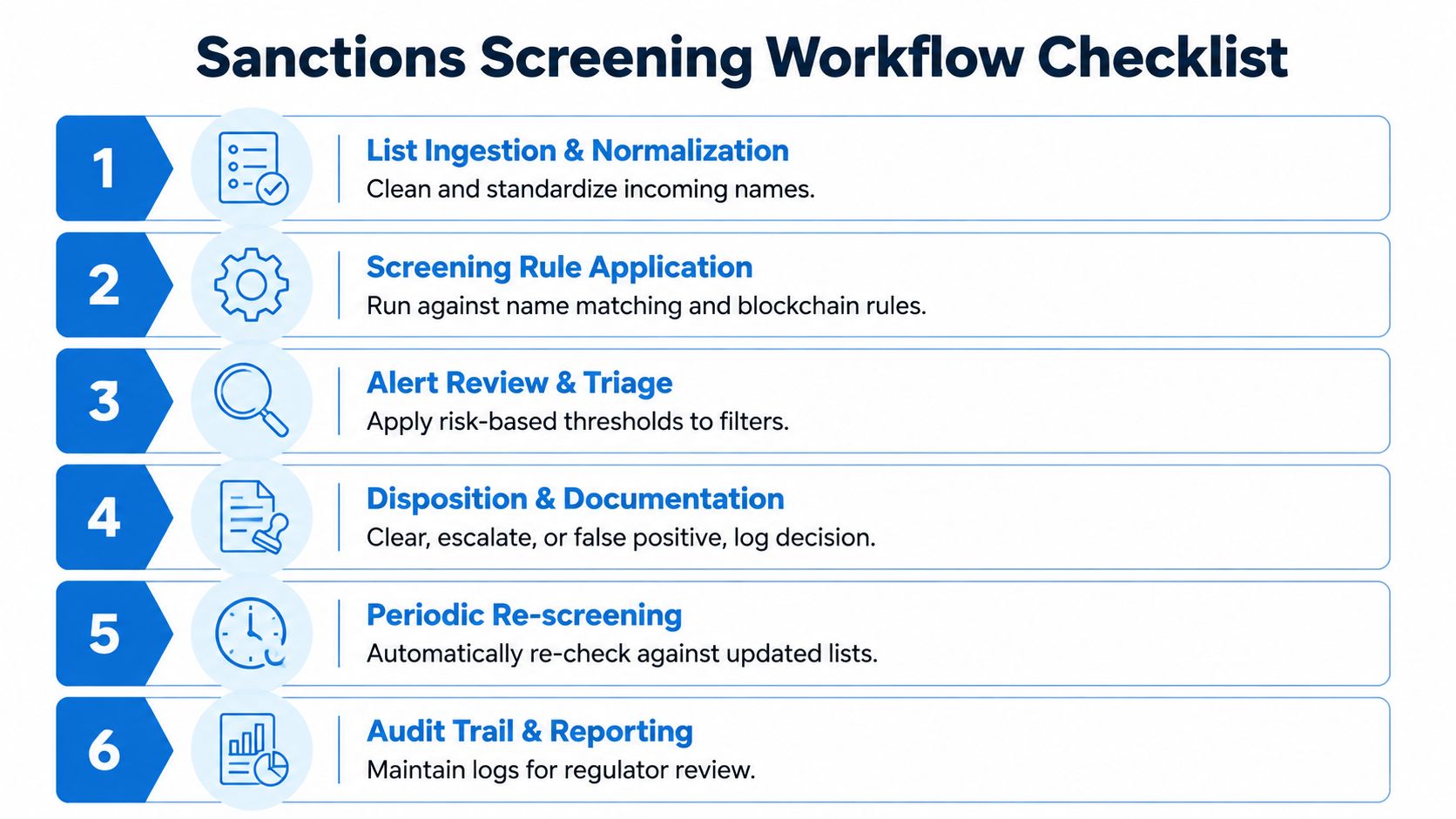
Give the team a checklist that follows the data from ingestion to review. Assign an owner for each handoff, because unclear ownership is how a failed feed becomes an unrecognized screening gap.
The operating checklist
- Ingest and normalize lists. Confirm the source, retrieval status, record count change, file integrity, and activation time. Normalize names and identifiers without discarding the original values.
- Prepare the subject. Collect legal name, aliases, registration details, address, country, date information where appropriate, beneficial ownership data, and wallet or chain identifiers. Mark missing fields rather than treating them as negative evidence.
- Apply the rules. Run exact, fuzzy, phonetic, transliteration, identifier, geographic, ownership, and blockchain exposure checks according to the subject's risk segment.
- Triage the alert. Separate weak similarities from strong identifier alignment. Review contextual fields before requesting more information or restricting activity.
- Resolve and escalate. Clear a documented non-match, hold or reject a probable match, and escalate ambiguous cases to the designated compliance owner. Never allow an analyst to delete an alert without documentation.
- Re-screen and report. Re-screen active relationships after material list changes and on the approved ongoing schedule. Monitor feed failures, unresolved cases, overrides, repeat alerts, and decision consistency.
- Review the system. Test rules against known examples, examine near misses, approve changes, and preserve the evidence supporting each configuration decision.
For organizations that also screen volunteers, contractors, or nonprofit partners, a resource on choosing a nonprofit background check company can help separate general background-check needs from sanctions-specific controls. Those checks shouldn't be treated as interchangeable. A criminal-history workflow and a sanctions workflow use different sources, matching logic, escalation standards, and evidence requirements.
Use a decision tree for common edge cases. A partial name with no supporting identifiers should enter contextual review, not an automatic block. A new designation should trigger feed validation, affected-population re-screening, and an incident owner. An unfamiliar wallet should be held long enough to validate chain, ownership indicators, exposure, and customer explanation.
The process is working when analysts can move quickly without guessing, managers can see where capacity is going, and auditors can reproduce decisions from the stored record. That standard is more demanding than a checkbox, but it is also more sustainable.
OneSafe supports global and web3 organizations with multi-currency business accounts, payments, corporate cards, crypto-compatible workflows, and KYB-oriented onboarding, with sanctions and watchlist screening incorporated into its compliance controls. If you're building a payment operation that needs clearer controls across fiat and digital assets, visit OneSafe to evaluate how its account and payment infrastructure fits your workflow.