On November 17, 2026, an Apple Pay outage halted instant crypto purchases for thousands of users — exposing a fragility any business relying on crypto banking must address. Crypto banking isn’t just holding digital assets; it’s the full stack of services that let businesses move, convert, and spend money across fiat and cryptocurrency rails. A single gateway failure can block a routine crypto buy. This explainer walks through what happened, why it matters for startups and DAOs, and how a diversified on-ramp strategy keeps operations running even when a major service goes down.
Table of Contents
- What Happened: Apple Pay Outage Disrupts Crypto Purchases
- Crypto Banking 101: How Fiat Meets Crypto
- Why the Outage Matters for Businesses
- What Changes Now — and What Stays the Same
- Building a Resilient Crypto Banking Stack
- Open Questions and What to Watch Next
- Key Takeaways
What Happened: Apple Pay Outage Disrupts Crypto Purchases
On November 17, 2026, as reported by NewsNation and BigGo Finance, Apple Pay suffered a widespread outage that cut off instant crypto buying on exchanges integrating the payment method. The disruption also affected the App Store and Apple Music, leaving anyone trying to buy crypto with a linked card stuck — transactions simply wouldn’t process. According to Downdetector, user reports of Apple Pay problems spiked sharply in the morning, confirming the failure’s breadth.
The outage wasn’t isolated to Apple’s own ecosystem. Platforms like Coinbase and Crypto.com — whose Apple Pay integration status can be checked on dedicated pages — immediately lost that purchase rail. For businesses that depend on fast dollar-to-crypto conversions to meet payroll or fund operations, those hours of downtime were a stark reminder of how much the crypto payment stack still leans on a few consumer gateways.
The BigGo Finance headline laid it out plainly: the simultaneous failure of multiple Apple services, including Apple Pay, the App Store, and Apple Music, effectively removed one of the most popular instant fiat-to-crypto rails for the duration. This is more than a tech glitch — it’s a crypto on-ramp outage that can ripple through business operations built around a single method of moving fiat into digital assets.
Crypto Banking 101: How Fiat Meets Crypto
Most businesses don’t sit on a vault of ether. They buy crypto when needed — to pay freelancers in USDC, settle supplier invoices, or fund a smart contract deployment. Crypto banking platforms bridge traditional bank accounts and blockchain networks. A dollar balance triggers a conversion, and the business receives the equivalent crypto in a secure wallet.
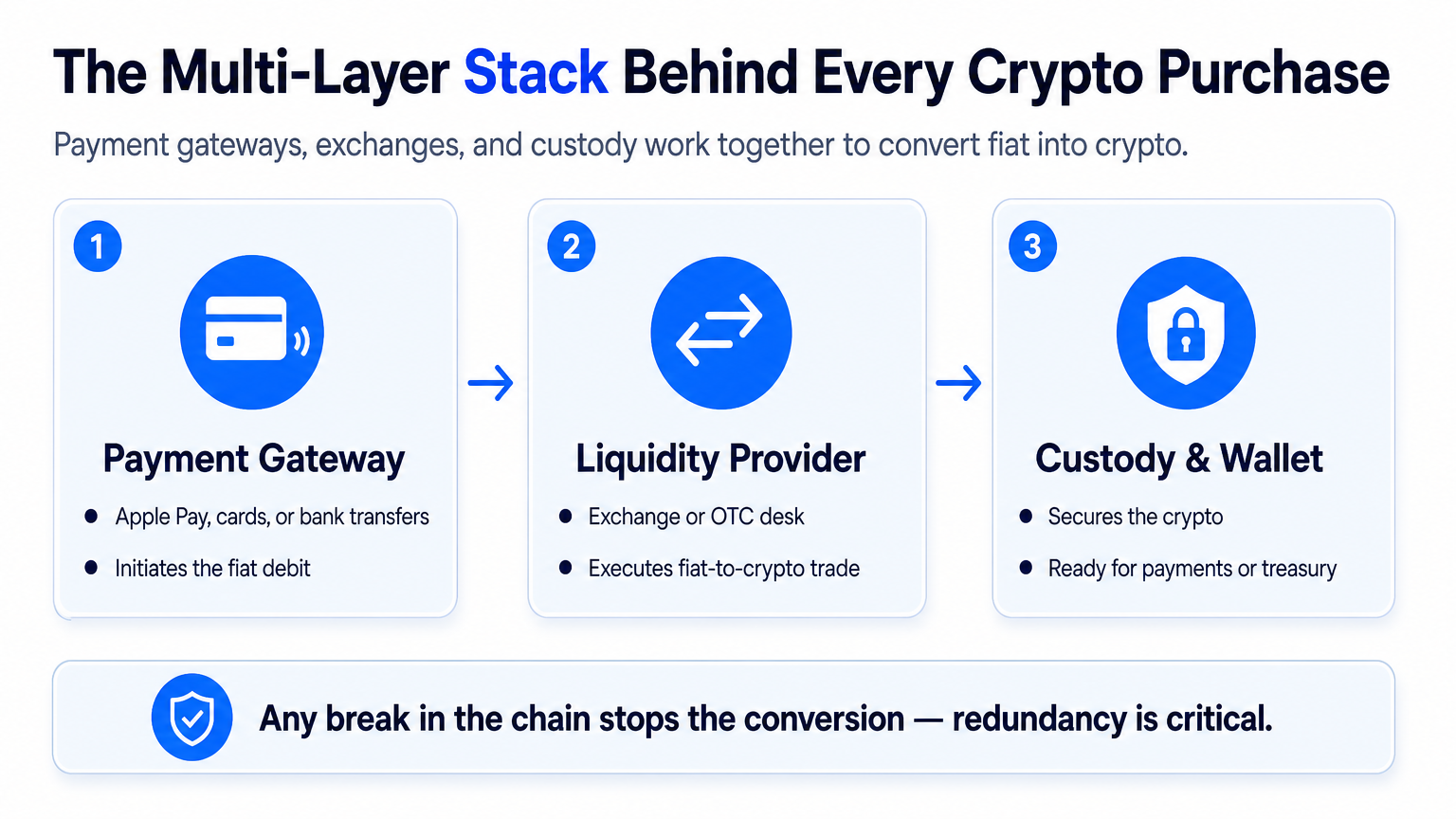
Behind that simplicity, several layers work together: a payment gateway (like Apple Pay, card processors, or bank transfers), an exchange or liquidity provider to execute the conversion, and custody infrastructure. The term on-ramp describes any method that moves fiat into crypto. An off-ramp does the reverse. Speed isn’t a luxury; it’s how businesses meet obligations when markets move.
A typical flow: a business initiates a crypto purchase, the platform calls a payment gateway to debit the bank card, the gateway settles the fiat, and the exchange credits the crypto. If any link fails, the whole chain breaks. Consumer-friendly gateways like Apple Pay make the experience seamless — tap, confirm with Face ID, and you own crypto — but that convenience depends entirely on the gateway’s uptime.
Apple has deepened its digital-asset involvement, as we analyzed in Stablecoin Payments Go Mainstream: Apple and Google Hiring. The November 17 outage shows that the companies building on-ramps can themselves become the bottleneck.
Why the Outage Matters for Businesses
If Apple Pay is your sole way to fund crypto purchases, an outage blocks asset acquisition entirely. A startup paying contractors, a DAO distributing grants, or an e‑commerce operation settling in stablecoins can face missed deadlines and frustrated partners. The core risk: many businesses have optimized for convenience and never tested what happens when their primary on-ramp vanishes.
A common setup: a Web3 startup maintains a dollar float and converts $10,000 to USDC weekly via “Buy with Apple Pay” to pay remote contributors. The flow has a single point of failure — the Apple Pay gateway. If it goes down, the conversion can’t happen, and payroll stalls. No automated fallback exists because the process was designed around that one rail. The convenience of instant debit card purchases masks the fragility.
Picture a climate-tech startup paying its global design team in USDC every Monday. On November 17, the finance manager logs in, selects “Pay with Apple Pay,” and gets an error. The only backup is a standard ACH transfer, which would take two business days. The team won’t get paid until Wednesday, and the startup’s reliability takes a hit. As we explored in How Trybit's New Mass Payout API Changes Crypto Payroll, even the most elegant payout system can’t help if fiat can’t be converted in time. The lesson: business crypto banking needs alternative rails that activate instantly.
What Changes Now — and What Stays the Same
Apple resolved the service degradation later that day, as confirmed on its System Status page, and most users regained access. For businesses that experienced only a brief interruption, the immediate impact was negligible. But the realization that such outages can recur should prompt a re-evaluation of the underlying architecture.
The lasting change is mindset. Businesses that viewed Apple Pay as sufficient now grasp that a single on-ramp is a vulnerability. Future disruptions — to payment processors, banks, or blockchains — will happen. Organizations that weather them treat on-ramps as a portfolio, not a single asset.
Diversification means having multiple, independent ways to convert fiat to crypto — methods that don’t all depend on the same third party. If one gateway goes down, another takes its place without halting operations. A resilient crypto payments setup ensures a business can continue buying, selling, and moving digital assets regardless of one service’s status. Without it, every outage becomes a business-continuity event; with it, an outage becomes a minor inconvenience worked around in minutes.
Building a Resilient Crypto Banking Stack
Start by mapping every step of your fiat-to-crypto flow and identifying dependencies. Ask: if this provider fails, do I have another method ready that can complete a conversion within the same time window? Then configure and test those alternatives. A simple checklist for any business using instant crypto buying:
- List all current on-ramps (card via gateway, ACH, wire, stablecoin swaps).
- Note their settlement times and dependent providers.
- For critical corridors, activate and trial at least one backup rail with a small test transaction.
- Pre-fund a stablecoin balance as a short-term buffer, so you aren’t forced to convert during an outage.
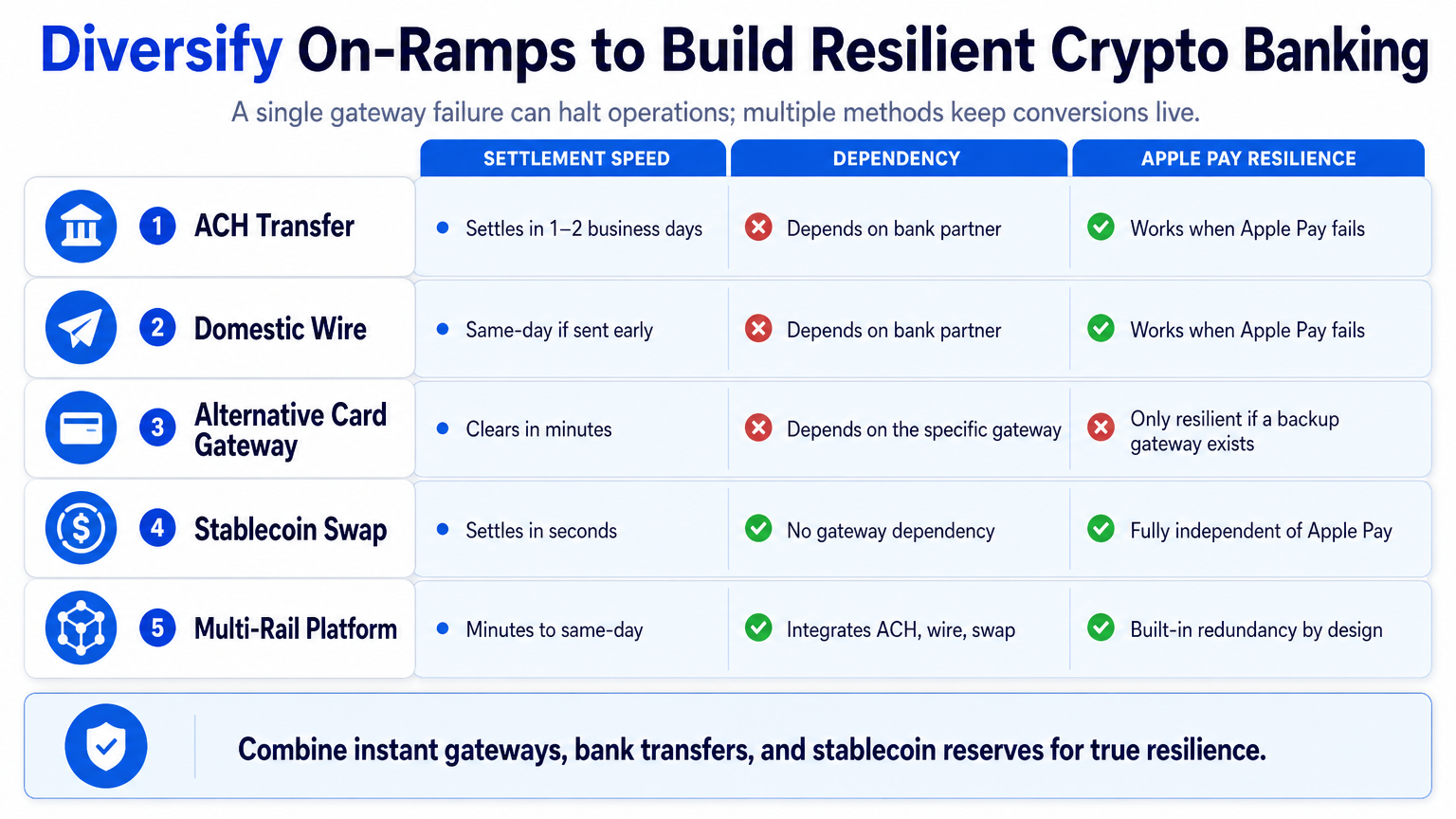
Several alternatives keep the pipe open even when Apple Pay is down:
| Method | Settlement Speed | Dependency on Single Gateway | Resilience If Apple Pay Fails |
|---|---|---|---|
| ACH (bank transfer) | 1–2 business days | Bank partner | Unaffected, but slower |
| Domestic Wire transfer | Same day (if early) | Bank partner | Unaffected, higher cost |
| Debit/Credit Card (other gateways) | Minutes | Specific gateway | Only if an alternative gateway is set up |
| Stablecoin swap (from existing balance) | Seconds | None (on-chain) | Fully independent |
| Crypto-native platform with multiple rails | Minutes to same day | Platform integrates multiple methods | Built-in redundancy |
The key insight: stablecoin swaps from a pre-funded balance are immune to payment gateway outages because the conversion happens on-chain or within a platform that already holds the funds. A small USDC or USDT reserve can decouple purchasing ability from any single fiat rail.
A healthy stack might include a primary instant method (card gateway) for speed, a bank transfer (ACH or wire) for larger conversions, and an on-hand stablecoin position accessible through a platform’s swap functionality. A DAO might keep part of its treasury in stablecoins and use wires for scheduled top-ups, never relying solely on a consumer gateway.
OneSafe, for instance, combines ACH transfers, domestic and international wires, and fiat to crypto converter tools in one account. Because you can fund crypto purchases through a bank transfer or an existing balance, you’re not locked into a single rail. If a processor goes down, the ACH or wire option stays available, and a pre-funded USD balance or USDC holding enables immediate swaps. That architecture reduces operational risk for global businesses and DAOs, letting you choose the best path based on speed, cost, and availability — exactly what stablecoin infrastructure demands, as discussed in Why Stablecoin Infrastructure Is Crypto Banking's Next Battle. Crypto-native banking builds the entire experience around the reality that businesses today transact in both worlds. For a DAO, that means customizable permissions, automated stablecoin payouts, and custody that doesn’t rely on retail exchange accounts. For a global startup, it’s one dashboard for paying contractors in euros via wire, converting dollars to USDC for developers, and holding a multi-currency float — all without switching platforms. The World Bank’s recent stablecoin test highlights this convergence, as we explored in World Bank Stablecoin Test: A Turning Point for Crypto Banking?. When your banking partner already understands on-ramp diversification, resilience comes by design.
Open Questions and What to Watch Next
Apple has not disclosed the root cause of the November 17 outage. Without a public post-mortem, businesses can’t assess if it was an isolated incident or a sign of deeper infrastructure fragility. It’s wise to assume any large consumer gateway can experience similar disruptions.
Regulatory trends are already pushing for more robust payment infrastructure. The BIS has called for stronger oversight of stablecoin arrangements and the payment systems they depend on — Stablecoin Payments: BIS Report Takeaways for Businesses lays out the implications. If regulators mandate higher uptime standards or backup rails, the industry’s reliance on a single gateway could be forced to evolve. For now, that’s an emerging conversation.
Beyond payment gateways, businesses should scenario-plan for disruptions at their bank partner, exchange liquidity provider, or even the blockchain they use. A DAO that only uses Ethereum for payroll could be stuck during congestion and fee spikes. A startup relying on a single bank connection for wires could see delays during maintenance. The principle is the same: built-in redundancy across every chokepoint. For businesses looking to stay ahead of such trends, tools like Joyrise can automatically publish SEO-optimized content to keep your site ranking while you focus on operations.
Key Takeaways
- The November 17, 2026 Apple Pay outage demonstrated that a single payment gateway can halt instant crypto buying for businesses that haven’t set up alternative on-ramps.
- Crypto banking is only as resilient as its weakest link; diversifying on-ramps — combining ACH, wires, and stablecoin swaps — turns an outage from a crisis into a manageable delay.
- Pre-funding a stablecoin balance acts as a powerful buffer, allowing crypto purchases independent of any payment processor.
- Crypto-native platforms that integrate multiple rails natively, like OneSafe, eliminate the need to stitch together separate services and reduce operational risk for global startups and DAOs.
- Regulation and infrastructure trends are moving toward higher expectations for payment reliability — businesses that build redundancy now will be ahead of the curve.
For a banking experience that keeps your crypto operations running even when a major gateway fails, explore how OneSafe can help your business diversify its financial rails.