On November 17, 2026, Osler, Hoskin & Harcourt LLP reported that Canada’s Department of Finance published proposed stablecoin regulations on October 24, 2026. The draft rules under the Stablecoin Act plus amendments to the Retail Payment Activities Regulations would reshape how businesses using stablecoin payments handle issuance, reserves, reporting, and fiat touchpoints. Comments close December 23, 2026.
Table of Contents
- What Just Happened: Canada’s Stablecoin Regulation Proposal
- Why It Matters Now for Businesses Using Stablecoin Payments
- The Background a Newcomer Needs to Follow the Story
- Concrete Implications and Recommended Actions
- What to Watch Next and Open Questions
- Key Takeaways
What Just Happened: Canada’s Stablecoin Regulation Proposal

Canada enacted a broader stablecoin framework in Bill C-15 earlier in 2026, which DLA Piper summarized in an April 2026 client update as creating a statutory basis for stablecoin regulation. The October 24 draft now supplies operational detail: issuer qualifications, stablecoin definitions, reserve asset requirements, governance and risk management obligations, and regular reporting to the Bank of Canada.
According to Osler’s November 17, 2026 report, the amendments also expand retail payments oversight under the Retail Payment Activities Act. That extends the compliance perimeter beyond token issuers to payment service providers sitting between businesses and fiat banking.
Key dates: October 24, 2026 draft and December 23, 2026 comment deadline
The Department of Finance Canada published the draft on October 24, 2026. Industry comments are open until December 23, 2026. No final effective date has been announced. Businesses should treat the comment window as the first formal opportunity to shape rules that will then move into final form.
Who qualifies as an issuer and what reserve requirements look like
The draft clarifies issuer thresholds, stablecoin definitions, and reserve assets. The Canada’s Stablecoin Framework page from the Department of Finance sets out the policy direction, while the statutory foundation is in the Stablecoin Act. Ongoing compliance would include governance, risk management, and reporting to the Bank of Canada, with potential penalties for violations.
What are the new stablecoin rules in Canada and when do they take effect?
The rules are still in draft and do not take effect yet. They define issuers and stablecoins, set reserve asset requirements, impose governance and risk management duties, require Bank of Canada reporting, and expand retail payment oversight. If finalized, an effective date would be set after December 23, 2026.
| Aspect | Detail |
|---|---|
| Draft published | October 24, 2026 |
| Comment deadline | December 23, 2026 |
| Proposed rules | Issuer qualifications, reserve requirements, governance/reporting, expanded retail payments oversight |
| Affected entities | Stablecoin issuers and payment service providers touching fiat rails |
| What businesses should do now | Map stablecoin flows, vet providers, prepare for compliance |
Why It Matters Now for Businesses Using Stablecoin Payments
The immediate signal: national regulators are moving from guidance to law
This is not a consultation paper. Canada is putting stablecoin regulation into enforceable form. For any business using USDC business payments or cross-border stablecoin payments, that shift increases the cost of staying reactive. A partner unprepared for issuer-level or payment-oversight obligations can pass friction downstream. For a broader read, OneSafe’s Canada’s Stablecoin Payment Rules: 5 Takeaways connects the draft to business workflows.
How stablecoin payments sit at the intersection of speed and compliance risk
Stablecoin rails are fast and final. Compliance risk lives at fiat touchpoints where stablecoins enter or leave a bank account. Under the proposed rules, those touchpoints become harder to ignore: regulators will look first at the fiat on-ramp and off-ramp. A global business stablecoin payment may settle in minutes, but if the fiat leg sits with an unregistered provider, the entire flow becomes a review item.
Why a pro-active stance beats rushed retrofitting later
Once the rules are finalized, service providers will update contracts, reserves, and reporting. Businesses that have already mapped their stablecoin payment flows can adapt by adjusting counterparties. Those that wait will face a rushed re-platforming exercise while vendor relationships are being re-papered.
How will Canada’s stablecoin regulation affect my business’s payment operations?
For most non-issuer businesses, the effect will be indirect but real. Expect your stablecoin payment provider, custodian, or fiat-crypto banking partner to add due diligence, reserve-related terms, and reporting requirements. If you transact with a Canadian counterparty, its payment service provider may face new Bank of Canada oversight, leading to longer onboarding, stricter documentation, and possible higher fees.
The Background a Newcomer Needs to Follow the Story
Stablecoin payments 101: USDC, settlement velocity, and cross-border cost savings
A stablecoin is a token pegged to a fiat currency; USDC is among the most widely used for business payments. USDC business payments settle on blockchain rails in minutes, outside traditional banking hours. For cross-border stablecoin payments, that means less settlement risk and fewer intermediary fees. Businesses also use stablecoin invoice payments to suppliers to avoid currency-conversion delays.
Existing infrastructure: APIs, on-ramp/off-ramp providers, and neo-banking platforms
Most businesses do not run their own stablecoin settlement infrastructure. They use APIs, hosted acceptance flows, and on-ramp/off-ramp providers to convert between fiat and crypto. That stack works until regulation demands a unified view of both rails. A standalone stablecoin gateway still needs a bank for the fiat leg, and the two systems rarely share one audit trail. Neo-banking for crypto businesses exists to collapse that split into a single account structure.
Why Canada’s move matters globally—regulatory contagion and the G7 trend
Canada is a G7 economy, so its draft becomes a reference point for other regulators. Osler has separately described Canada’s approach as diverging from the U.S. GENIUS Act, meaning a single U.S.-style playbook will not work across North America. For context on international pilots, see Stablecoin Payments: What the World Bank Pilot Means.
What is a stablecoin payment and why do businesses use them?
A stablecoin payment is a transfer of a blockchain-based token pegged to a fiat currency, typically USDC, in place of a bank wire. Businesses use stablecoin payments for near-instant settlement, cross-border operability without correspondent bank cutoffs, and reduced intermediary fees. The trade-off is that final fiat conversion still happens somewhere, and that is where compliance obligations attach.
Concrete Implications and Recommended Actions
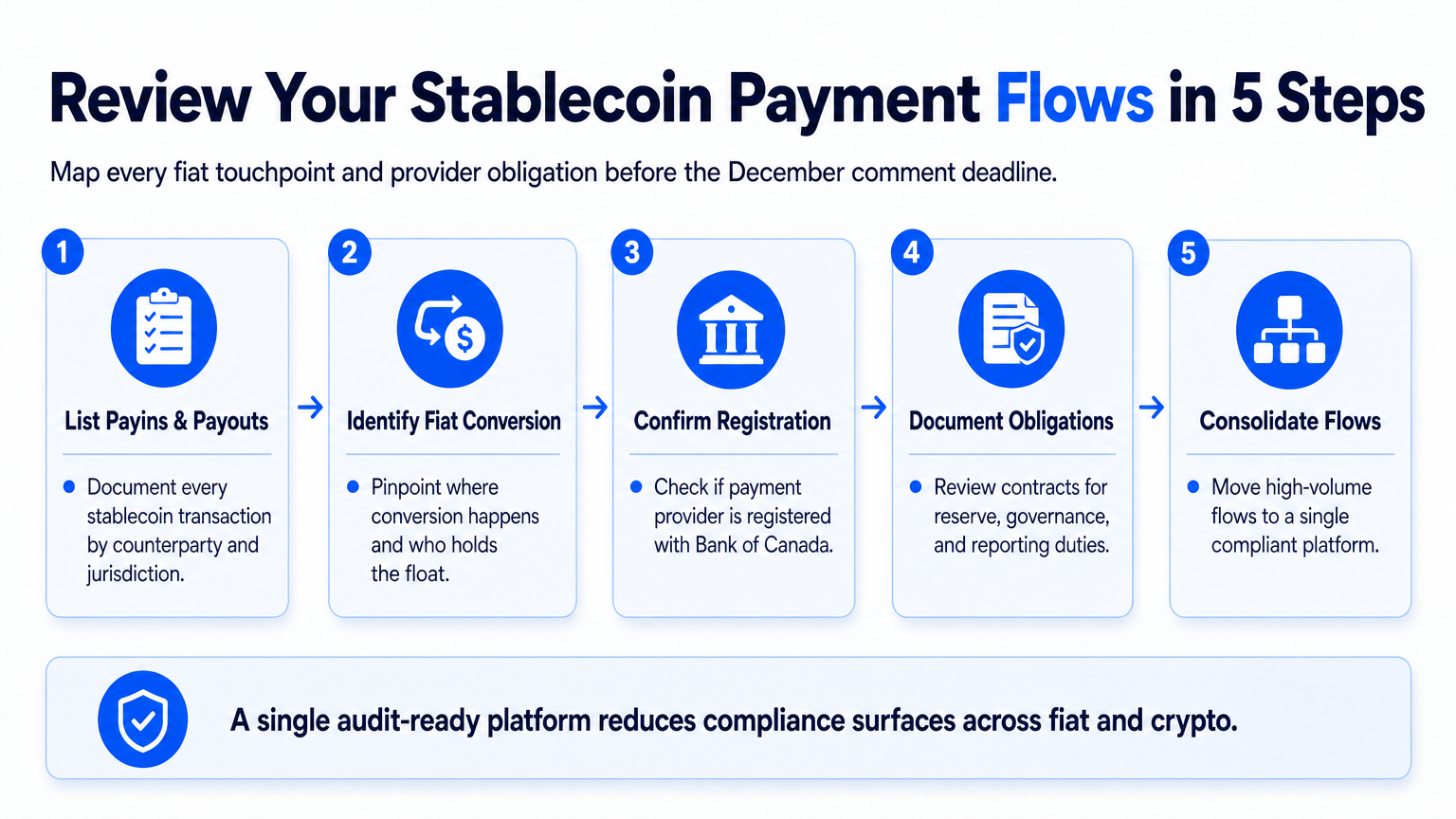
Review your stablecoin payment flows: senders, receivers, and the fiat touchpoints
Before December 23, 2026, finance leads should be able to answer these without a spreadsheet:
- List every stablecoin payin and payout, including counterparty jurisdiction and whether it touches Canada.
- Identify where fiat conversion happens and who holds the float.
- Confirm whether your payment provider is already registered with the Bank of Canada.
- Document reserve, governance, and reporting obligations that flow through your contracts.
- Move high-volume flows to a single platform that can produce compliant records across fiat and crypto rails.
This exercise also surfaces hidden FX costs and duplicate custody arrangements.
Move operations to a platform that treats fiat and crypto as a single stack
A fiat crypto banking platform removes the separation between a bank account and a stablecoin wallet. OneSafe is a financial technology company, not a bank; banking services are provided through partner banks. Its account structure supports fiat and crypto transactions in one interface—USD, Euro, and CAD accounts plus USDC deposits and withdrawals—reducing the number of separate compliance relationships a business must manage when stablecoin regulation Canada tightens.
Use multi-currency accounts and automated FX to minimize exposure and cost
Multi-currency accounts reduce forced conversions. Holding CAD, USD, and Euro alongside stablecoins lets you choose when to convert. Automated stablecoin FX conversion shortens the window between receiving USDC and funding a fiat invoice, reducing unnecessary conversion events.
Leverage segregated, regulated custody (Fireblocks) and role-based controls for DAOs
For DAOs, the stakes are higher. A DAO stablecoin treasury should not sit in a single hot wallet controlled by one admin key. Segregated custody via Fireblocks, combined with role-based permissions, creates an approval trail that can be shown to a regulator or banking partner. OneSafe, for instance, combines Fireblocks-secured digital asset custody with customizable roles and permissions for DAOs, so spending authority and treasury control are not concentrated in one place.
Keep onboarding, invoicing, and payouts inside one compliance-walled ecosystem
Stablecoin invoice payments are easier to defend when the invoice, payment, and conversion all live in the same system. A unified platform creates the record by default: invoice issued, stablecoin received, conversion executed, fiat settled, and card spend authorized in one ledger.
How can I accept or send stablecoin payments while staying compliant?
Use a regulated on-ramp/off-ramp provider, keep documentation for every conversion and counterparty, and do not treat stablecoins as outside ordinary fiat compliance. The Canadian proposal regulates the infrastructure around stablecoin payments, so choosing providers that can evidence governance, reporting, and reserve-related obligations is now part of staying compliant.
What should I do now to prepare for stablecoin regulation in my core markets?
First, map every stablecoin flow that touches Canada. Second, submit comments before December 23, 2026 if your business has material exposure. Third, audit your payment partners across all core markets because other jurisdictions are moving in the same direction. Fourth, consolidate fiat and crypto operations onto one platform so future changes do not require rebuilding your payment stack.
Why choose a fiat‑plus‑crypto platform over a standalone stablecoin gateway?
A standalone gateway still requires a separate bank for the fiat leg. That creates two compliance surfaces, two reconciliation processes, and two sets of onboarding documents. A fiat-plus-crypto platform collapses those dependencies into one account structure, one ledger, and one reporting view. When a regulator asks for the fiat leg of a stablecoin payment, the answer should be in the same system as the chain settlement, not in a separate banking portal.
How do DAOs handle stablecoin treasury operations when rules tighten?
DAOs should move stablecoin treasury operations behind role-based permissions, segregated custody, and automated payment workflows. That means no single key controls the treasury, contributors are paid through documented invoices, and the DAO can produce records for fiat and crypto activity side by side. A DAO stablecoin treasury that relies on informal multisig alone may work technically, but it becomes harder to reconcile with a regulatory expectation of governance and reporting.
What to Watch Next and Open Questions
Final rule timing and possible grace periods after December 23
The comment window closes on December 23, 2026, but no final rule date has been published and no grace period has been confirmed. Businesses should plan for a possible implementation lag, but not assume one. Treat the draft as the shape of the future rule and begin aligning operations now.
How other jurisdictions (EU, UK, Singapore) will react
Canada’s draft does not exist in a vacuum. The EU, UK, and Singapore are each building stablecoin regimes with different triggers and thresholds. Whether Canada’s expanded retail payments oversight becomes a model or an outlier, either outcome raises compliance costs for global operators.
Will the rules accelerate stablecoin adoption or push businesses into permissionless rails?
A regulated framework can make stablecoin payments safer and more acceptable to enterprise counterparties. But if compliance costs are too high, some volume may move to permissionless rails. The balance will depend on how final reserve and reporting obligations are calibrated. For more on how regulatory forums have shaped that balance, see Stablecoin Regulation: What Today’s Forum Means for You.
The missing piece: cross-border coordination between payment oversight bodies
The draft addresses Canada’s domestic perimeter. It does not solve the harder problem: how the Bank of Canada, U.S. federal regulators, and EU authorities coordinate on a stablecoin payment crossing three jurisdictions in one settlement. Until that coordination exists, businesses should keep their own records clear enough to satisfy multiple regulators at once.
Key Takeaways
- Canada’s proposed stablecoin rules were published on October 24, 2026, with comments due December 23, 2026, covering issuer qualifications, reserve assets, reporting, and expanded retail payments oversight.
- Businesses using stablecoin payments should map every fiat touchpoint now, because the compliance obligation will concentrate where stablecoins convert to CAD, USD, or EUR.
- A fiat-plus-crypto platform reduces the number of separate banking and payment relationships a business must reconcile when regulation tightens.
- DAOs should move stablecoin treasuries behind segregated custody, role-based controls, and documented invoicing rather than relying on informal multisig setups.
- No final rule date or grace period has been confirmed; the safest planning assumption is that the draft is the shape of the future rule.
For teams managing compliance-heavy content workflows, Joyrise can draft and publish SEO articles to Webflow, WordPress, or Shopify automatically, but it does not replace reading the final rule text.
To bring your fiat and stablecoin payment operations into a single compliance-ready account, explore OneSafe.