Table of Contents
- title: "Stablecoin Payments: The AI Agent Alliance Explained" meta_description: "Rain's Agentic Payments Alliance, with Visa, Mastercard, Circle, and others, is building standards for AI agent payments. What this means for stablecoin payments and businesses."
- The Alliance That Just Changed Stablecoin Payments
- Why This Matters for Global Businesses Today
- Background: Stablecoin Payments Are Already Moving Money
- What the Alliance Actually Does: Standards for Agentic Money
- Preparing Your Business: Infrastructure for Programmable Stablecoin Payments
- What to Watch Next
- FAQ
- Key Takeaways
title: "Stablecoin Payments: The AI Agent Alliance Explained" meta_description: "Rain's Agentic Payments Alliance, with Visa, Mastercard, Circle, and others, is building standards for AI agent payments. What this means for stablecoin payments and businesses."
Stablecoin Payments: The AI Agent Alliance Explained
The Alliance That Just Changed Stablecoin Payments
What was announced on August 18, 2026
Rain launched the Agentic Payments Alliance, a 26‑member coalition tasked with building shared standards for how AI agents prove identity and spending authority, Startup Fortune reported on August 24, 2026. The move lands at a moment when stablecoin payments already move billions in value daily — and now those rails need to accommodate software that spends on its own.
The announcement is not a white paper. It is an operational standards effort backed by payments incumbents, crypto infrastructure providers, and compliance firms who see agentic spending as a near‑term volume driver.
The 26 players: from Visa and Mastercard to Circle and Solana
Members include Visa, Mastercard, Circle, Solana, Uniswap Labs, Fiserv, Fireblocks, Chainalysis, and Remitly — card networks, a major stablecoin issuer, a layer‑1, a DEX, an acquirer, a custody provider, a blockchain analytics firm, and a remittance platform. Bringing Visa and Mastercard, who already run competing agent‑payment protocols, under one umbrella aims to prevent a fragmented, proprietary lock‑in future before it hardens.
The core problem: how does an AI agent prove who it’s acting for?
When a human initiates a payment, identity and authorization rely on decades‑old rails. An AI agent — configured to pay an invoice or settle a smart contract — has none of those affordances. The Alliance will define interoperable standards for three questions:
- Who does the agent represent? (identity binding)
- What is it allowed to spend? (limits, scope, delegation)
- How does a counterparty verify both in real time? (authentication handshake)
Without shared answers, every bank and wallet builds its own layer — the same mess that plagued early digital identity.
Why This Matters for Global Businesses Today
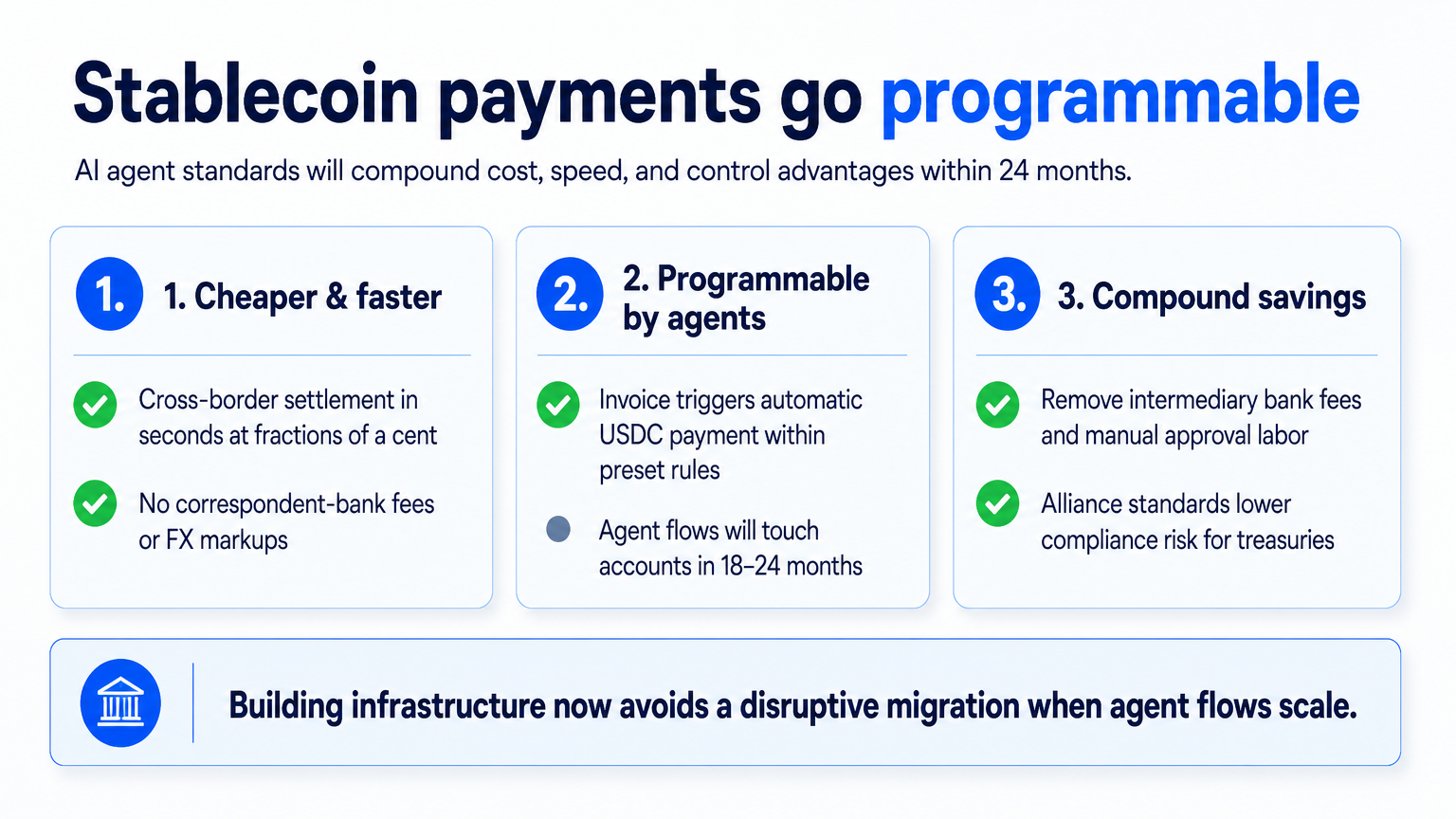
Stablecoin payments are already cheaper and faster — now they’re becoming programmable
Cross‑border stablecoin payments settle in seconds at fractions of a cent on networks like Solana, without correspondent‑bank fees. McKinsey’s analysis of tokenized cash and next‑gen payments confirms that programmability compresses costs and enables real‑time treasury operations. The Alliance adds a logic layer on top: a supplier invoice triggering an automatic USDC payment within preset rules — the shift from cheaper wires to autonomous commerce.
AI agents will soon be a normal part of payment flows
Rain CEO Farooq Malik put it bluntly: “No single company should get to decide how agents transact on someone’s behalf.” Mastercard launched Agent Pay for Machines in June 2026, and Google Cloud announced its Agents‑to‑Payments Protocol (AP2). The Alliance tries to make those protocols talk to each other. For finance leads, agent‑driven payment flows will touch your accounts within 18–24 months, whether you deploy them or receive them.
Cost, speed, and control advantages are about to compound
Today a startup might use Circle’s APIs to send USDC payouts programmatically. Tomorrow it can delegate a recurring payment decision to an agent with guardrails — pay up to $5 000/mo if the invoice matches the PO, settle in USDC, log to the ERP. Savings compound because you remove both intermediary bank fees and the labor of manual approvals. The Alliance makes that delegation ledger‑agnostic and verifiable, lowering the compliance risk that keeps treasuries on the sidelines.
Background: Stablecoin Payments Are Already Moving Money
How stablecoin payments work for cross‑border B2B
A business holds USDC, sends it to a counterparty’s wallet, and it settles on‑chain in seconds. The recipient can hold USDC, convert to fiat via an on/off‑ramp, or route into DeFi. No correspondent bank chain, no layered FX markups, no cutoff times. The IMF has noted that stablecoins improve payments and global finance by decoupling the medium of exchange from legacy messaging.
Current adoption: Circle, Stripe, Paxos, and the API ecosystem
Circle’s USDC payments infrastructure powers on‑chain settlement through programmable wallets and APIs. Stripe reintroduced stablecoin payments in 2024 and expanded pay‑in and payout capabilities. Paxos issues regulated stablecoins and provides white‑label settlement. The API layer is mature enough that a business no longer needs in‑house blockchain engineers.
The regulatory backdrop: GENIUS Act, CLARITY Act
The GENIUS Act (2025) set a federal framework for payment stablecoin issuers. The CLARITY Act, which would provide a broader digital asset framework, remains stalled in Congress as of August 25, 2026, according to Startup Fortune. That vacuum lets industry‑led standards like the Alliance fill the gap.
What the Alliance Actually Does: Standards for Agentic Money
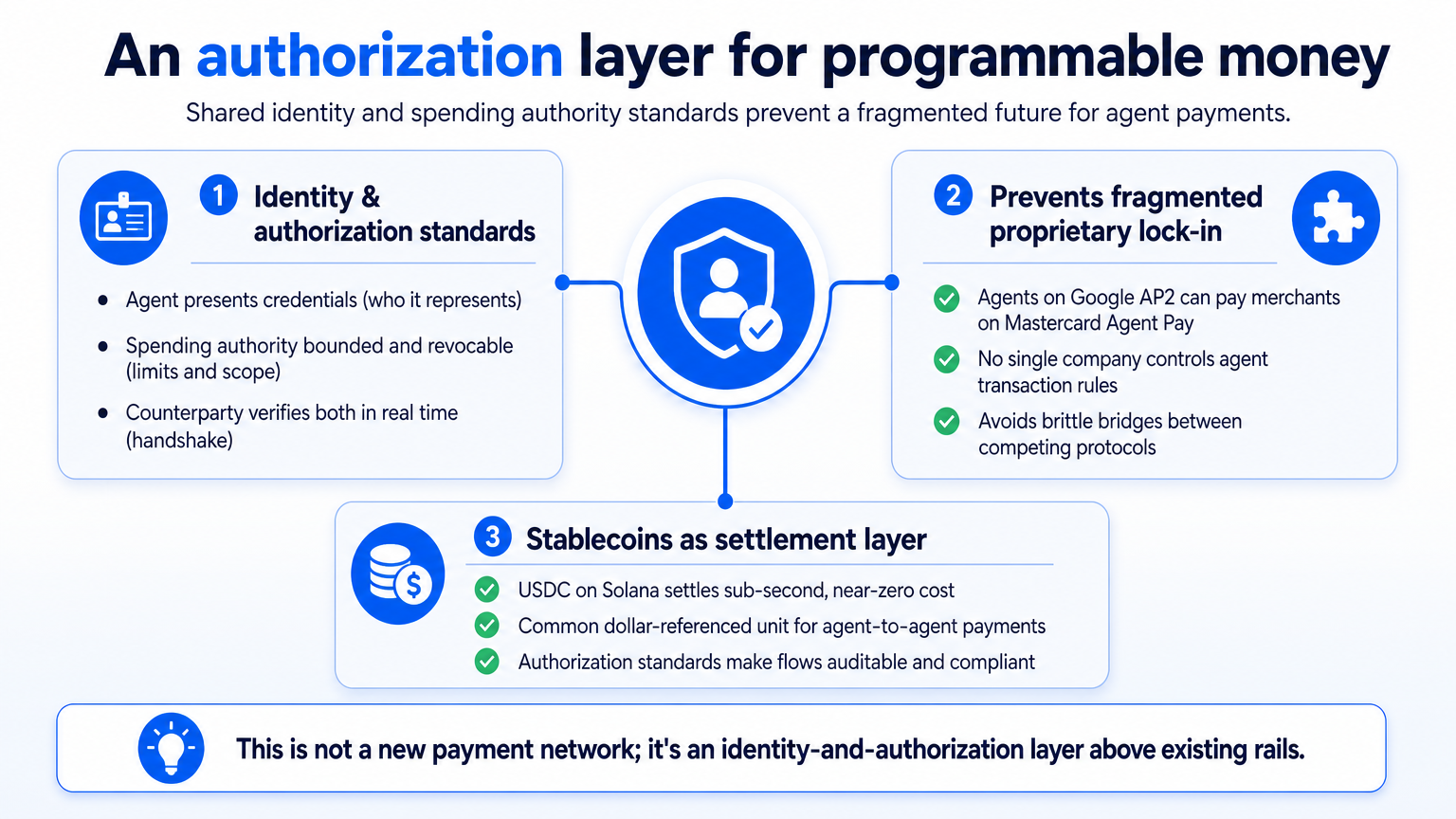
Shared identity and authorization protocols for AI agents
The Alliance writes specifications for how an agent presents credentials, how a rail verifies them, and how spending authority is bounded and revocable — essentially OAuth for money. It is not a payment network. It is an identity‑and‑authorization layer above existing networks (VisaNet, Mastercard, blockchains) and below the application layer where agents run.
Why this prevents a fragmented future
Without shared standards, an agent configured on Google’s AP2 couldn’t pay a merchant running Mastercard’s Agent Pay without a brittle bridge. Competitors agreeing on plumbing prevents that. a16z’s fintech team framed the problem in May 2025: the agent payments stack needs open identity and authorization standards, or every AI checkout becomes a walled garden.
How stablecoins become the settlement layer for agent‑to‑agent payments
Stablecoins offer an always‑on, programmable rail. A USDC transfer on Solana settles sub‑second at near‑zero cost without a merchant account. When an agent pays another agent — a freight‑booking bot settling with a warehouse bot — a Circle stablecoin provides a common, dollar‑referenced unit. The Alliance’s authorization standards make that flow auditable and compliant, addressing AML and KYC concerns.
Preparing Your Business: Infrastructure for Programmable Stablecoin Payments
| Step | Action | Why |
|---|---|---|
| 1. Consolidate treasury | Open a platform account holding both fiat and USDC with on/off‑ramps | Single source of truth for balances when agent flows arrive |
| 2. Issue controllable corporate cards | Virtual cards with per‑vendor, per‑transaction limits, eventually API‑triggered | Agent spending needs pre‑set boundaries |
| 3. Automate a cross‑border payment in stablecoins | Shift one recurring payment to USDC settlement | Tests operational muscle before agent flows multiply |
| 4. Map authorization logic | Document which payments follow fixed rules (invoice matches PO, under limit, to known party) | These are the first flows an agent can execute; the Alliance will encode exactly this delegation |
| 5. Monitor Alliance draft specs | Track Rain’s outputs and prepare payment API integrations | Early alignment cuts later adoption cost |
How OneSafe fits
A platform like OneSafe — multi‑currency accounts, corporate cards with spend limits, native USDC on/off‑ramps — collapses steps one through three into one interface. Businesses that already manage fiat and stablecoin operations through a unified neo‑banking platform won’t need to build bridges between bank and wallet when agent standards arrive. That matters because the Alliance’s authorization layer will plug into existing endpoints; an endpoint that natively speaks both fiat and crypto eliminates the integration tax fragmented stacks will pay.
Cross‑border stablecoin payments are already reshaping how businesses move money, as Asia’s hubs show. The Alliance accelerates that trend by layering automation onto the settlement rail.
What to Watch Next
Will the CLARITY Act move, or will industry standards become de facto?
With CLARITY stalled, the Alliance’s standards embed deeper in production stacks. Regulators will likely codify what the industry built, following the GENIUS Act pattern.
The interoperability race
Visa and Mastercard each have agent‑payment protocols; Solana and Ethereum have different assumptions. The Alliance’s credibility rests on producing standards that work across all stacks without favoring one. If it fails, fragmentation will happen under its own banner.
When will we see the first AI‑agent B2B stablecoin payment at scale?
Circle provides settlement, Mastercard and Visa provide network endpoints, Fireblocks custody, Chainalysis compliance, and Rain the authorization plumbing. A pilot B2B payment where an agent triggers, verifies, and settles a USDC invoice without human intervention is likely within 12 months from a crypto‑native enterprise.
FAQ
What is the Agentic Payments Alliance?
A 26‑member coalition launched by Rain on August 18, 2026 — including Visa, Mastercard, Circle, Solana, and others — building standards for how AI agents prove identity and spending authority.
How will this alliance affect stablecoin payments?
It will make stablecoin payments programmable‑by‑default with an open authorization layer, letting businesses delegate payments to agents with preset limits without vendor lock‑in.
What does it mean for global companies and Web3 startups?
Cross‑border crypto payments will execute without manual approval, compressing time and cost. For Web3 startups, agent‑payment standards will be compatible with existing decentralized infrastructure, not require a migration to card rails.
What should a business do now to prepare?
Consolidate fiat and stablecoin treasury, issue controllable corporate cards, shift a recurring payment to USDC, and document automatable payment decisions — the Alliance is standardizing that bounded delegation.
How does the stalled CLARITY Act impact the standards?
It creates a vacuum, making Alliance standards the de facto rulebook. Businesses aligning with them are following the emerging private‑sector standard regulators will likely codify later.
What role does OneSafe play?
It’s the operational bridge — a single platform for fiat and USDC, corporate cards, and cross‑border payments, ready to absorb Alliance agent‑authorization standards without separate banking and crypto infrastructure.
The Web3 payments shift challenges whether businesses need traditional banks at all, and the Alliance adds a machine‑driven spending layer that legacy banking interfaces weren’t designed to support. The surge in stablecoin payments paired with crypto card spending already shows businesses routing more volume through these rails; the Alliance adds the automation logic to multiply that volume.
Key Takeaways
- The Agentic Payments Alliance (26 members, August 2026) is building open standards for AI agent identity and spending authorization — the authorization layer all networks will need.
- Programmable money moved by agents will touch business accounts within 18–24 months; building fiat‑plus‑stablecoin infrastructure now avoids a disruptive migration.
- The stalled CLARITY Act leaves industry standards as the de facto compliance baseline; early alignment reduces regulatory risk.
- A unified platform holding fiat and USDC, with controllable cards and automated cross‑border payments, is the stack that plugs directly into agent‑payment protocols.
- The first scaled AI‑agent B2B stablecoin payment is likely within 12 months, making current infrastructure decisions a competitive timeline issue.
For businesses ready to bridge fiat and crypto operations on a single platform built for the agent‑driven payment era, open a OneSafe account and start onboarding today.