
Stablecoin payments for B2B are moving from conference-panel speculation into concrete export infrastructure. On August 28, 2026, Businesskorea reported that digital-asset custody firm BDACS and Devall Co., operator of the B2B invoicing and collection service Chungoose, are jointly building a system that lets overseas buyers pay Korean exporters in stablecoins with the proceeds settled in won. The key design decision: exporters are not expected to hold digital assets themselves.
Table of Contents
- What just happened: Korea’s stablecoin settlement pilot
- Why this matters for finance leaders now
- Stablecoin payments 101: a quick primer for newcomers
- What the Korea pilot teaches us about the future of B2B payments
- How global businesses can prepare for stablecoin payments
- What to watch next: open questions and roadblocks
- Key Takeaways
What just happened: Korea’s stablecoin settlement pilot
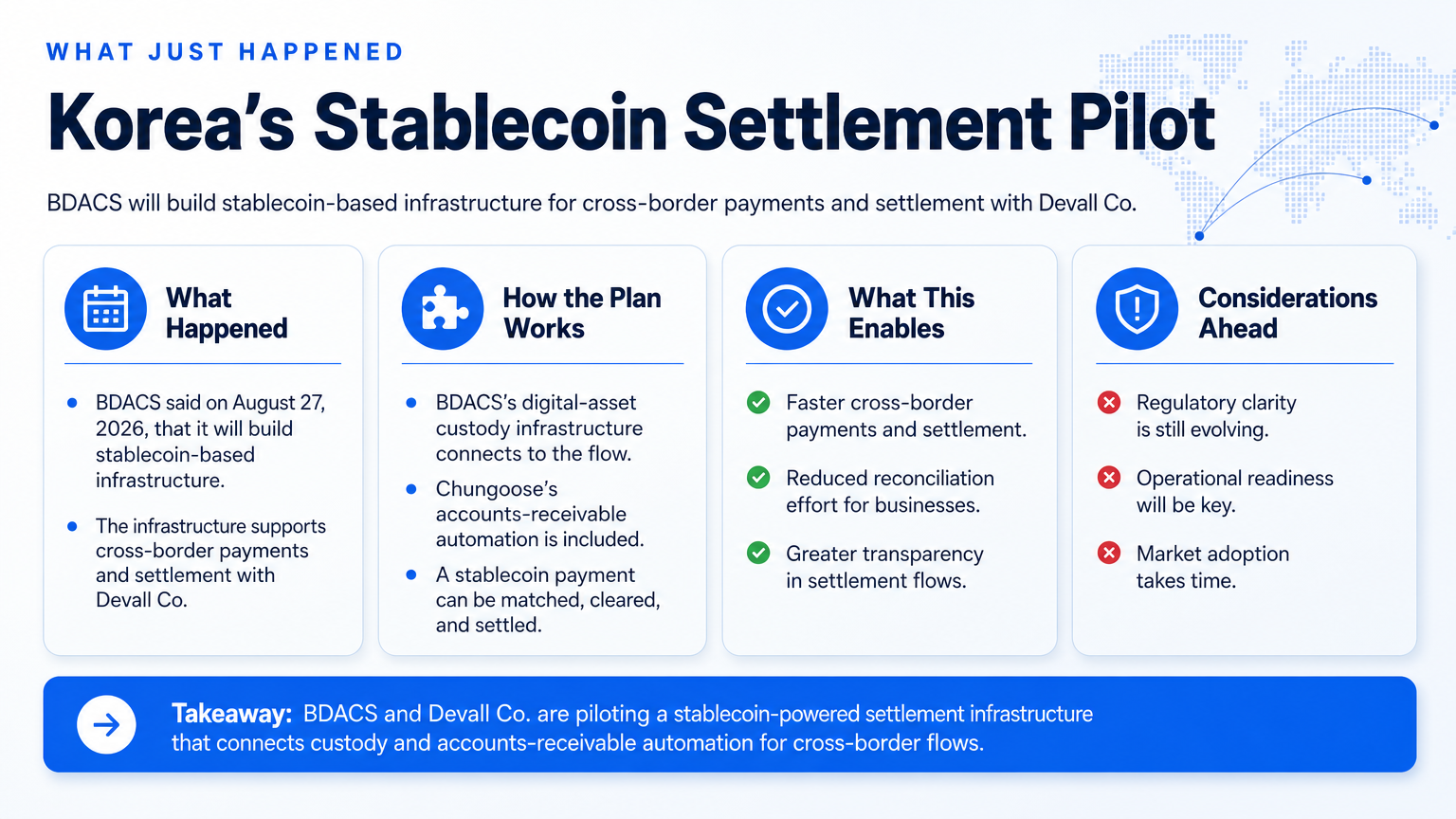
BDACS said on August 27, 2026, that it will build stablecoin-based infrastructure for cross-border payments and settlement with Devall Co. The plan joins BDACS’s digital-asset custody infrastructure with Chungoose’s accounts-receivable automation so a stablecoin payment can be used for commercial trade collection.
The system is described as a one-stop structure covering the process from invoice issuance through payment and settlement. In practice, an overseas buyer can pay in stablecoins, and the Korean exporter receives won. The exporter is contractually entitled to fiat settlement, not to a permanent crypto balance.
| Element | Reported detail |
|---|---|
| Anchor participants | BDACS, a digital-asset custody firm; Devall Co., operator of Chungoose |
| Announcement date | BDACS statement on August 27, 2026; reported by Businesskorea on August 28, 2026 |
| Payment flow | Overseas buyer pays in stablecoins; Korean exporter settles in won |
| Custody burden | Exporters do not hold digital assets themselves |
| Scope | B2B invoicing, collection, and settlement for commercial trade |
| Live status | Being developed; no reported launch date or transaction volume |
What is the Korea stablecoin settlement pilot?
The Korean exporter stablecoin pilot is a commercial build-out, not a central-bank project. The BDACS Devall stablecoin system combines custody and invoicing collection so that a Korean exporter can offer a stablecoin payment option to an overseas buyer while the settlement in won occurs behind the scenes. The announced goal is faster receipt and lower cost than conventional cross-border collection, without asking the exporter to add crypto to its balance sheet.
This is cross-border stablecoin settlement infrastructure aimed at a specific pain point: the exporter’s receivable arrives through a crypto rail, but the working capital lands in traditional bank money.
Why this matters for finance leaders now
The cost and speed advantage over legacy rails
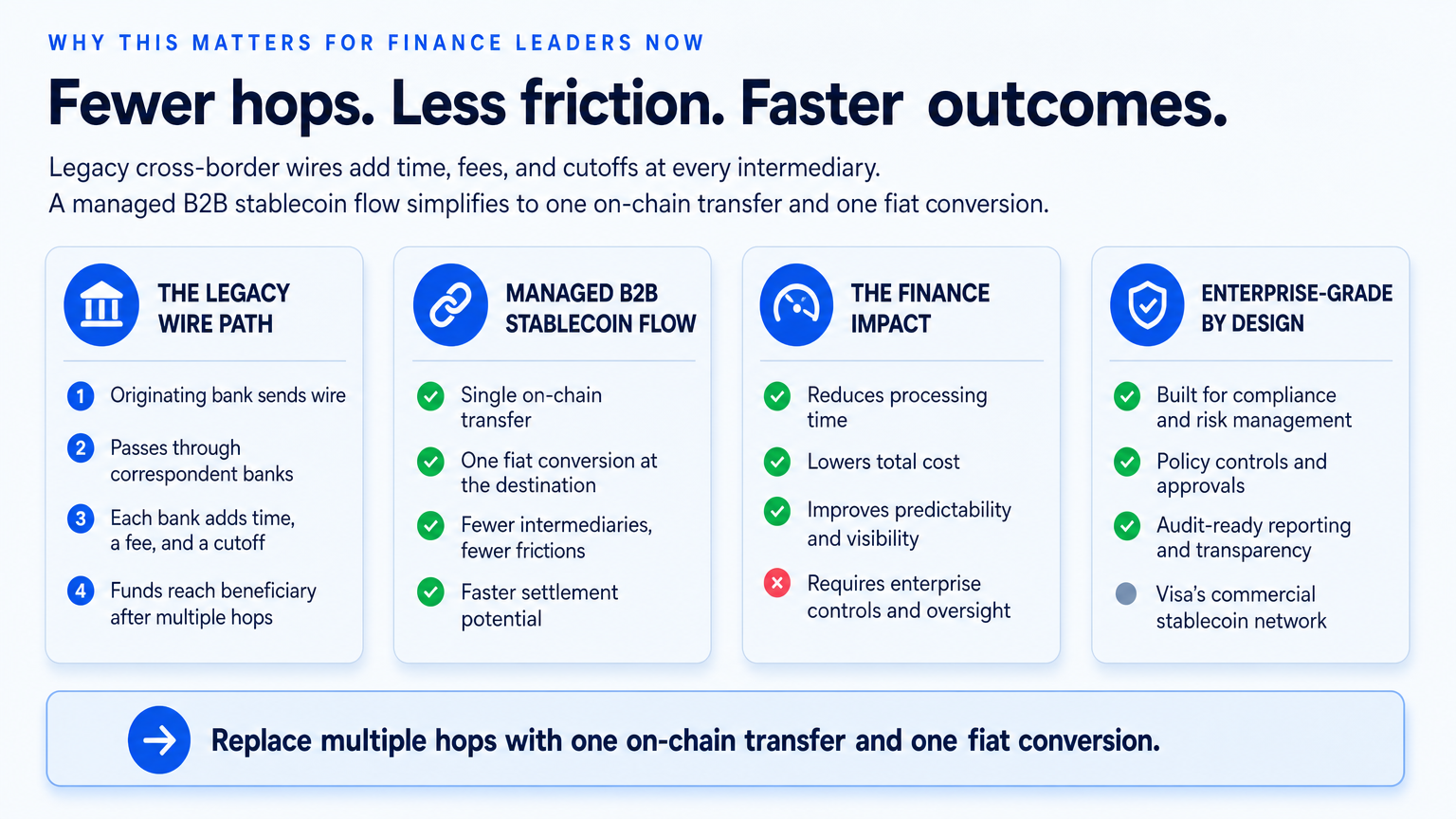
Legacy cross-border wires typically pass through multiple correspondent banks, each adding processing time, a fee, and a cutoff window. A managed B2B stablecoin flow can replace several intermediary hops with a single on-chain transfer plus one fiat conversion. Visa’s commercial resources describe B2B stablecoin payments as always-on settlement; Fipto’s guide similarly emphasizes settlement in minutes rather than days.
The cost argument is not only about the transaction fee. It also includes reducing the pre-funding that firms keep in local accounts, cutting the FX spread on multiple conversion layers, and shortening days sales outstanding.
How do stablecoin payments reduce costs for cross-border B2B transactions?
The stablecoin FX cost savings come from compressing three cost centers into one. A traditional route may charge for intermediary bank handling, FX conversion, and cross-border transfer. A B2B stablecoin flow can convert once, near the point of settlement, and use the stablecoin as a transit asset rather than a stored balance.
For a Korean exporter in the BDACS-Devall model, the buyer’s stablecoin payment is immediately turned into won by the service layer. The exporter avoids holding USDC or USDT, and the FX risk window shrinks from days to the time it takes to complete conversion and local settlement.
Regulatory tailwinds making B2B stablecoins viable
The payments industry is moving in the same direction. Payments Dive has reported that Mastercard and PayPal are considering stablecoins for B2B payments. That matters because these are familiar enterprise payment brands, not crypto-native startups. Meanwhile, stablecoin payments in Asia’s hubs already lead the way, and the UK is reshaping its approach to stablecoin innovation in a way that could make business use easier. As the Korean structure shows, the question is shifting from “can this settle?” to “how do we run it operationally?”
Stablecoin payments 101: a quick primer for newcomers
Key stablecoins for payments today
USDC and USDT dominate payment use cases. USDC for business payments is especially common because of its issuer transparency and integrations with enterprise payment providers. Stripe’s explainer on B2B stablecoin payments notes that businesses can accept stablecoins and receive fiat settlement, which is the same posture the Korean system proposes.
The important distinction for treasury teams: stablecoins are a payment rail, not an investment. In B2B use, the goal is short holding periods and defined conversion points.
From consumer to B2B: the evolution of real-world use cases
Consumer remittances and cross-border person-to-person transfers were the first clear stablecoin use case. B2B is a harder test because invoicing, purchase orders, reconciliation, and local tax treatment all introduce friction. Modern Treasury’s stablecoin analysis frames B2B as the natural next stage because corporate payers need always-on settlement without waiting for banking hours. The Korean project is structurally different from consumer remittance: it runs through an invoicing and receivable system, not a wallet-to-wallet app.
What the Korea pilot teaches us about the future of B2B payments
The infrastructure stack: custody, conversion, and compliance
The Korean system previews what a production B2B stablecoin flow actually requires: a custodian to receive and secure the digital asset, an invoicing layer to tie the payment to a specific receivable, an FX and liquidity layer to convert the asset into won, and a compliance layer to handle identity, sanctions screening, and transaction monitoring.
None of that is visible to the buyer or the exporter. The buyer pays an invoice in stablecoins; the exporter sees a won collection. The infrastructure works in the background, which is why this model can appeal to risk-averse finance teams that do not want a crypto treasury.
What infrastructure is required for businesses to accept stablecoins without holding crypto?
For a business asking how to accept stablecoin payments for business without opening a crypto position, the answer is a managed fiat-settlement flow. The required stablecoin payment infrastructure has five layers:
- A crypto payment gateway for businesses that generates an invoice-specific payment instruction and records the receivable.
- A licensed or regulated custodian that receives the stablecoin and controls the private keys.
- A conversion and liquidity provider that turns USDC or another stablecoin into the destination fiat currency.
- A compliance stack covering KYB/KYC, sanctions screening, travel-rule data, and transaction monitoring.
- A fiat settlement account that credits the exporter in local currency.
The payer’s stablecoin is a transit asset, not a permanent balance. For finance leaders, the practical test is whether the provider can settle a receivable in fiat by default. Some hybrid platforms, such as OneSafe, already combine multi-currency fiat accounts with crypto on/off-ramps, corporate cards, and wire support, which can reduce the number of systems a treasury team has to reconcile.
How this model reduces FX risk and accelerates cash flow
The Korean structure shortens two costly moments in an export cycle: the time between invoice issuance and payment receipt, and the time the exporter is exposed to FX movement. If a stablecoin arrives and is converted to won in a tightly managed window, the exporter does not carry USDC volatility or a long won/dollar exposure.
Accelerated cash flow is the more immediate benefit. Faster settlement means the receivable is available for working capital sooner, which matters more than a few basis points of fee difference for many exporters.
How global businesses can prepare for stablecoin payments
How can finance leads prepare their companies for stablecoin payment adoption?
Start with a short self-assessment before changing any banking relationship:
- Identify which currency pairs and corridors create the most FX cost and settlement delay.
- Confirm which counterparties would actually pay in stablecoins if given a clean invoice option.
- Decide on a default settlement posture: fiat-only, stablecoin-held, or hybrid.
- Test one small receivable with a provider that supports fiat settlement from stablecoin acceptance.
- Document accounting treatment, reconciliation steps, and approval limits before scaling.
That sequence keeps the finance function in control of the decision rather than reacting to an individual client request.
Questions to ask a payment platform or custodian
Before selecting a partner, treasury and finance leads should ask:
- Is fiat settlement the default, or does the business receive crypto unless it opts out?
- Who is the licensed custodian, and in which jurisdiction is it regulated?
- What happens to the receivable if the stablecoin loses its peg during conversion?
- Are conversion fees, custody fees, and settlement cutoffs disclosed upfront?
- How are compliance checks embedded in the payment flow?
- What reconciliation data will the platform provide to the accounting team?
Ask for a documented fiat-settlement default, not just crypto acceptance. A platform that only offers a wallet is not the same as one that manages custody, conversion, and bank settlement as a single flow.
Building a stablecoin-friendly treasury policy
A treasury policy should state which stablecoins are acceptable, what the maximum holding period is, who authorizes conversion, and how gains or losses from conversion are recorded. It should also address the control environment around fiat and crypto accounts. Finance teams that already use global or multi-currency accounts should review the operational risks before adding a stablecoin rail; a practical look at global account risks is a useful starting point.
What to watch next: open questions and roadblocks
Will more countries follow Korea’s lead?
The Korean case is a commercial initiative, not a government mandate, so its significance depends partly on whether regulators allow the won-settlement leg to scale. Singapore, Hong Kong, and other Asian hubs already have active stablecoin regulation and institutional infrastructure, which makes regional expansion plausible. The deeper question is whether exporters in other markets will demand the same option from invoicing platforms and banks.
The regulatory puzzle: GENIUS Act and beyond
The U.S. framework remains the largest unresolved piece. The GENIUS Act is the most visible U.S. attempt to establish payment stablecoin rules, but reserve, redemption, and custody requirements are still being finalized. In the UK, regulators are moving toward a more innovation-friendly stablecoin regime, as covered in OneSafe’s UK stablecoin regulation analysis. The Korean pilot sits inside a broader regulatory puzzle: enterprises want clear rules on custody, conversion, and settlement before they commit material receivable volume.
What stablecoin regulations are emerging in 2026?
Stablecoin regulations in 2026 are bifurcating between regimes that treat stablecoins primarily as payment instruments and those that impose broader asset rules. The U.S. GENIUS Act, UK innovation-focused reforms, and Asian financial hubs’ payment licensing frameworks are the main watch points. For corporate treasuries, the practical question is not whether stablecoin payments are legal, but whether a given corridor has a licensed custodian, a clear settlement path, and enforceable redemption rules. The Korean structure only works as a B2B payment system if those legal foundations are in place.
Key Takeaways
- A commercially built Korean exporter stablecoin pilot is pairing BDACS custody with Chungoose invoicing to settle stablecoin payments in won without making exporters hold crypto.
- Stablecoin B2B payments reduce cost mainly by collapsing correspondent banking hops and FX conversion layers into one controlled settlement flow.
- The operational requirement for fiat-settled stablecoin acceptance is custody, conversion, compliance, and a fiat settlement account—not a corporate crypto wallet.
- Finance teams should evaluate any stablecoin provider on whether fiat settlement is the default and how conversion risk is managed.
- The main unresolved variables are U.S. stablecoin legislation, UK implementation, and whether other export markets replicate Korea’s custody-plus-invoicing model.
Start with a fiat-settled stablecoin flow before building a crypto treasury: see how OneSafe’s global business accounts can bridge fiat and stablecoin payment rails.