What are the risks of a global account? For businesses operating across currencies and, increasingly, between fiat and crypto, the question isn’t theoretical—it’s a daily operational reality. A global account consolidates multi-currency capabilities, foreign exchange, and often crypto transactions into a single interface, but that convenience layers traditional cross-border banking risks with unspoken pitfalls unique to neo-banking and digital assets. This risk map cuts through the consensus to expose what legacy providers, neo-banks, and crypto-native platforms often leave unexamined, helping you make an informed decision about your financial infrastructure.
Table of Contents
- Direct Answer: The Risk Map of a Global Account
- The Core Risks Every Global Account Carries
- Where the Consensus Falls Short: Risks No One is Talking About
- Adjudicating the Disagreement: Unified Fiat-Crypto Platforms— Risk Reducer or Concentrator?
- Real-World Impact: What Sovereign Debt Flows Mean for Your Multi-Currency Balances
- What to Look for in a Global Account Provider: A Risk-First Checklist
- FAQ: Your Most Pressing Questions Answered
- Key Takeaways
Direct Answer: The Risk Map of a Global Account
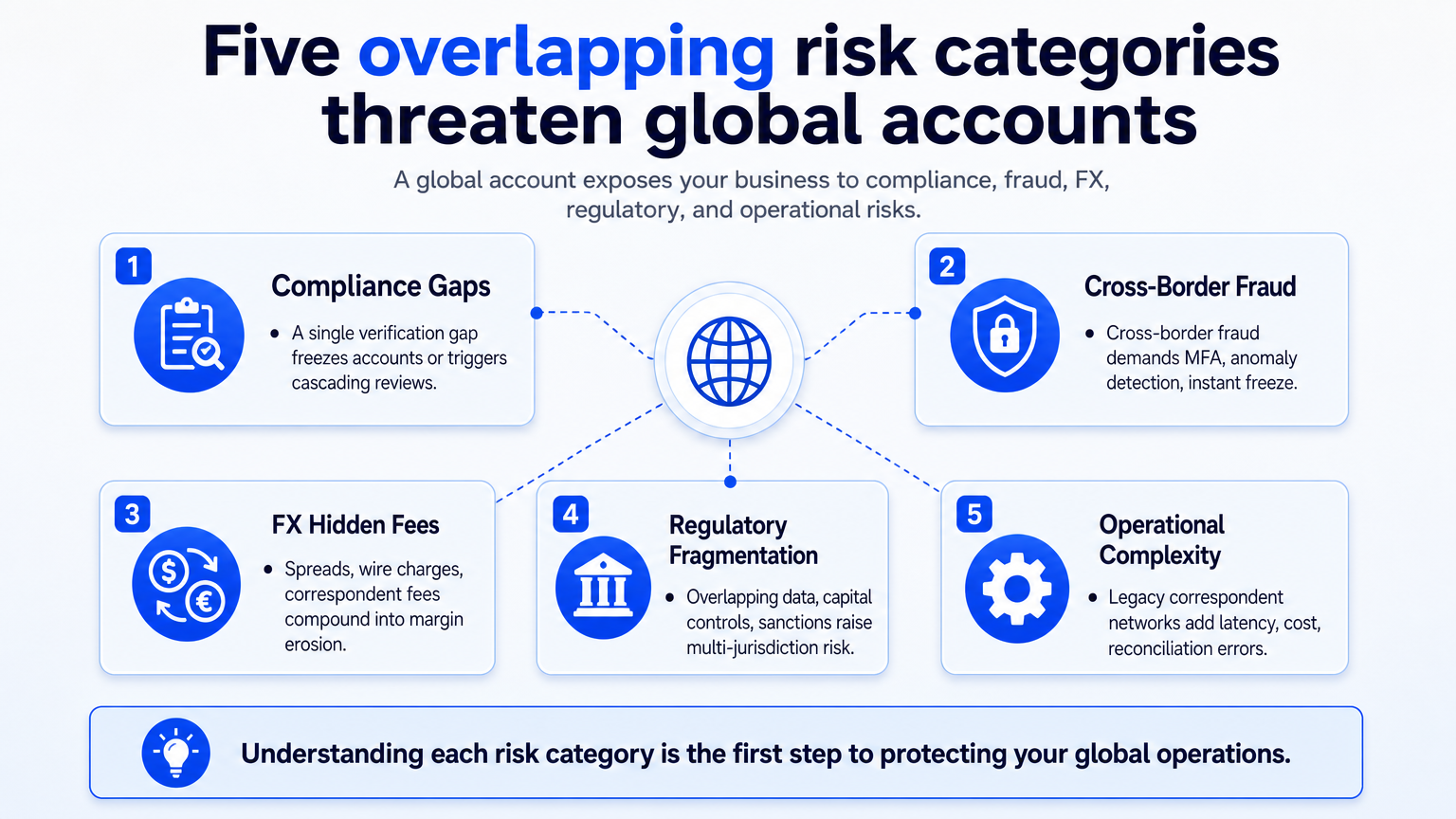
A global account exposes your business to five overlapping risk categories: compliance and verification gaps, cross-border fraud and account takeover, FX volatility and hidden fees, regulatory fragmentation, and operational complexity. When crypto custody and Web3 operations are added, those risks amplify with volatility, custody mismatches, and compliance blind spots for decentralized organizations. The challenge isn’t avoiding risk entirely—it’s identifying which provider structures mitigate rather than concentrate these threats.
The Core Risks Every Global Account Carries
Compliance and Verification Gaps
Cross-border know-your-business (KYB) and anti-money laundering checks must satisfy regulators in every jurisdiction your business touches. A single verification gap can freeze accounts, delay transactions, or trigger a compliance review that cascades across currencies. As J.P. Morgan Private Bank’s insights highlight, fragmentation of regulatory standards across borders significantly raises the cost and complexity of banking relationships. A provider that only verifies at onboarding—without continuous transaction monitoring—leaves you vulnerable to sanctions violations.
Cross-Border Fraud and Account Takeover
Global accounts expand the attack surface. Authorized push payment fraud, business email compromise, and credential stuffing become harder to detect across multiple rails and time zones. The SEC’s investor bulletin on account fraud notes that international accounts are prime targets for takeover because recovery is slow and uncertain. Preventing fraud demands multi-factor authentication, anomaly detection, and instant freeze capabilities—features not all platforms offer by default. As we’ve outlined in drawbacks to neo banking, not every digital platform delivers enterprise-grade security.
FX Volatility and Hidden Fees
FX hidden fees are the most persistent drain. Even when a platform advertises “zero” foreign exchange margin, the true cost often lives in the spread versus the interbank rate, plus flat wire charges and correspondent banking fees buried in fine print. A provider may quote 0.25% but then route through an intermediary that tacks on $20–$50 per transfer. For businesses moving funds regularly, these hidden costs compound into a material margin erosion.
Regulatory Fragmentation Across Jurisdictions
A global account must comply with overlapping regimes—data privacy laws, capital controls, tax reporting, and sanctions lists that differ by country. A single non-compliant transaction can trigger account suspension or legal action in multiple jurisdictions. Morgan Stanley’s guidance on international investing warns that routine cross-border transfers can trigger unexpected tax and reporting obligations because no single regulator provides a unified view. Without a provider that actively tracks regulatory changes, you are self-insuring against compliance gaps.
Operational Complexity and Legacy Middleware
Many global accounts still rely on legacy correspondent banking networks and middleware that introduce points of failure. Each intermediary adds latency, cost, and opacity. If your provider aggregates multiple underlying bank partners without a single pane of glass, reconciliation becomes a manual, error-prone task—the root cause of delayed settlements and cash-flow forecasting errors.
Where the Consensus Falls Short: Risks No One is Talking About
Crypto Volatility and Custody: The Risk Multiplier
Adding cryptocurrency introduces a risk multiplier because crypto custody risks are fundamentally different from fiat. Prices can swing 10% in hours, and if your provider stores your crypto in a commingled hot wallet rather than a segregated, insured custody solution, you face both market risk and counterparty risk simultaneously. Crypto held on a platform isn’t protected by deposit insurance; if the provider fails, you may become an unsecured creditor. Volatility itself can trigger forced conversions or margin calls if the platform offers lending features, turning a simple multi-currency balance into an unplanned exposure.
The DAO and Web3 Compliance Blind Spot
DAO banking compliance is uniquely difficult because most global accounts are built for legal entities with clear beneficial ownership. A decentralized autonomous organization lacks a traditional corporate structure, making standard KYB checks nearly impossible without individual members stepping up as signatories—undermining the DAO’s decentralized ethos. Many platforms simply reject DAOs or apply retail-level KYC to contributors, creating a patchwork that fails both the organization and regulators. Without customizable roles, permissions, and segregated custody, DAOs are forced to operate in regulatory gray zones or fragment their treasury across multiple wallets, increasing operational risk.
Cost Structures Designed to Erode Margins
Beyond advertised fees, hidden costs abound: flat wire fees on both send and receive sides, percentage-based SWIFT charges that scale with volume, and forced currency conversion on incoming payments at unfavorable rates. A $10,000 SWIFT transfer at 0.35% plus a $50 flat fee costs $85, but if the receiving intermediary takes a cut, the total can exceed 1%. Add 3% foreign exchange on card transactions and nightly settlement adjustments, and a business can lose hundreds of dollars monthly without a clear line item. Providers that bundle fees into a single opaque spread make it impossible to optimize routing.
What Asset Segregation Really Covers (and What It Doesn’t)
Asset segregation is often sold as a safety blanket, but asset segregation explained honestly is this: it protects your funds only against the provider’s operating creditors—not against market loss, fraud by your own employees, or operational errors. If a provider segregates client funds in a separate account at a partner bank, those funds should be ring-fenced in the event of the provider’s insolvency. However, segregation does not guarantee the partner bank’s solvency, and it does not cover crypto assets held with a third-party custodian that might fail. Moreover, a fraudulent instruction can still trigger a release of funds; liability often shifts to you. Understanding the precise legal structure—whether the account is in your name or pooled, and which jurisdiction’s law governs—is essential.
The Onboarding Speed vs. Due Diligence Trade-Off
Platforms promising “instant” account opening inevitably cut corners on due diligence. A fully digital onboarding in under an hour may rely on automated document verification that misses sophisticated synthetic identity fraud. A provider that completes robust KYB within a week uses a layered approach balancing speed with manual review for high-risk indicators. By contrast, instant accounts often backload reviews, meaning your account can be frozen days later when compliance catches up—precisely when you can least afford a disruption. The safest path is a provider transparent about onboarding timelines and committed to continuous monitoring, not just point-in-time checks.
Adjudicating the Disagreement: Unified Fiat-Crypto Platforms— Risk Reducer or Concentrator?
The industry splits on whether a single platform handling both fiat and crypto reduces or concentrates risk. Critics argue that mixing the two exposes fiat balances to crypto volatility and creates a single point of failure; proponents counter that a unified interface eliminates the need to move funds between multiple services, cutting the attack surface of third-party APIs.
The truth is that a unified platform reduces risk only when it is built with segregated infrastructure for fiat and crypto, uses institutional-grade custody (such as Fireblocks), and enforces mandatory multi-factor authentication and role-based access controls. That architecture difference is critical, as we detail in our neobank vs digital bank comparison. When those conditions are met, the single source of truth improves visibility and cuts incident response time. A platform like OneSafe, which combines multi-currency fiat accounts with Fireblocks-secured digital asset custody and customizable team roles, demonstrates this principle. However, a poorly architected unified interface that co-mingles hot wallets and fiat accounts under a single security perimeter concentrates risk to an unacceptable degree. The differentiator is the underlying segregation architecture, not the unified user interface.
Real-World Impact: What Sovereign Debt Flows Mean for Your Multi-Currency Balances
Global account risk isn’t limited to your provider’s platform; macroeconomic forces directly affect the value and liquidity of your balances. As Brookings reported in August 2026, the U.S. Treasury is borrowing heavily on global bond markets to finance persistent deficits. When sovereign debt issuance surges, it can strengthen the dollar as global capital flows into Treasuries, but it also raises the yield curve, affecting interest rate differentials and FX volatility. For a business holding EUR or CAD alongside USD, a sudden shift can swing exchange rates several percentage points in a day, increasing the effective cost of holding non-USD currencies and the counterparty risk of foreign bank partners. Providers lacking real-time FX monitoring or stablecoin conversion options expose you to these macro shocks without a buffer.
What to Look for in a Global Account Provider: A Risk-First Checklist
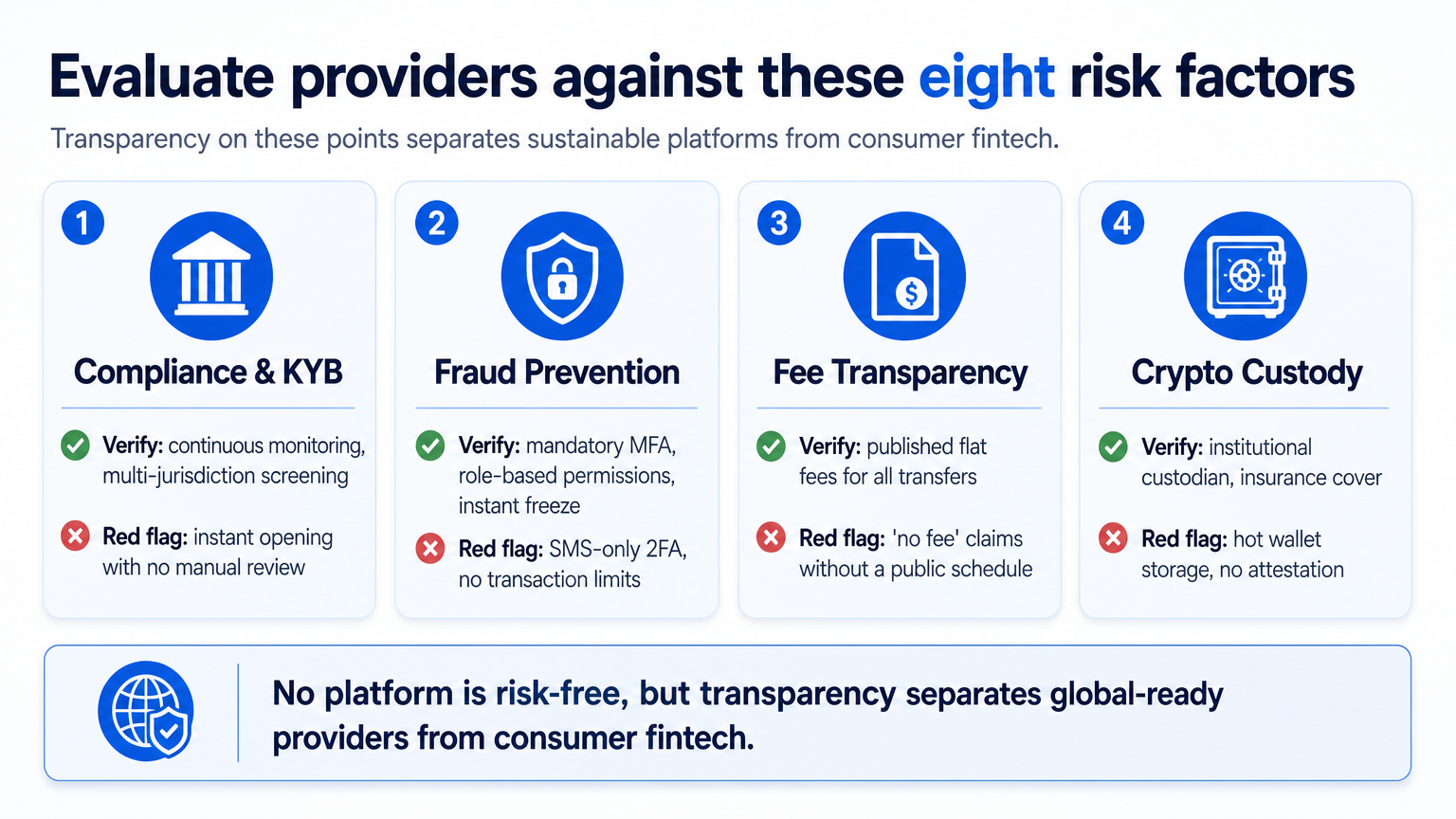
Use this table to evaluate providers against the risks mapped above. For a comprehensive comparison of options, read our guide to the best global bank accounts for business.
| Risk Factor | What to Verify | Red Flags |
|---|---|---|
| Compliance & KYB | Continuous transaction monitoring, multi-jurisdiction sanctions screening, clear beneficial ownership requirements | Instant account opening with no manual review; vague KYB policy |
| Fraud prevention | Mandatory MFA, role-based permissions, instant freeze capability, anomaly detection | SMS-only 2FA, no transaction limits per role |
| Fee transparency | Published flat fees and percentages for wires, SWIFT, FX, crypto conversions; no hidden intermediary charges | “No fee” claims without a public fee schedule |
| Asset segregation | Legal opinion or documentation confirming segregated accounts for fiat; custodian name and insurance for crypto | Commingled funds in a single omnibus account; no clarity on custodian |
| Crypto custody architecture | Multi-signature wallets, institutional custodian (e.g., Fireblocks), insurance cover | Hot wallet storage, no third-party attestation |
| Regulatory coverage | Countries of operation, OFAC/UN sanctions compliance, data privacy certifications | No public list of restricted jurisdictions |
| Onboarding process | Average time to account activation, documents required, ongoing monitoring commitment | “Instant” without KYB; mandatory crypto-only funding |
| Operational resilience | Uptime history, disaster recovery plan, support response times | No dedicated business support, no SLAs |
Evaluate each provider against every row. No single platform is risk-free, but transparency on these factors separates those designed for global businesses from those optimized for consumer fintech.
FAQ: Your Most Pressing Questions Answered
What is a global account?
A global account enables businesses to hold, send, and receive multiple currencies—often including cryptocurrencies—through a single interface, typically provided by a neo-bank or fintech. It combines local currency account details, cross-border payment rails, and FX services to reduce the need for separate banking relationships in each jurisdiction.
How do I protect my business against global APP fraud?
Implement internal controls: mandatory dual authorization for payments over a threshold, confirmation of payment instructions via a separate channel, and daily reconciliation. Choose a provider that enforces strong customer authentication, transaction monitoring, and instant payment freeze capability. Educate your team on social engineering tactics, as the human layer remains the weakest link.
What hidden costs should I expect with a multi-currency account?
Expect flat wire fees ($25–$50), percentage-based SWIFT charges (0.35%+), intermediary bank fees deducted mid-route, forced currency conversion on incoming payments at unfavorable rates, and foreign exchange markups on card transactions (often 3%). Look for a provider that publishes its complete fee schedule, including any partner bank pass-through costs.
Does asset segregation protect all my funds?
No. Segregation protects against the provider’s insolvency by ring-fencing client funds from the firm’s own creditors. It does not protect against market losses, fraud by your own employees, operational errors, or the insolvency of the partner bank or custodian holding the segregated assets. Always verify the exact legal structure and the jurisdiction’s insolvency treatment of segregated accounts.
How can I balance fast onboarding with thorough risk checks?
Choose a provider with a tiered approach: rapid initial verification using automated document checks and registry lookups, with full manual review only for flagged cases. Insist on continuous monitoring after onboarding, so risk doesn’t go unexamined just because the account was opened quickly. Avoid platforms promising truly instant access with no identity verification.
Is a unified fiat-crypto platform safer than using separate services?
It is safer only when the platform maintains strict segregation between fiat and crypto infrastructure, uses institutional-grade custodians, and enforces robust access controls. In that case, the unified interface reduces the attack surface of multiple third-party integrations and accelerates incident response. If these safeguards are absent, a unified platform concentrates risk into a single point of failure and is less safe than using specialized, unlinked services.
Key Takeaways
- Global account risks extend far beyond fraud and FX—compliance gaps, regulatory fragmentation, and hidden correspondent banking fees collectively erode margins if not actively managed.
- Crypto custody and DAO compliance blind spots are the most underappreciated threats; a platform that treats crypto as an add-on without segregated, insured custody multiplies your exposure.
- Asset segregation is a critical safeguard, but it only protects against provider insolvency, not market loss or partner-bank failure—verify the legal structure before assuming fund safety.
- A unified fiat-crypto platform reduces risk when it enforces strong segregation, role-based permissions, and transparent fees; it concentrates risk when these controls are absent.
- When evaluating a provider, demand a public fee schedule, documented compliance monitoring, and a clear onboarding timeline—transparency on these points separates sustainable platforms from those designed to cut corners.
Sign up for an account that brings multi-currency and crypto management into a single, transparent interface at OneSafe.