
Visa’s stablecoin settlement program added the Monad blockchain on November 10, 2026, promising faster stablecoin payments and future privacy features. The move—confirmed by the Monad Foundation and a Visa executive—gives banks and acquirers a new high‑speed network for settlement, potentially reducing finality times and costs. For companies using stablecoin rails, this marks an acceleration in chain diversity and a shift in operational trade‑offs.
Table of Contents
- What just happened
- Why it matters for stablecoin payments
- How stablecoin payments work today
- Concrete implications for your payment stack
- What you should do now
- What to watch next
- Key takeaways
What just happened
The Monad Foundation disclosed on November 10, 2026, that its Layer‑1 blockchain is now a live settlement option inside Visa’s stablecoin program (Unchained Crypto cited the foundation’s release and a Visa executive quote). No participating issuers were named, though USDC is the program’s dominant coin. Monad brings sub‑second block times and throughput far beyond older chains, slashing settlement finality to seconds. Crucially, a stablecoin privacy module—offering confidential transactions while settling publicly—is still in development and expected in the coming months. The same source noted that the Visa stablecoin program’s annualized settlement run rate has already surpassed $25 billion, about 3.6 times the figure from April 2026.
Why it matters for stablecoin payments
- Settlement chain choice is now a real decision. Each approved network (Ethereum, Solana, Monad, etc.) trades off speed, cost, and auditability. A cross‑border stablecoin payment that takes minutes and costs dollars on Ethereum can settle for fractions of a cent in seconds on Monad or Solana. Payment operations teams must now factor network selection into treasury workflows.
- Faster finality frees capital. Nearly instant settlement lowers credit exposure and enables just‑in‑time vendor payments or real‑time payroll settlement. Fiercer network competition also pushes gas fees downward.
- The infrastructure arms race is permanent. Monad’s addition, just months after the April 2025 pilot launch that started with nine blockchains, shows that card networks see blockchain settlement as a permanent layer. For businesses, early integration can lock in cost advantages.
How stablecoin payments work today

Stablecoins like USDC and USDT are digital dollars that settle directly on blockchains—no card batching or correspondent banks. Visa’s stablecoin settlement program lets acquirers and issuers complete card transactions with USDC on approved networks, bridging legacy card flows to real‑time crypto rails.
The missing piece for most businesses is the operational layer that ties on‑chain balances to traditional banking (ACH, wire, FX, invoicing, compliance). Without it, stablecoin receipts can’t easily pay fiat expenses. Neo‑banking for crypto businesses platforms fill this gap by combining fiat accounts, crypto wallets, and automated on‑/off‑ramps. For instance, OneSafe (a fintech platform, not a bank) consolidates USD, Euro, CAD accounts, wire transfers, corporate cards, and free USDC deposits/withdrawals into one interface. This lets a company receive stablecoins, convert to fiat at competitive rates, pay a supplier via SEPA, or settle payroll—all without juggling separate exchange accounts. The approach streamlines Web3 treasury management and cuts reconciliation overhead.
A recent example of traditional banks moving toward this model is PNC’s USDC pilot for crypto treasury management, which illustrates how stablecoin rails are entering mainstream banking (September 2026).
Concrete implications for your payment stack
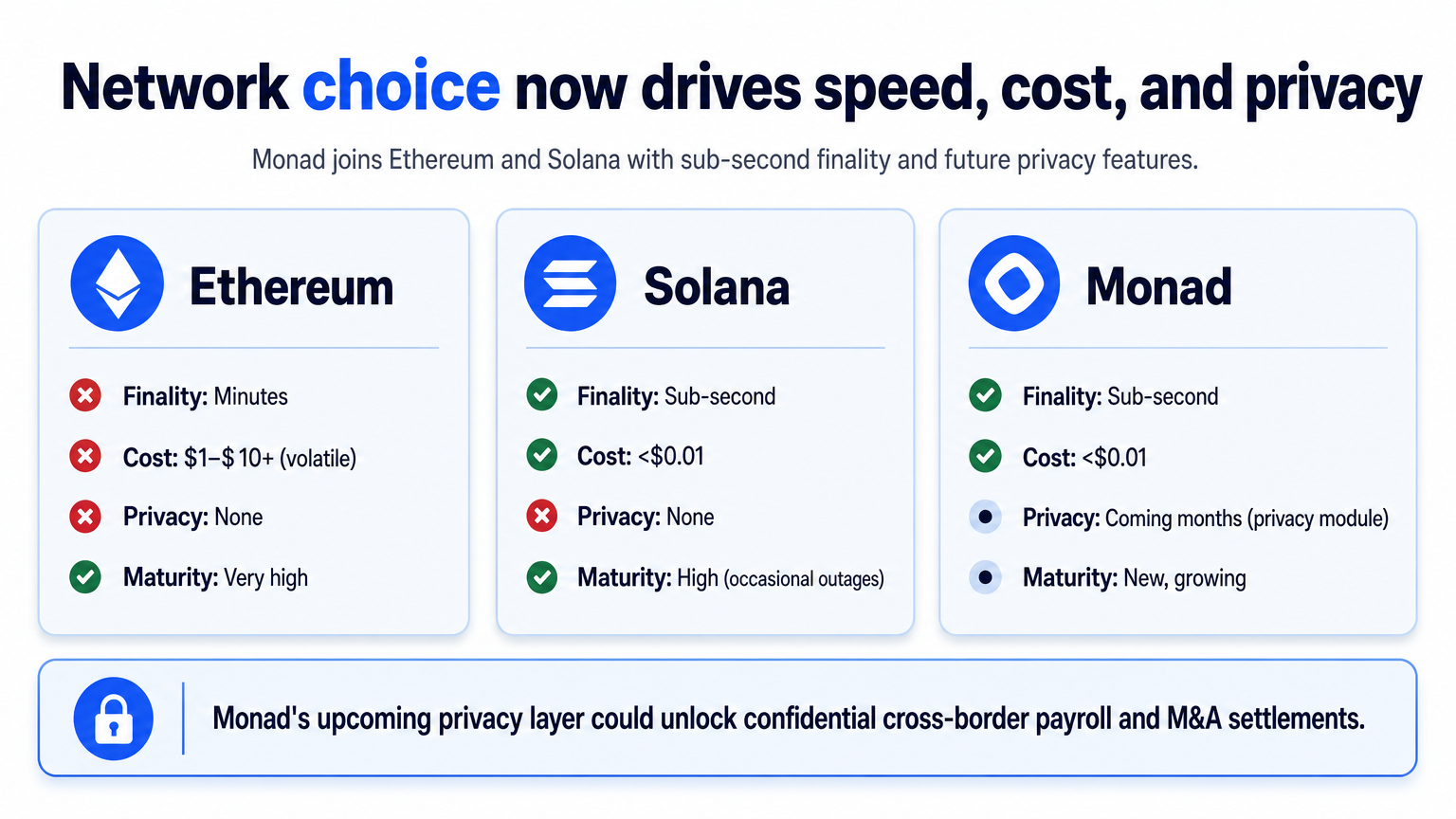
| Network | Finality | Typical USDC transfer cost | Privacy features today | Maturity |
|---|---|---|---|---|
| Ethereum | Minutes | $1–$10+ (volatile) | None | Very high |
| Solana | Sub‑second | <$0.01 | None | High, occasional outages |
| Monad | Sub‑second | <$0.01 | Not yet; privacy module due in coming months | New, growing |
Network choice now influences everything: settlement speed, audit trail accessibility, and even custody compatibility. Monad’s upcoming privacy feature would let businesses shield transaction amounts and counterparties, making cross‑border stablecoins viable for confidential payroll, supplier discounts, or M&A settlements—use cases that currently rely on private banking networks.
Real‑world costs for a typical flow: receive $50k USDC, pay a €30k supplier, retain the rest. Fragmented setups force you to route through an exchange (0.15–0.5% conversion plus spread), then a wire ($25–$50 + intermediary fees), with reconciliation headaches. A unified platform with free USDC ramps and integrated FX can collapse that to a single‑click operation. Security and compliance risks multiply when you stitch providers together, as highlighted by the card exploit that hit several crypto‑friendly platforms.
What you should do now
- Audit your stablecoin readiness. List every payment rail and check if you can natively send or receive stablecoins—and on which networks. Calculate true conversion costs (spread + fees). If you only use Ethereum, you’re likely overpaying.
- Prioritize multi‑network partners. Ask providers which blockchains they support now and if they plan to add Monad. Single‑network lock‑in limits your ability to pivot as the infrastructure evolves.
- Look for unified fiat‑crypto management. The ideal provider combines fiat bank accounts with secure crypto custody (e.g., Fireblocks), transparent FX, and integrated compliance—not a separate exchange integration. This serves as an operating system for neo‑banking for crypto businesses, handling everything from stablecoin payroll to international wires. For DAOs and Web3 teams, additional features like on‑chain invoicing become critical—as seen in how Web3 payments are moving into regional trade flows.
What to watch next
- Other L1s will follow. Aptos, Sui, and similar chains are rumored to be in discussions with card networks. More competition could push settlement fees toward zero, but it risks fragmenting stablecoin balances across chains. Centralized aggregation through a payment partner that routes and consolidates across networks will become essential.
- Regulatory clarity under the GENIUS Act is slowly progressing. If enacted, it would set custody rules for stablecoins. For now, working with a regulated partner remains the safest path.
- Liquidity fragmentation is a real operational concern. With Monad now a settlement option, businesses could end up with small USDC balances on multiple chains, each requiring effort and fees to consolidate. Monitoring Visa’s program will give early signals about which networks gain critical mass.
For fintech content teams needing to keep pace with these infrastructure shifts, Joyrise—which plans, writes, and publishes illustrated SEO articles to your Webflow blog every day (read your first article before you pay)—can free up internal resources while ensuring timely coverage.
Key takeaways
- Monad’s entry into Visa’s stablecoin program adds a high‑speed, low‑cost settlement network with a forthcoming privacy layer, reshaping cost and confidentiality for stablecoin payments.
- Businesses must now choose settlement networks based on speed, fees, and privacy, not default to Ethereum.
- A unified fiat‑crypto platform is the most practical way to bridge stablecoins and traditional treasury, avoiding fragmentation and excess costs.
- When evaluating providers in 2026, insist on multi‑network support, transparent pricing, and institutional‑grade custody.
Open an account with OneSafe to manage both fiat and stablecoin payments from a single, secure platform.



