Stablecoin payments are under direct attack from the world's most influential central banking body, but the noise from Jackson Hole ignores a simple truth: businesses are already settling millions of dollars across borders using stablecoins today, while tokenized deposits remain a laboratory experiment. That gap between rhetoric and reality is what founders, finance leads, and treasury operators need to understand right now.
Table of Contents
- What Just Happened: BIS Throws Shade at Stablecoin Payments
- Why This Matters for Founders and Finance Leads
- Background: Stablecoin Payments Are Already Scaling
- Tokenized Deposits vs Stablecoins: A Pragmatic Adjudication
- What You Should Do Now
- What to Watch: The Next 12 Months
- Key Takeaways
What Just Happened: BIS Throws Shade at Stablecoin Payments
On August 28, 2026, Bank for International Settlements (BIS) General Manager Pablo Hernández de Cos delivered a speech at the Federal Reserve Bank of Kansas City's Jackson Hole Economic Symposium that directly challenged the role of stablecoins as money. As reported by PYMNTS.com and Reuters, de Cos argued that tokenized deposits are more likely than stablecoins to perform the role of money because they preserve what he called "singleness" — the ability of monetary units to be redeemed at par into central bank money.
The BIS stablecoin payments stance had already been signaled in a June 23, 2026 press release outlining the path to a next-generation monetary system. De Cos's Jackson Hole remarks solidified that position, framing stablecoins as too fragmented and commercially volatile to serve as a credible payment rail at scale. He acknowledged that both stablecoins and tokenized deposits use tokenization, but insisted the similarity ends there: tokenized deposits are account-based bank liabilities with interbank settlement through central bank accounts, while stablecoins are issued by private entities with no unified redemption guarantee.
The BIS's "singleness" principle means that $1 in any form of money should always be worth exactly $1 of central bank money, instantly and at zero cost. With tokenized deposits, that uniformity is enforced through the banking system's existing clearing and settlement infrastructure. With stablecoins, however, a USDC holder might need to sell it for USDT before paying a supplier that only accepts USDT, and during volatile market conditions, that trade can slip below par. The argument is theoretically sound, but it sidesteps operational reality on the ground.
Why This Matters for Founders and Finance Leads
If your business pays contractors in the Philippines, settles invoices with a supplier in Brazil, or manages treasury for a DAO with contributors in thirty countries, you already know that the correspondent banking system is broken for frequent, mid-value cross-border payments. Wires take days, cost $25–$50 per transaction, and impose opaque FX markups. Stablecoin payments — typically USDC or USDT on networks like Ethereum, Solana, or layer‑2s — clear in seconds, cost pennies, and offer transparent on-chain settlement. That is not hypothetical: as of mid-2026, crypto card spending linked to stablecoins has tripled, and B2B pilots in markets like Korea are already demonstrating live stablecoin settlement for commercial invoices. The BIS's theoretical critique doesn't erase those live, measurable improvements.
The BIS position matters because it influences national regulators designing digital asset frameworks. If supervisors conclude that only tokenized deposits are legitimate digital money, they might restrict crypto business payments or impose capital requirements that erode the very efficiency that makes stablecoins useful. That's the risk treasury teams must price into their planning for the next 12–24 months.
Background: Stablecoin Payments Are Already Scaling
In a typical business-to-business cross-border stablecoin payment, the sender buys a stablecoin with local fiat, sends it to the recipient's wallet address, and the recipient either holds it as working capital or off‑ramps it into local currency. The whole cycle can be completed in under five minutes. Because the blockchain serves as the settlement layer, there is no intermediary bank chain, no cut‑off times, and no geographic restriction beyond wallet access.
For Web3-native organizations like DAOs, stablecoin payments are the treasury backbone. A DAO may need to pay developers monthly, reimburse travel expenses, and fund grants — all in a transparent, auditable manner. On-chain stablecoin payments, often governed by multi‑sig wallets and automated via smart contracts, deliver exactly that. Platforms that combine crypto‑native treasury management with fiat payment rails allow DAOs to handle payroll in USDC while meeting local tax obligations in fiat, all from a single dashboard. This fusion of old and new money is not a future concept; it's how over $800 million in transaction volume has already moved through businesses using modern financial operations platforms.
Tokenized Deposits vs Stablecoins: A Pragmatic Adjudication
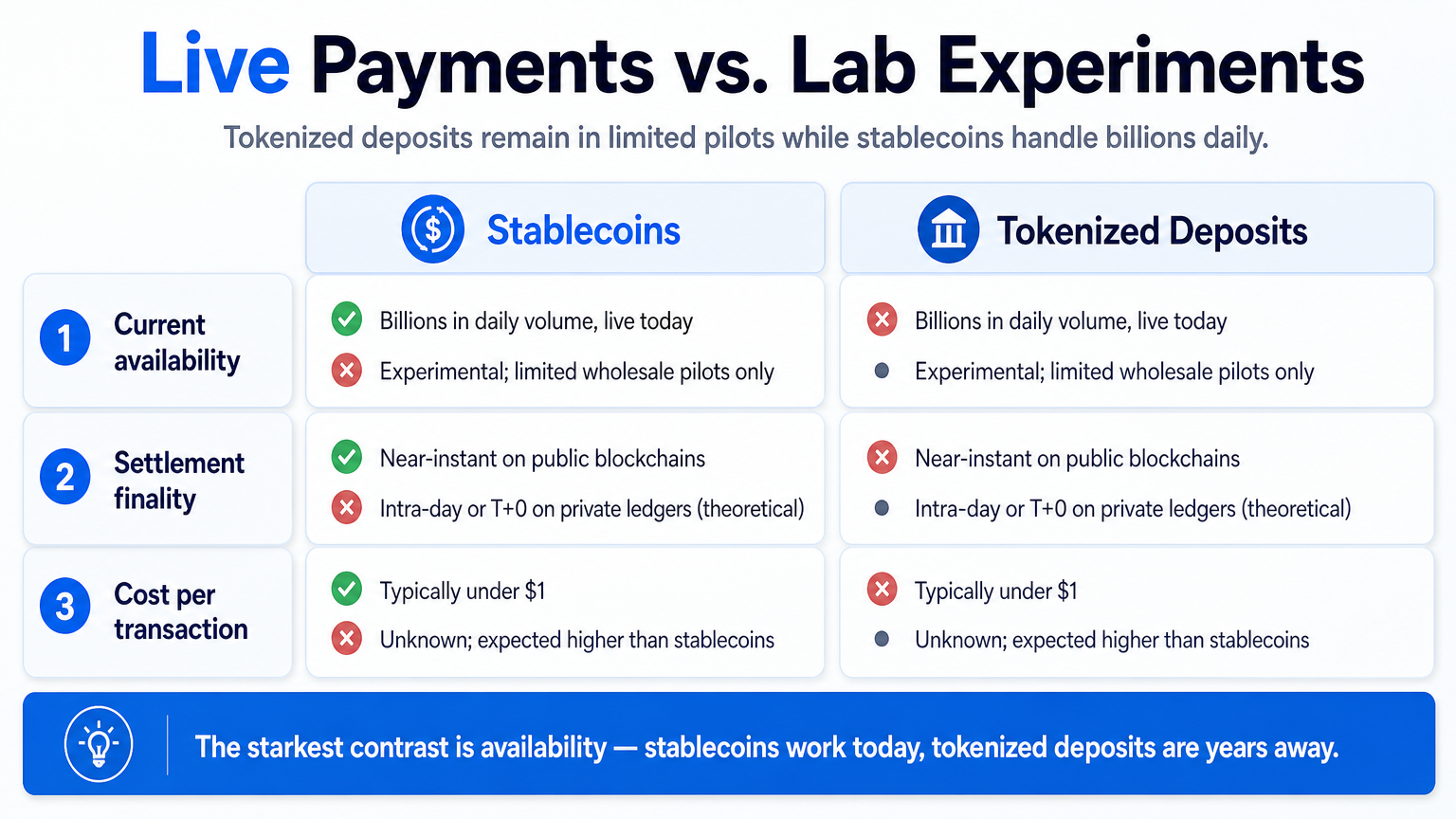
The following table condenses the real‑world differences between stablecoin payments and tokenized deposits as of August 2026:
| Feature | Stablecoin Payments | Tokenized Deposits |
|---|---|---|
| Current availability | Live, billions in daily volume | Experimental; limited pilots in wholesale banking |
| Settlement finality | Near‑instant on public blockchains | Intra‑day or T+0 via private ledgers (theoretical) |
| Redemption guarantee | Market‑dependent; no universal par-back guarantee | Bank liability with central bank settlement backing |
| Regulatory clarity | Emerging frameworks (MiCA, GENIUS Act) | Regulated bank instruments; clear but under development |
| Accessibility | Any business with a wallet and on‑ramp | Limited to banks and their corporate clients |
| Cost per transaction | Typically under $1 | Unknown; expected to be higher than stablecoins |
| Business use case | Cross‑border payments, treasury, payroll | Wholesale interbank settlement; not yet retail |
Sources: Brookings Institution, Federal Reserve Bank of New York Staff Report No. 1179, PCBB.
The starkest contrast is availability. A business that needs to pay a supplier in Mexico this week cannot use tokenized deposits — there is no bank offering them as a corporate payment product. It can, however, use a stablecoin payment API to move funds within minutes. That practical immediacy is why the cross-border stablecoin payments corridor has grown so rapidly, particularly in Asia where traditional rails are costly and slow.
Safety depends on the specific stablecoin, the counterparties involved, and the regulatory perimeter. The BIS correctly notes that stablecoins lack a universal par-redemption mechanism. However, for a business, safety is operationally defined by whether the issuer maintains a verifiable 1:1 reserve, whether the asset is regulated in key jurisdictions, and whether the payment infrastructure prevents theft. Circle's USDC publishes monthly attestations and is already MiCA‑compliant. When a business uses a platform with Fireblocks custody and mandatory multi‑factor authentication, the operational risk is comparable to maintaining balances at multiple foreign banks.
Beyond speed and cost, stablecoin payments offer three advantages that tokenized deposits do not yet approach: programmability via smart contracts for automated disbursements, 24/7 settlement that eliminates float loss, and global accessibility without correspondent banking relationships.
What You Should Do Now
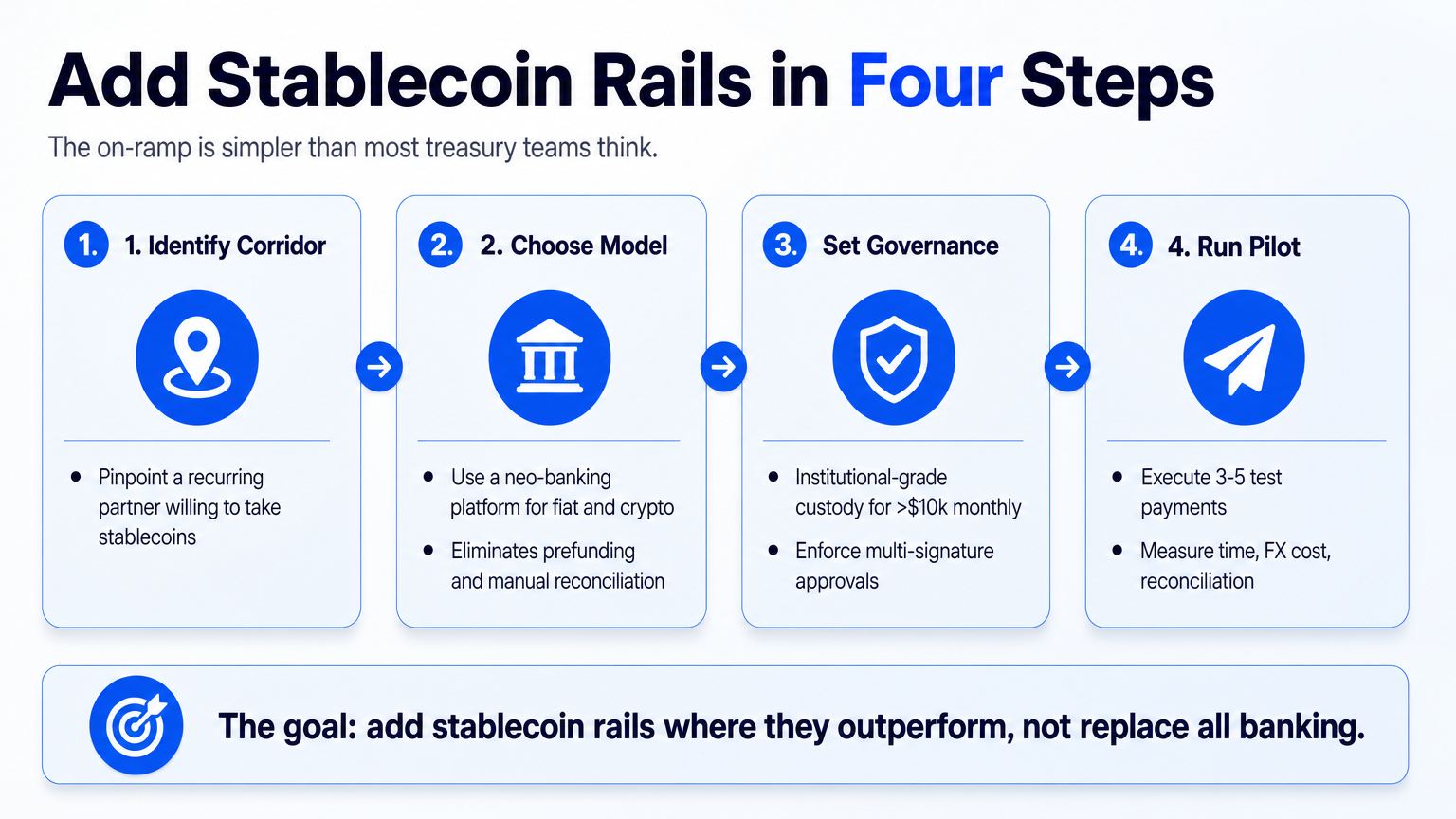
The on‑ramp is simpler than most treasury teams anticipate:
- Identify a stablecoin acceptance corridor — pinpoint at least one recurring payment partner willing to receive stablecoins.
- Choose an operational model — a neo‑banking platform that handles fiat and crypto in one interface eliminates the need to pre‑fund exchange accounts and manually reconcile separate ledgers.
- Set up governance and custody — for volumes above $10,000 monthly, use institutional‑grade custody and enforce multi‑signature approvals.
- Run a controlled pilot — execute three to five test payments, measure end‑to‑end time, effective FX cost, and reconciliation overhead against your current wire process.
The goal is not to replace all fiat banking, but to add stablecoin rails where they outperform. A company might keep operating cash in a U.S. bank account for payroll while using USDC for monthly settlement with an overseas logistics partner.
What to Watch: The Next 12 Months
The stablecoin regulation 2026 landscape is crystallizing. In the U.S., the GENIUS Act is progressing through Congress and could be enacted by early 2027. MiCA's stablecoin provisions are already binding in the EU. These frameworks provide the legal certainty that institutional treasury adoption demands. The BIS's public preference for tokenized deposits may slow some central banks' acceptance, but it is unlikely to derail regulatory momentum already built.
Tokenized deposit pilots and CBDC trials will accelerate, but remain wholesale‑focused and bank‑exclusive. The BIS's own work through Project Agorá envisions a multi‑year timeline before any business use case emerges. Smart businesses are running dual‑rail operations now — maintaining fiat relationships while building stablecoin competence — so that when regulatory clarity arrives, they have already tested workflows and built counterparty networks.
Watch for finalization of the GENIUS Act (likely Q4 2026‑Q1 2027), MiCA Phase II implementation, BIS policy papers influencing Basel Committee treatment of bank stablecoin exposures, and national frameworks in Japan, Singapore, the UK, and the EU.
Key Takeaways
- The BIS's Jackson Hole critique ignores that stablecoin payments are live and solving real cross‑border friction, while tokenized deposits are years away from commercial availability.
- For a business operator, the pragmatic choice is to adopt stablecoins for specific high‑cost corridors while monitoring regulatory developments.
- Combining stablecoin payment APIs with a neo‑banking platform that handles fiat and crypto minimizes operational complexity.
- The "singleness" argument is manageable through sound treasury practices: pick widely accepted stablecoins, use institutional custody, and automate fiat‑crypto conversions.
Ready to bring stablecoin payments into your business treasury? Explore how a unified fiat and stablecoin platform can simplify your cross-border operations.
Ready to put this into practice? Get started with onesafe.io.