On October 31, 2026, the HSBC Franklin Templeton tokenization pilot saw Uber test on-chain money market access—a move that redefines crypto treasury management for corporate treasuries, startups, and DAOs. By converting idle cash into yield-bearing tokens redeemable on weekends, the trial erases the trade-off between liquidity and yield. For DAO treasury management, on-chain treasury models, and any team seeking a crypto treasury platform, the pilot sets a new standard for always-on cash efficiency.
Table of Contents
- What Just Happened: HSBC and Franklin Templeton Pilot On-Chain Money Market Access
- Why This Pilot Changes Crypto Treasury Management Right Now
- Crypto Treasury Management Basics
- Tokenization Creates a Continuous Yield Loop
- DAO Treasury Management Without an HSBC-Size Banking Relationship
- Actions to Take Now and What to Watch Next
- Key Takeaways
What Just Happened: HSBC and Franklin Templeton Pilot On-Chain Money Market Access
On October 31, 2026, CoinDesk reported that Uber stored excess cash as tokenized shares in a Franklin Templeton money market fund via HSBC’s institutional platform. Idle cash was converted into blockchain-based tokens representing MMF shares, held on a permissioned ledger, and redeemable 24/7—including weekends.
| Component | Role |
|---|---|
| Uber | Corporate treasury testing on-chain cash management |
| HSBC | Banking partner providing blockchain platform and custody |
| Franklin Templeton | Asset manager issuing tokenized MMF shares |
| Tokenized MMF shares | Yield-bearing instrument available for instant redemption |
| Settlement | 24/7; no reliance on banking hours or T+2 cycles |
The most significant detail: redemptions and payments worked on weekends, removing the need for large cash buffers entirely.
Why This Pilot Changes Crypto Treasury Management Right Now
Uber’s experiment transforms the baseline for corporate liquidity. It proves a company can eliminate idle cash—cash stays invested continuously and is redeemed only when a payment is due. This on-chain treasury approach collapses the old sweep-account model. Tokenized shares become programmable assets, usable as collateral or integrated into smart-contract workflows. BlackRock’s framing of tokenization underscores the shift to programmable assets, while moves like the Ripple OCC charter give banks a clearer path to custody these instruments.
Crypto Treasury Management Basics

Crypto treasury management encompasses strategies and controls for digital assets—cryptocurrencies, stablecoins, tokenized real-world assets—alongside fiat positions. It integrates cash flow forecasting, liquidity, yield, risk controls, and compliance adapted to blockchain settlement. Modern Treasury’s guide notes it’s about integrating new settlement rails, not just holding Bitcoin.
The differences from traditional treasury are profound: 24/7 markets, instant settlement, and risks centered on private key custody and smart contracts rather than counterparty credit. Citi’s considerations highlight fragmented regulation and real-time volatility. Bitcoin treasury management—a subset—focuses on BTC as a reserve asset with multi-sig custody and on-/off-ramp friction.
Secure crypto treasury management demands institutional-grade custody (e.g., Fireblocks), multi-signature wallets, role-based access, and real-time monitoring. The 2024 London iPhone theft case—analyzed in OneSafe’s security wake-up call—showed how a single compromise can drain assets. A robust setup requires MFA, key rotation, and insurance where possible.
Tokenization Creates a Continuous Yield Loop
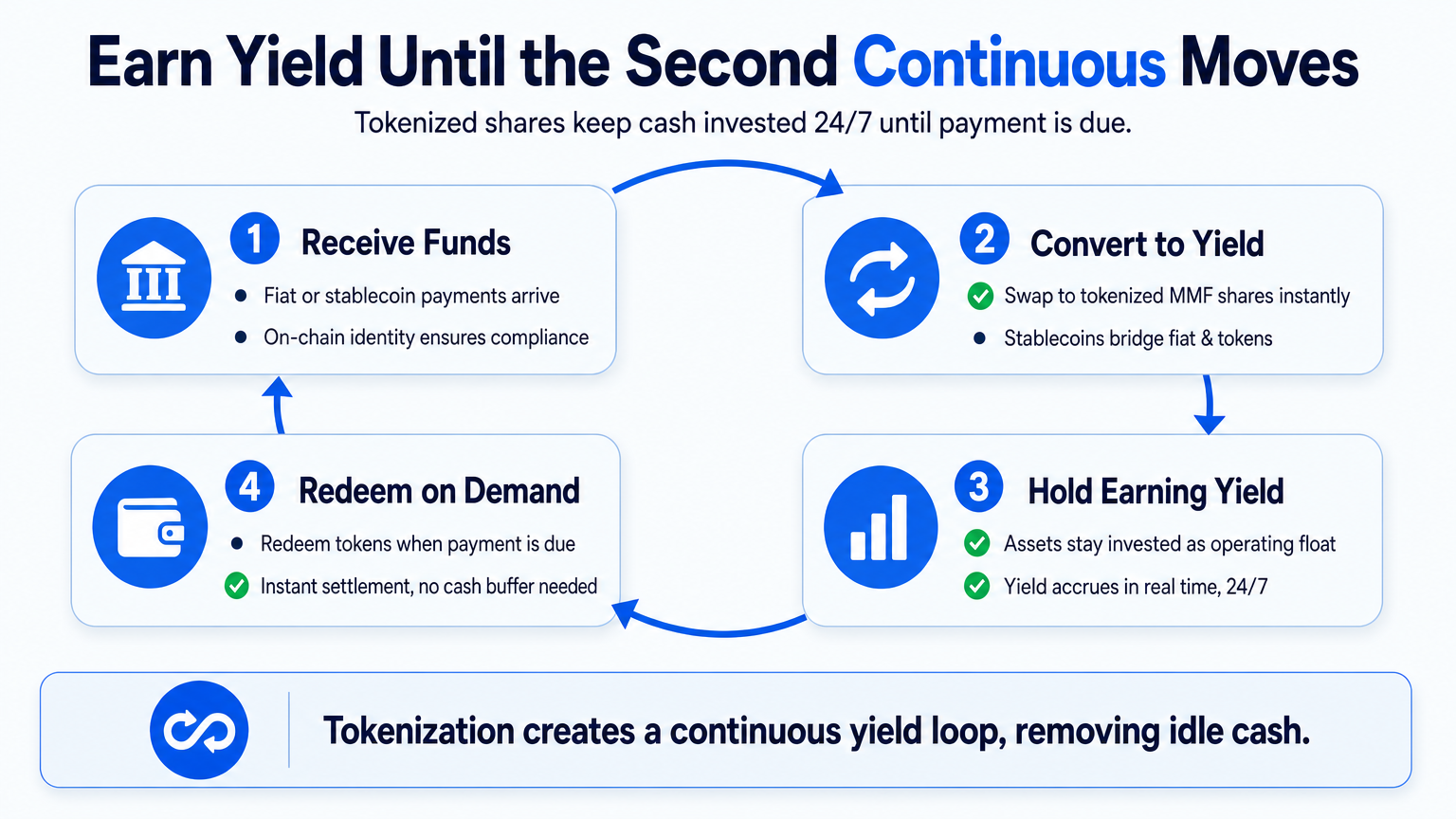
The Uber pilot fits into a broader trend where tokenization removes boundaries between investing and spending. With over $1 billion in on-chain U.S. Treasury exposure tracked by rwa.xyz, the infrastructure is maturing. A business can receive payments in fiat or stablecoin, convert to tokenized MMF shares via a platform, hold them as operating float, and redeem only when a payment is due. Because settlement is instant, the company earns yield up to the second cash moves.
Stablecoins bridge fiat and tokenized securities. On-chain identity checks ensure compliance. This stablecoin treasury model enables automated AP/AR workflows, like tokenizing a receivable and paying a vendor instantly. A unified crypto treasury platform—like OneSafe, which offers invoicing, crypto on-/off-ramps, and multi-currency accounts in one interface—makes this loop achievable without separate banking and exchange relationships.
DAO Treasury Management Without an HSBC-Size Banking Relationship
Most startups and DAOs can’t call HSBC, but the core architecture is replicable. The need is a unified environment that handles fiat and crypto together, with on-/off-ramps to tokenized asset protocols. This is where DAO treasury management demands a composable stack.
The unified fiat-and-crypto platform play
ADAO typically juggles a bank account, an exchange, a multisig wallet, and spreadsheets. The pilot shows the future is a single stack that holds fiat, stablecoins, and tokenized assets; pays vendors in either currency; and automates conversion. OneSafe, which provides multi-currency treasury accounts, ACH and wire payments, corporate cards, and instant crypto-to-fiat conversions—all with custom roles and permissions for DAOs—addresses this fragmentation. It has processed over $800 million in volume from 1,000+ businesses across 30+ countries.
Composable workflows: invoicing, on-/off-ramps, and role-based controls
With a unified platform, a DAO can bill in fiat or stablecoin, then programmatically convert incoming stablecoins to yield-bearing tokens. Role-based approvals ensure no single contributor moves funds unilaterally, and automation eliminates manual error. For details on the risks of manual crypto payroll, see the crypto payroll hidden risk analysis.
Replicating the yield-on-cash model
A comparable model is achievable by:
- Opening a hybrid fiat-and-crypto account that natively supports multiple currencies and stablecoins.
- Connecting to tokenized Treasury protocols for instant minting/redeeming against stablecoins.
- Automating treasury rules via APIs: threshold triggers convert idle stables into yield tokens, and redemption rules liquidate when a fiat payment is needed.
- Enforcing governance with multisig wallet controls, granular permissions, and daily reconciliation.
The result is a tokenized money market fund-backed treasury that operates 24/7 using composable open-finance tools.
Actions to Take Now and What to Watch Next
Four steps to prepare for tokenized money market access
- Establish a multi-currency operating base: open an account handling fiat and stables with instant conversions.
- Implement policy controls and secure custody: multi-sig approvals, role-based permissions, and institutional custody from day one.
- Design automated cash flow rules: map idle balance triggers and pilot a small allocation in tokenized Treasuries to test liquidity and audit trails.
- Integrate reporting and compliance: treat tokenized assets as cash equivalents with daily mark-to-market visibility and segregation of duties.
Regulatory signals, bank participation, and stablecoin legislation
The pilot’s success hinges on regulatory clarity. The SEC’s shifting stance in 2026 has created a more permissive environment. Stablecoin regulation impact continues to evolve; legislation could accelerate bank participation in tokenization platforms and open access via fintech intermediaries.
To stay current, tools like Joyrise—which plans, writes and publishes illustrated SEO articles to your Webflow blog every day—can keep your team informed without adding to your workload.
Key Takeaways
- Uber’s tokenization pilot with HSBC and Franklin Templeton proves corporate cash can stay invested while available for payments on weekends.
- The pilot forces CFOs and DAO leads to treat tokenized traditional assets as part of the core treasury stack.
- Crypto treasury management now includes tokenized MMFs and stablecoin yield strategies, requiring24/7 settlement, secure custody, and role-based controls.
- Startups and DAOs can replicate the model with a unified fiat-crypto platform, tokenized Treasury protocols, and automated conversion loops.
- Regulatory momentum and stablecoin legislation will define how quickly tokenized cash management becomes standard.
Ready to manage your fiat and crypto treasury from a single, secure platform? Explore OneSafe.