Uber’s Tokenized Fund Test and What It Means for Crypto Treasury Management
On October 31, 2026, Uber Technologies completed a blockchain-based cash management pilot with HSBC and Franklin Templeton, testing a tokenized money market fund for corporate treasury—a major step for crypto treasury management. The test, reported by IDNFinancials and Bloomberg, reportedly added 1.5 days of yield to working capital by settling fund shares on-chain in near real-time. For finance leads at startups, DAOs, and global businesses already managing hybrid fiat/crypto treasuries, the pilot marks a critical inflection point: the infrastructure now proves mature enough to reshape how any organization puts idle cash to work.
Table of Contents
- What Uber Just Tested—and Why It Matters for Crypto Treasury Management
- Tokenized Funds Aren't Just for Fortune 500s Anymore
- The Operational Shift: From Idle Cash to Programmable Yield
- Risk Management in a World of On-Chain Yield
- What to Watch Next—and What to Do Now
- What is crypto treasury management?
- How is tokenized yield different from traditional money market funds for corporate treasury?
- Can a startup or DAO really benefit from what Uber tested?
- What risk framework should I apply before putting idle corporate cash into tokenized funds?
- How does a unified fiat/crypto platform reduce operational friction?
- Key Takeaways
- Further reading
What Uber Just Tested—and Why It Matters for Crypto Treasury Management
The October 31 pilot: tokenized money market fund with HSBC and Franklin Templeton
Uber’s test used the public Canton blockchain to tokenize shares in a Franklin Templeton money market fund. HSBC acted as settlement bank, Fireblocks provided custody, and Tradeweb facilitated the workflow. The pilot involved real fund shares and settlement, integrated into a corporate treasury process—the first operating company to publicly demonstrate tokenized money market fund utility without disrupting daily liquidity.
1.5 days of yield gained: how on-chain settlement changes the treasury math
Traditional money market funds settle T+1, often losing two days of yield on redemptions placed after a cutoff. By settling on-chain T+0, Uber compressed that lag to minutes. For a treasury with $100 million in working capital that sits idle even 24 hours, the annual yield pickup at 5% is material. Real-time settlement also eliminates the need to park cash in zero-interest accounts for short-term obligations, shifting idle cash into programmable on-chain working capital.
Tokenized Funds Aren't Just for Fortune 500s Anymore
The infrastructure that made Uber's test possible already serves smaller treasuries
The pilot used the Canton Network and Fireblocks—the same technology stack accessible through fintech platforms today. A startup or DAO doesn’t need bespoke blockchain builds; platforms that unify fiat and crypto accounts, like OneSafe, already bridge the gap. OneSafe provides a single interface for multi-currency fiat accounts, crypto wallets, and on/off-ramp conversions. Custody via Fireblocks gives qualified institutional-grade security to tokenized fund shares.
How a DAO or global startup can use a platform like OneSafe to connect to these instruments
DAO treasury yield traditionally meant stablecoin lending or liquidity pools, which carry protocol and impermanent-loss risks. Tokenized money market funds, by contrast, are backed by U.S. government securities and settled on a permissioned network with known counterparties. A platform handling both fiat and crypto can act as the conduit: idle USDC in a segregated account can be swapped for tokenized fund shares and redeemed on demand. OneSafe’s free USDC deposits and withdrawals and its customizable roles for multisig governance let DAOs control yield deployment without compromising decentralized oversight.
The Operational Shift: From Idle Cash to Programmable Yield

T+0 redemption vs. traditional money market fund settlement
| Feature | Traditional Money Market Fund | Tokenized Money Market Fund (Uber Pilot Type) |
|---|---|---|
| Settlement time | T+1 (next business day) | T+0 (minutes to hours, 24/7) |
| Redemption cutoff | Banking hours only | On-chain, 24/7 |
| Yield capture on cash parked 1 day | None if placed after cutoff | Full day’s yield possible |
| Minimum investment | Often $1M+ for institutional shares | Tokenization can enable fractional shares |
| Custody | Fund administrator, bank | Qualified custodian (e.g., Fireblocks) plus smart contract |
| Integration with crypto treasury | Requires separate fiat bank accounts and manual sweeps | Native to a hybrid fiat/crypto treasury platform |
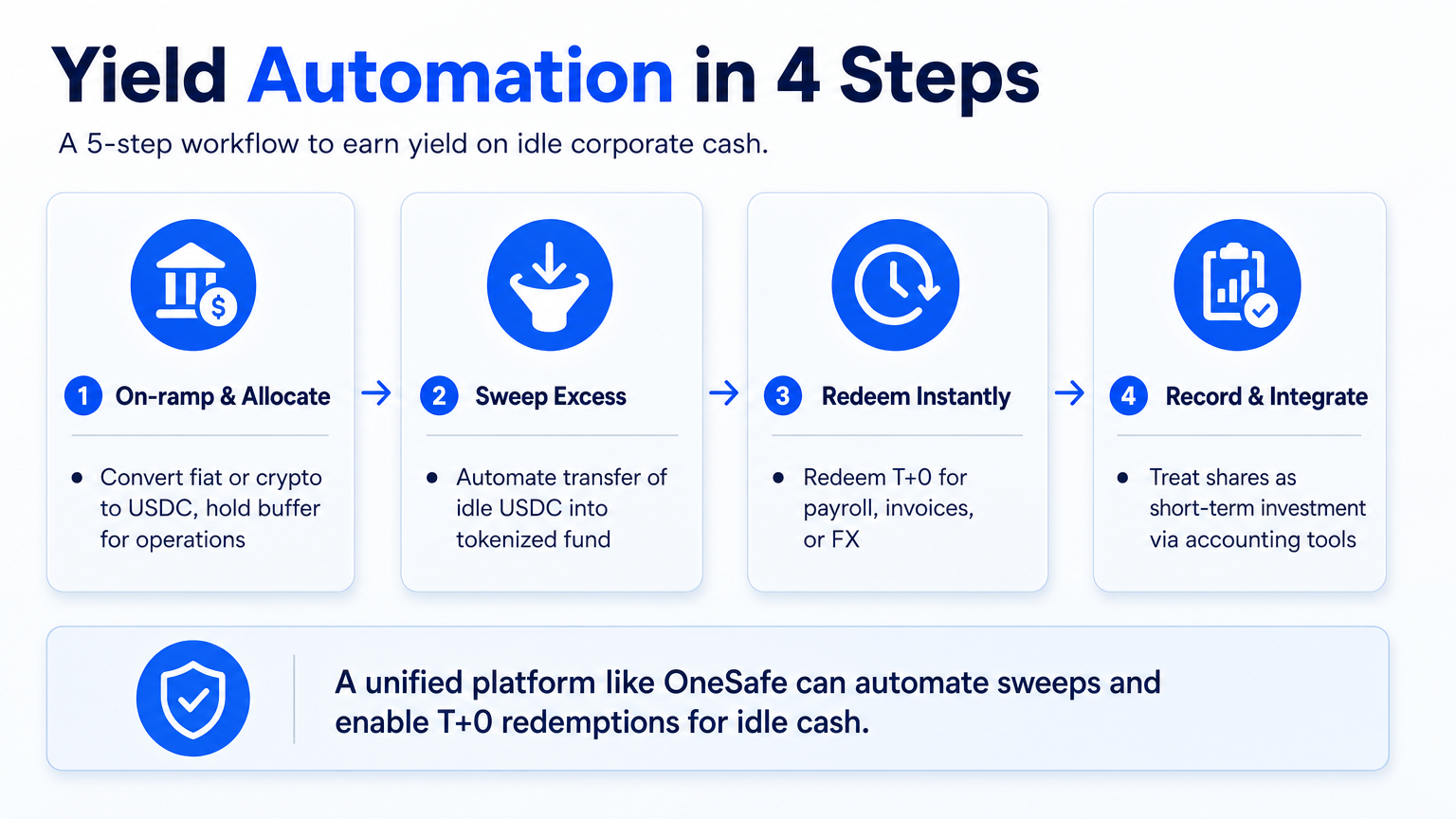
Tokenized funds live in the same wallet environment as stablecoins, allowing automated sweeps—moving excess USDC into a tokenized fund when a threshold is reached, and redeeming instantly for scheduled payments.
Integrating tokenized yield into a hybrid fiat/crypto treasury: the workflow
- On-ramp fiat into a multi-currency account, optionally converting to USDC.
- Allocate operating liquidity to stablecoins with a buffer.
- Sweep excess USDC into a regulated tokenized fund via the platform; shares sit in a Fireblocks-secured wallet.
- Redeem as needed for payroll, invoices, or FX, with T+0 settlement.
- Record transactions via accounting integrations, treating fund shares as short-term investments.
For global businesses, eliminating SWIFT delays and banking hours turns cash management into a yield-aware, 24/7 operation.
Risk Management in a World of On-Chain Yield
Counterparty, smart contract, and regulatory risks
The Uber pilot shows institutional comfort growing when the issuer is a regulated manager like Franklin Templeton, settlement is through a bank like HSBC, and custody is by a qualified custodian. Smart contract risk remains, but it can be managed through audits, permissioned networks, and segregated accounts. For startups and DAOs, the lesson is to separate yield-seeking capital from core operating cash and require multi-sig approval for yield deployment.
Why segregated accounts and Fireblocks-grade custody still matter
Tokenized fund shares are tokens representing a claim on a fund. Segregated custody addresses ensure commingling events don’t expose all corporate funds. OneSafe uses Fireblocks custody, and the same architecture can extend to tokenized funds. The 2024 London iPhone theft incident reinforced that wallet-level compromises demand strict segmentation. Regulatory clarity is evolving—the SEC’s 2026 stablecoin guidance provides a compliance framework, but any treasury must still verify that tokenized shares are registered or exempt and that the platform meets money transmitter and securities laws.
What to Watch Next—and What to Do Now
The next 5 companies likely to follow Uber
HSBC, Franklin Templeton, Tradeweb, and Fireblocks built a repeatable workflow. Firms with large recurring treasury balances and stablecoin holdings—tech, pharma, logistics—are natural next movers. The signal to banking partners is clear: corporate clients will soon demand tokenized money market fund access as standard. For DAOs and startups, the barrier to entry is falling quickly; neo-banking platforms are evaluating integrations to offer tokenized yield with a few clicks. The DeFi compliance alert linking the Binance hack to DPRK also underscores the need to vet counterparty provenance, making regulated institutional offerings the default over unvetted pools.
Immediate actions for finance leads
- Quantify idle cash drag. Calculate how much cash sits uninvested monthly due to settlement lags and buffers. Multiply by your current money market yield.
- Map your fiat-crypto bridge. Document every on-ramp and off-ramp touchpoint—customer receipts, crypto payroll, vendor payments—and identify which can be consolidated in a single platform.
- Ask your provider about tokenized fund access. Determine if they support tokenized funds, the custody model, and compliance documentation. If not, consider a platform like OneSafe that already bridges traditional banking and on-chain assets.
For ongoing insights into evolving treasury tools and tokenized fund access, you can follow a daily blog like Joyrise that plans, writes, and publishes illustrated SEO articles to your Webflow blog every day.
What is crypto treasury management?
Crypto treasury management covers policies, tools, and workflows for safeguarding, investing, and spending digital assets alongside fiat. It adds 24/7 settlement, self-custody or qualified custodian decisions, and blockchain-native security. The Uber test shows the definition expanding to include tokenized traditional assets, making it a superset of conventional treasury.
How is tokenized yield different from traditional money market funds for corporate treasury?
Tokenized funds settle on-chain T+0, 24/7, exist as blockchain tokens inside a crypto custody environment, and enable programmable sweeps. This eliminates the settlement gap and unifies yield with other crypto holdings, unlike manual bank portals.
Can a startup or DAO really benefit from what Uber tested?
Yes. The same infrastructure—Canton, Fireblocks, regulated fund issuer—is accessible via fintech platforms. Tokenization allows low minimums, and the efficiency gains are scale-agnostic.
What risk framework should I apply before putting idle corporate cash into tokenized funds?
Layer your framework: verify a regulated issuer with high-quality underlying assets (U.S. Treasuries), require independent audits and a permissioned network, use qualified custody with segregated accounts and multi-sig, confirm securities-law compliance, and never deploy more than you can temporarily lock.
How does a unified fiat/crypto platform reduce operational friction?
A single dashboard eliminates the need to move funds between bank and crypto custodian. Fiat receipts convert to stablecoins, sweep into tokenized fund shares, and redeem back to fiat—all in one interface. This consolidates reconciliation, reduces costs, and enables automated sweeps.
Key Takeaways
- Uber’s October 2026 pilot added 1.5 days of yield, proving tokenized treasury management is production-ready.
- The same infrastructure is accessible to startups and DAos through unified platforms.
- Adding tokenized yield requires a risk framework that separates capital and mandates mulit-sig custody.
- Workflow: on-ramp fiat, convert to stablecoins, sweep excess into tokenized shares, redeem T+0.
- Quantify idle cash drag, map your fiat-crypto touchpoints, and talk to your platform provider about tokenized fund access.
For teams ready to unify fiat and crypto operations with institutonal-grade custody, open a OneSafe account today and start earning yield on every idle dollar.
Further reading
Ready to put this into practice? Get started with onesafe.io.