Your Berlin startup has approved a contractor invoice in Mexico. The payment leaves your account in euros, passes through one or more financial institutions, converts into pesos, and arrives short of the expected amount. The contractor sees a deduction, your finance team starts tracing the payment, and nobody can immediately tell whether the missing value came from the exchange rate, an intermediary, or the receiving bank.
That situation captures the core question behind what is cross border payments. The basic definition is simple. The operational reality isn't. A cross-border payment moves value between parties in different countries, currencies, or banking jurisdictions, and the route it takes determines its speed, cost, visibility, and compliance burden.
For a business, choosing the right route means understanding the rails underneath the payment, the fees added along the way, and the controls that prevent avoidable delays. It also means knowing where stablecoins and instant-payment links help, and where a fiat bank account and regulated off-ramp remain necessary.
Table of Contents
- Domestic rails still do much of the actual clearing
- Standards improve the message, not every settlement constraint
What Cross Border Payments Really Mean
A cross-border payment is an instruction to transfer money or another form of value from a payer to a recipient when the two parties sit in different countries, use different currencies, or rely on separate banking jurisdictions. A company in Germany paying a Mexican contractor, a software business collecting subscription revenue from customers overseas, and a family member sending money home are all using cross-border payment flows.
The payment doesn't need to cross a physical border in the way a parcel does. The important fact is that the institutions supporting the payer and payee operate under different national systems. Those systems may have different currencies, clearing schedules, compliance rules, account formats, and settlement arrangements.
Retail and business payments follow different rules
Retail remittances usually involve an individual sending money to another individual. The amount may be modest, and the recipient often needs a local-currency payout. B2B payments are different. They can involve supplier invoices, contractor payroll, marketplace settlements, treasury transfers, or customer collections, with stronger requirements for beneficiary verification, invoice documentation, approval controls, and audit records.
That distinction matters because the same transfer method won't serve every use case well. A consumer wallet may be convenient for a personal remittance, while a finance team paying hundreds of contractors needs repeatable onboarding, payment files, approval workflows, and reconciliation.
Cross-border payments now sit inside the core infrastructure of global commerce. McKinsey estimates annual cross-border payment volume at about $190 trillion, producing more than $290 billion in global revenue, with revenue growing at roughly 4% per year. The McKinsey analysis of cross-border payments also frames the category as essential infrastructure for trade, payroll, treasury, and vendor settlement, not a niche remittance service.
Why founders encounter the problem early
Distributed teams create recurring outbound payments to contractors and employees in different countries. SaaS companies face the reverse problem when overseas customers want to pay in local currencies or through local payment methods. Marketplaces must collect from one jurisdiction and settle to another, often while managing several currencies at once.
The rest of the problem comes down to three operator questions:
- Which rail carries the payment?
- What does the recipient receive after fees and FX conversion?
- Which controls make the payment traceable, compliant, and repeatable?
Answering those questions is more useful than memorizing a single definition.
How the System Evolved Into Today's Rails
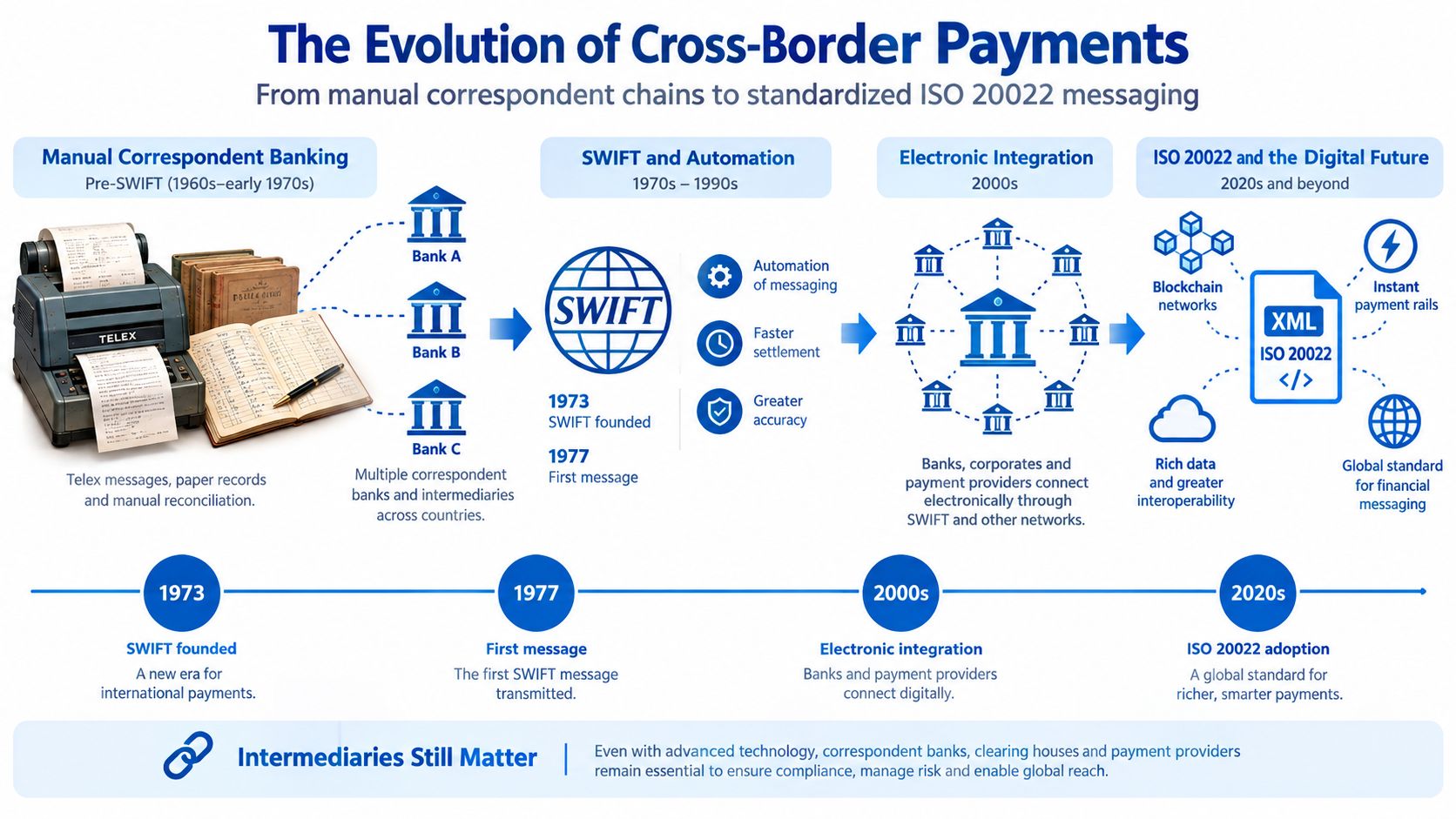
International payments grew from bilateral banking relationships rather than from one universal global payment network. Before electronic standardization, banks exchanged payment instructions through manual communications and maintained records across correspondent relationships. Each bank needed a practical way to access another bank's market, currency, and settlement accounts.
SWIFT improved the messaging problem by giving financial institutions a standardized way to exchange instructions. It's important to separate messaging from settlement. SWIFT transmits financial messages. It doesn't itself move the underlying funds or maintain the accounts that settle them.
The money typically moves through correspondent banks. Bank A may hold an account with Bank B in the currency needed for a transaction. In that relationship, Bank A's account is often described as a nostro account from Bank A's perspective, while Bank B may describe the same balance as a vostro account. These accounts form a liquidity grid across institutions and currencies.
Domestic rails still do much of the actual clearing
ACH in the United States, Fedwire, CHAPS, RTGS systems, SEPA Credit Transfer, and TARGET services were built as domestic or regional clearing utilities. They have their own operating hours, message formats, participation rules, and settlement mechanisms. Correspondent banks connect those separate systems when a payment needs to travel internationally.
That layering explains why a transfer can be digitally initiated yet still take time. The instruction may move quickly, but the institutions must still validate the parties, source liquidity, apply local rules, pass the payment between systems, and reconcile the final credit.
The BIS tracks payment message data across more than 200 jurisdictions, illustrating how interconnected and measurable the infrastructure has become. The IMF overview of the evolving cross-border payments market describes the sector as extending beyond traditional bank wires into alternative messaging systems and crypto-related payments.
Standards improve the message, not every settlement constraint
ISO 20022 provides richer, structured payment data and helps institutions interpret the same information more consistently. The guide to fintech development in 2026 is useful background for founders evaluating the software and integration layer around these standards.
Practical rule: A faster message doesn't guarantee faster settlement if the receiving institution, currency route, compliance review, or operating window remains slow.
The evolution is therefore a layering story. New standards improve data, domestic instant rails improve local movement, and blockchain networks offer another settlement environment. Businesses still need orchestration across those layers.
The Main Payment Rails Compared
Finance teams often use the word “wire” as if it describes one universal method. It doesn't. A domestic wire, an ACH credit, a SWIFT instruction, and a SEPA transfer have different settlement models and operational trade-offs.
| Rail | Speed | Typical Fee | FX Handling | Best For |
|---|---|---|---|---|
| ACH | Batched and schedule-dependent | Usually lower for domestic flows | Conversion may happen before or after the ACH leg | Recurring supplier payments, payroll, predictable payouts |
| Domestic wires | Same-day or near same-day within the relevant system | Higher than ACH, often fixed per transfer | Usually handled by the sending bank or provider | Time-sensitive domestic settlement and high-value transfers |
| International wires over SWIFT | Often requires multiple processing stages and may take several business days | Can include sending, intermediary, and receiving charges | Bank or provider applies a conversion rate and spread | Global vendors, treasury transfers, corridors without local alternatives |
| SEPA Credit Transfer or SEPA Instant | Standard or near-instant depending on the scheme and participant | Often efficient for euro-denominated regional flows | Usually avoids conversion inside the euro leg | Eurozone payroll, invoices, and supplier settlement |
ACH is useful when the recipient has access to the relevant domestic clearing system and timing is predictable. It's not a global rail. A business may send funds through a local or international funding route and then use ACH for the final domestic credit.
Domestic wire systems such as Fedwire, CHAPS, and other RTGS arrangements prioritize final settlement inside their own jurisdictions. They can support urgent payments, but they don't automatically solve the cross-border part. The payment may still need another rail before or after the domestic wire leg.
SWIFT is valuable because it reaches markets that don't share a local clearing network. Its weakness is the number of institutions and processes that may sit between the originator and beneficiary. For a focused comparison of domestic ACH and international SWIFT flows, see this ACH versus SWIFT explanation.
SEPA Credit Transfer and SEPA Instant are most effective when both sides fit the applicable euro payment environment. A transaction that begins outside that environment may still need a separate funding or conversion leg.
The practical choice isn't “Which rail is fastest?” It's “Which combination of rails gives this payment the right balance of reach, speed, cost, and control?”
A real cross-border payment often combines two rails. An international funding leg might reach a local account, followed by ACH or another domestic clearing credit to the beneficiary. Optimization is therefore an orchestration decision, not a single-product decision.
Where the Hidden Costs Actually Come From
A payment can appear free at the point of initiation and still cost the business materially. The total economic cost includes every deduction from the payer's account, every reduction in the recipient's proceeds, and the internal work required to investigate and reconcile the transfer.
The first layer is the originating transfer fee. The sending bank or payment provider may charge a fixed amount for initiating the payment. The second is the correspondent deduction. An intermediary can remove a fee before forwarding the funds, and more than one intermediary may participate when the sending and receiving institutions don't have a direct relationship.
The beneficiary bank may then apply a landing or receiving fee. Finally, the conversion rate may contain an FX margin. The payer sees one exchange rate, but the provider may have acquired currency closer to the market rate and retained the difference.
| Cost Layer | Who Charges It | Typical Range | Hidden? |
|---|---|---|---|
| Transfer initiation | Originating bank or payment provider | Varies by account and route | Sometimes visible |
| Correspondent deduction | Intermediary bank or banks | Varies by route and number of intermediaries | Often unclear in advance |
| Beneficiary landing fee | Receiving bank or local institution | Varies by institution and market | Frequently missed in the quote |
| FX margin | Bank, PSP, or conversion provider | Embedded in the exchange rate | Often the least visible |
| Internal handling | Finance and operations team | Depends on exception volume and workflow | Usually excluded from payment pricing |
The BIS attributes the structural expense and delay of cross-border payments to several interacting factors: liquidity costs, uneven regulatory requirements, limited competition at market entry, and non-uniform message formats and system specifications. Those conditions reduce straight-through processing and make the payment path harder to see, especially in retail and remittance flows. The BIS discussion of cross-border payment frictions explains why messaging upgrades alone haven't removed the underlying cost structure.
The latest monitoring also shows that speed and pricing remain unresolved. In 2025, 67.3% of payments settled within one business day, down 1.7 percentage points from the prior year, while average FX margins for transactions requiring conversion by the receiving PSP remained 0.7% to 1.1%, according to the FSB's cross-border payments monitoring.
For a finance lead, the right metric is effective delivered cost. Compare the amount debited, the amount received, the applied FX rate, intermediary deductions, and internal handling time. A quote that highlights “no transfer fee” answers only one part of that calculation.
Stablecoins and Instant Links vs Legacy Banking
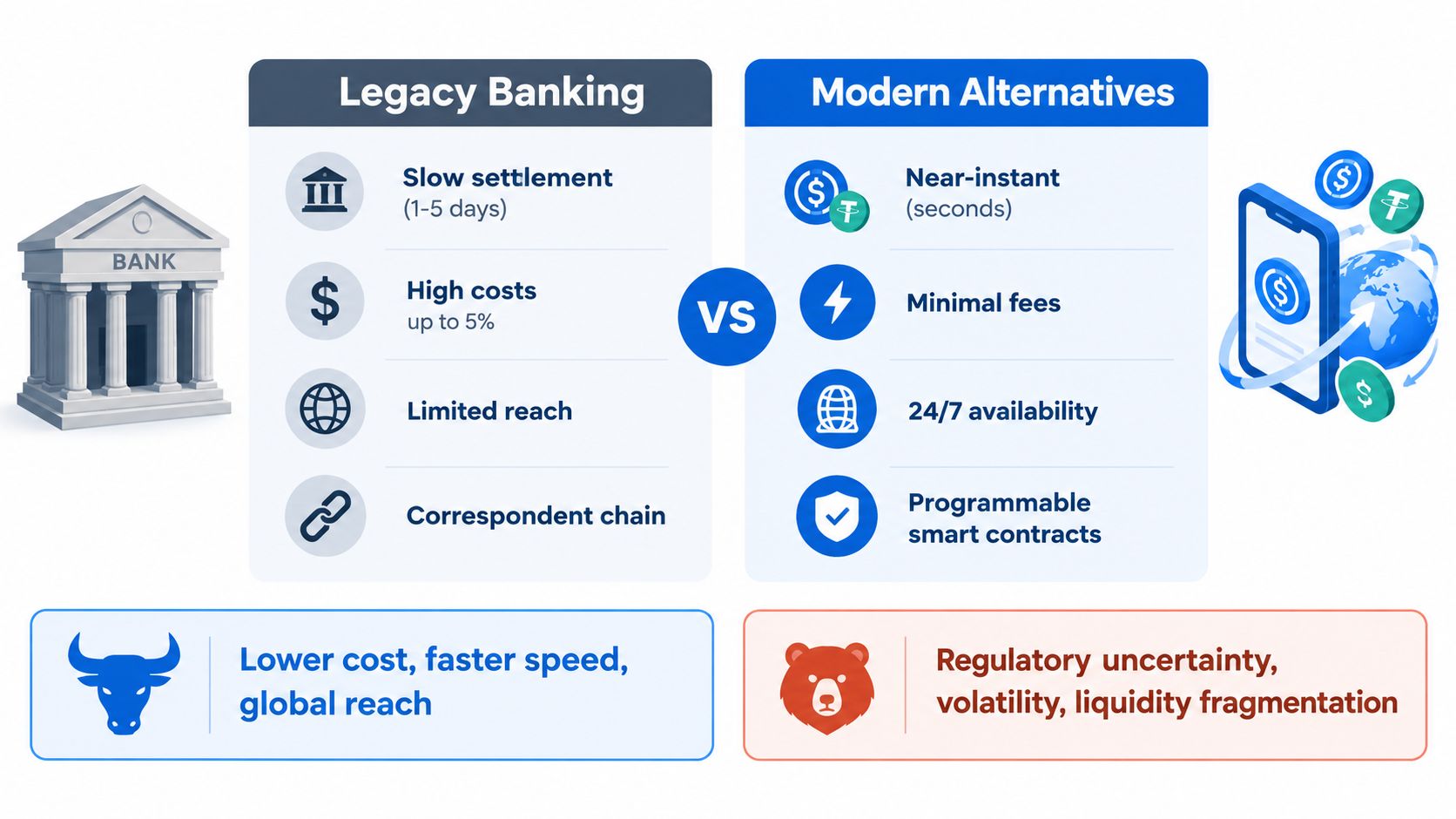
Stablecoins and instant-payment links are changing the available toolkit, but they haven't made correspondent banking irrelevant. The more accurate description is a hybrid system in which businesses choose different rails for different legs of the transaction.
The bull case is straightforward. A stablecoin can move between compatible blockchain wallets without waiting for bank opening hours or a chain of correspondent accounts. An instant-payment link can connect domestic systems such as FedNow, RTP, SEPA Instant, PIX, or UPI, allowing a payment to move rapidly once it reaches the relevant local network.
The alternative market is broad enough to attract serious attention. The IMF notes that combining Swift-recorded flows with alternative messaging systems and crypto-related payments may have brought the overall cross-border market close to $1 quadrillion in 2024, showing how much activity sits outside traditional bank-wire definitions. That scale doesn't prove that stablecoins have replaced banks. It shows that the category now includes multiple forms of messaging, settlement, and value transfer.
Where the alternatives still meet friction
Stablecoin settlement can be fast on the blockchain leg, but a business usually needs to convert between fiat and digital assets. That conversion requires an on-ramp or off-ramp, compliance screening, liquidity, and a recipient capable of receiving or converting the asset.
Regulatory treatment also differs across markets. MiCA and the US GENIUS Act framework are part of the changes, but a business still needs to confirm which provider is licensed, which assets it supports, and what reporting obligations apply to each corridor.
For many small and midsize businesses, the practical model is a fiat-to-stablecoin-to-fiat flow. The company funds the payment in its operating currency, a regulated provider converts the value, the stablecoin moves across the settlement leg, and a local partner pays the recipient in domestic currency. This gives the business faster movement without requiring its treasury team to hold a volatile crypto asset.
For further context on how bank-led digital assets may fit into payment infrastructure, review this explanation of bank-led stablecoins and financial inclusion.
The trade-off is operational rather than ideological. Legacy rails offer familiar compliance and fiat acceptance. Stablecoins can offer continuous settlement and programmable movement, but the business must manage network selection, wallet controls, asset support, liquidity, and regulatory exposure.
Common Pain Points for Global Businesses
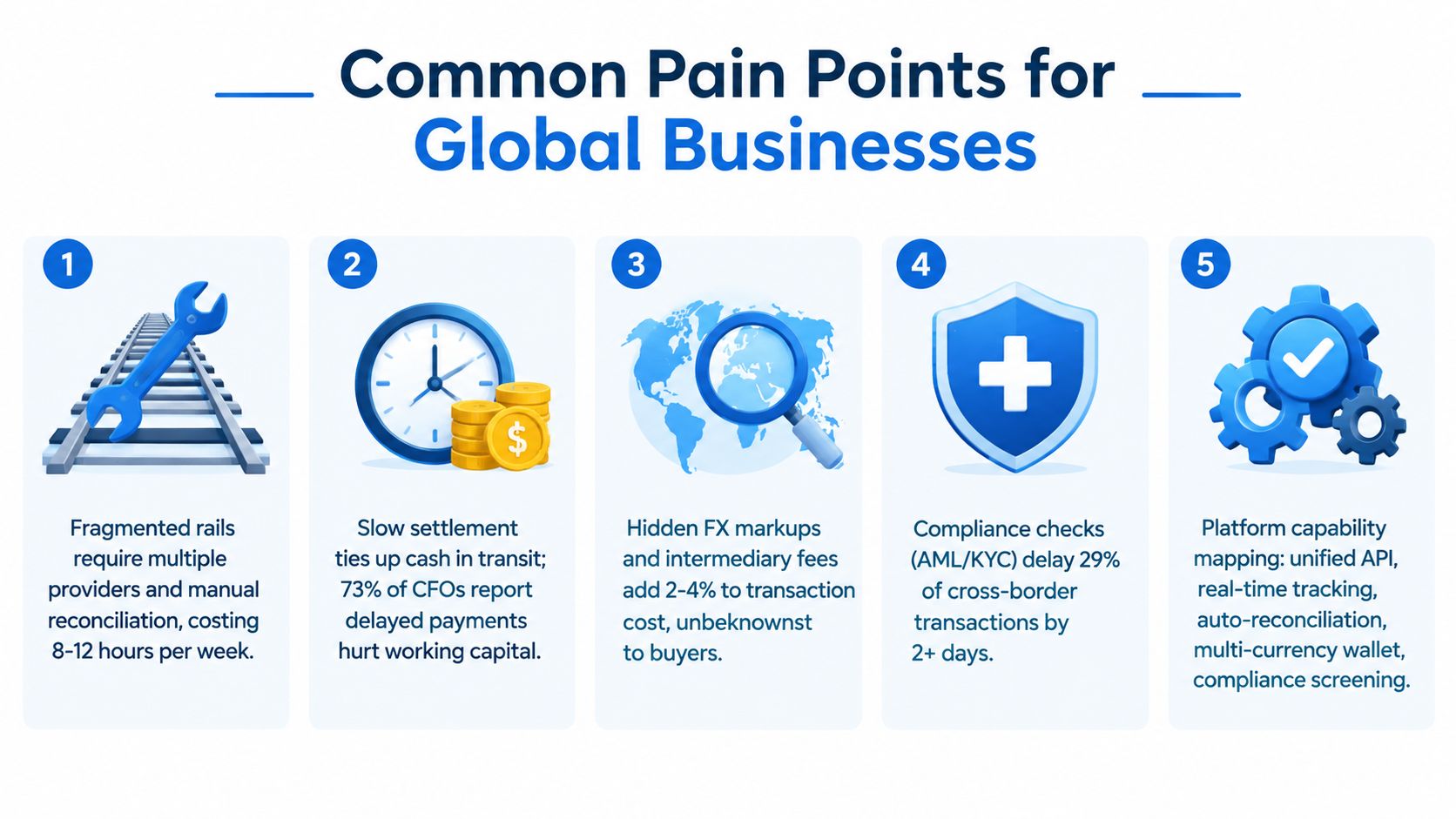
Global payment problems rarely begin with a founder choosing the wrong button. They emerge from the interaction between several rails, currencies, operating windows, compliance reviews, and accounting systems.
A finance team may maintain one login for SWIFT payments, another for ACH, another for local payouts, and a separate crypto platform. Each system produces different references and statements. The payment may complete successfully while the reconciliation work remains manual.
Match each failure mode to a control
- Fragmented rails: Use a multi-currency account or unified payment interface where local clearing, wires, and digital-asset flows can be viewed through one operational layer.
- Settlement uncertainty: Route predictable supplier outflows through local rails where available, and reserve urgent channels for payments whose timing matters.
- FX timing risk: Group currency exposures, define an internal tolerance band, and consider a forward contract when an invoice date and currency obligation are fixed.
- Weak team controls: Add role-based permissions, beneficiary approval, payment limits, and dual authorization before non-finance staff can release funds.
- Poor auditability: Store payment references, invoices, conversion details, and approval records in one ledger. Tracking tools can help teams identify where a payment is waiting instead of asking several banks for updates.
The operating model matters as much as the rail. A finance lead evaluating governed finance automation for 2026 should look for approval logic, exception handling, audit history, and integration with the general ledger, not only payment initiation.
Web3 firms and DAOs face the same problems with an added constraint. They may have treasury assets on-chain but lack a conventional banking relationship for payroll, taxes, vendors, and local-currency settlement. A compliant fiat off-ramp can therefore enable ordinary business operations, while governance controls determine who can authorize the conversion and payout. A practical overview of the operating model appears in this guide to B2B cross-border payments.
A payment platform should make the exception visible. If your team can't explain where the funds are, which rate applied, and who approved the release, the workflow isn't controlled yet.
A Practical Optimization Checklist
A finance lead can improve cross-border payment operations without replacing every provider at once. Start with a corridor inventory, then make one change at a time and measure the delivered result.
Assign an owner to each improvement
Map the corridors, owned by the finance operations lead. List payer location, beneficiary location, currencies, urgency, frequency, average amount, and current rail. Review the map at the start and end of the quarter.
Match urgency to the channel, owned by treasury. Use ACH or other local clearing for predictable supplier runs where available. Use SEPA Instant or a domestic instant rail for time-sensitive payments within its supported environment. Use SWIFT when correspondent reach makes it necessary, not because “wire” is the default setting.
Control FX exposure, owned by the treasury manager. Separate invoices that need immediate conversion from recurring exposures that can be batched. Set an internal hedging band and document when a forward contract is appropriate. Check the rate applied against the quoted rate after every payment run.
Batch compatible payments, owned by accounts payable. Group supplier and contractor payments that share a corridor, currency, and due date. Batching can reduce repeated fixed charges and simplify approval, but don't delay payroll or contractual obligations merely to reduce transaction count.
Consolidate balances, owned by the controller. Keep operating balances in the currencies the business regularly uses, and route internal transfers through one controlled ledger where practical. Fewer disconnected accounts mean fewer statements, payment references, and reconciliation queues.
Add governance checkpoints, owned by the CFO or finance director. Require dual approval above the company's defined threshold, vet beneficiaries against applicable sanctions requirements, and review failed or returned payments monthly. Reconcile effective FX margins against quoted rates every quarter.
The measurement should include more than the provider's advertised fee. Track the amount debited, the recipient's delivered amount, settlement time, returned-payment rate, manual review volume, and staff time spent resolving exceptions.
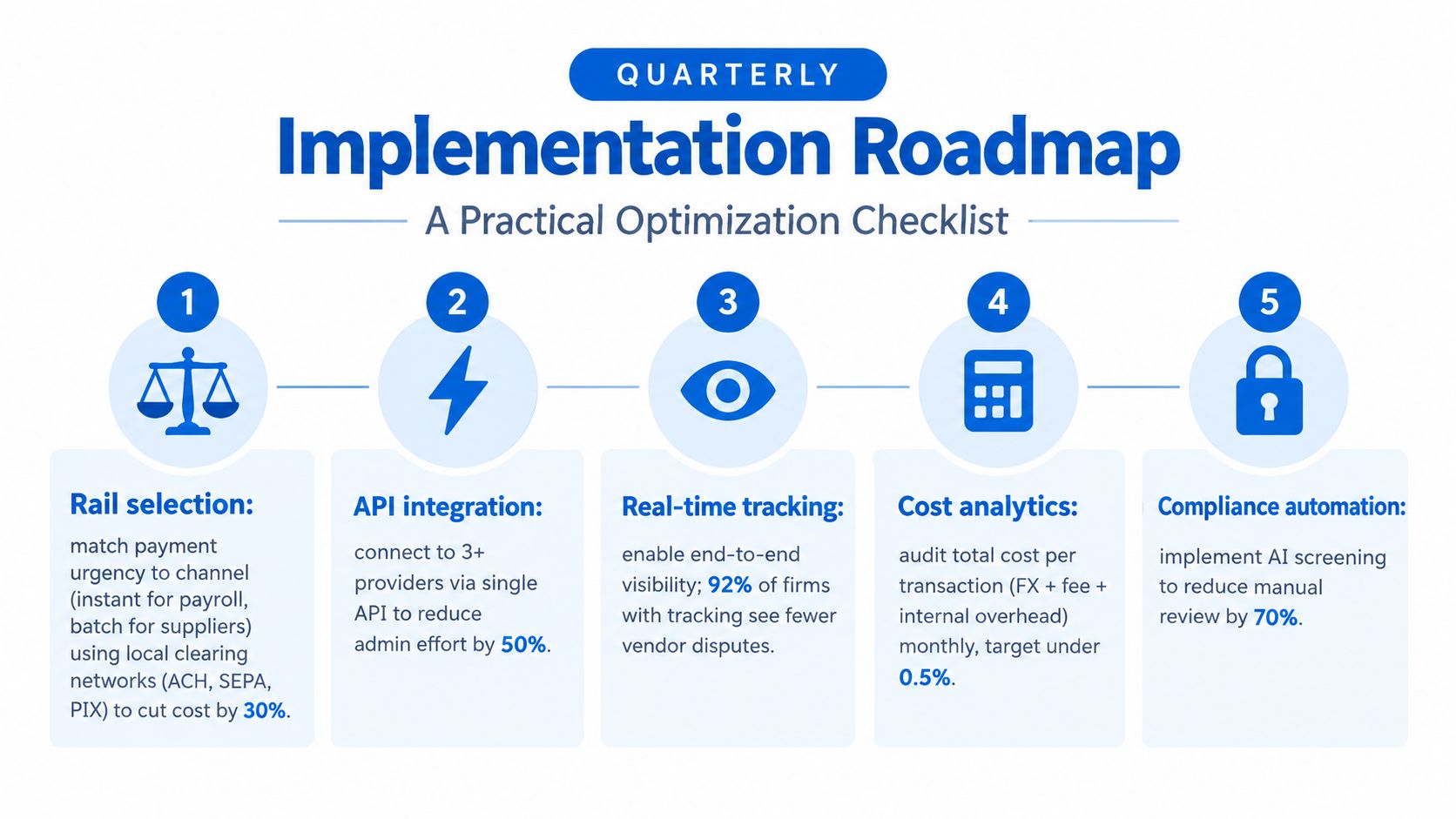
Quarterly checkpoint: Keep a corridor only when the business case includes reach, compliance, settlement reliability, and total delivered cost. A low visible fee isn't enough if exceptions consume the savings.
ISO 20022 can support better compatibility and fully automated straight-through processing when institutions implement it consistently. The IMF guidance on harmonized ISO 20022 messaging connects structured messages and interoperability with improved processing, while the FSB and G20 roadmap targets 75% of cross-border payments credited within one hour by 2027. That makes clean beneficiary data and complete payment purpose information an operational priority, not a formatting exercise.
What to Watch in Cross Border Payments Next
The next stage won't produce one universal rail overnight. Businesses should expect a patchwork in which domestic instant-payment systems, correspondent networks, richer messaging standards, and blockchain settlement connect through APIs and regulated intermediaries.
SWIFT's role is likely to keep evolving from message delivery toward better pre-validation, tracking, and coordination with faster settlement services. The useful question for a founder isn't whether SWIFT survives. It's whether the provider can use SWIFT when reach is necessary while selecting local or digital rails when the corridor supports them.
Instant-payment interconnections will also expand regionally. FedNow, RTP, SEPA Instant, India's UPI, and Singapore's PayNow represent domestic or regional capabilities rather than one global network. Their value depends on interoperability, participant access, currency conversion, and the ability to connect the final local credit to the business's originating account.
Stablecoins will need to fit treasury controls
Tokenized deposits and bank-issued stablecoins may appeal to treasury teams that want digital settlement without direct exposure to freely floating crypto assets. Their usefulness will depend on reserve arrangements, redemption rights, licensing, liquidity, supported currencies, and whether the recipient's financial institution accepts the asset.
Regulation will set the boundaries. FATF Travel Rule requirements, the EU's MiCA framework, and the US GENIUS Act framework all point toward stronger expectations for issuer controls, customer due diligence, transaction monitoring, and information sharing. A business shouldn't select a stablecoin route solely because the blockchain transaction is quick.
The practical trade-offs are clear:
- Integration effort: Connecting several rails and data standards takes engineering and operational work.
- Migration friction: ISO 20022 adoption can create mapping, testing, and exception-management work during the transition.
- Pricing transparency: Clearer FX and fee disclosure may reduce the implicit margin some providers previously earned.
- Treasury complexity: Stablecoins can improve settlement speed while adding wallet, liquidity, and compliance decisions.
- Coverage limits: An instant rail is useful only where the payer, beneficiary, currencies, and participating institutions support it.
For a business, the durable strategy is modular. Keep a reliable fiat route for payroll, taxes, and regulated obligations. Add local rails where they reduce unnecessary correspondent hops. Test stablecoin settlement on corridors where the provider can handle conversion, screening, custody, and local payout without creating a new manual process.
OneSafe offers multi-currency business accounts, ACH, domestic and international wires, SWIFT transfers, corporate cards, and crypto-compatible USDC workflows through one interface. If your team needs to coordinate fiat payments, stablecoin conversions, web3 invoices, and approval controls, visit OneSafe to assess whether its cross-border setup fits your corridors and governance requirements.