Table of Contents
- meta_description: "Stablecoin payments need post-transaction settlement and seamless on-chain to fiat conversion. How stablecoin B2B and neo-bank crypto payments close the gap."
- What Just Happened: StablePay Tests the Gap After On‑Chain Settlement
- Why It Matters: On‑Chain Finality Isn’t Transaction Completion
- The Background Newcomers Need
- Concrete Implications for Your Business
- What to Do Now: Recommended Actions
- What to Watch Next
- Key Takeaways
meta_description: "Stablecoin payments need post-transaction settlement and seamless on-chain to fiat conversion. How stablecoin B2B and neo-bank crypto payments close the gap."
Stablecoin Payments’ Next Step: Post-Transaction Integration
Stablecoin payments have slashed cross-border settlement times from days to seconds, but a trial announced by Korea’s StablePay Labs on September 14, 2026, exposes a blind spot that most infrastructure still ignores: the operational mess after on-chain confirmation. StablePay is testing a post-clearance environment that verifies merchant orders, applies settlement logic, and bridges blockchain data to back‑end systems—forming a post-transaction settlement layer—a recognition that finality on the ledger is not the same as a completed commercial transaction. For the first time, a payment infrastructure firm is publicly treating the fiat‑crypto handoff as the midpoint, not the finish line.
What Just Happened: StablePay Tests the Gap After On‑Chain Settlement
What happens after a stablecoin payment clears on-chain?
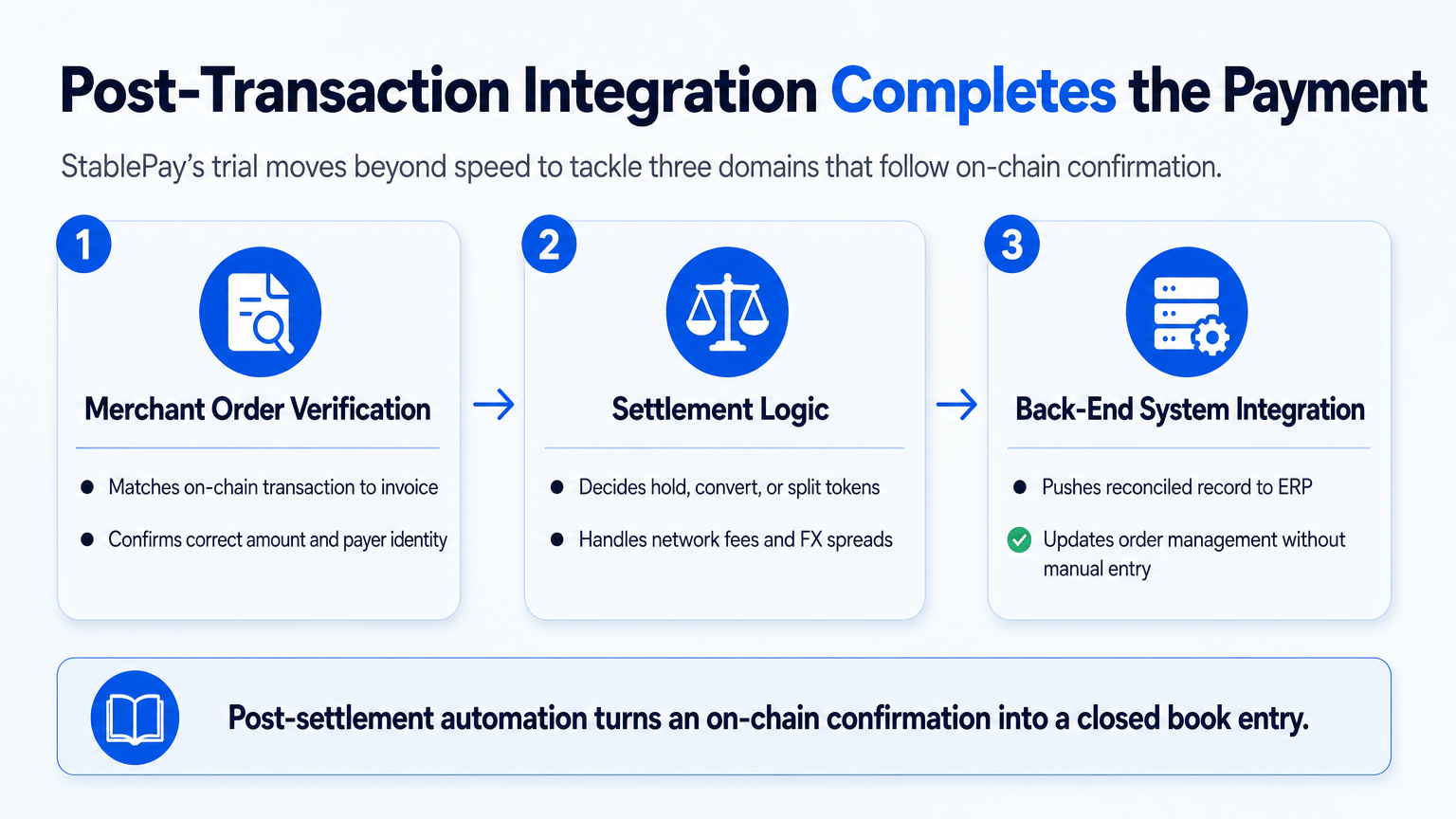
On September 14, 2026, KoreaTechDesk reported that StablePay Labs is building a post‑settlement layer designed to run after a stablecoin transfer receives blockchain confirmations. The trial covers three neglected domains:
- Merchant order verification – matching the incoming on‑chain transaction to a specific invoice, purchase order, or service record, including correct amount and payer identity.
- Settlement logic – determining whether the received tokens should be held as crypto, auto‑converted to fiat, or split across accounts; handling network fees, FX spreads, and any intermediary commissions.
- Back‑end system integration – pushing a reconciled, human‑readable record into the merchant’s order management, ERP, or accounting platform, so the sale lands in the general ledger without manual intervention.
StablePay’s environment bridges the blockchain to merchant systems in a structured way, rather than leaving it to the business to decode a raw transaction hash.
Why this trial signals a shift from settlement speed to operational completeness
Speed narratives have dominated stablecoin marketing for years. But a blockchain confirming a transfer in five seconds creates a new problem: an irrefutable, immutable entry exists, yet the order system still shows “awaiting payment” because no one told it the money arrived. StablePay’s trial is a public acknowledgement that on‑chain finality is not transaction completion. It shifts the industry conversation from “how fast can we settle?” to “how do we turn a confirmed block into a closed book entry without losing an afternoon?”
Why It Matters: On‑Chain Finality Isn’t Transaction Completion
Why isn’t on-chain settlement the final step in a stablecoin payment?
A blockchain confirms that tokens moved from address A to address B. It does not confirm why. From the merchant’s perspective, the payment journey still demands:
- Payment intent matching – connecting the transaction to a specific order. Without this, finance teams manually compare wallet activity against open invoices, a process that multiplies with volume.
- Value reconciliation – accounting for gas fees, price fluctuation during the brief settlement window, and any on‑chain to fiat conversion. A USDC payment worth $5,000 may land as $4,988 after network costs and a mild peg drift.
- Tax and compliance tagging – categorizing the inflow for VAT, sales tax, or income recognition in the jurisdiction of the merchant, not the blockchain.
Post‑trade processing in traditional finance encompasses clearing, settlement, and asset servicing. Crypto payments compress settlement time but explode the manual post‑trade burden if the infrastructure stops at the block explorer. That gap—the last mile from confirmed block to updated sales ledger—is what the StablePay trial aims to collapse.
The hidden ‘last mile’: from confirmed block to updated sales ledger
Most stablecoin payment providers today deliver an API that generates a deposit address and returns a webhook when the chain confirms the transfer. Workflows from that point—invoice tagging, multi‑currency reconciliation, FX execution—are left to the merchant. The result is a partial automation that creates a new reconciliation job: finance teams now track two parallel sets of records, one on‑chain and one in their ERP, and spend time making them match.
For global businesses and DAOs, partial automation creates a reconciliation burden
A global business accepting stablecoins alongside wire transfers, card payments, and local payment methods faces a fragmented dataset. The on‑chain payment arrives in a crypto wallet; the fiat sales ledger sits in a bank account or accounting package. Bridging them manually doesn’t scale. For DAOs managing treasuries, the gap is even starker: on‑chain reporting satisfies governance token holders but not tax authorities who require fiat‑denominated statements.
The Background Newcomers Need
A stablecoin payment typically flows like this:
- Merchant issues an invoice denominated in fiat (USD, EUR) or a specified stablecoin.
- Buyer initiates a transfer from a wallet or exchange to the merchant’s provided address.
- The blockchain confirms the transaction—usually within seconds on modern L1s or L2s like Polygon, where stablecoin payment volumes have surged.
- The payment provider notifies the merchant that funds arrived.
Where current provider guides stop short is exactly at that notification. Stripe’s stablecoin payments documentation, for instance, covers customer-facing checkout and on‑chain confirmation, but leaves subsequent order fulfillment and accounting integration as an exercise for the business. The post‑settlement black box—what McKinsey describes as the “orchestration layer” needed for stablecoin payments infrastructure—remains unaddressed by most off‑the‑shelf gateways.
Concrete Implications for Your Business
Integration readiness: your order system, mid‑office, and accounting must speak on‑chain language
Adopting stablecoins without end‑to‑end integration means your OMS, ERP, and accounting platform never hear about the payment unless a person tells them. A mature stablecoin payment integration maps a blockchain event to a business object. That requires:
- A real‑time feed from the blockchain or a trusted node.
- A mapping layer that links wallet addresses to customer accounts.
- Automated FX logic for on‑chain to fiat conversion, since most accounting systems still run on fiat.
- A reconciliation engine that handles underpayments, overpayments, and failed conversions.
How banks can integrate stablecoins into existing payment systems shows that even large institutions struggle with the data model mismatch between UTXO‑based chains and double‑entry accounting.
Why separated crypto and fiat rails multiply work, not reduce it
Many businesses bolt a crypto payment gateway onto a fiat banking relationship and call it “accepting stablecoins.” The two rails live apart: the crypto wallet holds USDC, the bank account holds fiat, and the accounting team manually reconciles both. This doubles the operational surface area. Every stablecoin B2B payment that arrives on‑chain must be manually moved, converted, and recorded. The cost of that labour often erases the savings from the payment’s speed.
What operational challenges do merchants face when accepting stablecoins?
Apart from the reconciliation headache, merchant stablecoin acceptance introduces:
- Volatility window risk – even with stablecoins, the brief moment between receiving tokens and converting to fiat exposes the merchant to a basis point shift.
- Refund mechanics – sending a refund in crypto raises questions: at what exchange rate, to what address, and how is the credit note generated?
- Customer support overhead – buyers accustomed to card chargeback protections expect similar reversibility; blockchain transactions are final, and a mistake can’t be “clawed back” without a new outbound payment.
A stablecoin payment provider that doesn’t automate the post‑transaction layer forces the merchant to solve these internally, often with spreadsheet‑driven processes that don’t scale.
DAO treasuries: when on‑chain reporting satisfies members but not tax authorities
How do DAOs handle the intersection of on‑chain settlement and fiat reporting requirements?
DAO treasuries may receive stablecoin inflows from protocol fees, NFT sales, or grants. On‑chain reporting via tools like Llama or Zerion satisfies the community, but tax filings demand fiat‑denominated profit‑and‑loss statements, often with clear sourcing of each transaction’s origin. The mismatch means DAOs that treat on‑chain settlement as the finish line end up with a parallel, manual fiat reporting process. A DAO stablecoin treasury needs programmable permissions (so a multisig or governance vote authorizes outflows) and an automated export of every on‑chain movement tagged with a fiat value at the time of the transaction. Without that, treasury managers face a painful reconstruction exercise every tax season or audit.
What to Do Now: Recommended Actions
Audit your payment stack for end‑to‑end settlement capability
Map every step after a stablecoin hits your wallet. If the answer to any of these is “a person does it manually,” you have an integration gap:
- Does the payment match to an open invoice automatically?
- Is the conversion to fiat executed and booked without a separate login to an exchange?
- Does the accounting system receive a journal entry with the correct transaction date, amount, and counterparty?
A stablecoin accounting workflow that ends at on‑chain confirmation is half‑built.
How can businesses integrate stablecoin payments into existing accounting and ERP systems?
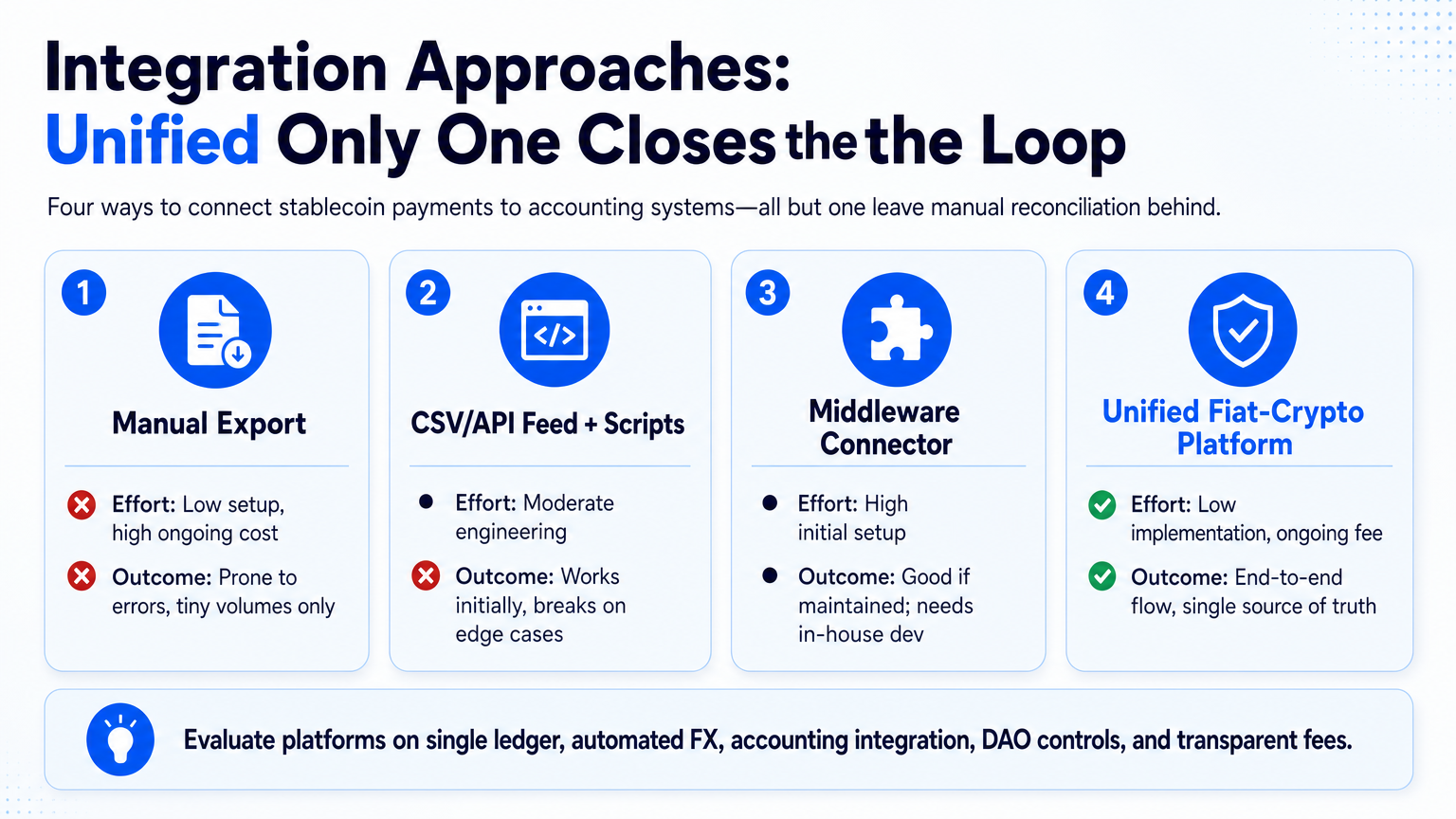
Integration options exist on a spectrum:
| Approach | Effort | Outcome |
|---|---|---|
| Manual export of wallet activity, re‑key into accounting | Low setup, high ongoing cost | Prone to errors, only works at tiny volumes |
| CSV/API feed from wallet, scripted mapping to ERP | Moderate engineering | Better, but breaks on edge‑cases |
| Purpose‑built middleware (e.g., webhook‑to‑ERP connector) | High initial setup | Good if maintained; requires in‑house dev |
| Unified platform that combines fiat banking and stablecoin custody | Low implementation, ongoing fee | End‑to‑end flow, single source of truth |
The last option removes the translation layer between crypto and fiat rails by having a single provider handle both. That provider can then generate normalized accounting entries, regardless of whether the underlying settlement occurred on‑chain or via wire.
What should a business look for in a platform that bridges fiat and stablecoin operations?
Evaluate any stablecoin payment provider or neo‑bank crypto payments platform against these criteria:
- Single ledger for fiat and crypto – no separate wallet and bank account that must be manually balanced.
- Automated FX and settlement rules – the platform executes on‑chain to fiat conversion on receipt, according to your pre‑set policy.
- Accounting integration – it posts to Xero, QuickBooks, or your ERP with minimal coding.
- DAO‑specific controls – customizable roles, multisig approval workflows, and export‑ready audit trails.
- Transparent fee structure – network fees, conversion spreads, and withdrawal charges clearly itemized, not buried in a spread.
Some platforms designed for global businesses and Web3 startups now embed these capabilities natively. For instance, OneSafe provides a unified interface for fiat and crypto operations, combining ACH, wires, and stablecoin custody with accounting integrations and automated conversion rules—removing the need to run separate banking and crypto exchange accounts. The difference between a partial integration and a consolidated one is the difference between hiring a full‑time reconciliations analyst and letting the platform close the loop.
What to Watch Next
More merchant‑focused post‑settlement pilots as stablecoin volume grows
StablePay’s work is unlikely to stay isolated. With stablecoin payment pilots from Visa and B2B‑focused trials in Korea already underway, 2026 is shaping up as the year the industry moves past “can we settle fast?” to “can we complete the transaction soup‑to‑nuts?” Expect more payment orchestrators to release post‑clearance modules that handle reconciliation and accounting entry generation.
Regulatory frameworks that may mandate settlement‑level controls
As jurisdictions from the EU to Africa formalise stablecoin rules, regulators are beginning to scrutinize the full transaction lifecycle—not just wallet KYC but also settlement-level record‑keeping, auditability of on‑chain to fiat conversion, and tax information reporting. A framework that treats the on‑chain confirmation as the only record may soon be viewed as incomplete. Businesses that build out their post‑transaction integration now will be better positioned when those requirements arrive.
Key Takeaways
- On‑chain finality is not the end of a payment; order verification, settlement logic, and accounting integration must follow for a transaction to be commercially complete.
- StablePay’s September 2026 trial signals that infrastructure providers are finally tackling the post‑settlement layer, not just settlement speed.
- Manual reconciliation between crypto wallets and fiat ledgers is the largest hidden cost of accepting stablecoins—and it grows with volume.
- A unified platform that combines fiat banking and stablecoin custody eliminates the dual‑rail headache and automates the last mile.
- DAOs face a unique reporting gap where on‑chain transparency doesn’t satisfy fiat tax requirements unless automated accounting integration is in place.
For businesses ready to move from partial stablecoin acceptance to a fully integrated fiat‑crypto operation, explore OneSafe’s unified platform.