If you’re searching for banks that take Bitcoin, you’re really looking for one of three things: buying Bitcoin through your bank account, finding a bank that will hold your Bitcoin, or running a business that needs to move between fiat and crypto. Most lists dump bank names without clarifying which job they actually do. This guide separates the three—buy, deposit, operate—and gives founders a fee-aware, risk-aware framework for choosing between a legacy crypto-friendly bank and a crypto-native platform like OneSafe.
Table of Contents
- Executive summary: What “banks that take Bitcoin” actually means in 2026
- Core concepts: three requests hiding behind “banks that take Bitcoin”
- Crypto-friendly banks 2026: legacy banks, charters, and neobanks
- How crypto-friendly banking actually works
- Options and tradeoffs: legacy bank vs. crypto-native platform
- A practical framework for choosing
- Mistakes, myths, and limitations
- Next steps for fiat + Bitcoin operations
- FAQ: Banks that take Bitcoin
- Key Takeaways
Executive summary: What “banks that take Bitcoin” actually means in 2026
No chartered U.S. bank accepts spot Bitcoin as a retail deposit. You can, however, buy Bitcoin with a bank account, hold it at a state-regulated custodian, or manage a fiat‑plus‑crypto treasury through a platform that integrates both rails. The right answer depends on which of those you need.
Core concepts: three requests hiding behind “banks that take Bitcoin”
Buy Bitcoin with bank account vs. holding Bitcoin in a bank
Most people mean either the ability to send a wire or ACH to an exchange, or a bank that will custody Bitcoin. The first is common—most U.S. banks allow transfers to regulated exchanges. The second is almost non‑existent. No traditional charter lets a bank hold a non‑security token as a retail deposit. Any platform offering a Bitcoin business account isn’t a bank holding spot BTC; it’s a crypto-native service that provides fiat accounts and crypto custody side by side.
Crypto-native platforms and the “not a bank” distinction
Platforms like OneSafe are financial technology companies—not banks. They partner with licensed banks for fiat accounts and offer a unified interface for crypto custody, corporate cards, and cross‑border payments. They are neobank for crypto businesses that collapse the stack: one login for ACH, USDC, wires, and multi‑sig treasury management.
Key terms: custody, FDIC insurance, stablecoins, on/off‑ramp
- Custody: Who holds the private keys. With crypto, that’s often a qualified custodian like Fireblocks (used by OneSafe).
- FDIC insurance: Protects only fiat deposits at member banks—up to $250,000 per depositor. It does not cover crypto assets.
- Stablecoins: Programmable dollars on blockchain rails (USDC) that let you move value faster and cheaper than wire transfers.
- Crypto on‑ramp off‑ramp: The conversion between fiat and crypto. A good business platform cuts that from days to minutes.
Crypto-friendly banks 2026: legacy banks, charters, and neobanks
US banks that support Bitcoin and stablecoins today
Ranking pages often list JPMorgan, Bank of America, Citi, and Revolut as crypto‑friendly. The reality: those banks support institutional custody or allow personal customers to buy via linked accounts, but they don’t offer spot Bitcoin business deposit accounts. A 2026 survey by James Baker CPA notes that US banks that support Bitcoin and stablecoins for business are rare—Mercury, Brex, and Bluevine sometimes tolerate crypto activity but impose high minimums or close accounts if volumes spike. Best Crypto-Friendly Banks for US LLCs in 2026 confirms genuine crypto‑friendly business banking remains scarce. Essentially, no banks that accept Bitcoin as a deposit exist in the traditional sense.
Operation Chokepoint 2.0 and the Silvergate/Signature fall
The collapse of Silvergate and Signature Bank in 2023 left a gaping hole in crypto‑to‑fiat plumbing. Under what many call Operation Chokepoint 2.0, regulators discouraged banks from serving digital asset firms. Startups and DAOs were forced toward neobanks and stablecoin rails that don’t depend on a single bank’s willingness to hold their fiat.
Where crypto-native platforms fill the gap
Crypto‑native platforms like OneSafe stepped in with partner‑bank fiat accounts, on‑chain custody, and API‑driven compliance. They aren’t banks, but they do what a bank used to do for a crypto company: accept wires, pay bills, convert to USDC, and provide segregated operating accounts—without the constant threat of de‑banking. This is stablecoin banking in practice: using USDC rails to move value while the underlying fiat sits in a partner institution.
How crypto-friendly banking actually works
Crypto on‑ramp off‑ramp speeds: ACH, wires, and USDC
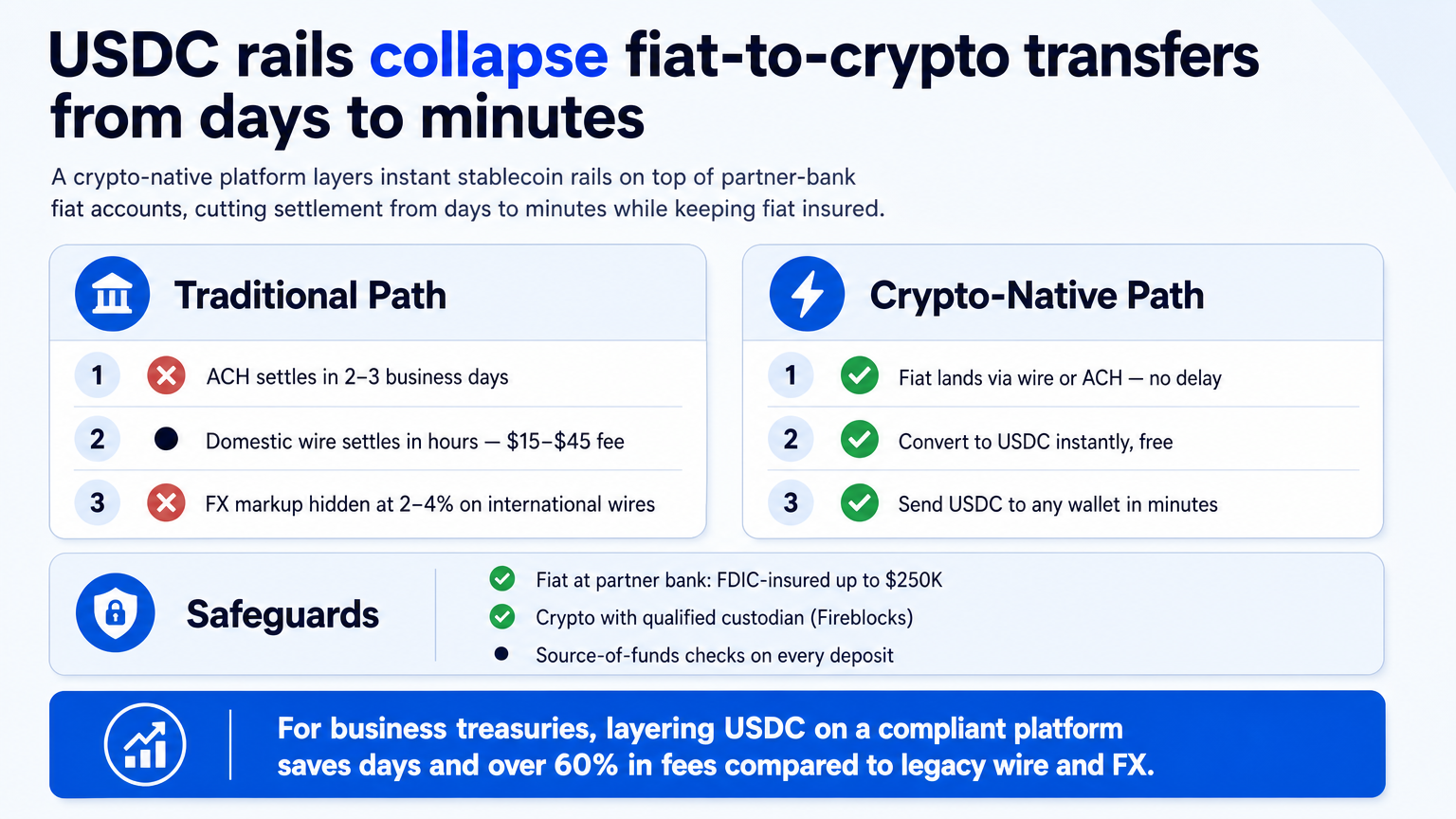
A traditional bank processes ACH in 2–3 business days and a domestic wire in hours. A crypto‑native platform layers an instant stablecoin rail. For example, OneSafe lets you receive a client’s wire as fiat, convert to USDC for free, and send that USDC to a DeFi protocol in minutes. Off‑ramping fiat costs 0.15%. That avoids the hidden FX markups of 2–4% at legacy banks.
Custody, FDIC limits, and source-of-funds checks
Fiat balances in a crypto‑native platform are held at partner banks and may be FDIC‑insured up to the limit, but the crypto assets are not. Source‑of‑funds checks are strict: German banks, for instance, cannot accept Bitcoin directly as a mortgage down payment because section 16a GwG prohibits paying in crypto, requiring exhaustive proof of origin (CryptoTicker). Any US‑facing business should expect detailed KYC and KYB requests.
Options and tradeoffs: legacy bank vs. crypto-native platform
Fee and speed comparison
| Service | Legacy crypto-friendly bank (typical) | Crypto-native platform (OneSafe) |
|---|---|---|
| Domestic ACH | Free or $1–$3 | 0.15% fiat deposit/withdrawal |
| Domestic wire | $15–$45 | $25 withdrawal, $10 deposit |
| International wire (SWIFT) | $25–$55 + ~2% FX | 0.35% + $50, plus FX fee of 0.25% |
| Corporate card FX | 2–4% | 3% |
| USDC on/off‑ramp | Not supported | Free deposits/withdrawals |
| Stablecoin conversion | N/A | 0.15% to fiat |
| Multi‑sig treasury | No | Yes, via Fireblocks |
Sources: OneSafe fee schedule, typical U.S. business bank disclosures.
Business/DAO requirements: permissions, segregated accounts, invoicing
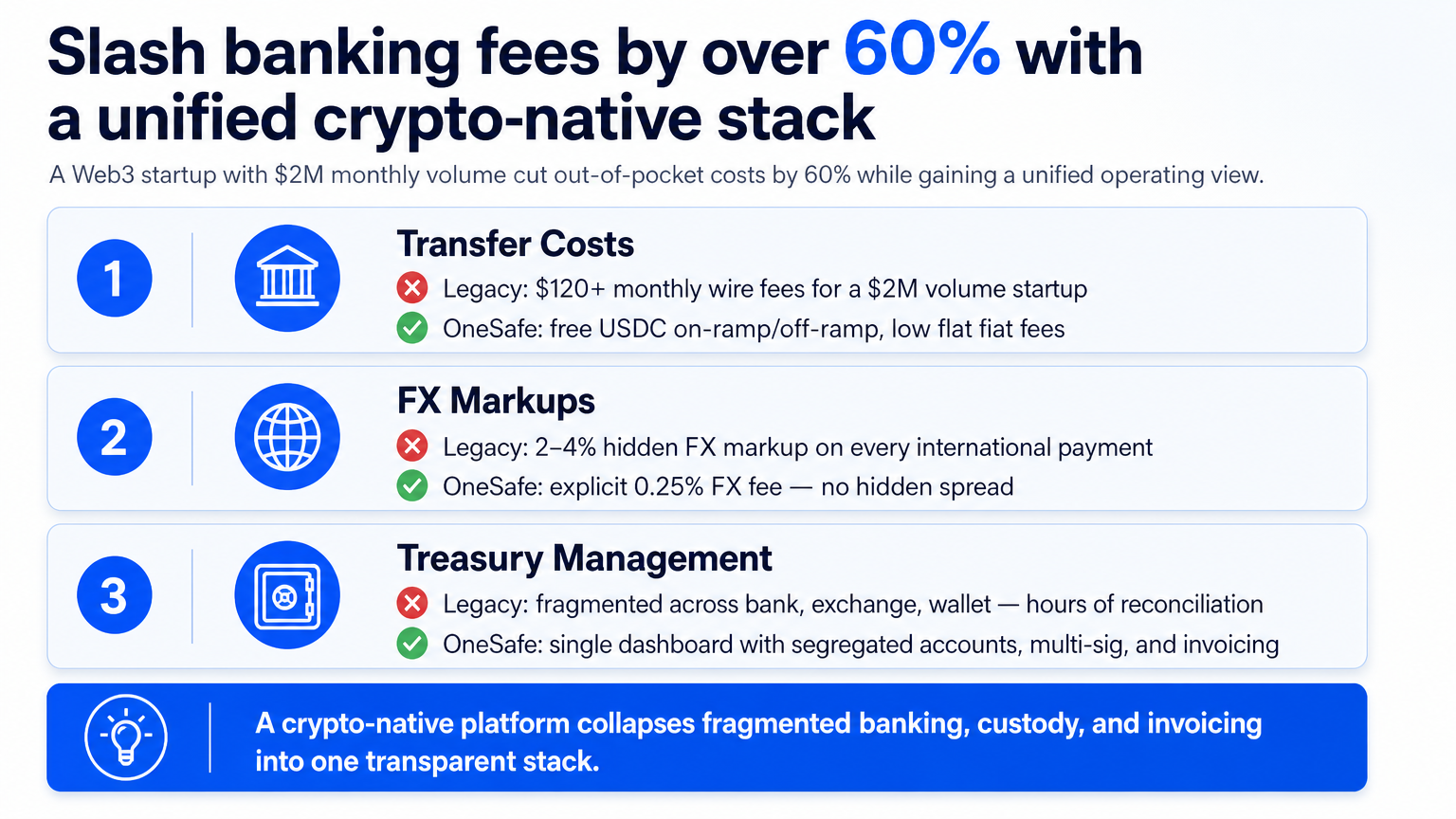
A crypto startup juggling a Mercury account, a Coinbase Institutional wallet, and a Gnosis Safe fragments reconciliation and security. A platform with customizable roles and permissions, stablecoin invoicing, and segregated sub‑accounts under one dashboard reduces that burden—the core value of a Web3 account.
A practical framework for choosing
Decision checklist for startups and finance leads
- Need to hold spot Bitcoin as a deposit? You need a qualified custodian, not a bank.
- Treasury predominantly stablecoins? A neobank with USDC rails is often cheaper and faster.
- Multiple signers with permissions? Legacy bank systems rarely support granular DAO access.
- High wire volume? Explicit 0.25% FX beats a bank’s hidden 2% markup.
- Willing to document source of funds? All regulated platforms will ask; have formation docs, EIN, and cap table ready.
Worked example: consolidating a stack
A Web3 startup with $2M monthly volume was using Mercury for fiat, Coinbase for USDC on‑ramp, and a Safe for assets. They paid $120 in bank wire fees, lost ~2.5% on FX to pay overseas contractors, and spent an hour reconciling across three systems. After moving to OneSafe, they used the free USDC on‑ramp, paid contractors with USDC at no fee, and consolidated treasury in Fireblocks‑secured accounts. Out‑of‑pocket fees dropped to $490/month, savings over 60%. The tradeoff: no walk‑in bank relationship, but a single interface and clean audit trail.
Mistakes, myths, and limitations
Announcement ≠ acceptance: the Chainlink–Infosys lesson
On September 24, 2026, Chainlink and Infosys announced a deal supposedly touching 1.7 billion bank accounts. But no named banks, no production timeline, and no commitment to pay fees in LINK. The token dropped 4.4% that day, down 43% for the year (24/7 Wall St.). Lesson: a press release does not mean any banks that accept Bitcoin will ever materialize. Until you can test a live integration, treat it as vapor.
Scam exposure, reimbursement gaps, and what banks won’t fix
In late September 2026, a P.E.I. woman lost $9,800 in a Bitcoin scam after a caller spoofed her bank’s number. For six months, she’s tried to get TD Bank to reimburse her without success (CBC News, September 25, 2026). Banks do not backstop crypto transactions. Even if you buy Bitcoin with a bank account, any loss from a scam is almost never covered. Operational security—multi‑sig, address whitelisting, MFA—is your only real safeguard.
Next steps for fiat + Bitcoin operations
Questions to ask any crypto-friendly bank or platform
- Do you hold my Bitcoin, or use a third‑party custodian?
- Is my fiat account FDIC insured, and at which partner bank?
- What are the all‑in costs for a SWIFT wire and FX?
- Can I set granular spending limits and roles for team members?
- Do you support native stablecoin invoicing and reconciliation?
- How do you handle source‑of‑funds checks?
Where OneSafe fits in the spectrum
OneSafe is a financial technology company, not a bank. It provides neo‑banking services through partner banks: multi‑currency accounts, ACH, wires, corporate cards, transparent FX, and free USDC on‑off‑ramps. Digital assets are secured via Fireblocks custody. Onboarding is fully digital, typically within a week, with no minimum balance. For a DAO or global startup, it’s the “operate” solution in the taxonomy.
FAQ: Banks that take Bitcoin
Which banks accept Bitcoin and crypto deposits?
Traditional chartered banks that accept Bitcoin as retail deposits don’t exist. State‑regulated trust companies and platforms hold Bitcoin, but crypto balances are not FDIC‑insured.
Can I buy Bitcoin with a regular bank account?
Yes. Most U.S. banks let you transfer funds to a licensed exchange. You don’t need a special Bitcoin business account just to on‑ramp; the bank simply processes the fiat transfer.
Which US banks support Bitcoin and stablecoins in 2026?
JPMorgan and Citi provide institutional custody. Select smaller banks like Customers Bank serve crypto firms indirectly, but with strict limits. For stablecoins, platforms like OneSafe offer USDC accounts while the underlying fiat stays in a partner bank—a form of stablecoin banking.
Do traditional banks allow crypto transactions?
Most allow personal transfers to exchanges. Many will close business accounts that regularly transact with non‑exchange crypto entities. It’s wise to have a secondary relationship.
Are crypto banks safe and regulated?
“Crypto bank” is a misnomer. Some are state‑licensed trust companies; others are technology platforms that partner with regulated banks. Safety depends on who holds your crypto and what insurance applies.
Is my crypto protected by FDIC insurance?
No. FDIC insurance applies only to fiat deposits at insured banks. Crypto assets are not covered.
What is the difference between a crypto bank and a wallet?
A wallet holds private keys and can be custodial or non‑custodial. A neobank for crypto businesses typically adds a fiat account, custodial wallet, and on/off‑ramp in one interface.
Do I need a special bank account for a crypto business?
Yes. Standard accounts can be frozen if the bank deems your activity high‑risk. A purpose‑built Bitcoin business account platform reduces that risk.
What happened to Silvergate and Signature Bank?
Both crypto‑friendly banks failed in the 2023 crisis. Regulatory pressure since then has pushed crypto companies toward stablecoin rails and neobanks.
What should a Web3 startup or DAO look for in a banking platform?
Look for segregated fiat accounts, multi‑user permissions, custodial support for on‑chain assets, transparent fees, and a single stack that replaces a bank, an exchange, and a wallet.
Key Takeaways
- “Banks that take Bitcoin” conflates three jobs—buy, deposit, operate—and no traditional bank does all three.
- FDIC insurance never covers crypto.
- For business treasuries, stablecoins on a crypto‑native platform often beat legacy bank wires in speed and cost.
- A headline partnership doesn’t equal real banking integration.
- Banks will not reimburse you for Bitcoin scam losses; operational security is your only backstop.
If you’re ready to run fiat and crypto from a single dashboard, open a free OneSafe account and start onboarding in minutes.