On September 30, 2026, AllUnity launched the USDAU stablecoin, marking a dollar-backed stablecoin regulation milestone: it’s issued under the EU’s Markets in Crypto-Assets (MiCA) framework across six blockchains. For finance leads and founders, this isn’t just another coin—it’s the first concrete case study of operationalizing MiCA for business payments and treasury, with built-in FX and institutional minting. The launch signals that regulated stablecoins are moving from concept to cross-border infrastructure. This event is a concrete example of crypto regulation for businesses integrating digital assets into their operations.
Table of Contents
- What Just Happened: AllUnity USDAU Launches Across Six Blockchains
- Why This Matters Now for Global Businesses and DAOs
- The Regulatory Background in 60 Seconds
- Concrete Implications: How Businesses Can Act on This Today
- What to Watch Next: Stablecoin Regulation in 2026 and Beyond
- Key Takeaways
What Just Happened: AllUnity USDAU Launches Across Six Blockchains
What is USDAU and how is it different from other stablecoins?
USDAU is a US dollar-backed stablecoin issued by AllUnity, a BaFin-licensed electronic money institution under MiCA. As reported by Crypto News on September 30, 2026, it is available at launch on Ethereum, Solana, Base, Tempo, Arc, and Polygon, with more networks expected later this year. Unlike unregulated or offshore stablecoins, USDAU can be minted and redeemed 1:1 at par exclusively by eligible institutional clients through AllUnity’s Business Mint Account, and reserves are held in US dollars supported by Banking Circle for transaction banking. Flowdesk provides liquidity. This means USDAU is designed from the ground up as a business tool, not a retail speculative asset, and its regulatory status eliminates the ambiguity around reserve backing and redemption rights that haunts many older stablecoins.
Built-In Stablecoin FX and Multi-Chain Access
Alongside the stablecoin, AllUnity launched a stablecoin FX feature (branded Instant FX) that enables on-chain conversion between supported currencies. This lets businesses settle cross-border invoices or manage treasury positions without leaving the blockchain environment. The multi-chain deployment means a corporate treasury can hold USDAU on Ethereum for DeFi integrations, on Solana for speed, or on Polygon for lower-cost payments, all under a single compliant roof. This represents a step toward what stablecoin regulation 2026 is increasingly enabling: a digital dollar that moves like crypto but meets institutional compliance standards.
Why This Matters Now for Global Businesses and DAOs
How does the launch of USDAU change the landscape for business stablecoin adoption?
Until now, business stablecoin adoption was split: firms could use unregulated coins and shoulder compliance risk, or wait for banks to tokenize deposits. USDAU provides a third path—a regulated stablecoin issuer with clear legal rights for holders, full reserve backing, and a license that holds across the EU. This directly addresses the core concerns that have kept Treasuries on the sidelines: uncertainty over asset segregation, redemption guarantees, and regulatory reprisal. With a live example, financial teams can now benchmark requirements and negotiate with payment providers against a concrete standard, accelerating adoption timelines.
A Working Model of Regulatory Compliance
AllUnity’s launch is a real-world proof point that MiCA’s stablecoin provisions are operationally achievable. The issuer has navigated e-money licensing, reserve arrangements, and smart contract audits. For businesses, this reduces the compliance burden: using a MiCA compliant stablecoin means the issuer shoulders the regulatory responsibility. Your firm still needs to handle its own AML/KYC and transaction monitoring, but asset safety and redemption rights are contractually defined. In a fragmented global environment, having at least one jurisdiction with clear rules helps treasury teams argue for inclusion of digital dollars in their payment stack.
Stablecoins as Infrastructure, Not Just Speculation
The USDAU launch underscores a shift in market structure: stablecoins are becoming payment rails. With Instant FX and multi-chain support, AllUnity is targeting cross-border crypto payments, not just holding. For a CFO, this means a dollar-pegged asset that can be moved 24/7 across jurisdictions, converted into other currencies on-chain, and integrated into existing ERP or treasury systems through APIs—all under a single regulatory regime. This is a direct challenge to the correspondent banking system’s speed and cost.
The Regulatory Background in 60 Seconds
What does MiCA compliance actually require from stablecoin issuers?
MiCA, which took full effect for stablecoins in mid-2024, imposes requirements that are essential to understand when choosing a partner. According to the European Securities and Markets Authority (ESMA), issuers of asset-referenced tokens or e-money tokens must:
- Hold a license as a credit institution or e-money institution (AllUnity holds a BaFin e-money license).
- Maintain full reserve backing with no rehypothecation, invested in high-quality liquid assets. Reserves must align with redemption demands at all times.
- Guarantee redemption rights — holders can redeem at par at any time, with specific timelines and no fees.
- Segregate assets from the issuer’s own funds to protect users in insolvency.
- Publish a white paper disclosing risks, redemption mechanics, and governance.
These rules set a high standard for digital asset compliance in the EU, far surpassing current US state-level money transmitter frameworks, giving businesses a clearer legal basis for holding and transferring value. The Chainalysis blog notes ongoing challenges around supervision and cross-border enforcement, but for an EU-licensed issuer, the bar is high and legally enforceable.
The US GENIUS Act and the Patchwork of State Rules
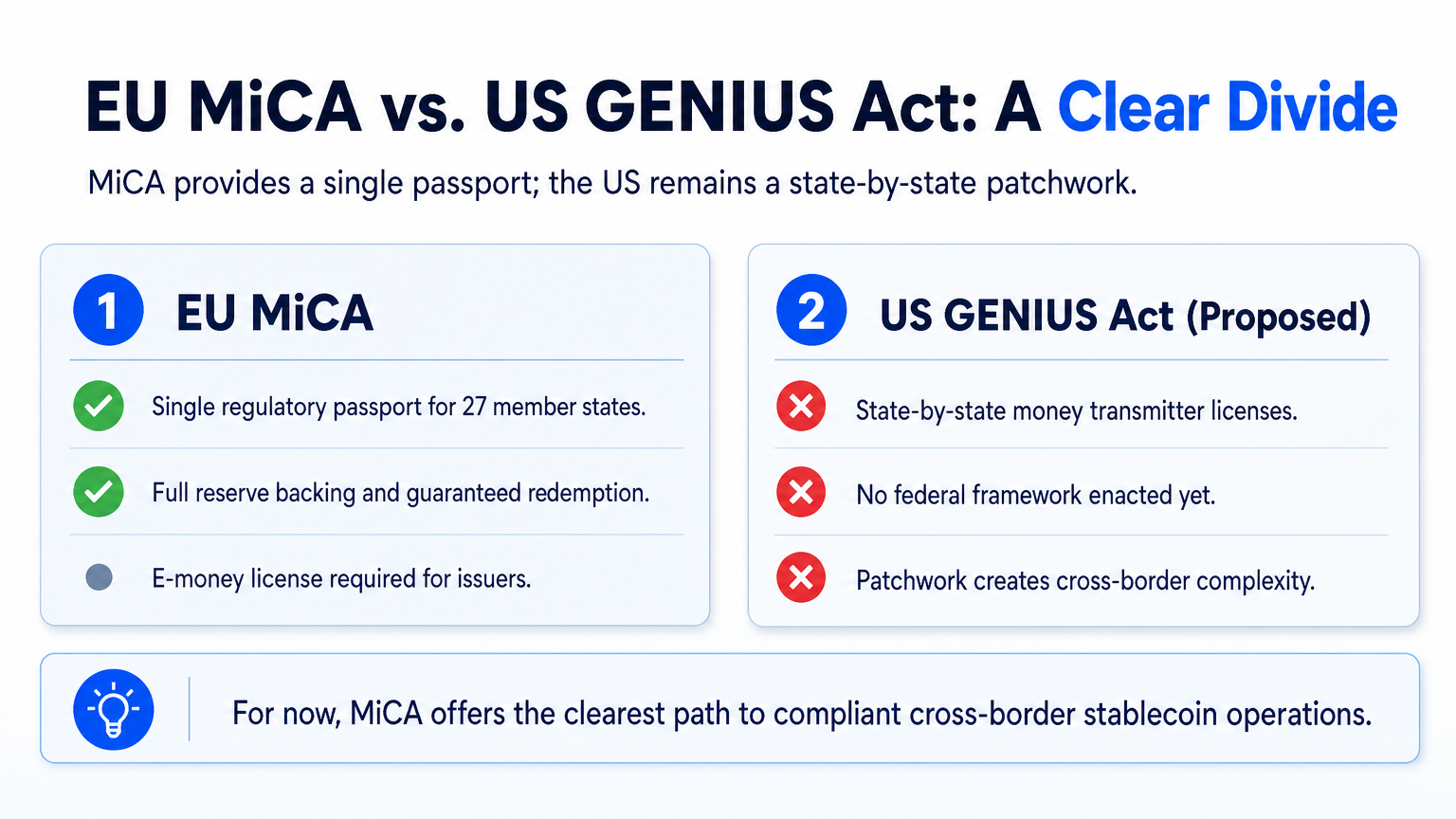
In the US, stablecoin regulation remains fragmented. The proposed GENIUS Act (the Guiding and Establishing National Innovation for US Stablecoins Act) would create a federal framework for stablecoin issuers, but as of September 2026, it has not passed. Instead, businesses must navigate a state-by-state licensing system, with New York’s BitLicense and Wyoming’s special-purpose depository institutions as notable examples. Major banks and fintechs are watching the Citi-Coinbase partnership—a deal reported earlier this year—as a template for bank-grade stablecoin payments in the US. That initiative aims to bridge traditional banking and blockchain settlement, but it operates within existing state rules rather than a unified federal standard. For now, US businesses face a more complex compliance landscape than their European counterparts.
What do the EU’s MiCA and the proposed US GENIUS Act mean for cross-border operations?
For cross-border operations, the contrast between the EU's MiCA and the US's GENIUS Act (still proposed) is stark. Under MiCA, an EU-licensed stablecoin like USDAU can be used across all 27 EU member states with a single regulatory passport, simplifying treasury management for businesses operating in Europe. The US, by contrast, requires navigating state-level money transmitter licenses, creating a patchwork that complicates cross-state and international payments. The pending GENIUS Act aims to create a federal framework, but until it passes, US companies with international subsidiaries may find it easier to use a MiCA-compliant stablecoin for EU operations while maintaining separate compliance for US activities. This dual-track reality means global businesses must design treasury structures that can handle both a clear regulatory regime (EU) and a fragmented one (US), making stablecoin regulation a key factor in cross-border architecture decisions.
Concrete Implications: How Businesses Can Act on This Today

What are the practical steps for a global business to start using USDAU for payments or FX?
A corporate treasury can begin integrating USDAU by following a structured approach:
- Legal and compliance review: Confirm that your entity type and jurisdiction are eligible for AllUnity’s Business Mint Account and that you can meet the KYC/KYB requirements.
- Treasury workflow mapping: Identify specific cross-border payment corridors (e.g., paying suppliers in Europe or Asia) where a stablecoin could replace a SWIFT wire. Estimate cost savings using AllUnity’s Instant FX against your current bank’s spreads.
- On-chain wallet setup: Choose a blockchain network from the supported six that matches your security and speed needs. Integrate a corporate multi-sig wallet.
- Mint or purchase: Mint USDAU at par via the Business Mint Account, or acquire it through liquidity providers like Flowdesk.
- Test with a single payment: Run an end-to-end payment to a partner or subsidiary, tracking settlement time and fees.
- Integrate with accounting: Map on-chain transactions to your general ledger. Platforms like OneSafe offer crypto treasury management tools that can automate reconciliation and fiat-crypto conversions, easing this step.
How can businesses manage the fiat-to-stablecoin conversion while staying compliant?
The fiat on/off-ramp remains a critical compliance chokepoint. Businesses must ensure that any exchange or platform they use for USD-to-USDAU conversions is properly licensed in their jurisdiction and applies robust AML checks. Regulated stablecoin issuers like AllUnity handle the reserve side; your company’s obligation is to justify the source of funds and report large transactions. Working with a neo-banking platform that supports both fiat and crypto accounts, such as OneSafe, can help by providing a single interface for withdrawing from blockchain to bank accounts while maintaining compliance documentation. The key is to keep an audit trail linking each stablecoin issuance or redemption to a verified corporate bank account.
Evaluating Platform Partners for On/Off-Ramp and Compliance
When choosing a banking or payments partner to support USDAU, look for:
- Multi-currency fiat accounts in USD, EUR, and your operating currencies, enabling seamless sweeps between fiat and stablecoins.
- Direct on/off-ramp APIs that allow automated minting and redemption without manual intervention, reducing operational risk.
- Digital asset custody by regulated custodians (e.g., Fireblocks), ensuring that private keys are institutionally managed.
- KYB/KYC automation that meets EU and local standards, with a typical onboarding time of under a week.
Platforms that bundle these capabilities—as OneSafe’s business bank account with no minimum balance does—let you start small and scale as your stablecoin use grows, without the overhead of multiple vendor relationships.
What should DAOs and Web3 companies specifically consider when adopting regulated stablecoins?
DAOs and on-chain organizations face a unique tension: they need to interact with regulated financial infrastructure while preserving decentralized governance. When adopting a MiCA compliant stablecoin like USDAU:
- Entity structure: AllUnity requires eligible institutional clients, so a DAO may need a legal wrapper (e.g., a foundation or association) to open a Business Mint Account.
- Multi-sig governance: Map on-chain voting or multi-sig approval flows to the corporate treasury wallet to maintain decentralized control while keeping compliance records.
- Treasury composition: Holding regulated stablecoins alongside protocol-native tokens can stabilize working capital, but requires clear policies on conversion and reporting.
- Automated compliance: Use platforms that support Web3 accounts with customizable roles and permissions, so different sub-entities or guilds can transact without breaking treasury oversight.
Regulated stablecoins don’t remove the need for DAOs to have off-chain legal structures for banking access, but they do provide a defensible, liquid dollar asset that can be held entirely on-chain.
What to Watch Next: Stablecoin Regulation in 2026 and Beyond
Will the US Finally Pass a Federal Framework?
The GENIUS Act has bipartisan support in principle, but disagreements over state versus federal jurisdiction, consumer protection, and reserve composition have stalled its passage. The Citi-Coinbase stablecoin payments deal shifted the landscape by demonstrating that large banks are willing to operate within the current patchwork. If more banks follow suit, pressure will mount for a federal framework that preempts state laws, but businesses should not wait for legislation. In the meantime, a MiCA-compliant stablecoin offers a ready-made, legally clear alternative for international operations, even for US-based companies working with European subsidiaries.
The Coming Wave of MiCA-Compliant Issuers
AllUnity is not alone. Circle launched its euro- and dollar-pegged MiCA-compliant stablecoins earlier, and several other issuers are in the pipeline, according to the MiCA-Compliant Stablecoins List. As more issuers enter, we can expect competition on yields, redemption speeds, and FX integrations. Businesses should watch for multi-currency stablecoin suites that offer seamless conversion between euros and dollars on-chain, further eroding the cost of cross-border treasury management.
| Key Facts: USDAU Launch (September 30, 2026) | |
|---|---|
| Issuer | AllUnity (BaFin-licensed e-money institution) |
| Backing | 1:1 US dollar reserves, no rehypothecation |
| Redemption | At par, available to eligible institutions via Business Mint Account |
| Blockchains | Ethereum, Solana, Base, Tempo, Arc, Polygon |
| Built-in FX | Yes, Instant FX for on-chain currency conversion |
| Reserve partner | Banking Circle |
| Liquidity provider | Flowdesk |
| Regulatory regime | EU MiCA |
Key Takeaways
- AllUnity’s USDAU is a MiCA-licensed, institution-only stablecoin with built-in FX, offering a compliant blueprint for cross-border business payments as of September 2026.
- MiCA requires full reserve backing and guaranteed redemption at par, giving corporate treasuries a legally enforceable safe harbor unlike unregulated alternatives.
- Businesses can start integrating USDAU by mapping high-cost payment corridors, securing a compliant fiat on/off-ramp, and testing a single on-chain settlement.
- DAOs need legal wrappers to access institutional minting, but regulated stablecoins provide an on-chain dollar asset that aligns with decentralized treasury management.
- With the US GENIUS Act still pending, an EU-licensed stablecoin is currently the clearest path to eliminating regulatory uncertainty in digital dollar operations.
For global businesses ready to unify fiat and stablecoin treasury operations, explore how OneSafe streamlines compliant on/off-ramps and multi-currency accounts.