
If you’ve opened a free business account with a neobank, you’ve likely wondered how do neobanks make money. The answer depends on whether the platform is a consumer-only challenger or a hybrid neobank for DAOs and global teams handling both wires and stablecoins. This FAQ walks through every revenue line, from interchange to on-chain custody, so you can see exactly which neobank business model you’re paying into—and where the highest neobank fees hide.
Table of Contents
- The direct answer: a layered revenue stack
- Core neobank revenue streams
- How crypto-friendly neobanks make money differently
- What should global businesses and DAOs check in a neobank’s fee schedule?
- FAQ: definitions, neobank vs digital bank, profitability, and insurance
- What changed in 2026?
- Sources and review cadence
- Key Takeaways
- Sources
The direct answer: a layered revenue stack
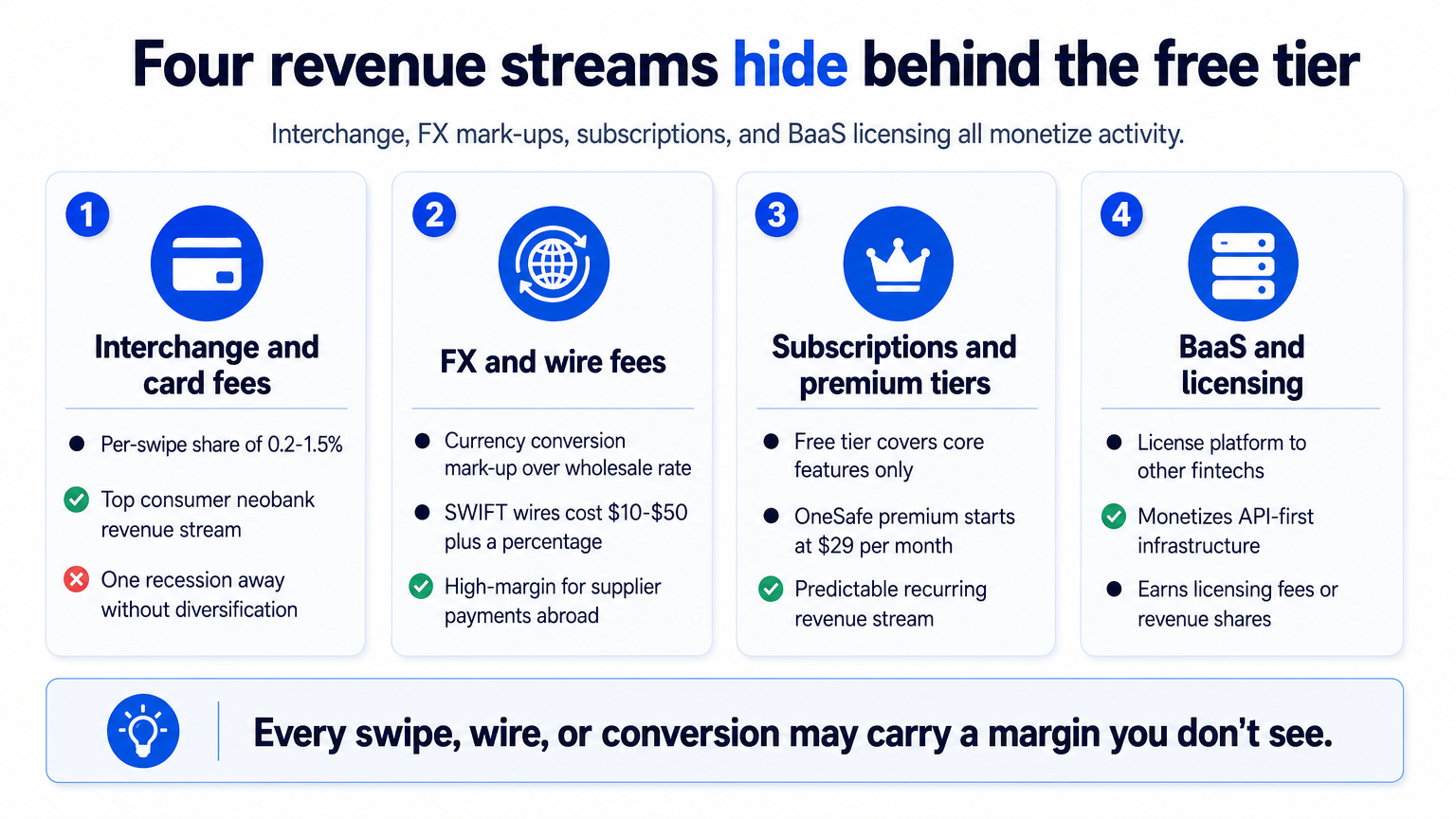
Neobanks earn from interchange fees, FX mark-ups, monthly subscriptions, and banking-as-a-service (BaaS) licensing. Hybrid fiat-crypto platforms add on/off-ramp spreads, custody economics, and stablecoin transaction fees. A “free” account simply shifts costs to transaction moments—every swipe, wire, or crypto conversion may carry a margin you don’t see as a line item. Understanding the revenue model behind the free tier is the only way to predict actual costs.
Core neobank revenue streams
Interchange and card fees
Interchange is the small percentage paid to the card issuer per transaction. For many consumer neobanks, this is the single largest neobank revenue stream—often 0.2% to 1.5% per swipe—but it’s fragile. Spending drops in a downturn, and regulatory caps (like the EU’s interchange fee regulation) compress margins. Bain & Company’s 2026 analysis warned that interchange-funded neobanks are brittle without diversification; one that lives on interchange alone is one recession away from trouble.
FX spreads and cross-border wire fees
Every currency conversion carries a mark-up over the wholesale rate. Even a 0.25% spread adds up quickly on large volumes, and many neobanks charge more for exotic pairs. Cross-border SWIFT wires typically come with fixed fees ($10–$50) plus a percentage. For businesses that regularly pay suppliers abroad, these fees are a high-margin, steady revenue line that often dwarfs interchange.
Subscriptions and premium tiers
Free tiers cover core features, while monthly plans unlock lower FX rates, free international wires, higher limits, or dedicated support. Subscription revenue is predictable and reduces reliance on transactional spikes. OneSafe’s premium tier, for example, starts at $29/month.
BaaS and licensing partnerships
Mature neobanks sometimes license their platform to other fintechs or traditional banks, providing the front end while the partner holds the license and capital. This BaaS model generates licensing fees or revenue shares, monetizing API-first infrastructure beyond the neobank’s own customers.
How crypto-friendly neobanks make money differently
Why crypto-native platforms don’t live on interchange
A consumer neobank thrives on daily card swipes. A crypto neobank serving DAOs and Web3 startups sees fewer taps and more large wire transfers, stablecoin moves, and instant fiat-to-crypto conversions. Interchange becomes a minor note. Revenue instead flows from wire fees, FX margins, on/off-ramp spreads, and sometimes custody or staking programs. As OneSafe’s recently published guide on the best neobanks for global fiat and crypto enterprises put it, “traditional neobanks treat crypto as a nuisance, while crypto wallets can’t pay your landlord.” That gap forces businesses to pay duplicate fees across separate banking and crypto platforms.
OneSafe’s fee schedule as a worked example
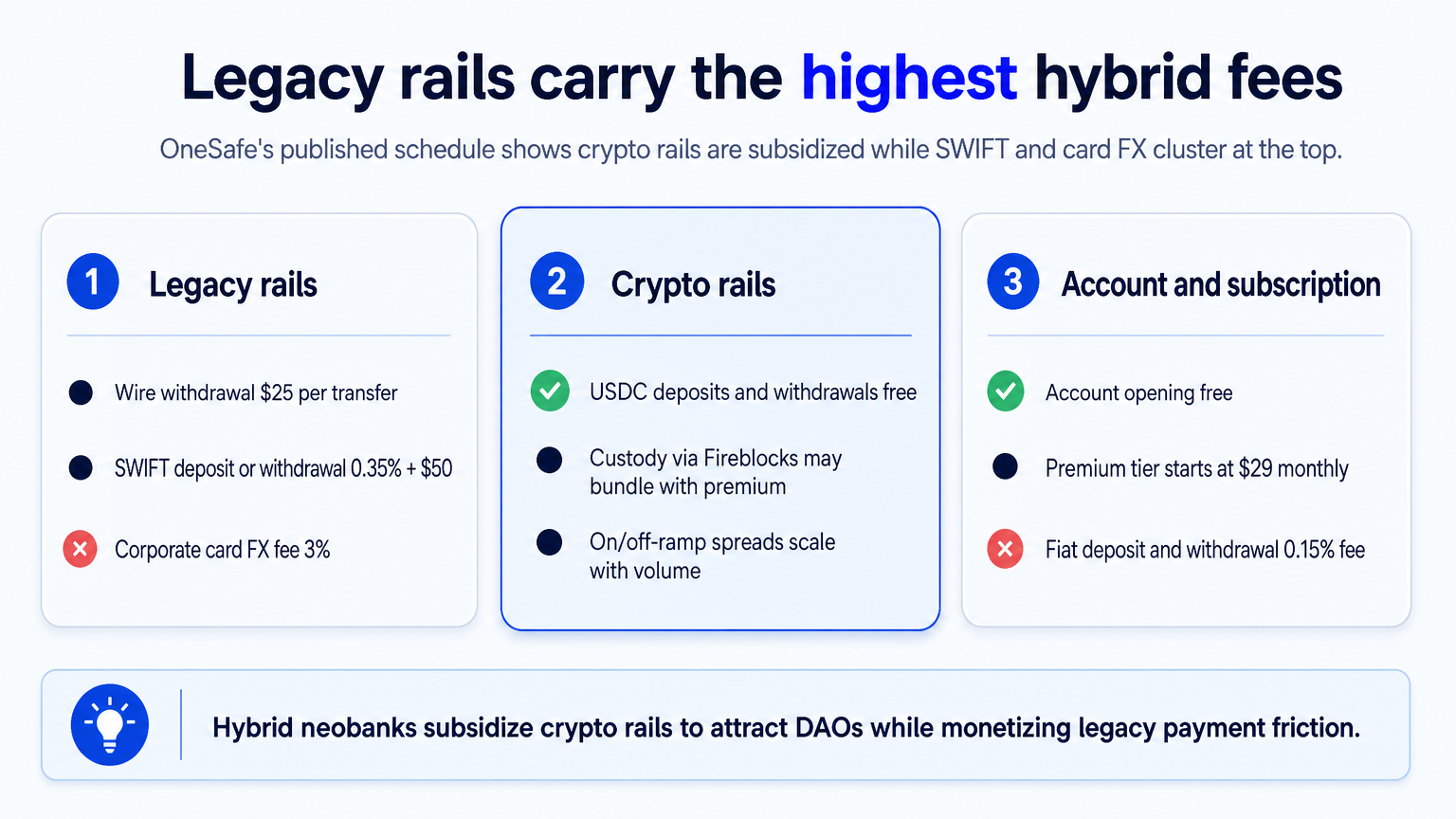
A transparent fee schedule reveals what a hybrid neobank actually charges. OneSafe publishes:
| Revenue Line | Fee or Charge |
|---|---|
| Account opening (general) | Free |
| Monthly subscription (premium) | $29+/month |
| Fiat deposit / withdrawal | 0.15% fee |
| Wire withdrawal | $25 per transfer |
| Wire deposit | $10 per transfer |
| SWIFT deposit / withdrawal | 0.35% + $50 per transfer |
| Corporate card FX fee | 3% |
| Crypto deposits / withdrawals (USDC) | Free |
The highest fees cluster on legacy rails (SWIFT, wires, card FX), while crypto rails are subsidized to attract the target user. That’s the hybrid play in one table.
Custody and on/off-ramp economics
When a platform holds digital assets (OneSafe uses Fireblocks for custody), it may charge custody fees, though premium tiers often bundle those. The bigger stream is on/off-ramp spreads—converting fiat to crypto or vice versa at a rate slightly worse than interbank, with margins that scale with volume. For DAOs that routinely move between treasuries, this becomes a meaningful contributor.
What should global businesses and DAOs check in a neobank’s fee schedule?
Questions to ask before opening an account
- Wire and SWIFT fees: A $50 fixed fee plus a percentage can drain working capital. Stablecoin payments may be leaner.
- FX spread transparency: A published 0.25% is manageable; an opaque “prevailing rate” hides wider mark-ups.
- Incoming fiat deposit fees: OneSafe charges 0.15% on incoming fiat—many traditional banks don’t. Model this against your receivables.
- For DAOs: Does the platform support multi-signature approvals, customizable roles, and on-chain treasury visibility?
- Minimum balance: Some neobanks require $5,000–$10,000. OneSafe’s free account has a $0 minimum—a detail that matters for lean startups.
Where surprise neobank fees hide
Card FX is the classic gotcha—a 3% charge on every corporate card transaction made in a non-native currency stacks up fast for teams that travel or pay global SaaS subscriptions. SWIFT fees combine a percentage (0.35%) with a fixed fee ($50), so a single $10,000 wire costs $85. For crypto, some tokens carry network fees beyond the “free USDC” promise; always check the exact coins you plan to move. Model a typical month: three international wires, two large FX conversions, and a dozen card payments may look inexpensive until you run the numbers.
Regulation, licensing, and FDIC confusion
Neobanks are technology platforms, not licensed banks. The partner bank holds the license, and your fiat funds may be eligible for pass-through FDIC insurance only if structured correctly—and crypto assets are never covered. OneSafe explicitly does not claim FDIC insurance. As the Fed’s new stablecoin rules take shape (see its business impact analysis), custody and reserve treatment are evolving, making regulatory transparency critical. Before funding, verify the partner bank, its license, and what deposit protection actually covers in your jurisdiction.
FAQ: definitions, neobank vs digital bank, profitability, and insurance
What is a neobank, and how does it work?
A neobank is a fintech company delivering banking-like services through an app, with no branches. It builds the customer-facing layer and integrates with a licensed bank’s systems via APIs—the banking-as-a-service model. You legally remain a customer of the partner bank.
Neobank vs digital bank: why the distinction matters
A digital bank operates under its own banking license (like an online-only division of a traditional bank), while a neobank depends on a partner’s license. That neobank vs digital bank difference determines who directly supervises your funds: a licensed digital bank is overseen by prudential regulators, whereas a neobank’s protection is mediated through its partner. Always ask, “Does it hold its own banking license?” If not, it’s a neobank.
Who holds the license, and are neobanks regulated like regular banks?
The partner bank holds the core license. Neobanks may hold money transmitter licenses, but deposit-taking authority stays with the regulated institution. Neobanks as technology companies face fintech oversight, not full bank capital and liquidity requirements, so operational resilience sits outside the bank regulatory perimeter.
Is my money FDIC-insured?
Only if the partner bank is FDIC-insured and your account qualifies for pass-through coverage—usually for US personal accounts and some business accounts. Crypto is never covered. Always read the disclosures, not the headline.
Are neobanks profitable, and how profitable?
Most aren’t yet. Scaling requires heavy spending, and interchange-dependent models need enormous volume to break even. Bain’s 2026 review found funding pressure is forcing diversification. When profitability arrives, margins are thin—low single digits. Hybrid models that earn from fiat wires, FX, and crypto spreads often show healthier unit economics per customer than pure interchange plays.
What changed in 2026?
- Stablecoin regulation is moving from theory to practice. The Fed’s draft rules and Treasury’s certification push stablecoins toward bank-grade treatment, making hybrid platforms more relevant for businesses paying in USDC.
- Incumbent banks are waking up slowly. Experts note that traditional institutions still underestimate neobanks’ threat, leaving a window for agile platforms to capture cross-border SME flows.
- Consumer benchmarks are rising. The best online banks now offer higher APYs and lower fees, raising the standard for what “free” must mean, and that pressure flows upward to business accounts.
- Hybrid fiat-crypto platforms are finding product-market fit. Web3 startups and DAOs are abandoning the “one bank, one wallet” split in favor of unified interfaces, shifting revenue toward FX, wire, and conversion fees rather than card swipes.
Sources and review cadence
This FAQ draws on OneSafe’s public fee schedule and knowledge base (September 2026), plus analyses from Bain, Bankrate, and industry reports. Review your provider’s fees quarterly—wire, SWIFT, FX spreads, crypto costs, partner bank identity, and FDIC status can change. Treat the fee page as a living document, not a one-time read.
Key Takeaways
- A free account monetizes your activity through interchange, FX mark-ups, wire fees, and subscriptions.
- Crypto-friendly neobanks add on/off-ramp spreads and custody economics, aligning revenue with cross-border businesses and DAOs.
- Model your typical month against the published fee schedule: SWIFT at $50 a pop and 3% card FX can silently turn “free” into a significant cost center.
- Neobanks are technology platforms, not banks; the partner bank holds the license, and FDIC insurance is never automatic.
- Profitability remains rare, but hybrid models charging transparently for wires, FX, and crypto conversions are building unit economics that pure interchange models often cannot reach.
Explore a neobank that publishes its fees openly so you can model real costs: see if OneSafe fits your global business or DAO.
Sources