Mastercard’s decision to bring Morph into its crypto partner program—reported by TokenPost on September 30, 2026—is a concrete signal that web3 payments are moving from speculative rails to operational finance. The work will examine stablecoin collection, payments, and settlement for Web3 businesses, institutions, and freelancers serving customers worldwide. For startups and DAOs that already run on both fiat and crypto, the announcement changes what “mainstream” means: the question is no longer whether stablecoin payments work, but whether your financial stack can handle them without fragmenting treasury.
Table of Contents
- What Just Happened: Morph Joins Mastercard’s Stablecoin Program
- Why It Matters for Web3 Payments Right Now
- Background: Where Stablecoins Fit in the Web3 Payment Stack
- Concrete Implications for Global Businesses and DAOs
- What to Watch Next & Open Questions
- Key Takeaways
What Just Happened: Morph Joins Mastercard’s Stablecoin Program
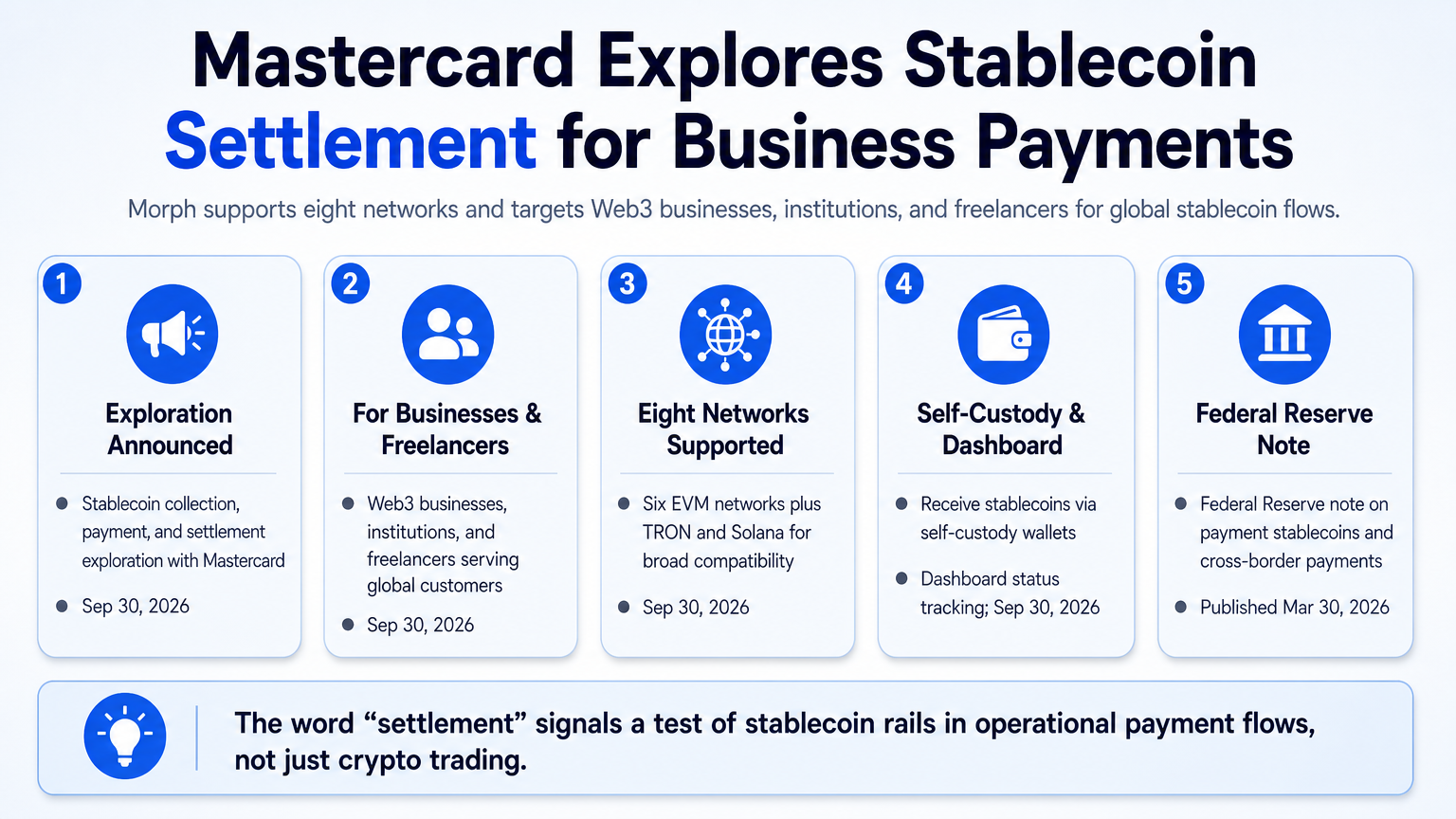
On September 30, 2026, TokenPost reporter John Kim reported that Morph has entered Mastercard’s crypto partner program to examine stablecoin payment uses for businesses and institutions serving customers across global markets. The report states that the effort covers stablecoin collection, payments, and settlement for Web3 businesses, institutions, and freelancers. The program brings digital-asset firms, payment providers, and financial institutions into the same partnership network.
Morph Payments supports six Ethereum Virtual Machine networks, along with TRON and Solana. According to the report, businesses can receive stablecoins through self-custody wallets and monitor payment status on a dashboard. Morph is exploring stablecoin payment applications through the program.
| Signal | What the source reports | Date |
|---|---|---|
| Morph joins Mastercard program | Stablecoin collection, payment, and settlement exploration with Mastercard | Sep 30, 2026 |
| Target users | Web3 businesses, institutions, and freelancers serving global customers | Sep 30, 2026 |
| Network support | Six EVM networks plus TRON and Solana | Sep 30, 2026 |
| Receiving method | Stablecoins via self-custody wallets, with dashboard status tracking | Sep 30, 2026 |
| Central-bank context | Federal Reserve note on payment stablecoins and cross-border payments | Mar 30, 2026 |
The word “settlement” matters here. This is not a rewards token or a trading promotion; it is a card network testing how stablecoin settlement can fit into the same operational layer where invoices, vendor payments, and payroll actually move.
Why It Matters for Web3 Payments Right Now
The Mastercard stablecoin program matters because it places stablecoin settlement inside real business payment flows, not just exchange withdrawals. Card networks and fintech processors have been building stablecoin rails for some time: Visa maintains a stablecoin payments solutions page, and Stripe documents stablecoin payments for merchants. But bringing a network like Morph into Mastercard’s partner program turns a payments concept into a testable settlement path for freelancers, institutions, and Web3 businesses.
The macro context is also moving. A Federal Reserve note published on March 30, 2026 examined payment stablecoins and cross-border payments, including benefits and implications for monetary policy. The Fed’s attention confirms that stablecoin payment infrastructure is now a policy question, not a niche crypto issue.
What does Mastercard’s stablecoin push mean for businesses that operate in both fiat and crypto?
It means the boundary between fiat receivables and crypto payables becomes a settlement choice rather than a treasury event. A business that invoices a client in dollars and pays contract developers in USDC can already bridge those legs manually, but the cost is fragmented accounts, repeated conversions, and reconciliation risk. When Mastercard-level rails test stablecoin collection and settlement, founders should treat fiat-crypto integration as a permanent requirement for crypto business payments—not a temporary workaround.
That does not mean banks disappear. It means a bank payment rail and a stablecoin settlement rail can sit side by side, with the business choosing whichever is faster, cheaper, or more acceptable to the counterparty. The early evidence from bank-grade stablecoin payments points in the same direction: traditional institutions are connecting to crypto-native settlement, and the operating burden falls on the business to manage both ledgers cleanly.
Background: Where Stablecoins Fit in the Web3 Payment Stack
Web3 payments use blockchain rails to move value directly, reducing intermediaries and, in many corridors, settlement time. But the native asset volatility of tokens such as ETH or SOL makes them poor units of account for payroll or vendor invoices. That is why stablecoin payments sit at the center of the Web3 payment stack: they keep the speed and auditability of blockchain settlement while staying pegged to a fiat denominator.
The surrounding stack includes Web3 payment tools covering gateways, wallets, and processors, plus integration patterns documented in guides such as Swapin’s web3 payment gateway overview. Ethereum.org’s Web3 explainer frames the broader ownership model, but for business operations the relevant question is narrower: can a team receive stablecoins, convert to fiat, pay vendors, and prove compliance without stitching together five tools?
Concrete Implications for Global Businesses and DAOs
Bridging the Fiat–Crypto Gap Is Suddenly a Core Requirement
For a global startup or DAO, the gap is not philosophical. A US-based client may pay an invoice in dollars while a contributor expects USDC, or a treasury may hold stablecoins while payroll runs in local currency. The Morph news suggests that stablecoin settlement will increasingly appear at the settlement layer governed by mainstream payment networks. If a business cannot off-ramp from blockchain to a bank account cleanly, it will still be forced into manual transfers and ad hoc accounting.
The practical takeaway is to treat fiat-crypto integration as infrastructure. A DAO paying contributors in stablecoins, settling invoices in fiat, and holding reserves across both rails should not be running those workflows in separate systems.
Custody and Compliance Become Non‑Negotiable
As stablecoin payment flows grow, custody stops being a wallet preference and becomes a controls question. Businesses need to know where keys sit, who can approve a payment, and whether the same platform enforces KYB, transaction limits, and audit-ready reporting. For DAOs, role-based permissions and segregated accounts matter as much as the settlement rail itself.
Some platforms now combine crypto-friendly business banking with institutional custody. OneSafe, a financial technology company rather than a bank, offers digital asset custody secured on Fireblocks, mandatory Multi-Factor Authentication on signup, and role-based controls for DAOs. The relevant point is not any single vendor; it is that custody and compliance are operational requirements, not optional add-ons, once stablecoin payments move beyond testing.
What Practical Adoption Looks Like with an Integrated Platform
The useful end state is a Web3 account that behaves like a financial operating system: multi-currency fiat accounts, corporate cards with spend limits, automated invoicing, and on-chain asset custody in one interface. That removes the worst failure mode of early stablecoin adoption—splitting treasury across a bank, an exchange, and a self-custody wallet with no single source of truth.
For businesses that already operate across fiat and crypto, the move from fragmented tools to an integrated platform is often faster than expected. OneSafe’s onboarding, for example, is fully digital and typically completed within a week, requiring business formation papers and a government-issued photo ID. That kind of interface is what makes stablecoin settlement usable for ordinary vendor payments rather than a specialized treasury event.
How can global startups and DAOs use stablecoin payments right now?
The path is more practical than most teams assume. A founder does not need to wait for Mastercard’s program to reach general availability.
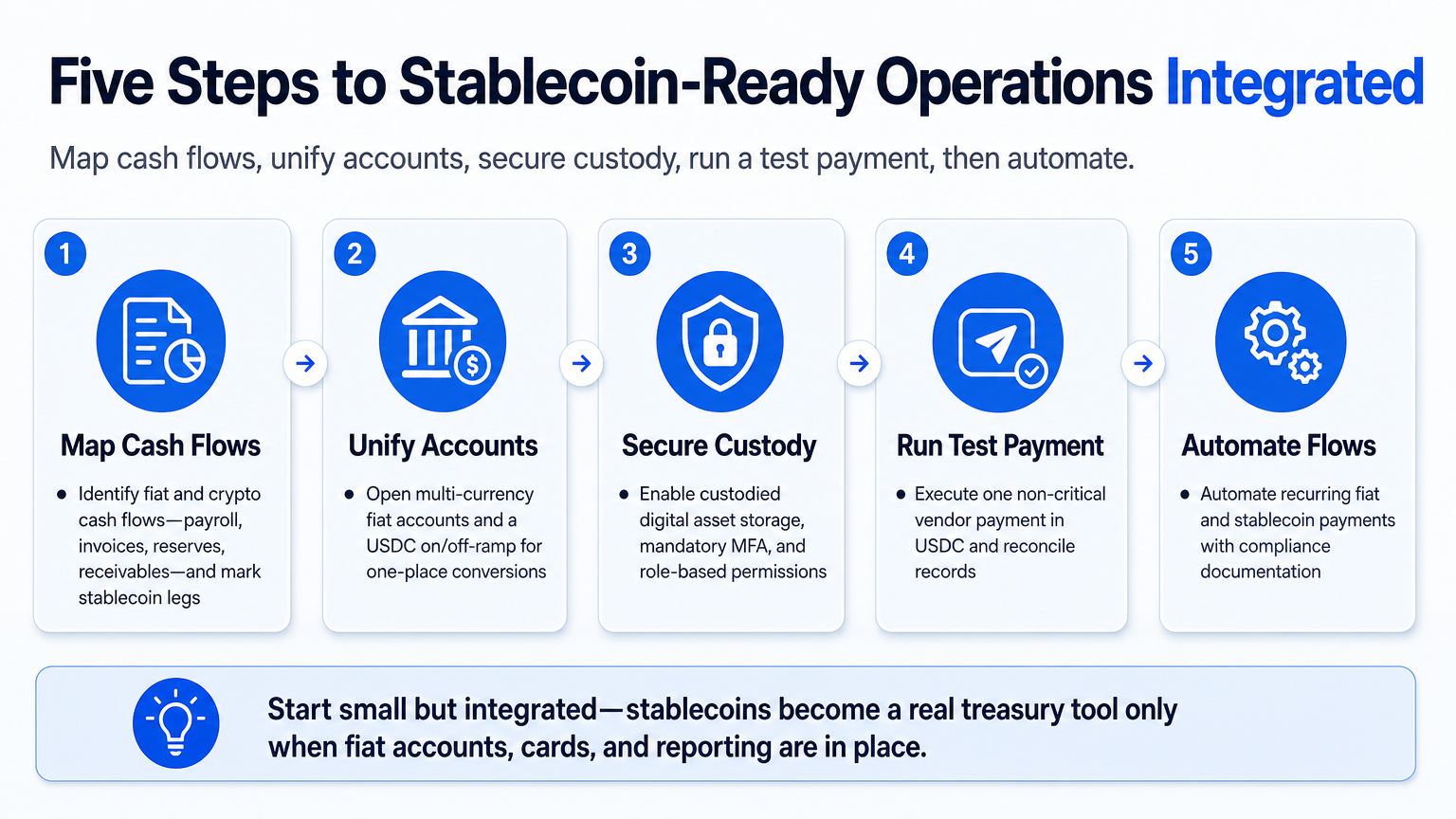
A five-step checklist for moving a startup or DAO to stablecoin-ready operations:
- Map every fiat and crypto cash flow—payroll, vendor invoices, treasury reserves, client receivables—and mark which legs are best settled in stablecoins.
- Open multi-currency fiat accounts alongside a USDC on/off-ramp so conversions happen in one place instead of across an exchange and a bank.
- Enable custodied digital asset storage, mandatory MFA, and role-based permissions before putting any material balance on-chain.
- Run one non-critical vendor payment in USDC and reconcile it against the invoice and dashboard records.
- Automate recurring payments and invoicing in both fiat and stablecoin, keeping compliance documentation for every conversion.
The point is to start small, but start integrated. Stablecoin payments become a real treasury tool only when the surrounding fiat accounts, cards, and reporting are already in place.
What kind of platform or infrastructure is needed to make stablecoin payments work for everyday operations?
The minimum is no longer “a wallet.” A workable setup needs segregated fiat accounts, wire and ACH support, corporate cards for vendor spend, crypto on/off-ramps, and a compliance layer that can show regulators what happened. For DAOs, that also means DAO payment solutions with customizable roles, approval thresholds, and transparent reporting.
In practice, a platform such as OneSafe illustrates the shape of that Web3 financial infrastructure: multi-currency accounts in USD, Euro, and CAD, corporate cards with spend limits, automated payments and invoicing, free USDC deposits and withdrawals, and Fireblocks-backed custody for digital assets. The fiat side remains important because most suppliers, landlords, and tax authorities still settle in local currency. The crypto side becomes useful only when it connects to those fiat rails without manual intervention.
What to Watch Next & Open Questions
The most important near-term signal is whether Mastercard expands the program beyond Morph or publishes actual settlement volume, fees, or partner pricing. So far the September 30, 2026 report describes exploration, not a commercial rollout. That distinction matters for founders deciding whether to allocate budget now.
Regulatory timing is the second variable. The Federal Reserve’s March 30, 2026 note sets the analytical frame, but rules on stablecoin certification and bank participation will determine how quickly stablecoin settlement reaches everyday vendors. Watch whether Treasury or federal banking agencies issue concrete certification standards in the next quarter or two.
Is this the moment web3 payments become mainstream for commerce, not just trading?
Not yet—but the composition of the signal is the closest thing to a commerce stack the industry has produced. A card network, a Layer 2 payments network, freelancers, institutions, and a stated focus on collection and settlement is fundamentally different from exchange order books or NFT checkout pages.
The responsible read is that the industry has entered the proof-of-operations phase. The open questions are settlement finality, dispute resolution, chargeback handling, tax treatment, and whether stablecoin settlement volumes show up in recurring business flows rather than one-off tests. If those questions start resolving in favor of stablecoins, the answer to “is this the moment” will look obvious in hindsight. For now, the correct posture is to treat web3 payments as operational infrastructure and build the fiat-crypto bridge before the rest of the market does.
Key Takeaways
- Mastercard’s September 30, 2026 Morph program is an exploration of stablecoin collection, payment, and settlement for real business payables, not just trading.
- Businesses operating in both fiat and crypto should treat fiat-crypto integration as a core treasury requirement now, not a future option.
- A workable stablecoin payment stack needs multi-currency fiat accounts, corporate cards, crypto on/off-ramps, and institutional-grade custody with role-based controls.
- Start small but integrated: map cash flows, open unified accounts, run one USDC vendor payment, then automate recurring flows.
- Watch for Mastercard expansion, real settlement volume, and regulatory certification before calling commerce fully mainstream.
If you need a single account for fiat and stablecoin operations without fragmenting treasury across banks, exchanges, and wallets, sign up at OneSafe.