Crypto banking is shifting from asset custody to cross-border interoperability. A PYMNTS report from August 26, 2026, details how the financial industry is unbundling the cross-border payments stack and what that means for global businesses, DAOs, and founders moving money across currencies daily.
Table of Contents
- What Just Happened: The Cross-Border Stack Is Being Unbundled
- Why It Matters for Crypto Banking Right Now
- The Background: Crypto Banking’s Path to Interoperability
- What It Means for Founders and Finance Leads
- What to Watch Next and Open Questions
- Key Takeaways
What Just Happened: The Cross-Border Stack Is Being Unbundled
The PYMNTS report on August 26, 2026
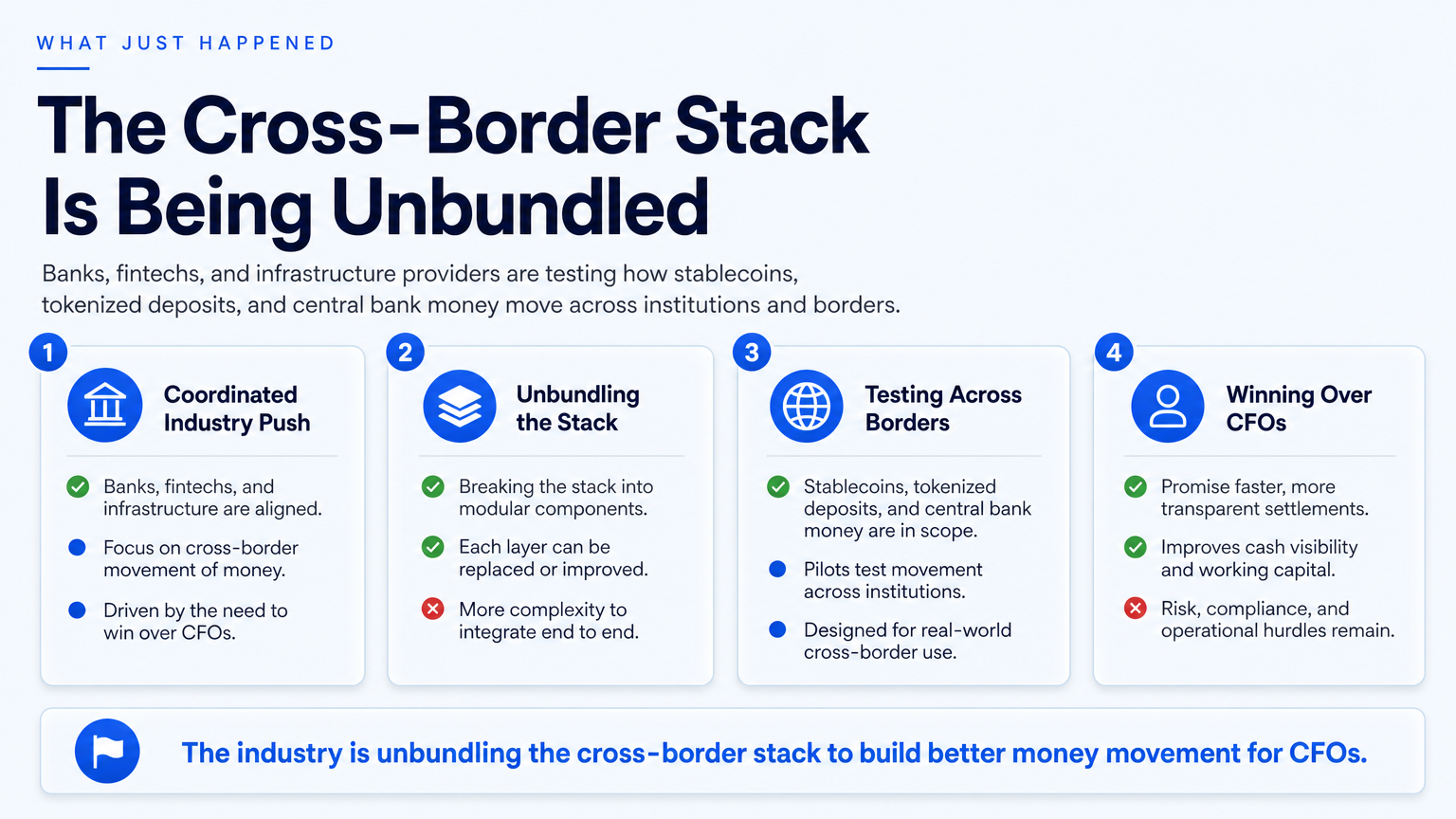
In “Banks and FinTechs Are Unbundling the Cross-Border Stack to Win Over CFOs,” PYMNTS identified a coordinated push among banks, fintechs, and infrastructure providers to test how stablecoins, tokenized deposits, and central bank money move across institutions and borders (source). The digital-money race is moving from issuing assets to building the interoperability layer.
Key projects driving interoperability: BLOOM, Agorá, Pangea, Qivalis, UniKA
Five initiatives illustrate how the plumbing is being re-plumbed:
- BLOOM – testing a multi-currency settlement network routing stablecoin and tokenized deposit payments across jurisdictions.
- Project Agorá – a wholesale CBDC experiment focused on interbank settlement and liquidity management.
- Project Pangea – exploring atomic settlement that collapses FX, compliance, and reconciliation into a single step.
- Qivalis – a fintech-led corridor linking tokenized deposit rails in Europe and Asia.
- UniKA – an infrastructure play aiming to be the universal API for regulated digital money movement.
All five share a common goal: collapse the six-step correspondent-banking lifecycle—messaging, FX, compliance screening, liquidity provisioning, settlement, reconciliation—into one programmable workflow.
Why It Matters for Crypto Banking Right Now
From asset custody to programmable workflows
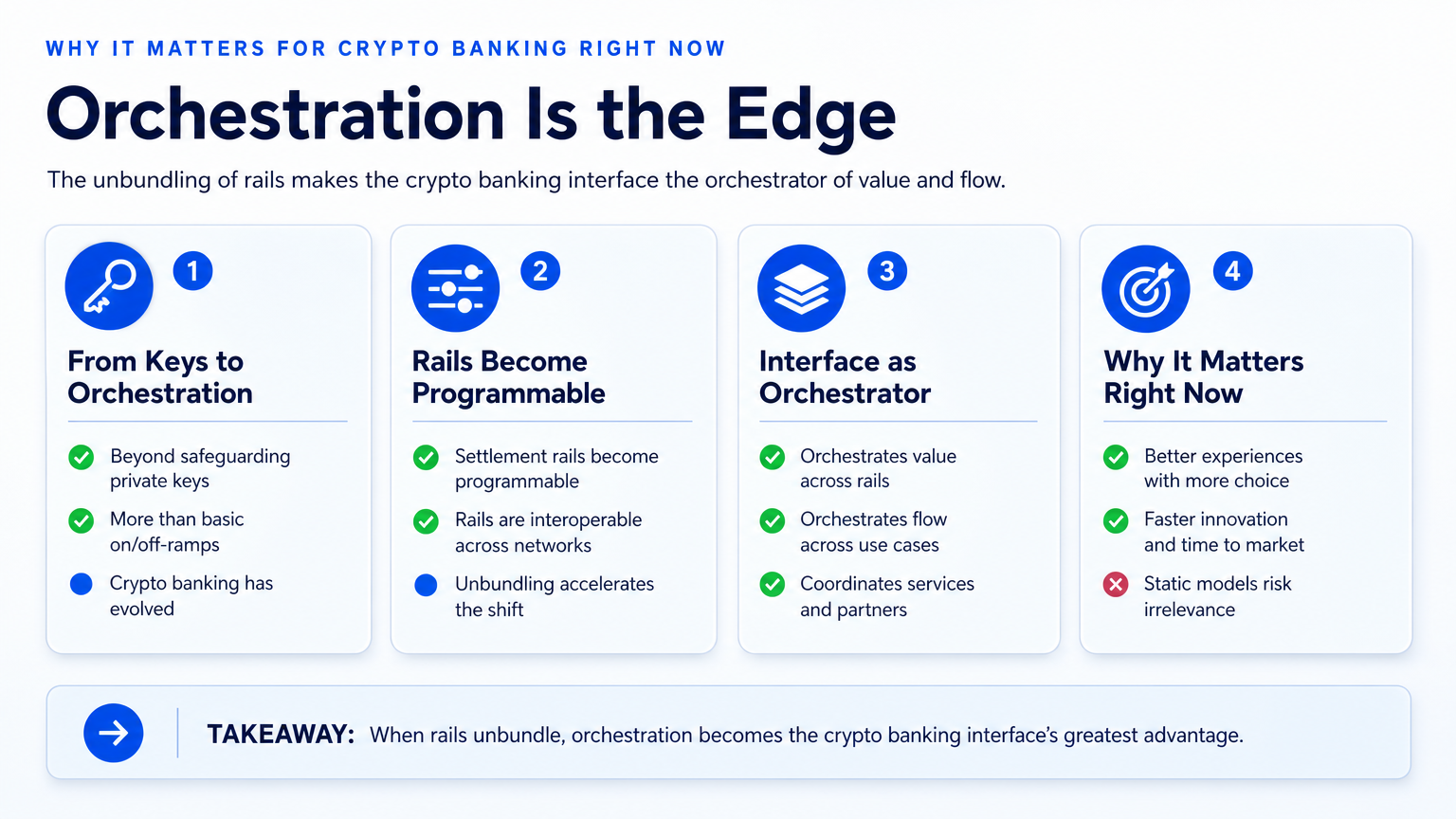
For years, crypto banking meant safeguarding private keys and providing basic on/off-ramps. The unbundling described in the PYMNTS report accelerates the shift: when settlement rails become programmable and interoperable, the crypto banking interface can act as an orchestration layer for multi-currency commercial flows.
The CFO’s new reality: one settlement lifecycle, not six correspondent steps
A well-architected crypto banking platform routes a payment through a tokenized corridor where stablecoins, FX, and compliance are executed atomically. The payoff is predictability of liquidity, lower trapped capital, and real-time visibility into cash positions. For stablecoin adoption patterns in cross-border corridors, see Stablecoin Payments: Asia's Hubs Lead the Way.
The Background: Crypto Banking’s Path to Interoperability
Phase 1: custody and basic on/off-ramp (2017–2021)
Early crypto banking was synonymous with custodial wallets. Converting digital assets to fiat required fragmented exchange liquidity and slow bank wires. Most platforms didn't offer multi-currency accounts, corporate cards, or automated payment workflows. Definitions from that era, like NerdWallet's crypto banking overview, capture this custody-first framing.
Phase 2: rise of crypto-native neobanks (2021–2024)
Web3 neobanking combined fiat accounts, crypto sub-ledgers, virtual cards, and real-time conversion under one login. Digital KYC/KYB completed in days, not weeks. OneSafe, a financial technology company, exemplifies this phase with multi-currency accounts in USD, Euro, and CAD alongside on-chain USDC custody via Fireblocks. But even these integrations stitched together separate rails.
Phase 3: the interoperability imperative (today)
The PYMNTS report crystallizes Phase 3: the boundary between crypto and fiat rails is being programmatically dissolved. A payment travels from a stablecoin balance to a tokenized deposit on a regulated bank ledger without manual conversion steps.
How is crypto banking defined in 2026?
In 2026, crypto banking refers to a financial platform that natively integrates fiat and digital asset accounts, automates cross-currency transactions, and connects to programmable settlement rails—tokenized deposits, stablecoins, and interoperable networks—without treating crypto and fiat as separate, siloed ledgers. It's a technology layer giving businesses a single operating surface for treasury, payments, and custody.
What It Means for Founders and Finance Leads
What does the unbundling of the cross-border stack mean for my business?
It means breaking free from the "nostro trap." When correspondent-banking steps are replaced by programmable corridors, your business no longer needs to pre-fund currency accounts at intermediary banks just to receive or send international payments. A single multi-currency corporate account with on-chain and off-chain rails programmatically sources liquidity at settlement. The PYMNTS report notes that winners control the junctions—your platform should sit at those junctions, not at a legacy bank's digital front-end.
Why should I choose a crypto banking platform over a traditional bank?
A traditional bank runs on a correspondent-banking model that, according to J.P. Morgan's cross-border payment modernization research, involves multiple intermediaries and settlement windows measured in days. A crypto banking platform hooked into the unbundled interoperability stack offers three advantages:
- Unified ledger: fiat and crypto in one interface, enabling instant swap-and-send workflows.
- Programmable money: smart routing auto-selects the cheapest, fastest path—ACH, wire, stablecoin corridor.
- Fast onboarding: digital KYB typically takes a week or less. For a full comparison, see Neobank vs Digital Bank: Which Is Right for Your Business?.
What should I look for in a crypto banking partner today?
A concrete checklist for a compliant crypto platform:
| Criterion | What to verify |
|---|---|
| Fiat-crypto unification | One account view across USD, EUR, CAD, and stablecoins, with real-time conversion. |
| Interoperability links | Connections to networks like BLOOM, Agorá, or UniKA, or multi-blockchain stablecoin routing. |
| Custody and compliance | Segregated accounts, SOC 2–type security, custody by a qualified custodian like Fireblocks. |
| Multi-rail payments | ACH, wires, SWIFT, and on-chain transfers with transparent fee schedules. |
| Global reach | Availability in your incorporation country and operating states, with clear exclusions. |
| Onboarding speed | Digital-only, fully remote, ideally ≤1 week. |
| DAO/Web3-native features | Customizable roles, permissioning, automated fiat and token disbursements. |
A platform checking these boxes can ride the interoperability wave. For more on global account trade-offs, read What Are the Risks of a Global Account?.
How do DAOs and global businesses manage fiat and crypto in one place?
DAOs hold treasury in stablecoins or native tokens but pay contributors in fiat across jurisdictions. The traditional approach—crypto wallet at one provider, fiat account at a bank, manual exchange bridging—creates audit nightmares. A unified DAO banking platform solves this by:
- Allowing USDC deposits and instant conversion to USD or EUR for wire payments in one interface.
- Providing customizable roles so a treasury multisig approves on-chain transactions while a finance lead handles fiat payouts.
- Automating recurring stablecoin payments to contributors, settling the fiat leg without manual intervention.
OneSafe supports segregated global accounts, automated payments, and invoicing in multiple fiat and stablecoins. Because it's a financial technology company, not a bank, banking services come through partners, keeping the interface neutral and avoiding re-bundled intermediary risk.
What are the risks and trade-offs of a crypto banking platform?
The interoperability race has friction.
- Regulatory divergence: The U.S. FDIC continues clarifying its crypto posture. Platforms outside the U.S. may follow different rulebooks, affecting tokenized deposit and stablecoin corridor access.
- Counterparty concentration: Deep integration with a single interoperability network exposes you to that network's governance and uptime. Diversified routing mitigates this.
- Custodial vs. non-custodial trade-offs: Even top-tier custodians like Fireblocks introduce a central point of trust. Self-custody for a portion of treasury sacrifices seamless fiat conversion.
- Fee complexity: Wire withdrawals, SWIFT transactions, and FX carry layered costs. For example, OneSafe discloses wire withdrawal fees of $25, SWIFT at 0.35% + $50, and FX at 0.25% or the prevailing rate—competitive but requiring active management for high-volume flows.
- Availability gaps: Many platforms are unavailable in certain U.S. states or OFAC-sanctioned countries. Verify coverage before committing.
For broader structural trade-offs, see Drawbacks to Neo Banking: What Founders Need to Know.
What to Watch Next and Open Questions
Regulatory posture: FDIC and beyond
The FDIC's evolving guidance on banks engaging with digital assets remains the single largest variable for platforms pairing banking partners with crypto custody. A permissive framework would accelerate tokenized deposit corridors; a restrictive one could force interoperability layers to route around U.S. banks, concentrating liquidity in non-U.S. jurisdictions.
Will a single interoperability layer emerge?
The five PYMNTS projects are backed by different consortiums. It's unclear whether corporate treasurers will get a single "SWIFT for stablecoins" or a patchwork of bilateral corridors. Platforms that abstract that complexity will win the CFO audience.
Key Takeaways
- The unbundling of the cross-border stack, reported August 26, 2026, shifts crypto banking from custody to interoperability—your platform must handle programmable, multi-currency workflows, not just store assets.
- CFOs and founders should evaluate crypto banking partners on their ability to collapse correspondent-banking steps into one settlement lifecycle. Look for fiat-crypto unification, multi-rail payments, and links to emerging interoperability networks.
- DAOs and Web3 startups gain the most from a single platform natively managing fiat and crypto treasury, automated payments, and role-based permissions, reducing operational complexity and audit risk.
- Risks such as regulatory fragmentation, custodial concentration, and fee complexity are real; mitigate them by choosing a compliant crypto platform with transparent pricing and diversified settlement corridors.
Ready to move your global business finances onto a single interface that bridges fiat and crypto? Open a OneSafe account today and experience the neo-banking platform built for the interoperability era.