Crypto banking entered a new chapter on November 19, 2026, when payments firm MoonPay submitted an application to the Office of the Comptroller of the Currency (OCC) to charter a non-depository trust bank. The move—reported by Cointelegraph via TradingView—forces business treasuries to answer a pressing question: should you buy into a federal charter for stablecoin custody and on/off-ramps, or stay on a partner-bank fintech platform that already combines fiat rails with institutional digital asset custody? This article maps the shift, the GENIUS Act deadline, and the concrete choice operators now face.
Table of Contents
- What just happened: MoonPay filed for a trust bank charter
- Why this changes crypto banking for business treasuries
- The background a newcomer needs to follow the story
- Chartered trust bank vs. fintech platform: a practical comparison
- Implications and actions for finance leads and founders
- What to watch next and open questions
- Key Takeaways
What just happened: MoonPay filed for a trust bank charter
MoonPay’s OCC application seeks MoonPay National Trust Bank—a non-depository institution in Miami Beach, Florida, that would not accept traditional deposits or issue loans (TradingView). Instead, the charter would authorize stablecoin issuance, redemption, reserve management, and digital asset custody under direct federal supervision. The firm already provides stablecoin infrastructure for businesses; a charter would let its banking subsidiary offer those services as a federally regulated entity.
A non-depository trust bank doesn’t take insured deposits, but it is a bank under the Bank Holding Company Act. It can hold assets in trust, manage stablecoin reserves, and access Fedwire. In crypto, where the biggest operational risk is custody and redemption, that matters. For the first time, a federally chartered entity could issue and redeem stablecoins on demand, with OCC safety-and-soundness examinations behind it—changing the counterparty profile for any business holding large stablecoin treasuries.
Why this changes crypto banking for business treasuries
Today, most businesses access stablecoins through exchanges or lightly regulated issuers. When a trust bank issues a stablecoin, it does so under federal standards: reserve composition, segregation of assets, and redemption timelines become enforceable, not merely promised. For a CFO, the difference between a white-paper promise and a federally examinable reserve is material—especially as the GENIUS Act’s requirements draw near.
MoonPay’s application also covers digital asset custody. Under a national trust charter, custody is legally separated from proprietary trading, much like traditional securities custody. Coinbase’s charter took effect earlier this month, and Circle received OCC approval in July 2026 (per the same TradingView report), signaling a broader migration. For businesses that need a crypto on/off-ramp, this could consolidate issuance, custody, and payment rails under one federally supervised roof—simplifying treasury audits.
The background a newcomer needs to follow the story
What is crypto banking?
Crypto banking refers to financial services that combine fiat account capabilities with cryptocurrency custody, trading, and payment functions. For businesses, it means a treasury partner that can hold dollars and digital assets, execute cross-border wires, and manage on-chain payments. The category splits into consumer-facing platforms and business payment infrastructure. This analysis is strictly about the latter.
What is a national trust bank charter?
A national trust bank charter from the OCC authorizes a financial institution to exercise fiduciary powers—acting as a trustee, custodian, or agent—without accepting retail deposits. It preempts many state licensing requirements and brings the entity under direct federal supervision. The OCC can examine capital, asset segregation, and operational risk, areas state money-transmitter regulation often misses. The Congressional Research Service notes that the OCC’s authority to grant such charters to fintech firms is controversial, with opponents arguing it stretches the National Bank Act (Congress.gov).
How crypto banking actually works today: three models
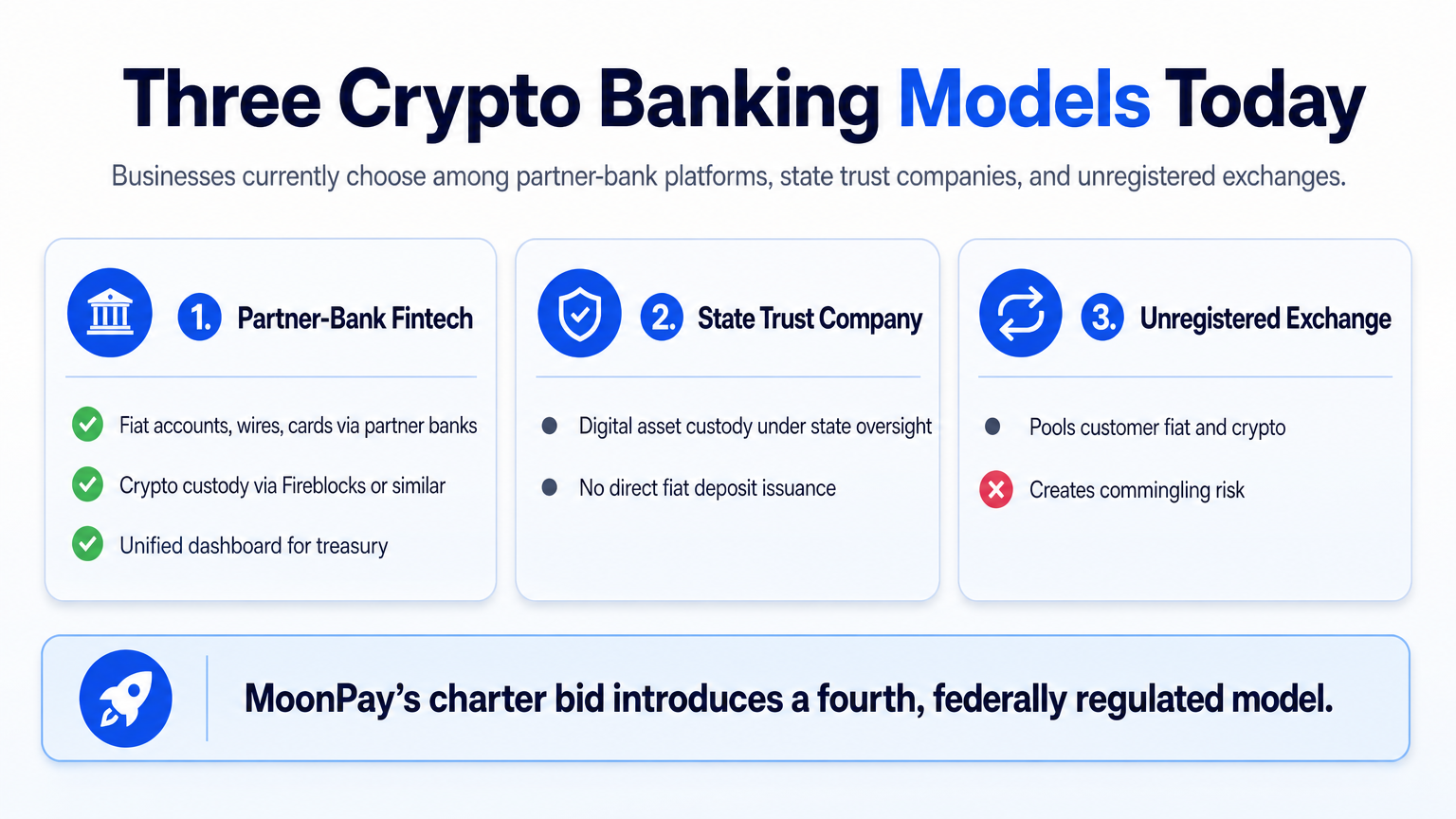
Businesses access crypto banking through three models:
- Partner-bank fintech platforms – A technology company partners with licensed banks for fiat accounts, wires, and cards, while crypto custody uses an institutional-grade custodian like Fireblocks. The fintech unifies everything in one dashboard.
- State-chartered trust companies – Firms such as BitGo or Anchorage hold a state trust charter, allowing them to custody digital assets under state oversight but not to issue fiat deposits directly.
- Unregistered or money-transmitter exchanges – Many large exchanges pool customer fiat and crypto without strict asset segregation, creating commingling risk.
MoonPay’s application introduces a fourth model: a federally chartered non-depository trust bank that can directly issue stablecoins.
How does the GENIUS Act change stablecoin rules?
The GENIUS Act, effective January 18, 2027, establishes federal standards for stablecoin issuers: 1:1 reserve backing with high-quality liquid assets, redemption within a specified timeframe, and regular examinations. As our analysis of the Act’s equal-footing provision explains, nonbank issuers will need a federal or state charter. A national trust charter satisfies that requirement immediately. A trust bank directly addresses redemption and reserve hurdles by placing reserves under OCC oversight.
Chartered trust bank vs. fintech platform: a practical comparison

Do I need a bank charter to offer crypto banking services?
No. A charter is necessary only if you want to become a regulated issuer of stablecoins or a direct federal custodian. For a business that needs a crypto business account to pay teams, convert between fiat and crypto, and hold working capital, a partner-bank platform with Fireblocks custody works without a charter.
What a trust charter does and does not offer
A trust charter provides:
- Federal preemption of state licensing
- Access to Fedwire and potentially a master account
- OCC examination of reserves and custody operations
- The ability to issue stablecoins that meet GENIUS Act requirements
It does not offer:
- FDIC insurance (no deposits)
- Lending or fractional-reserve powers
- Automatic public deposit-taking
For the user, the charter means federal capital and segregation rules—stronger than a state license but not a deposit guarantee.
Where a platform like OneSafe fits: partner banks, Fireblocks custody, fiat and crypto in one account
A non-chartered platform takes a different route. OneSafe pairs traditional banking partners for fiat current accounts, global wires, and corporate cards with digital asset custody secured on Fireblocks. The result is a single interface where a startup or DAO can hold fiat and crypto, pay vendors in USDC or fiat, and manage contributor roles. Onboarding is typically under a week, with no minimum balance for the free plan. This model sacrifices direct federal oversight but gains speed and transparent pricing—free USDC deposits/withdrawals, a 0.15% fiat deposit/withdrawal fee, and wire fees of $10 (incoming) or $25 (outgoing). For many operators, that combination already solves the crypto banking problem without waiting for a charter.
How should a business choose between a crypto bank and a fintech platform?
The decision hinges on stablecoin exposure and custody sensitivity. Use this checklist:
- Do you hold more than $500,000 in stablecoins for periods longer than a week? If yes, prioritize a federally chartered custodian once available.
- Do you need instant, programmatic fiat-to-crypto conversions for payroll or vendor payouts? A fintech platform with integrated on/off-ramps will likely be faster and cheaper.
- Must your stablecoin holdings be verifiably fully reserved and redeemable at par without liquidity gates? A chartered issuer gives that assurance.
- Do you operate across multiple states where patchwork licensing is a burden? A national charter simplifies compliance.
- Does your DAO require a dashboard with role-based access and automated payment workflows? That’s a platform strength, not yet guaranteed by a trust bank.
| Factor | Chartered Trust Bank (proposed) | Fintech Platform (e.g., OneSafe) |
|---|---|---|
| Regulatory status | OCC-supervised non-depository trust bank | Fintech company, services through partner banks |
| Stablecoin issuance | Direct, under federal standards | Not offered; users hold third-party stablecoins |
| Fiat account | Possible, but not deposit-taking | Yes, provided by partner banks |
| Crypto custody | Direct, federally examinable | Via Fireblocks (institutional grade) |
| On/off-ramp | Likely integrated, timing TBD | Native, near-instant conversions |
| Onboarding time | Unknown; likely weeks | Under one week, digital |
| Fee transparency | Varies (unknown until operational) | Public: free USDC transfers, 0.15% fiat deposit fee, $25 wire out |
Are crypto assets held on a fintech platform safe?
Security depends on architecture, not just a charter. OneSafe secures digital assets on Fireblocks—using multi-party computation (MPC) and hardware isolation—and enforces multi-factor authentication for every user. Fiat funds sit in segregated partner-bank accounts, not commingled with platform operating capital. While there is no OCC-level recourse if the fintech itself fails, the model avoids the exchange-commingling risk that has led to past losses. Crypto assets held via Fireblocks custody on a well-structured platform can be as safe as those in a trust bank, assuming sound operational security.
What fees should I expect from crypto banking?
Trust banks tend to charge custody fees as a percentage of assets under management plus per-transaction fees. Fintech platforms are typically more transparent and lower-cost for daily usage. OneSafe’s pricing is a real-world benchmark: $0 to open, free plan available ($0 monthly), a $29+/month premium option, 0.15% fiat deposit/withdrawal fee, $25 wire withdrawals, and free USDC transfers. A chartered trust bank may impose monthly custody minimums or reserve-related charges; those numbers remain unknown until the first trust bank launches.
What should DAOs ask about custody and stablecoin reserves?
For a DAO managing a fiat operating account and an on-chain treasury, due-diligence questions are concrete:
- “Are stablecoin reserves independently auditable and verifiably 1:1 with liquid assets?”
- “Do you support customizable, on-chain-aligned signing roles for multisig governance?”
- “If we hold USDC with a chartered bank, what is the redemption timeframe and are there gates?”
- “Can we automate contributor payments in fiat and stablecoins from a single interface, with role-based permissions?”
- “What happens to our fiat and crypto if the platform or partner bank fails—are assets segregated, and is there pass-through insurance on the fiat side?”
These questions separate treasury infrastructure from a simple wallet.
Implications and actions for finance leads and founders
Review custody and stablecoin reserves before January 2027
The GENIUS Act effective date is less than two months away. Any stablecoin you hold will be affected because reserves and redemption guarantees become federally mandated. Start auditing your custodians now. If your current stablecoin issuer lacks a clear path to a charter, plan a migration path to a federally compliant custodian. For more, see why stablecoin infrastructure is crypto banking’s next battle.
Separate payment rails from long-term treasury custody
Keep a fintech platform for day-to-day operations—payroll, vendor wires, conversions—but move long-term stablecoin holdings (above, say, $250,000) to a chartered custodian once available. This mirrors traditional treasury: a business checking account for cash flow, a trust account for reserves. OneSafe can serve as the operating hub, while a MoonPay trust bank (post-approval) could warehouse reserves with federal oversight.
Revisit onboarding, roles, and operational overhead
Chartered entities will likely bring heavier KYB/KYC and legal requirements. If your team values speed, a fintech platform’s digital onboarding (under a week) remains the faster route. For DAO treasury management, ensure any provider supports customizable roles so on-chain governance translates cleanly to off-chain approvals.
What to watch next and open questions
OCC decision and other pending charter applications
MoonPay’s application joins Rain, Modern Treasury, and Block. If approvals accelerate, a wave of trust banks could launch stablecoin services by mid-2027. If the OCC slows due to legal challenges, expect delays.
Community bank lawsuit and GENIUS Act rulemaking
In October 2026, community banks sued the OCC, arguing the regulator exceeded its authority by granting national trust charters to crypto firms that do not accept deposits (same TradingView report). The lawsuit questions whether a “bank” under the National Bank Act must take deposits. While that case proceeds, the OCC may be cautious. At the same time, agencies must finalize rules under the GENIUS Act. The outcome will determine whether MoonPay’s charter and the trust-bank path for stablecoin issuance survive. The statutory text is ambiguous, but a trust bank holding stablecoin reserves as fiduciary assets fits within the OCC’s long-standing interpretive authority—yet the lawsuit creates uncertainty that businesses should factor into 2027 planning.
Will trust banks lower costs or fragment liquidity?
An open question: will federally chartered issuers offer competitive wire and FX fees versus fintech platforms that already bundle fiat and crypto cheaply? Trust banks may add compliance costs that keep fees high, fragmenting stablecoin liquidity across many small issuers. Yet direct Fed access could reduce settlement costs. Watch the fee schedules of the first chartered stablecoin banks when they launch.
For teams that want to keep their own content marketing aligned with these rapid regulatory shifts, a tool like Joyrise—which analyzes your site, then writes and publishes SEO articles to Webflow, WordPress or Shopify every day—can help you publish timely analysis without draining your team’s time. Your first article is written before you pay.
Key Takeaways
- MoonPay’s November 2026 OCC application makes federally supervised stablecoin custody a near-term reality; the GENIUS Act deadline of January 2027 adds urgency.
- You do not need a bank charter to offer crypto banking; a partner-bank fintech platform with Fireblocks custody already delivers fiat rails, on/off-ramps, and DAO workflows.
- Use the $500,000-and-duration rule: large, long-held stablecoin positions warrant a chartered custodian; daily payment operations work well on a fintech platform.
- Separate operating accounts from reserve holdings, audit your stablecoin custodians now, and demand auditable 1:1 reserve proof before January 2027.
- Watch the community bank lawsuit and OCC’s pace—but your treasury plan shouldn’t wait.
Start managing your fiat and crypto treasury in a single platform built for global businesses: open an account with OneSafe today.