On November 19, 2026, Tether disclosed a strategic stake in SCRYPT, a Swiss firm specializing in digital asset financial infrastructure, as reported by BigGo Finance. The move pushes the issuer of the world’s largest stablecoin from minting USDT toward controlling the very rails on which stablecoin payments flow—a direct play for the infrastructure layer of cross-border settlement. For corporate treasury teams, finance leaders, and operations managers already routing stablecoin cross-border payments, this development demands a fresh look at how payment stacks are assembled and what concentration risks lie ahead.
Table of Contents
- The Latest: Tether’s SCRYPT Stake
- 5 Takeaways for Businesses Using Stablecoin Payments
- What You Should Do About It
- What to Watch Next
- What does Tether’s stake in SCRYPT mean for stablecoin payments?
- How will this impact cross-border business payments?
- What are the main risks of using stablecoins?
- How can I protect my funds when using stablecoins?
- What should businesses do to prepare for shifts in stablecoin infrastructure?
- Key Takeaways
The Latest: Tether’s SCRYPT Stake
On November 19, 2026, BigGo Finance reported that Tether acquired a stake in SCRYPT, a Swiss stablecoin-focused payments firm, with the explicit aim of building out cross-border payment capabilities. The deal is not a passive investment: it positions Tether to integrate SCRYPT’s payment-processing technology more deeply into USDT’s settlement flow, potentially reducing reliance on third-party acquirers and creating a more closed-loop ecosystem. While financial terms remain undisclosed, the strategic intent—controlling the payment layer, not just the token—marks a significant evolution in how the dominant stablecoin issuer approaches infrastructure.
5 Takeaways for Businesses Using Stablecoin Payments
1. Tether Is Building Its Own Payments Rails
Building its own payment rails means Tether aims to capture more of the transaction value chain. Instead of relying on external processors and banking partners, it can route USDT payments directly through SCRYPT’s infrastructure. For businesses, this might lower settlement times and fees inside that network—but it also deepens Tether’s control over the stablecoin payments ecosystem. If your payment flows depend heavily on USDT, you become more tightly coupled to a single issuer’s proprietary stack, a consideration that directly affects stablecoin payment infrastructure choices.
2. Cross-Border Payments Are the Prime Target
SCRYPT’s core expertise lies in cross-border payments for institutional clients, making the partnership a direct assault on the correspondent banking model. Research from the Federal Reserve underscores how stablecoins can reduce cross-border frictions by enabling 24/7 settlement and bypassing intermediary chains (The Fed - Payment Stablecoins and Cross Border Payments). Visa, too, has documented how stablecoins are reinventing global money movement (How stablecoins are reinventing cross-border payments - Visa). With Tether now owning a payment gateway, USDT cross-border flows could become faster and cheaper—but the advantage comes with a strategic lock-in that demands careful evaluation. Running USDC payments as a parallel flow can offset that lock-in while maintaining speed and compliance.
3. Stablecoin Payments Demand Better On/Off-Ramp Infrastructure
Every stablecoin transaction eventually hits a fiat on-ramp or off-ramp. Tether’s push into the payment layer underscores a persistent operational truth: on/off-ramp friction is the biggest bottleneck for stablecoin adoption for business. Platforms that unite multi-currency fiat accounts with instant crypto-to-fiat conversion and institutional-grade custody remove that bottleneck. For example, a neo-banking for crypto service like OneSafe—which offers segregated global accounts, automatic crypto-to-fiat conversions, and digital asset custody via Fireblocks—can collapse the fragmented infrastructure that Tether’s move is designed to own. Operations teams that control their own on/off-ramp layer, rather than relying on a single issuer’s stack, retain optionality and reduce switching costs.
4. Regulatory Scrutiny Will Intensify
When the largest stablecoin issuer builds out proprietary payment rails, regulators inevitably follow. The Bank for International Settlements has already outlined considerations for stablecoin arrangements in cross-border payments, emphasizing the need for robust oversight and transparency (Considerations for the use of stablecoin arrangements in cross-border payments). Tether’s expansion will likely accelerate legislative momentum in the U.S. and sharpen enforcement under frameworks like Europe’s MiCA. Regulatory moves like the SEC’s defense of its stablecoin oversight reinforce that regulatory scrutiny is not a future risk—it’s a current operational variable. Any business using USDT payments must ensure its KYB and compliance processes are airtight and that its banking partners can meet evolving standards.
5. Diversification Is Non-Negotiable
The SCRYPT stake turns Tether from a dominant token issuer into a vertically integrated payment service provider. While USDT’s unmatched liquidity is a genuine advantage for crypto treasury management, over-reliance introduces avoidable concentration risk. The sensible position: limit USDT as a share of total stablecoin holdings, maintain balances in USDC and other regulated stablecoins, and use platforms that support multiple tokens and fiat currencies simultaneously. Handling USDC payments alongside USDT flows gives you a regulated alternative that doesn’t depend on Tether’s proprietary rails. This is not speculation—it’s a direct hedge against a single issuer’s operational or regulatory event. A diversified treasury, supported by multi-currency accounts and Fireblocks custody, ensures that one infrastructure disruption cannot freeze your entire stablecoin payment flow.
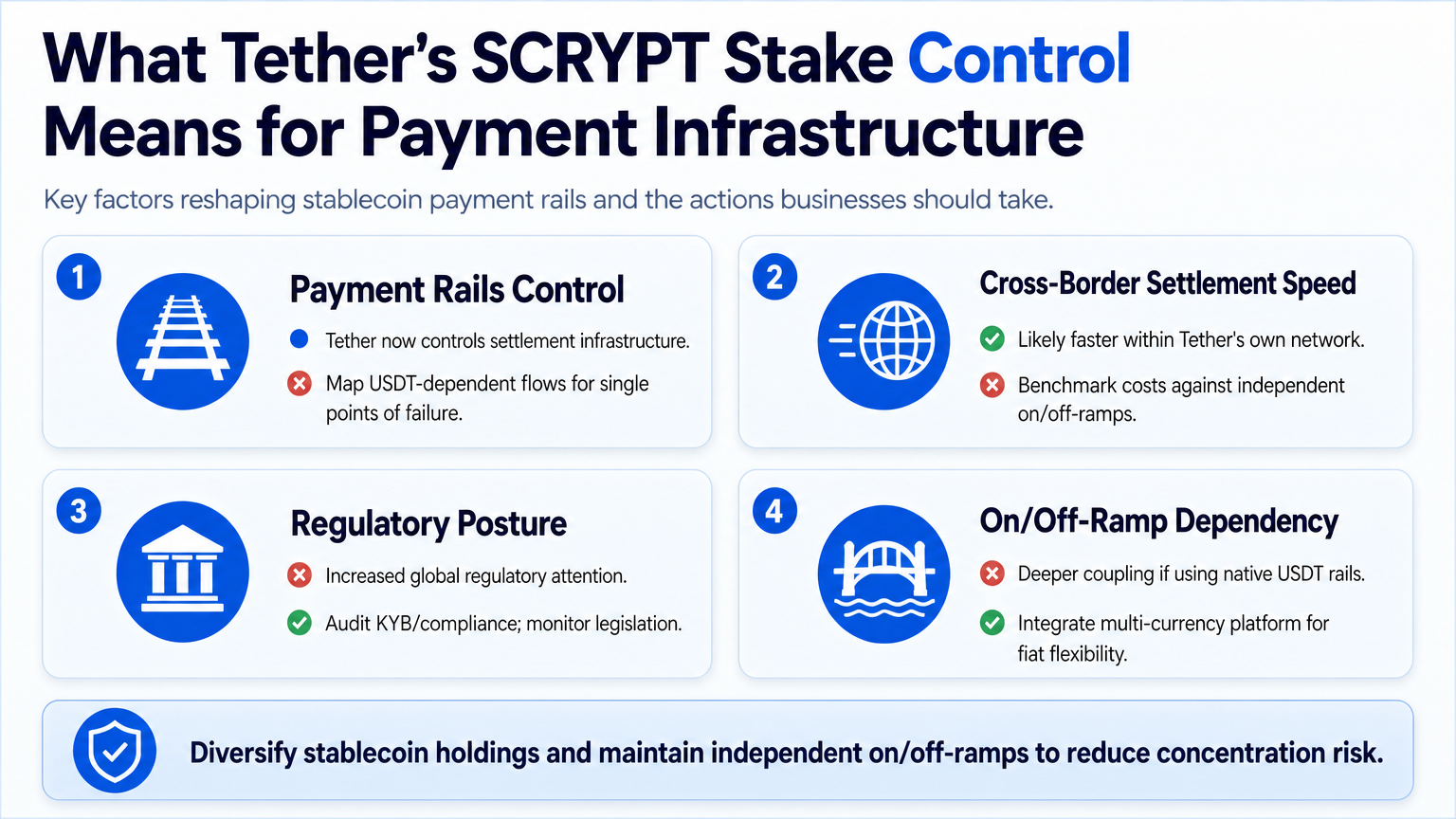
| Stablecoin Payment Infrastructure Factor | What Tether’s SCRYPT Stake Means | Action for Businesses |
|---|---|---|
| Payment rails control | Tether now builds and controls settlement infrastructure | Map all USDT-dependent flows and identify single points of failure |
| Cross-border settlement speed | Likely to improve within Tether’s own network | Benchmark costs against independent on/off-ramps |
| Regulatory posture | Increased attention from global regulators | Audit KYB/compliance practices and monitor legislative developments |
| On/off-ramp dependency | Deeper coupling if you use native USDT rails | Integrate a multi-currency neo-bank with instant fiat conversion to preserve optionality |
| Issuer concentration risk | Elevated | Set issuer limits; hold USDC and other stablecoins alongside USDT |
What You Should Do About It
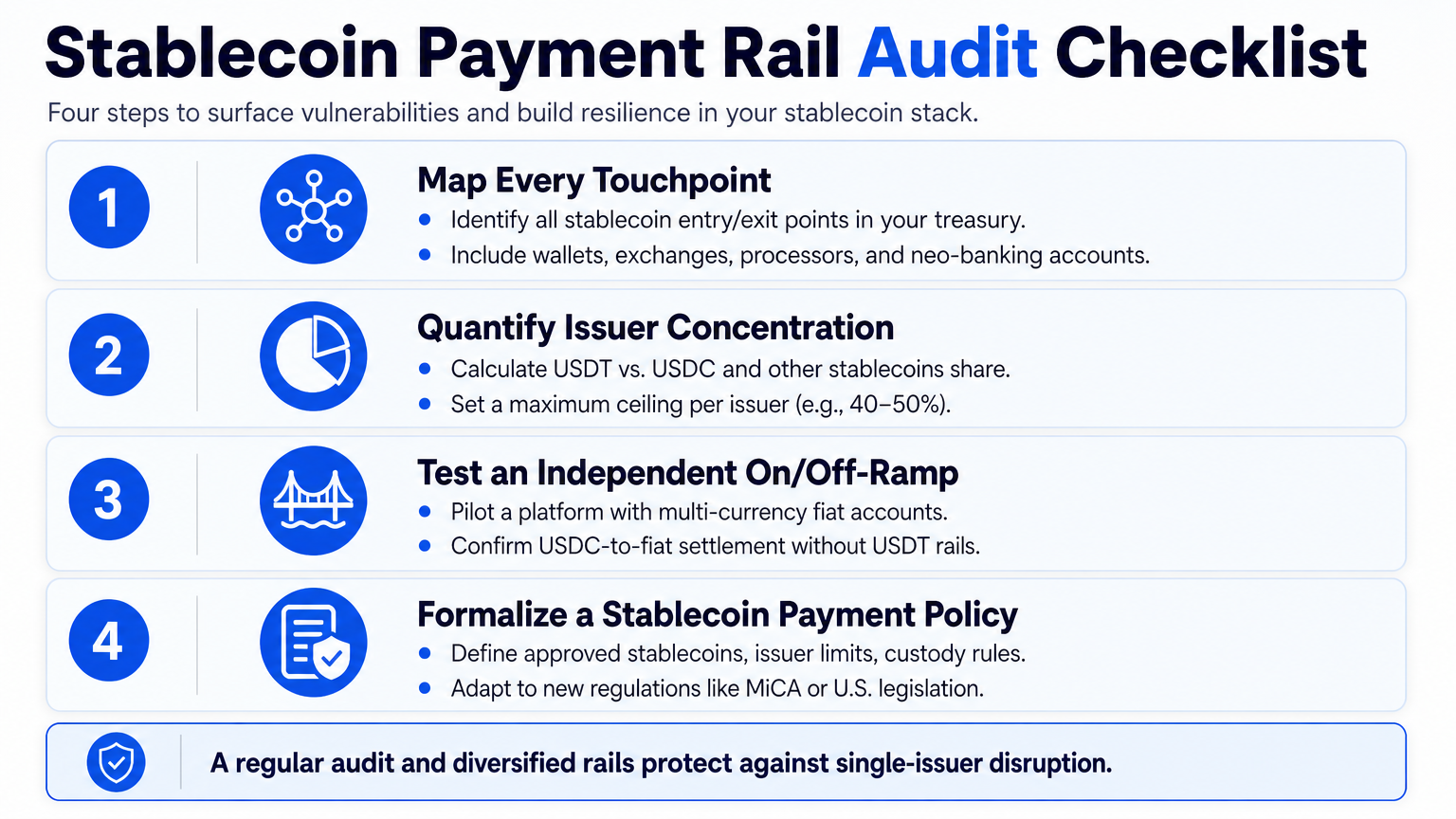
Actionable steps start with an honest inventory of your current stablecoin payment stack. Run this Stablecoin Payment Rail Audit Checklist to surface vulnerabilities:
- Map every touchpoint where USDT, USDC, or other stablecoins enter or leave your treasury. Include wallets, exchanges, payment processors, and neo-banking accounts.
- Quantify issuer concentration. Calculate the percentage of your stablecoin balance held in USDT versus USDC and others. Set a maximum ceiling for any single issuer, such as 40–50%, based on your risk appetite.
- Test an independent on/off-ramp. If your entire flow runs through one processor, pilot a platform that provides multi-currency fiat accounts, automatic crypto-to-fiat conversions, and custody via Fireblocks. Confirm that you can settle a USDC payment into fiat without routing through the USDT-only infrastructure Tether is building.
- Formalize a stablecoin payment policy that defines approved stablecoins, issuer limits, custody rules (e.g., Fireblocks or equivalent institutional-grade safe-keeping), and KYB requirements. Treat this as a living document that can adapt when new frameworks like MiCA or U.S. legislation come into force.
What to Watch Next
- SCRYPT’s product launches: The concrete payment products that emerge from this partnership will clarify Tether’s roadmap and the degree of merchant adoption they can command.
- Regulatory developments: Europe’s MiCA implementation and any U.S. stablecoin legislation will directly shape whether a vertically integrated issuer can operate freely across borders. Keep an eye on enforcement actions that test the limits.
- Neo-bank and payment-provider responses: Crypto-friendly financial platforms are likely to expand multi-token support and instant conversion rails to serve businesses that do not want to be locked into one issuer’s ecosystem. The speed at which stablecoin on-ramp and off-ramp capabilities evolve will be a leading indicator of the market’s resilience.
What does Tether’s stake in SCRYPT mean for stablecoin payments?
It means Tether is moving from being solely an issuer of USDT to becoming a vertically integrated stablecoin payment infrastructure provider. By owning part of the processing layer, Tether can route USDT transactions through its own rails, potentially offering faster settlement and lower internal fees. For the market, this deepens the issuer’s influence over how stablecoin payments are executed, raising the stakes for operational dependency and regulatory attention.
How will this impact cross-border business payments?
If SCRYPT succeeds in integrating USDT settlement directly into its cross-border engine, businesses that operate inside that network may experience quicker, cheaper international transfers compared to traditional SWIFT corridors. However, the efficiency gains are tied to an ecosystem that is increasingly under one issuer’s control. Companies using stablecoin cross-border payments should weigh the near-term speed advantage against the long-term risk of vendor lock-in, especially when independent alternatives like USDC via neutral on/off-ramps remain widely available.
What are the main risks of using stablecoins?
Three risks stand out: issuer concentration risk, regulatory risk, and infrastructure dependency risk. Concentration risk means that a single stablecoin—no matter how liquid—can expose a treasury to events specific to one issuer, such as reserve transparency concerns or operational freezes. Regulatory risk is acute because frameworks are still forming; a sudden change can impair redemption or transferability. Infrastructure dependency risk grows when businesses build their entire payment flow on proprietary rails that are not easy to exit. A prudent approach treats each of these risks as connected, not separate, and manages them through diversification and multi-rail architecture.
How can I protect my funds when using stablecoins?
Protection flows from diversification, custody, and counterparty segregation. Hold stablecoin reserves across multiple issuers (USDT, USDC, and others) and keep them with custodians that use institutional-grade security, such as Fireblocks. Use accounts that segregate your assets from the platform’s operational funds, ensuring that a single provider’s failure doesn’t trap your capital. Combine fiat and crypto in a single neo-banking interface so you can convert to fiat instantly when risk thresholds are crossed, rather than relying on a drawn-out redemption process through a single stablecoin’s own rails.
What should businesses do to prepare for shifts in stablecoin infrastructure?
Preparation means diversifying payment rails now, before a forced migration. Map your current stablecoin flows and identify the points where you are solely dependent on a single issuer or processor. Integrate a second, independent channel—a neo-banking platform that handles both fiat and multiple stablecoins, with instant conversion—so that you can redirect payments if a primary rail becomes unavailable or too risky. Formalize a treasury policy that sets issuer limits, approved custodians, and clear procedures for rotating stablecoin holdings. Treat the current infrastructure consolidation not as a threat, but as a clear signal to build resilience while options are still abundant.
Key Takeaways
- Tether’s SCRYPT stake transforms the dominant stablecoin issuer into a payments infrastructure owner, tightening its control over USDT settlement flows and raising concentration risk for businesses.
- Cross-border stablecoin payments stand to benefit from faster settlement, but the efficiency gains come with a strategic dependency that demands deliberate diversification.
- Auditing your stablecoin exposure, capping single-issuer holdings, and integrating independent on/off-ramps are immediately actionable steps that preserve optionality.
- Neo-banking platforms that combine multi-currency fiat accounts, instant crypto conversion, and Fireblocks-grade custody offer a practical hedge against single-rail lock-in.
- Regulatory scrutiny will intensify, making robust KYB and a documented stablecoin payment policy essential components of operational readiness.
Ready to bring fiat and crypto into a single, resilient account? Open an account with OneSafe and manage your global stablecoin payments on your terms.
For businesses that want to keep their audience informed about stablecoin payment trends without manual content creation, Joyrise’s automated SEO article publishing service can analyze your site and deliver daily articles to your Webflow, WordPress or Shopify store, with your first article written before you pay.