Sberbank crypto collateral now includes Bitcoin loan collateral, a crypto banking shift enabling DAO financial management. Below, we unpack what just happened, why it matters, and the operational implications for organizations navigating hybrid fiat-crypto finance.
Table of Contents
- What Just Happened: Sberbank’s Crypto Collateral Pivot
- What does Sberbank’s move mean for the future of crypto banking?
- Crypto Banking 101: The Context Newcomers Need
- What It Means for Web3 Startups, DAOs, and Global Businesses
- What to Watch Next: Open Questions and Practical Steps
- Key Takeways
What Just Happened: Sberbank’s Crypto Collateral Pivot
The New Russian Rules Taking Effect September 1
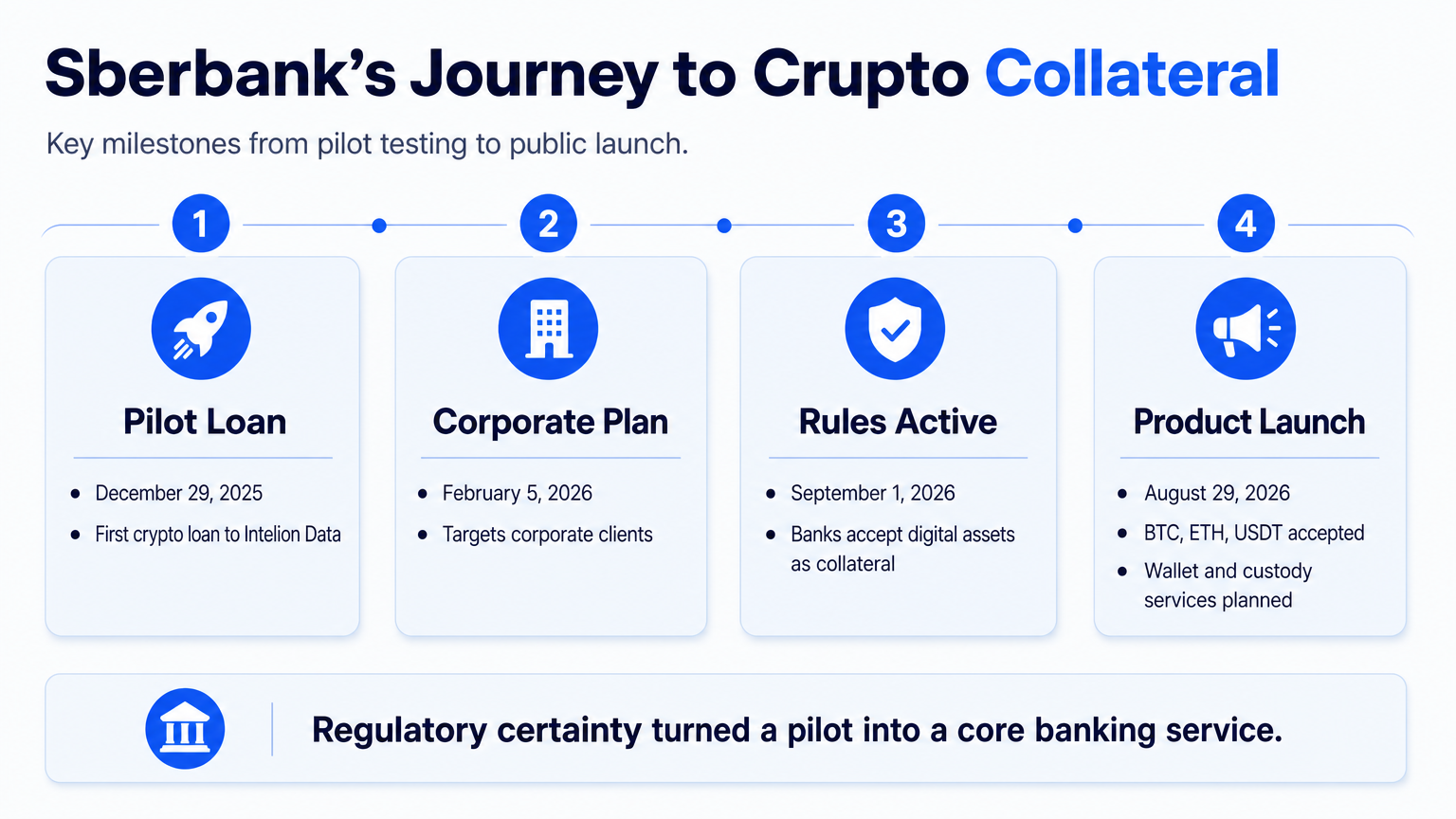
On August 29, 2026, Bitget reported that Sberbank will launch a lending product recognizing BTC, ETH, and USDT as eligible collateral. The product rests on a fresh regulatory foundation: the Central Bank of Russia’s updated framework, which formally allows banks to accept digital assets as security and comes into force on September 1, 2026. Previously, the legal status of crypto in Russian lending was either unaddressed or restricted, leaving banks without a clear path to collateralized digital-asset loans.
Sberbank’s entry is not a sudden lurch. As early as December 29, 2025, CoinDesk reported that the bank had piloted a bitcoin-backed loan to the mining firm Intelion Data, and on February 5, 2026, Reuters detailed Sberbank’s plan to extend crypto-backed lending to corporate clients. What’s new is the codified regulatory backing and the public move to accept three of the most liquid crypto assets at scale. The shift transforms a cautious experiment into a core banking service.
| Event | Date (Reported) | Key Detail |
|---|---|---|
| Pilot bitcoin-backed loan | December 29, 2025 (CoinDesk) | First crypto-backed loan to Intelion Data |
| Corporate lending plan announced | February 5, 2026 (Reuters) | Sberbank targets corporate clients for crypto loans |
| Central Bank rules effective | September1, 2026 | Legal framework for banks to accept digital assets as collateral |
| Public acceptance of BTC, ETH, USDT | August 29, 2026 (Bitget) | Lending product launches; wallet and custody services planned |
Beyond Lending: Wallet and Custody Services on the Horizon
The same Bitget report confirms that Sberbank intends to introduce a crypto wallet and a digital asset custody service within the year. Clients would be able to store and manage digital assets under the bank’s oversight, effectively creating a full-stack crypto banking offering. Together, the lending, wallet, and custody services mirror the kind of integrated platform that crypto-native firms have been building for years—but this time inside a legacy institution with over $500 billion in total assets.
What does Sberbank’s move mean for the future of crypto banking?
A Regulatory Signal for Instituional Adoption
Sberbank’s pivot is more than a regional headline. When a systemically important bank starts treating bitcoin as collateral, it sends a message: digital assets have moved from speculative token to functional financial instrument. In Russia’s case, the legal framework explicitly sanctions this transformation. That stands in stark contrast to the U.S., where the SEC and state regulators have consistently restricted or prosecuted crypto lending programs—most notably BlockFi’s 2022 settlement and the subsequent closure of several centralized yield platforms.
Weighing the divergence: On one side, Russia’s central bank is creating an explicit, unified rulebook that gives banks a compliance path. The U.S., by contrast, relies on enforcement actions and piecemeal guidance. The FDIC did clarify in 2025 that insured banks can engage in crypto-related activities under a pre-approval process, but no major U.S. bank has launched a Bitcoi-collateralized lending product for corporate clients as of August 2026. Russia’s approach reflects a pragmatic need to mobilize domestic capital under sanctions, while the American posture prioritizes consumer protection and market stability. The realistic takeaway is that both tracks will influence the emerging global norm—one from a position of strategic permissiveness, the other from caution. For companies with crypto treasuries, the Russian model demonstrates that a hybrid fiat-crypto banking stack is technically and legally possible, which will increase pressure on other jurisdictions to modernize their frameworks.
Riple Efects Beyond Russia’s Borders
The immediate impact is domestic: Russian corporate clients—miners, exporters, and tech firms—gain a mechanism to borrow against crypto without selling, potentially easing liquidity. But the ripple effects travel further. Sanctioned economies and emerging markets are watching. Sberbank’s model could be replicated by state-aligned banks in Asia, the Middle East, or Latin America, particularly where stablecoin payments are already gaining traction. This is not simply about bypassing sanctions; it’s about unlocking value from idle digital assets in regions where traditional collateral is scarce.
Crucially, the Sberbank announcement accelerates the instituional crypto adoption conversation. When a legacy bank builds a custody wallet and a lending product, it forces competing financial institutions to either follow suit or risk losing corporate clients that hold crypto. This unbundling and rebundling of services is at the heart of modern crypto banking, where blockchain rails and traditional liquidity combine. The infrastructure is no longer theoretical—it’s operating under defined regulatory rules, even if in a single, highly politicized jurisdiction.
Crypto Banking 101: The Context Newcomers Need
What are cryptocurrencies?
Cryptocurrencies are digital assets that rely on cryptographic proof and distributed ledgers—commonly blockchain—to secure transactions and control the creation of new units. Bitcoin, the first and largest, functions as a decentralized store of value; Ethereum extends the concept to programmable smart contracts; stablecoins like USDT aim to peg value to fiat currencies. Collectively, they represent a parallel financial system that operates 24/7 without a central intermediary.
How are cryptocurrencies bought, traded, and now used as collateral?
Users typically buy crypto on centralized or decentralized exchanges using fiat currency or other digital assets. Trading happens continuously on those markets. Using crypto as collateral works like a traditional secured loan: a borrower pledges a digital asset (e.g., Bitcoin) to a lender, who holds it in custody for the loan term. The borrower receives cash—usually fiat—in return, at a loan-to-value (LTV) ratio that accounts for volatility. If the value of the collateral drops below a threshold, the lender may liquidate the asset to protect its position. Sberbank’s new product applies this mechanism inside a regulated banking framework, meaning corporate borrowers can tap liquidity without selling their underlying crypto, potentially deferring taxable events.
Are cryptocurrencies regulated?
Regulation varies dramatically by country. In the U.S., the Securities and Exchange Commission and state agencies enforce securities and consumer protection laws, while the FDIC clarified in 2025 that banks may pursue crypto activities after demonstrating adequate controls. The result is a fragmented environment where federal and state rules overlap unevenly. Russia, by contrast, is moving toward a unified national framework that explicitly greenlights crypto-backed lending and custody. For a thorough primer on the disparate landscape, NerdWallet’s crypto banking guide outlines the distinctions. Global businesses must therefore treat crypto regulation 2026 as a patchwork—permissive in some jurisdictions, restrictive in others—and plan their treasury and banking relationships accordingly.
What It Means for Web3 Startups, DAOs, and Global Businesses
Rethinking Treaury Strategy When Banks Accept Digital Assets
For a Web3 startup with a large BTC or ETH treasury, the old calculus was simple: hold or sell. Sberbank’s move introduces a third path—pledge as collateral for fiat working capital. In a domestic Russian context, that might mean borrowing rubles against Bitcoi to fund payroll or operations without triggering capital gains. Outside Russia, the concept is now proven in a regulated setting, and treasury managers globally should start stress-teting their own setups.
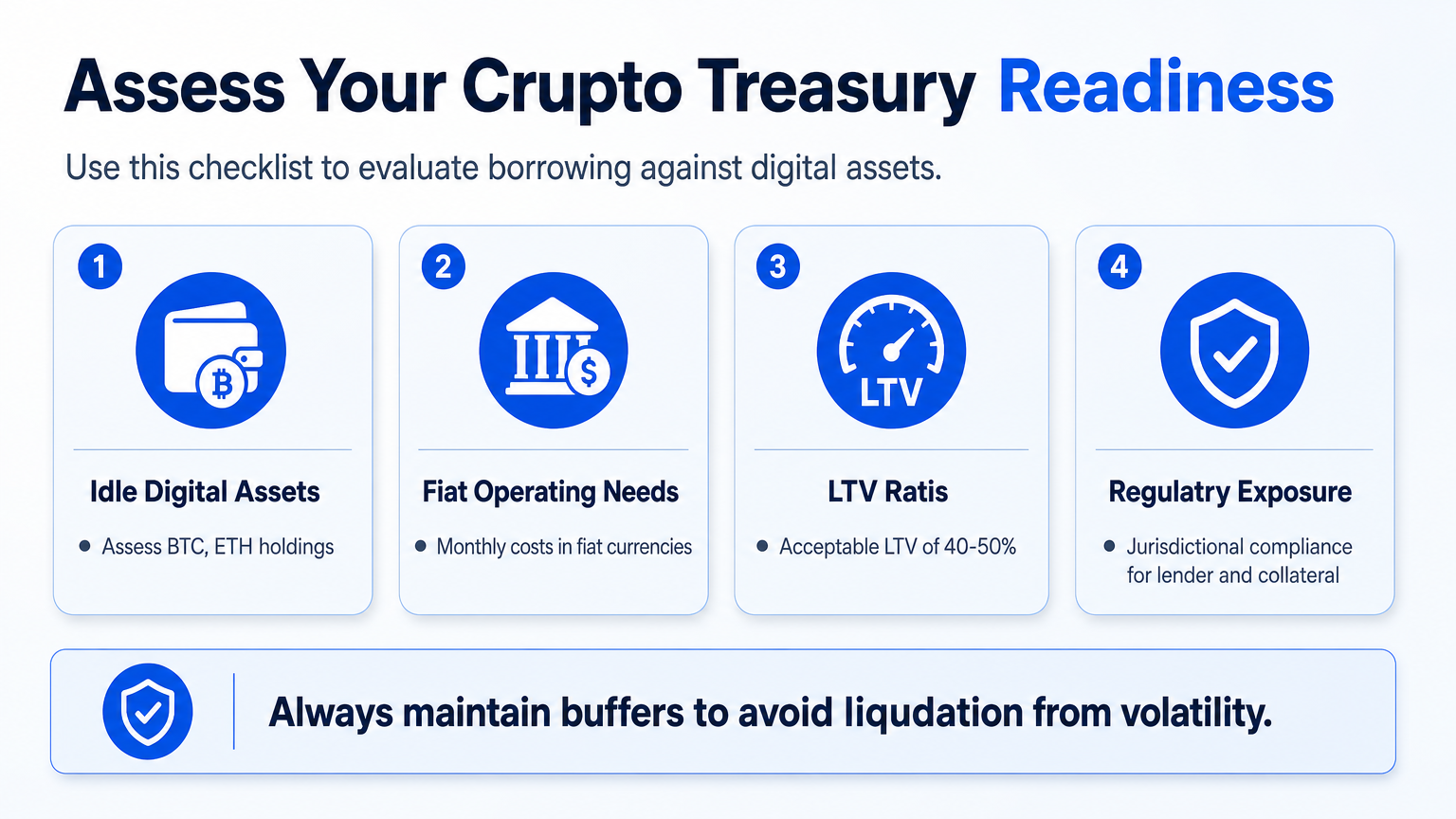
Treasury Assessment Framework for Crypto-Heavy Businesses
| Checklist Item | What to Evaluate | Status |
|---|---|---|
| Idle digital assets | Quantity of BTC, ETH, stablecoins held without immediate need | ☐ |
| Near-term fiat needs | Monthly operational costs in fiat currencies | ☐ |
| Loan-to-value comfort | Acceptable LTV ratio given crypto volatility (e.g., 40–50%) | ☐ |
| Custody preferences | Self-custody vs. third-party institutional custody | ☐ |
| Regulatory exposure | Jurisdictional compliance for lender and collateral | ☐ |
| LQuidation contingency | Plan for margin calls or forced sales | ☐ |
The key warning: Lquidation remains a risk in any crypto-collateralized loan. Volatility can trigger forced sales, so businesses must maintain adequate buffers or use dynamic LTV monitoring.
How can global businesses and DAOs manage both fiat and crypto in one place?
While Sberbank builds from scratch, platforms already exist that combine fiat and crypto treasury management into a single interface. OneSafe, for example, operates as a neo-banking platform that provides multi-currency fiat accounts (USD, EUR, CAD) alongside on-chain digital asset custody—backed by Fireblocks—and immediate crypto-to-fiat conversion. This crypto-fiat hybrid account model avoids the fragmentation of maintaining a traditional bank relationship and a separate crypto exchange or custodian. For a DAO, this means finance teams can issue automated payments in stablecoins, manage fiat payroll, and set role-based permissions—all without bouncing between four different providers.
The advantage isn’t just convenience: it’s compliance and custody alignment. Using Fireblocks-grade security for digital assets and segregated fiat accounts for operational cash, a neobank built for Web3 can offer the kind of oversight that regulators increasingly demand, while delivering the agility that DAOs and global startups require. Over 1,000 businesses across 30+ countries have already moved $800 million in volume through such unified platforms, demonstrating that the hybrid infrastructure Sberbank is now entering is both operational and scalable.
What to Watch Next: Open Questions and Practical Steps
Will Other Major Banks Follow?
The near-term catalysts are regulatory clarity and corporate demand. In jurisdictions where the central bank or financial authority provides a clear licensing path—as Russia did—large banks may follow Sberbank’s lead. In Europe, the Markets in Crypto-Assets (MiCA) framework is already creating a more predictable environment, and several Asian hubs are piloting institutional custody and stablecoin payment corridors. In the U.S., the FDIC’s 2025 process letter is a step, but without explicit federal legislation for crypto-backed lending, the largest banks are likely to stay on the sidelines, leaving the field to state-chartered trust companies and fintech platforms. The next 12 months will reveal whether the Sberbank moment triggers a domino efect or remains an isolated, geopolitcally driven experiment.
Navigating Sanctions and Cross-Border Compliance
A critical complication: Sberbank itself is subject to U.S. and EU sanctions. Non-Russian entities transacting with the bank risk severe penalties, making the product effectively off-limits for most international businesses. This illustrates a broader tension: crypto banking services may proliferate in sanction-friendly or permissive regimes, but global firms must rigorously screen every banking partner against OFAC and local sanctions lists. The operational solution is to work with platforms that embed compliance from day one—blocking sanctioned jurisdictions, monitoring transactions, and maintaining transparent audit trails. Any provider that enables multi-currency business account functionality alongside crypto must also enforce strict geoblocking and KY/AML protocols, as OneSafe does by restricting access in OFAC-sanctioned countries. For businesses, the imperative is clear: treat jurisdictional risk as a first-order treasury concern, not an afterthought.
Key Takeways
- Sberbank’s Bitcoi-collateralized lending product, effective under new Russian rules on September 1, 2026, represents the first major traditional bank embracing crypto as formal collateral—a regulatory milestone for crypto banking.
- The move forces a reassessment of treasury strategy: crypto-rich businesses can now consider borrowing against digital assets without selling, though lquidation risk demands disciplined management.
- The regulatory divergence between Russia’s permissive framework and U.S. enforcement-driven approach will shape institutional adoption globally; businesses must monitor jurisdictional shifts actively.
- A unified platform that combines fiat accounts, digital asset custody, and compliance infrastructure—like a web3 banking platform using Fireblocks—already solves the operational fragmentation that Sberbank is only beginning to address.
- Sanctions compliance remains a non-negotiable filter; any evaluation of crypto banking relationships must start with a full OFAC and sanctions screening.
For businesses ready to unify their fiat and crypto treasury operations, explore OneSafe’s global business account.