
Meta description: Rain’s embedded stablecoin wallets turn any app into a dollar account. Here’s what the shift means for global business banking, DAOs, and stablecoin regulation.
Table of Contents
- Rain’s Embedded Wallet Launch: What Just Happened
- Why This Matters Now for Founders and Finance Leads
- Stablecoin Payments 101: What Newcomers Need to Know
- What to Look for in a Stablecoin-Ready Business Account
- Open Questions: What to Watch Next
- FAQ
- Key Takeaways
Rain’s Embedded Wallet Launch: What Just Happened
On October 13, 2026, stablecoin payments platform Rain announced it has begun offering embedded stablecoin wallets that its partners can offer within their own applications, according to PYMNTS.com. The move lets any app — whether a marketplace, payroll tool, or DeFi interface — give users a native stablecoin balance without redirecting them to an external wallet.
The announcement in context
Rain’s embedded wallet is not a standalone consumer product. It is infrastructure. “The wallet is the account at the center of Rain’s platform,” the company said in its October 13 news release. “It is accessible through the same integration that issues the card, powers rewards, and supports money movement, so a user can get paid, save, spend, and send from one balance.” Rain also confirmed that the ability to earn on stablecoin balances is expected by year’s end 2026.
Previously, adding stablecoin functionality meant stitching together a custodial wallet provider, a card issuer, a compliance layer, and separate on/off-ramp rails — each with its own latency, fee structure, and technical surface. Rain’s announcement signals that the market is consolidating around a single integration that delivers issuance, custody, spending, and soon yield, all under one API.
How the embedded wallet works
An embedded wallet lives inside a partner’s application — the user never sees a separate wallet interface, seed phrase, or third-party dashboard. Technically, it resembles the non-custodial embedded wallet infrastructure that platforms like Fireblocks and Crossmint have defined: the wallet is created programmatically, key material is managed by the provider or split between the provider and the user via MPC (multi-party computation), and the partner app controls the user experience.
In Rain’s implementation, the same integration layer that provisions the wallet also handles stablecoin payments, card issuance, and rewards. This collapses what used to be a multi-vendor architecture into a single technical dependency — reducing integration time but also concentrating operational risk.
Why This Matters Now for Founders and Finance Leads
The shift from payment rails to embedded finance
Five years ago, the stablecoin conversation centered on settlement rails: could USDC move value faster and cheaper than SWIFT? That question is settled. Circle’s USDC settled over $1.4 trillion in on-chain transaction volume in 2024 alone. What’s new in 2026 is the shift from rails to accounts.
Rain’s launch exemplifies a broader market movement: stablecoin payments infrastructure is becoming embedded finance infrastructure. Instead of a business needing a bank account plus a crypto exchange plus a card issuer, platforms like Rain and, in the fiat-and-crypto unified space, OneSafe, are collapsing those functions into a single programmable layer. The broader distribution battle for stablecoin payments is no longer about which chain settles fastest — it’s about which platform can embed a fully functional dollar account into the software businesses already use.
This matters now because the cost of not embedding stablecoin accounts is rising. A startup that pays contractors in USDC but manages treasury in a traditional business account incurs three hidden costs: conversion friction, time delays on settlement, and reconciliation overhead across systems. Embedded wallets eliminate those seams by making the stablecoin balance simultaneously a payment rail, a holding account, and — once yield-bearing features ship — a treasury instrument.
Implications for DAO treasury management and global payroll
For DAOs, the implications are structural. A modern DAO treasury typically manages on-chain assets (stablecoins, governance tokens) alongside small fiat balances for operational expenses. The traditional approach forces the DAO into a fragmented stack: a multisig for on-chain funds, a separate fiat account for off-ramping, and manual processes for payroll.
Embedded stablecoin wallets, whether from Rain or through a unified fiat-crypto platform like OneSafe, offer an alternative: a single environment where a DAO can receive grants in USDC, pay contributors in stablecoins, off-ramp to fiat when needed, and assign role-based permissions across a distributed team. OneSafe processes over $800 million in transaction volume from more than 1,000 businesses across 30+ countries, with DAO-specific features including customizable roles and permissions, Fireblocks-secured custody, and automated payment workflows.
Stablecoin Payments 101: What Newcomers Need to Know

The cost and speed advantage over legacy rails
A cross-border wire via SWIFT typically costs $15–$50 in fees, takes 1–5 business days, and involves intermediary bank charges. A stablecoin payment on a high-throughput chain like Solana or Arbitrum settles in under 10 seconds for fractions of a cent. Paying 50 contractors monthly via international wire at $25 per transfer costs $1,250 in fees. The same volume via USDC on an efficient Layer 2 costs under $1 total — and the funds arrive in seconds.
The regulatory landscape
Regulatory frameworks are solidifying. The GENIUS Act, introduced in the US Senate in 2025, proposes a federal framework for payment stablecoins, including issuer licensing, reserve requirements, and redemption rights. In the EU, the Markets in Crypto-Assets (MiCA) regulation came into full effect for stablecoin issuers in 2024, reshaping which stablecoins can circulate and under what conditions. For founders, stablecoin regulation is not a future risk — it is a present filter. Choosing a platform today means evaluating whether the underlying issuer and custody partners will survive the compliance gauntlet. Platforms that have already built around regulated custodians are positioned to adapt without disrupting client operations.
What to Look for in a Stablecoin-Ready Business Account
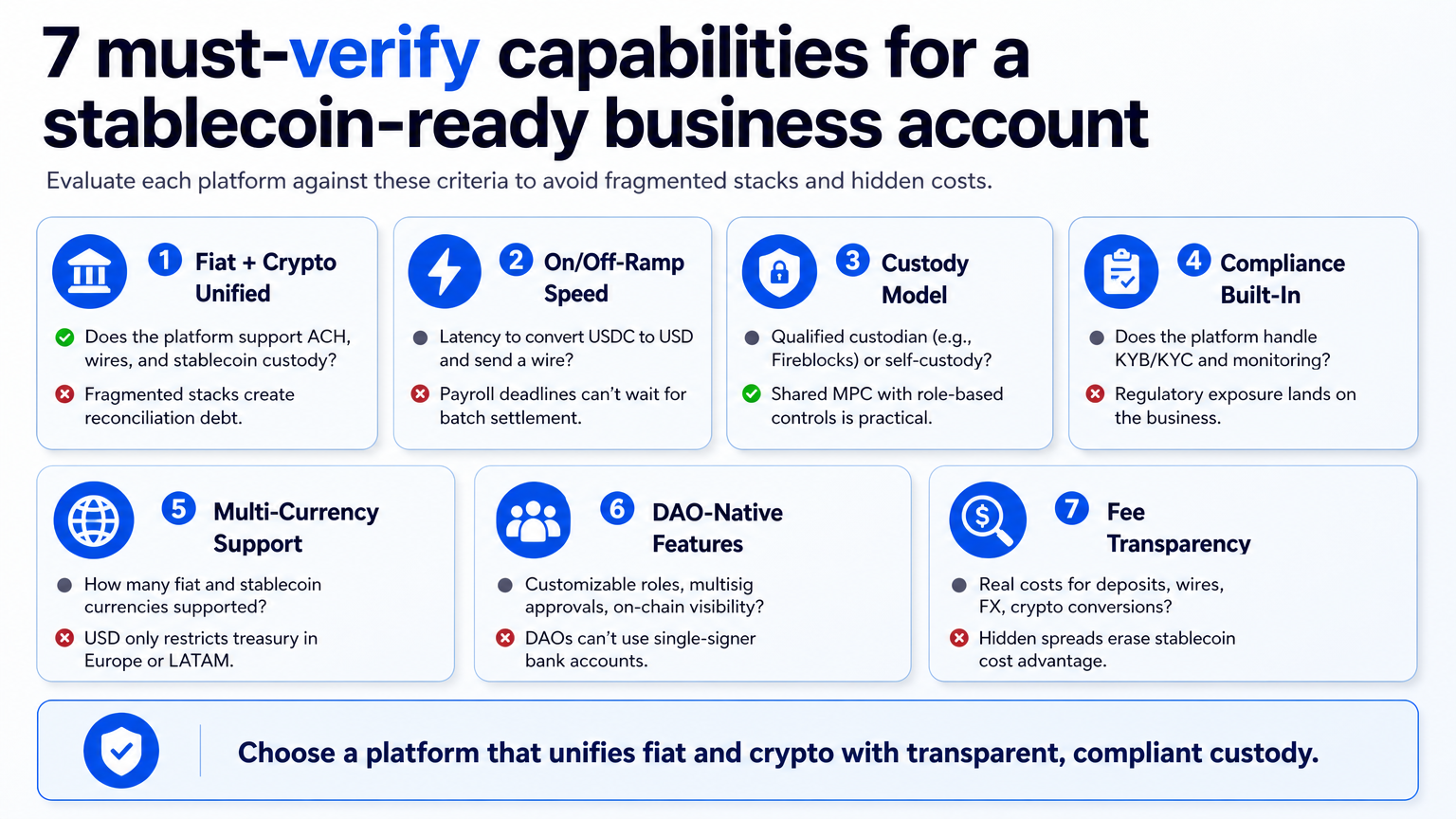
A practical checklist for evaluating business crypto accounts — whether considering Rain’s embedded infrastructure, a platform like OneSafe, or an alternative.
| Capability | What to Verify | Why It Matters |
|---|---|---|
| Fiat + crypto in one place | Does the platform support ACH, wires, bill pay and stablecoin custody? | Fragmented stacks create reconciliation debt and manual work. |
| On/off-ramp speed | What’s the latency to convert USDC to USD and send a domestic wire? | Payroll and vendor deadlines don’t wait for batch settlement. |
| Custody model | Is digital asset custody with a qualified custodian (e.g., Fireblocks) or self-custodial? | In a business context, shared MPC custody with role-based controls is usually more practical than pure self-custody. |
| Compliance infrastructure | Does the platform handle KYB/KYC and transaction monitoring? | Regulatory exposure lands on the business, not just the platform. |
| Multi-currency support | How many fiat on/off-ramp currencies and stablecoins are supported? | A platform limited to USD/USDC restricts treasury flexibility in Europe or LATAM. |
| DAO-native features | Are there customizable roles, multisig-style approvals, and on-chain visibility? | DAOs can’t operate with single-signer traditional bank accounts. |
| Fee transparency | What are the real costs for fiat deposits, wire withdrawals, FX, and crypto conversions? | Hidden conversion spreads erode the cost advantage of stablecoin payments. |
Unified fiat and crypto management
The most common failure mode for businesses adopting stablecoins: opening a separate crypto exchange account, manually off-ramping to a bank, and rebuilding payment workflows twice. A unified platform removes that boundary. For example, OneSafe supports ACH, domestic and international wires, bill payments, and instant crypto-to-fiat conversions within the same interface.
Why platforms like OneSafe are built for this moment
OneSafe represents a category of neo-banking platforms built for organizations that operate natively across fiat and crypto — a use case that Rain’s embedded wallet announcement validates but does not fully cover on the fiat side. OneSafe serves global businesses and DAOs with multi-currency accounts in USD, Euro, and CAD, corporate cards with spend limits, and automated payment solutions. Onboarding is completed within a week with standard business documentation. For organizations seeking a stablecoin-ready business account today rather than an API integration to build against, this closes the gap between crypto-native treasury management and operational fiat needs — a core requirement of global business banking in 2026.
Open Questions: What to Watch Next
Yield-bearing stablecoin accounts and their risks
Rain explicitly said that yield on stablecoin balances is expected by year-end 2026. This raises two questions every business should ask: Where does the yield come from? and What happens to my balance if the yield source fails? Stablecoin yield historically comes from on-chain lending protocols (Aave, Compound), off-chain Treasury bill backing, or platform-subsidized promotional rates. On-chain lending exposes balances to smart contract risk. T-bill-backed models depend on the issuer's reserve management. Subsidized rates are unsustainable. The stablecoin yield landscape is already reshaping treasury management. A business evaluating yield-bearing accounts should demand clear documentation of the yield source, whether principal is at risk, and whether there are lock-up periods. Vague answers are a red flag.
The role of regulation
The GENIUS Act could make US-issued payment stablecoins the globally dominant instrument — or it could impose reserve requirements so restrictive that only the largest banks can compete. MiCA’s ongoing implementation shows how fast regulatory timelines shift product roadmaps. One open question: will yield-bearing stablecoin accounts be classified as securities or deposit-taking activities in major jurisdictions? The answer will determine whether Rain’s planned yield feature expands into a full treasury product or remains limited. The practical stance for businesses: choose platforms that have already built compliance into their architecture, not bolted it on after the fact.
FAQ
What is Rain stablecoin and how do embedded wallets work?
Rain stablecoin refers to the stablecoin payment infrastructure Rain provides, not a separate stablecoin asset. Embedded wallets are programmatically created wallets that live inside another company’s application. The infrastructure provisions a wallet via API, handles key management through MPC, and exposes functionality through the partner app’s UI. In Rain’s implementation, the same integration supports card issuance, rewards, and money movement.
Why are stablecoin payments becoming popular for businesses?
Speed and cost: a stablecoin payment settles in seconds for sub-cent fees versus $15–$50 and days for a wire. Beyond settlement, businesses are adopting stablecoin payments because they collapse treasury, payroll, and vendor payments into a single asset class — reducing the overhead of maintaining separate fiat and crypto stacks.
What should I look for in a business account that supports stablecoins?
Verify the platform handles both fiat and crypto natively. Confirm the custody model and that the custodian is regulated. Examine the fee schedule — hidden conversion spreads erase cost advantages. For DAOs, ensure customizable roles and multi-signer approvals. Confirm a clear compliance framework for KYB and transaction monitoring.
How does the Rain launch impact cross-border payments?
Rain’s embedded wallets accelerate the unbundling of cross-border payments from correspondent banking. By embedding a USDC-denominated account into partner apps, Rain eliminates the last mile of integration friction. Cross-border stablecoin payments will increasingly happen inside the software where businesses already operate — payroll platforms, marketplaces, invoicing tools — rather than through standalone crypto products.
Is it safe to use stablecoin platforms for business treasury?
It depends on custody, compliance, and disclosure practices — not on the stablecoin itself. A qualified custodian with MFA enforcement and segregation of client funds is the baseline. Platforms that do not disclose their custody partner introduce operational risk. For yield-bearing accounts, ask where the yield comes from and whether principal is at risk. The growing institutional infrastructure makes business-grade security the norm.
Key Takeaways
- Rain’s embedded wallet launch shifts stablecoin payments from a standalone rail to an account primitive any app can integrate.
- For businesses and DAOs, the immediate opportunity is collapsing fragmented fiat-and-crypto stacks into a single treasury environment, reducing cost, latency, and operational risk.
- Evaluating a stablecoin-ready business account requires verifying unified fiat-crypto support, custody model, fee transparency, and compliance infrastructure.
- Yield-bearing stablecoin accounts, expected from Rain by year-end 2026, present material risk if the yield source and principal protections are not clearly disclosed.
- Stablecoin regulation (GENIUS Act, MiCA) will determine whether embedded stablecoin accounts become the default business banking interface over the next two years — choose platforms built with compliance as architecture.
For businesses ready to manage fiat and stablecoins in one platform, open a OneSafe account today.



