
Meta description: The U.S. Treasury’s August 2026 bond shift weakens the dollar, directly impacting crypto treasury management. Learn to rebalance fiat-crypto allocations and hedge FX exposure.
US Treasury Shift Reshapes Crypto Treasury Management
On August 22, 2026, the U.S. Treasury announced a shift in its quarterly refunding plans that will increase the supply of long-term bonds — and immediately rippled through forex markets, weakening the dollar. For finance leaders overseeing crypto treasury management, this macro signal demands a rapid reassessment of fiat-crypto allocations, stablecoin reserves, and FX hedging strategies. The connection between sovereign debt supply and digital asset treasuries is rarely discussed, yet today it’s urgent.
Table of Contents
- What Just Happened: The Treasury’s August Refunding Signal
- Why This Matters Now for Crypto Treasury Management
- The Background Every Crypto Finance Lead Needs
- Concrete Implications and Recommended Actions
- What to Watch Next and Open Questions
- Key Takeaways
What Just Happened: The Treasury’s August Refunding Signal
The announcement that shifts the macro picture
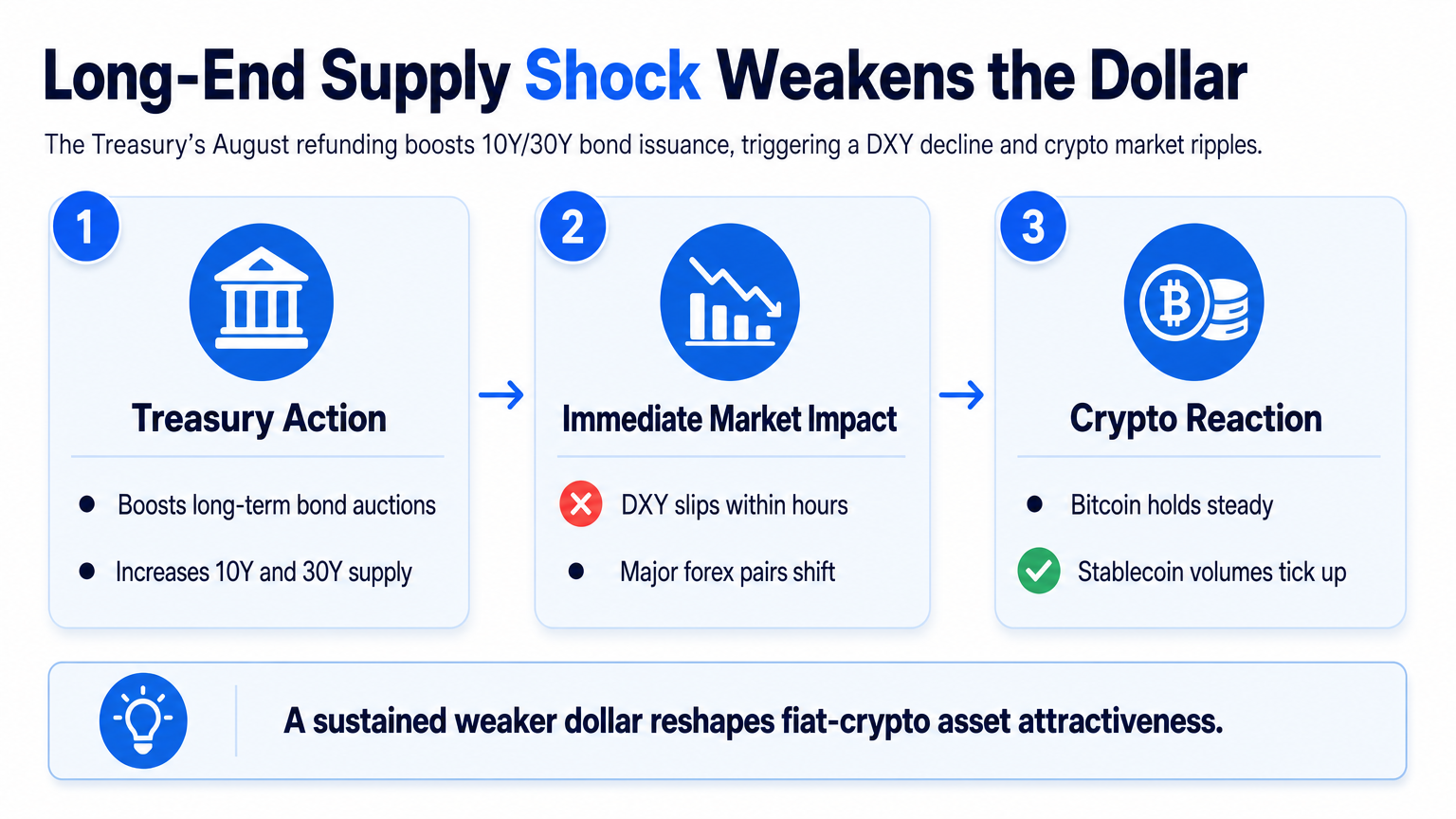
The U.S. Treasury’s August 22, 2026 refunding statement said it will boost long-term bond auctions in the 10- and 30-year sectors, increasing supply and pushing the dollar lower, as reported by CryptoRank. The larger-than-expected issuance signals deficit financing with longer-duration debt, absorbing global capital and altering the yield curve.
Immediate market reactions: dollar slip and crypto ripples
Within hours, the DXY slipped, and major pairs moved. Crypto markets registered a modest bid but not uniformly. Bitcoin held steady while stablecoin volumes ticked up, suggesting treasury managers began moving capital. For any business holding a hybrid fiat-crypto treasury, a sustained lower dollar reshapes relative asset attractiveness.
Why This Matters Now for Crypto Treasury Management
A weaker dollar as a tailwind for crypto-denominated balance sheets
When the dollar depreciates, non-dollar purchasing power of crypto assets improves for firms with global operations. A U.S. startup holding bitcoin or ether benefits as those assets’ dollar value may rise, but the immediate effect is on stablecoin reserves: USDC and USDT are dollar-pegged, so their real-world purchasing power erodes exactly with the dollar. That erodes working capital for payroll, vendors, and operational buffers. A treasury manager ignoring the dollar is taking an unhedged long-dollar position. This is a core element of any crypto treasury strategy.
Stablecoin reserves in the crosshairs of FX exposure
Many crypto-native businesses keep large cash equivalents in USDC for settlement and yield. While stablecoin risks often focus on smart-contract and reserve transparency, the macro angle is equally important. A declining dollar means the same number of USDC buys fewer euros, yen, or even bitcoin if the latter appreciates. For DAOs and Web3 startups with global contributors, the FX cost of a dollar-pegged reserve rises just when the dollar softens — a real margin compression that hits quarterly burn rates.
The hidden urgency for treasury rebalancing
Today’s announcement compresses the timeline for rebalancing. If the Treasury persists in flooding the long end, the dollar’s slide may accelerate, leaving treasury managers who wait with a less favorable exchange rate. The treasury bond yield crypto nexus works through the discount rate: higher long-term yields raise the opportunity cost of holding non-yielding fiat, while making the dollar scarcer — a short-term contradiction demanding active management. The moment to act is before the Fed’s next dot plot.
The Background Every Crypto Finance Lead Needs
How traditional and crypto treasuries interact with bond markets
Traditional treasuries allocate cash across short-term government securities, commercial paper, and deposits. A rise in long-term bond supply — and yield increase — makes long bonds attractive but depresses the currency. Crypto treasuries hold volatile assets (BTC, ETH) and stablecoins. The link is the cost of capital and real return on cash. Understanding Bitcoin Treasury Companies explains that firms treat bitcoin as a reserve asset uncorrelated to fiat debasement; when the dollar weakens, that narrative strengthens. Yet few firms model the interaction between bond supply and their own USDC reserves.
The yield curve signal and its historical effect on digital assets
A steepening yield curve driven by long-end supply has preceded dollar weakness and, often, crypto rallies — with a lag. The Introduction to Crypto Treasury Strategies notes that crypto treasuries are highly sensitive to real interest rates: when real rates fall, the opportunity cost of holding zero-yield bitcoin drops. Today’s announcement isn’t a direct rate cut, but by boosting supply it can push up term premiums, tightening financial conditions in one part of the curve while loosening another. Treasury managers who treat this as a simple “weaker dollar = buy more BTC” signal risk missing that stablecoin holdings may need to be reduced or hedged.
Why this refunding is different from previous cycles
Previous refunding announcements in 2023-2024 came during a rate-hiking cycle; the dollar was strong. Now, the market prices a Fed pause or cut, and the Treasury’s long-end issuance compounds dollar vulnerability. Crypto markets are more mature, with institutional custody and larger stablecoin floats. The macro impact on crypto holdings is thus more direct: a 1% DXY decline can shift the USD value of a non-dollar stablecoin basket by 0.7-0.9%. The scale of this increase may be the largest long-end supply shock since the pandemic.
How is treasury management for crypto different?
Crypto treasury management involves 24/7 markets, self-custody or third-party custody, and volatile assets. Reconciliation is complex (on-chain vs. bank statements), and security relies on private keys and multisig. Liquidity needs are unpredictable due to DeFi positions and payroll in multiple stablecoins. A crypto treasury manages a portfolio of BTC, ETH, USDC, and governance tokens, each with its own risk profile — a sharp contrast to fiat-only operations.
How does a crypto treasury affect accounting and financial reporting?
Under GAAP/IFRS, volatile digital assets held as intangible assets can force impairment charges, while stablecoins may qualify as cash equivalents if criteria are met. The Proliferation of Cryptoasset Treasury Strategies outlines disclosures on concentration risk, valuation, and custody. A weakening dollar impacts reported value of non-dollar stablecoins and can trigger revaluation gains or losses, making FX sensitivity analysis crucial.
What are some risks associated with crypto treasuries?
The Risk Factors Related to our Bitcoin Treasury Strategy cites volatility, custody breaches, regulatory changes, and liquidity shortfalls. Macro-driven risk — a sudden dollar slump — erodes real stablecoin value, forcing hurried sales. Second-order effects: some stablecoin issuers hold reserves in short-term Treasuries that lose value when yields rise, compounding the risk.
Can stablecoins replace traditional payment rails?
Stablecoins like USDC settle faster and cheaper than traditional rails, especially for cross-border payments. However, they lack legal finality, consumer protections, and universal acceptance. Stablecoin Payments for Startups: A Complete Guide explores the on/off-ramp challenges. In a dollar-weakening scenario, a startup might prefer euro or yen stablecoins, but that introduces FX complexity. OneSafe, as a financial technology company, provides multi-currency accounts in USD, Euro, and CAD alongside USDC — enabling instant conversion and spending, which helps but does not eliminate FX exposure. For a deeper look at the model, see What Is a Neobank? A Guide for Businesses & Crypto.
How can finance leaders build controls for crypto treasuries?
A strong framework starts with multisig wallets, segregated duties, hardware security modules, and daily on-chain reconciliation. Role-based permissioning and threshold approvals are essential. For DAOs, customizable roles can map on-chain governance to execution. Regular audits and separation of trading, custody, and reporting mitigate internal fraud.
Does the future of treasury management require support for crypto assets?
Given corporate bitcoin adoption and stablecoin settlement, a treasury function that cannot handle digital assets will be at a disadvantage for any globally operating or Web3 firm. Ignoring crypto cedes an entire yield and efficiency frontier. The future demands a platform that bridges fiat and crypto seamlessly — the unified approach defining Web3 finance operations.
What does secure treasury management look like for crypto?
Assets must be held in qualified custody (like Fireblocks), never on a single-key hot wallet, with MFA mandatory. Real-time monitoring of all crypto flows and insurance covering custodied portions are essential. For businesses using a neo-banking interface, that layer must integrate with institutional-grade custody without exposing keys.
Concrete Implications and Recommended Actions
Audit your fiat-crypto ratio and FX exposure now
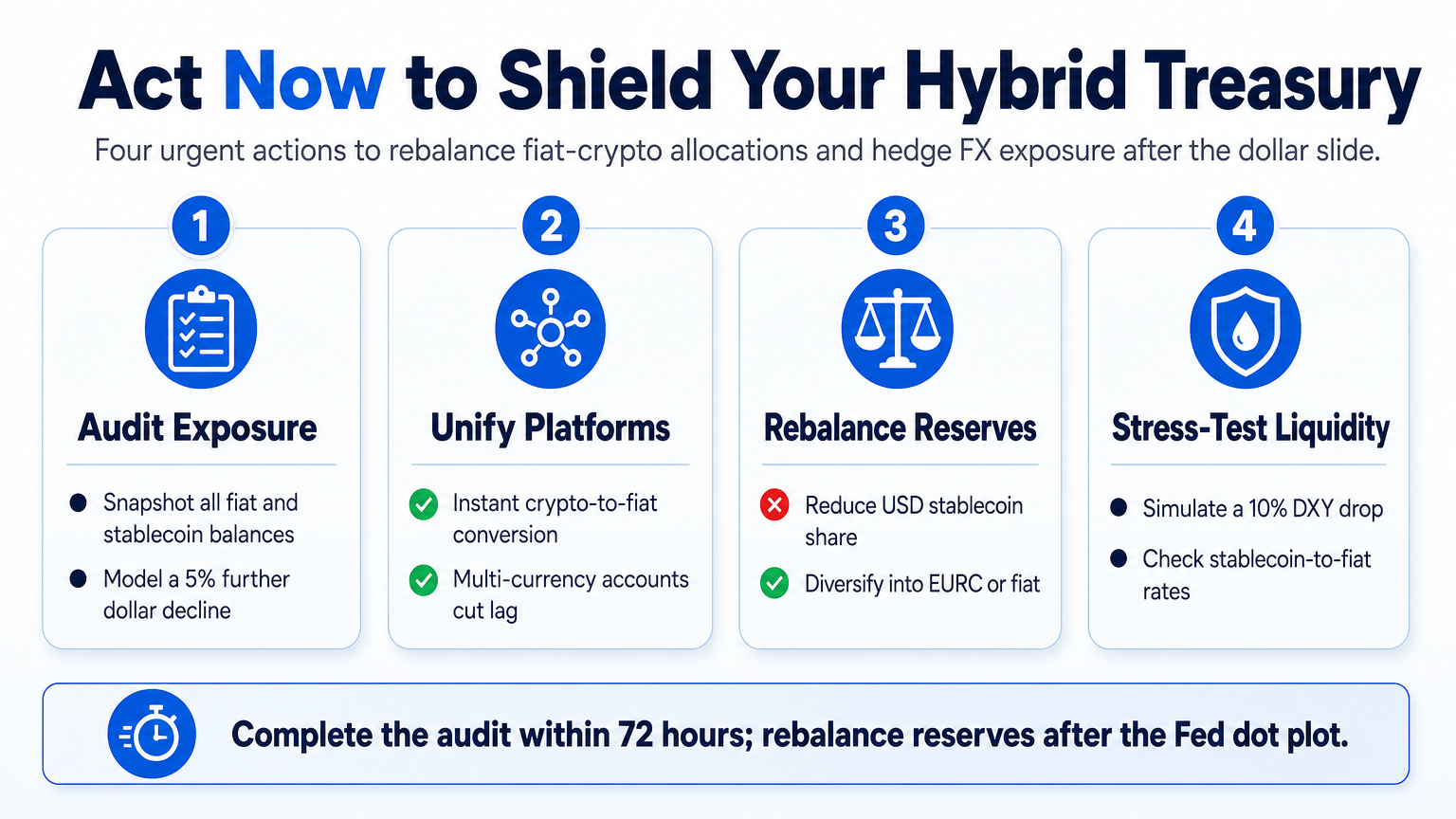
Pull a snapshot of every dollar, euro, and stablecoin balance across wallets and bank accounts. Calculate net fiat exposure after stablecoins, and model a 5% further dollar decline. This number — not a guess — should drive the rebalance. Effective fiat crypto balance management starts with this visibility.
Use unified platforms to cut reaction time (what OneSafe makes possible)
When a macro event hits, the difference between a profitable adjustment and a loss is often hours. A platform that holds fiat and crypto natively — with instant crypto-to-fiat conversion and multi-currency accounts — lets a treasury team shift from USDC to euro or from BTC to USDC without hopping between a bank, an exchange, and a custody provider. OneSafe processes these conversions immediately, with crypto deposits and withdrawals in USDC free of charge. This isn’t a luxury; it’s a risk-management necessity in volatile dollar flows. However, founders should be aware of potential downsides; Drawbacks to Neo Banking: What Founders Need to Know outlines key considerations. The platform’s segregated global accounts and Fireblocks custody mean capital moves fast without sacrificing security.
Adjust stablecoin allocation based on the new rate outlook
If the dollar is expected to weaken further, reduce the share of stablecoins in the operational float in favor of short-term debt instruments or multi-currency fiat accounts that earn interest. For unavoidable USDC reserves, evaluate whether to hedge via perpetual swaps or convert to non-USD stablecoins (like EURC) if supported by your rails. Holding a pure USD stablecoin portfolio is essentially a levered bet against your own purchasing power.
Stress-test liquidity in a dollar-weakening scenario
Run a scenario where DXY drops 10% over six months and stablecoin market caps contract. How does that affect payroll in local currencies? Can your payment rails still convert stablecoins to fiat at acceptable rates? If not, you need backup fiat lines. Simulate a day when the euro/USD rate spikes and your automated invoicing triggers a shortfall.
| Action | Key Metric | Timeline |
|---|---|---|
| Audit fiat-crypto split | Net USD exposure including USDC, USDT, bank cash | Complete within 72 hours |
| Model 5% dollar decline | Impact on operating expenses in non-USD currencies | Update weekly |
| Rebalance stablecoin reserves | Percentage of cash in non-USD stablecoins or fiat | After Fed dot plot, or sooner |
| Test conversion speed | Time from crypto-to-fiat settlement on your current platform | Benchmark under 30 minutes |
| Review custody permissions | Number of signers, role segregation, audit trail readiness | Immediate, alongside audit |
What to Watch Next and Open Questions
The Fed’s September dot plot and forward guidance
The Treasury’s move may be overtaken by the Federal Reserve’s September projections. If the dot plot signals fewer cuts, the dollar could strengthen, reversing today’s signal. A unified platform that supports both fiat and crypto lets you pivot without moving money between institutions.
Can on-chain metrics confirm or contradict the macro move?
Monitor stablecoin exchange netflows and USDC supply on major blockchains. A sustained decline in USDC circulating supply often precedes a rotation into risk assets or a flight from dollar exposure. Why Dropping US Dollar Index Isn’t Pumping Bitcoin Price explores the disconnect: DXY declines don’t always lead to immediate BTC rallies, but on-chain data can provide a leading indicator.
Regulatory posture toward stablecoins as money market instruments
If new guidance requires stablecoin issuers to hold reserves in short-dated Treasuries, a simultaneous increase in long-end supply could pressure those reserves, widening the spread between primary and secondary stablecoin markets. That would directly impact DAO treasury risk and stablecoin redemption liquidity. Keep an eye on the SEC’s fall agenda.
Key Takeaways
- The August 22, 2026 Treasury refunding weakens the dollar, directly impacting stablecoin reserves and demanding immediate rebalancing of fiat-crypto treasuries.
- A dollar decline erodes USDC purchasing power, making it urgent to audit net fiat exposure and consider diversifying into non-USD stablecoins or fiat.
- Unified neo-banking platforms that handle fiat and crypto natively — like OneSafe — cut response times, letting treasury managers convert and hedge without fragmentation.
- Stress-testing liquidity and modeling a 5% dollar drop should be standard practice for any Web3 finance operation.
- Watch the Fed’s September dot plot, on-chain stablecoin flows, and regulatory moves that could redefine stablecoin reserves.
Ready to manage a hybrid fiat-crypto treasury with the speed today’s macro environment demands? Explore OneSafe’s unified platform.