Table of Contents
- description: "Hong Kong's first production stablecoin payments pilot goes live. Learn how regulated HKD stablecoins, APAC's 60% global volume, and integrated platforms transform cross-border treasury."
- What just happened: Hong Kong’s stablecoin pilot goes live
- Why it matters now for global businesses and DAOs
- The state of stablecoin payments: a brief primer
- Beyond the API: stablecoin payments as part of your financial OS
- How APAC’s regulatory clarity sets a template for the world
- What should you do today? Concrete steps for treasury teams
- What to watch next: stablecoin regulations beyond APAC
- FAQ
- Key Takeaways
description: "Hong Kong's first production stablecoin payments pilot goes live. Learn how regulated HKD stablecoins, APAC's 60% global volume, and integrated platforms transform cross-border treasury."
Stablecoin payments hit the mainstream: APAC’s turning point
On October 6, 2026, a quiet milestone in Hong Kong turned a long-running experiment into a live operating reality. After years of sandbox testing, the city’s first production stablecoin payments pilot went active, backed by freshly issued licences and a regulated Hong Kong dollar-backed stablecoin that entered institutional beta in mid-August (Asian Business Review, October 6, 2026). For global businesses and DAOs that move money across borders, this is more than a regional story: it’s a signal that the payment infrastructure underpinning their treasury operations is shifting from theory to usable rails.
What just happened: Hong Kong’s stablecoin pilot goes live
From sandbox to reality, a timeline
Hong Kong’s stablecoin journey accelerated sharply in 2026. The Hong Kong Monetary Authority (HKMA) granted its initial batch of stablecoin licences, and by mid-August licensees rolled out the first institutional beta of a Hong Kong dollar-backed stablecoin—allowing select counterparties to mint, transfer, and redeem tokens 1:1 to HKD. On October 6, 2026, the transition to a live pilot was confirmed, with real payment flows between on-chain and traditional rails. This marks a deliberate move toward a fully regulated ecosystem, with prudential oversight covering issuance, reserve management, and redemption—removing the opaque risk that once made treasurers hesitant.
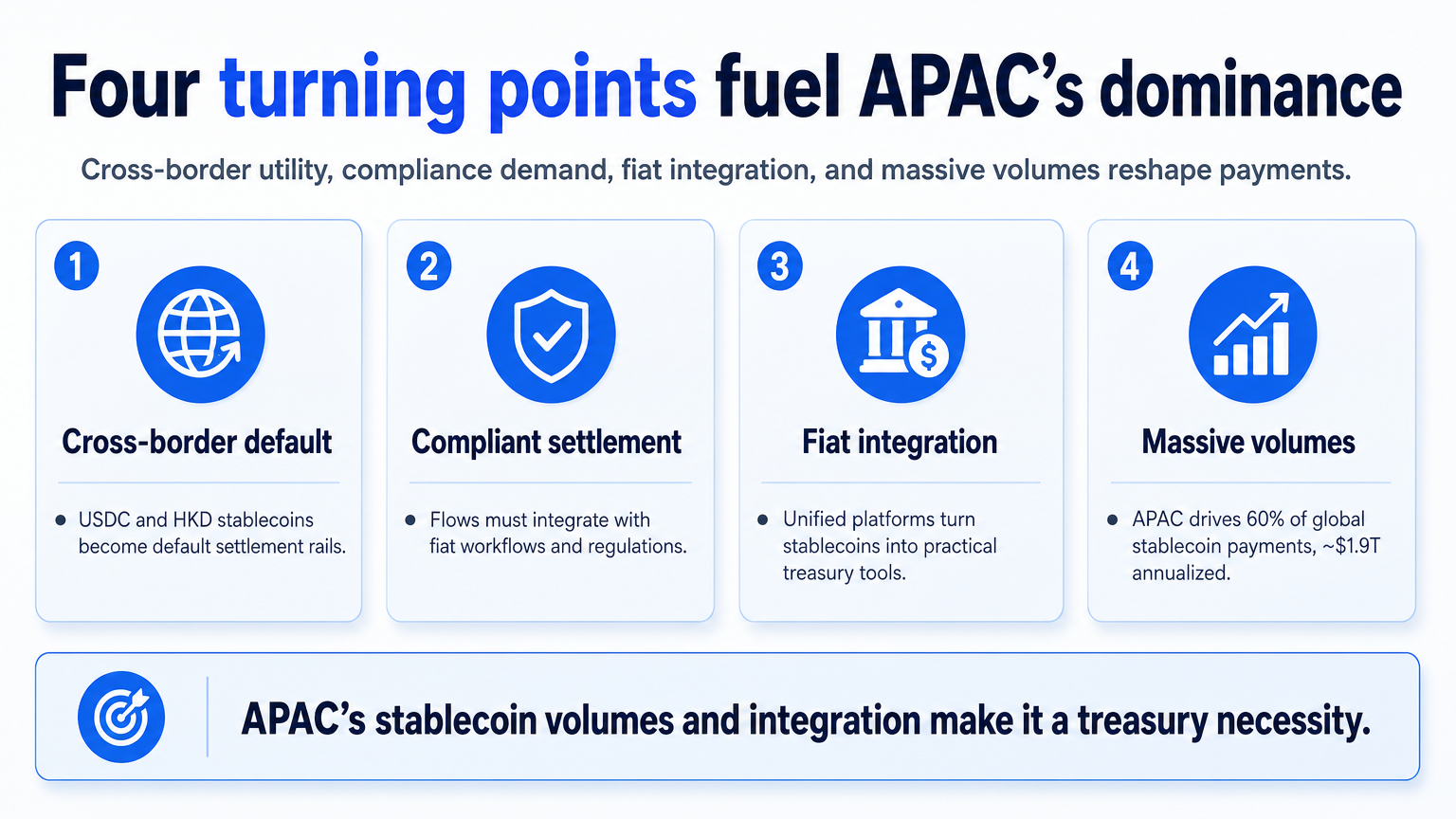
Four turning points driving APAC’s dominance
- Stablecoins as the default for cross-border utility – businesses treat USDC and now HKD-pegged instruments as the most efficient settlement rail.
- Demand for compliant collection and settlement – corporates want stablecoin flows that plug into existing fiat workflows with clear regulatory cover.
- Seamless integration with fiat infrastructure – platforms bridging fiat and crypto in one interface turn stablecoin payments from an API playground into a practical treasury tool.
- Volumes that demand attention – McKinsey estimates APAC accounts for 60% of global stablecoin payment volume, with annualized payments reaching roughly $1.9 trillion, driven heavily by Hong Kong.
These numbers reflect a region where cross-border stablecoin payments have moved beyond retail into institutional supply chains, B2B payroll, and vendor settlement.
Why it matters now for global businesses and DAOs
Cross-border settlement without the friction
For a global business paying suppliers in Southeast Asia or a DAO distributing contributor grants, the old correspondent banking model adds days of float, unpredictable FX markups, and opaque fees. A properly structured stablecoin payment settles in minutes, with costs reduced to a minuscule network fee and a small conversion spread. Hong Kong’s pilot validates the compliance framework needed to do this at scale, allowing treasury teams to use stablecoins as a mainline settlement tool without regulatory whiplash—provided they choose licensed vendors.
A signal for treasury teams
APAC developments confirm that stablecoin treasury management is no longer niche. Holding working capital in USDC, for instance, can be swept to a regulated Hong Kong issuer, converted to HKD-backed stablecoins, and used to settle local obligations without pre-funding multiple nostro accounts. The cost and speed advantages are real, and legal uncertainty is shrinking.
The state of stablecoin payments: a brief primer
Stablecoins like USDC settle faster and cheaper than wires. Major providers—Stripe, Circle, Visa—offer APIs for acceptance and disbursements. Regulatory frameworks, from the GENIUS Act in the US to the EU’s MiCA, are defining the perimeter. What’s missing from most coverage is a view of business stablecoin payments as part of a broader financial operating system. Accepting a stablecoin is easy; reconciling it in accounting software, paying payroll in fiat while holding stablecoin balances, and managing custody across multiple signers—that’s where complexity lives. The Hong Kong pilot pushes the conversation beyond acceptance APIs into integrated treasury workflows.
Beyond the API: stablecoin payments as part of your financial OS
The seams most businesses hit
A stablecoin acceptance widget still leaves the value stranded if the bank doesn’t support crypto. Manual off-ramps create reconciliation headaches and fragmented cash visibility. Integrated platforms solve this: a single financial OS handles fiat and crypto natively. OneSafe, for example, provides global multi-currency accounts, USDC on/off-ramps, corporate cards, and automated invoicing—all from one interface, so a business can receive a stablecoin payment, convert to fiat, and pay a vendor via ACH without leaving the platform.
A single pane of glass for fiat and crypto
Treasury teams need a unified ledger. When a DAO contributor is paid in USDC but the operating account holds euros, the platform should handle crypto-to-fiat conversion automatically, record it at the prevailing rate, and feed the transaction into accounting. That’s the difference between a payment rail and an operating system.
Why custody and permissions matter
Large stablecoin balances require institutional-grade custody (e.g., via Fireblocks, as used by OneSafe) and granular permissions. For DAOs, multi-signature approval for transfers above a threshold; for CFOs, access controls that prevent fund movement even if a user account is compromised.
How APAC’s regulatory clarity sets a template for the world
Licenses and sandboxes: Hong Kong vs. the rest
Hong Kong’s stablecoin licensing regime requires reserves in high-quality liquid assets, regular reporting, and capital requirements—mirroring MiCA’s direction but faster to operational licences. The US is still debating the GENIUS Act. Global businesses must evaluate the licensing status of every issuer and platform.
What it means for your compliance checklist
- Verify that any stablecoin issuer you interact with holds a stablecoin licensing Hong Kong (or equivalent) credential.
- Ensure your platform partner maintains clear KYC/KYB practices.
- Document the flow from stablecoin receipt to fiat settlement for audits.
What should you do today? Concrete steps for treasury teams
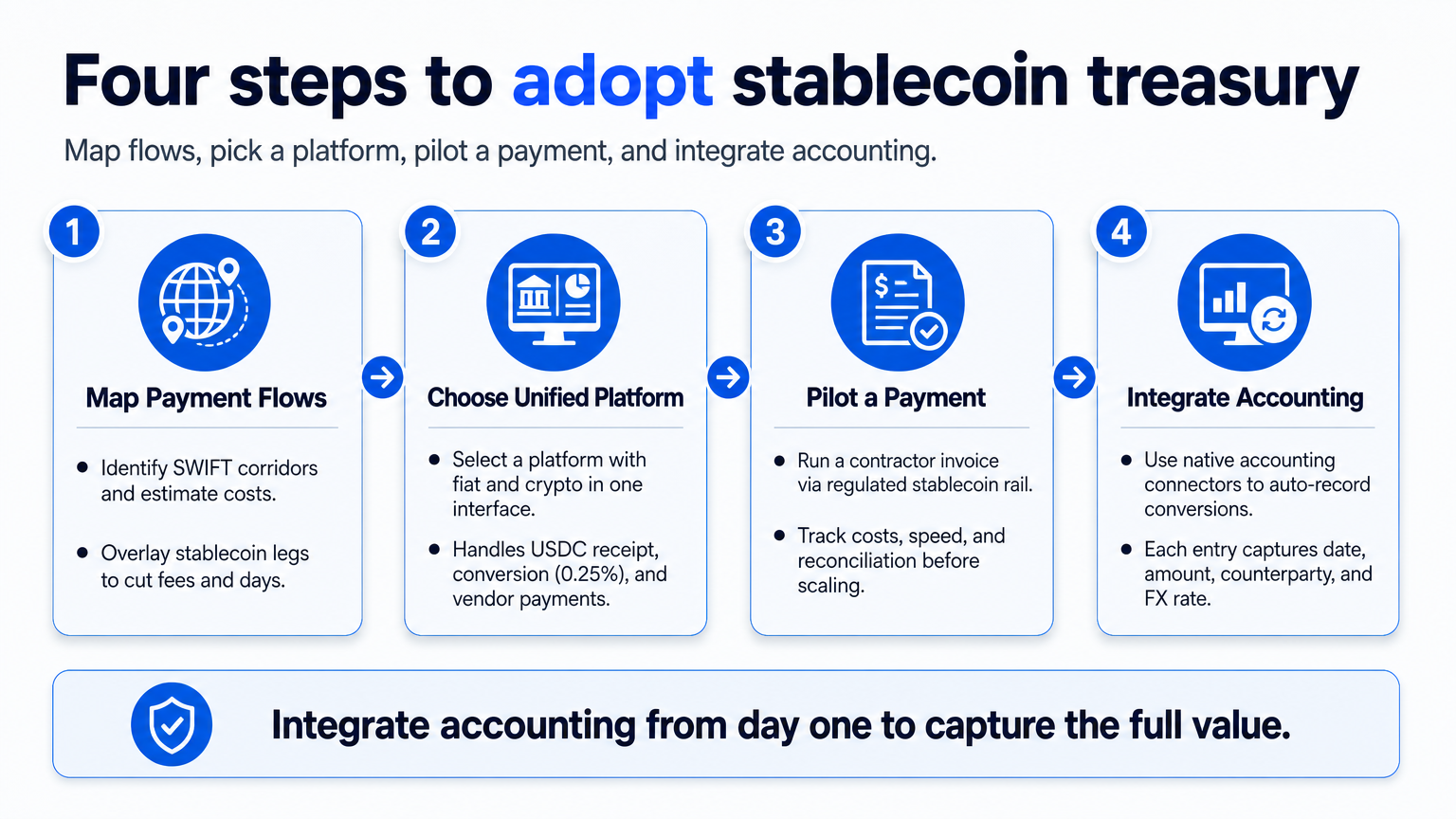
1. Map your cross-border payment flows
Identify every corridor that uses SWIFT or other rails. Estimate cost and settlement time, then overlay where a USDC or HKD-backed stablecoin leg could cut days and fees by 80–90%.
2. Choose a platform that bridges, not just one rail
Evaluate platforms that unify banking and crypto. One interface for fiat balances, USDC receipt, conversion at 0.25% or the prevailing FX rate, and vendor payments via wire or card—eliminating the need to shuttle funds manually between exchange and bank.
3. Start with a small pilot, Hong Kong-style
Pick one low-risk cross-border payment—a monthly contractor invoice—and run it through a regulated stablecoin rail on your integrated platform. Track costs, settlement time, and reconciliation effort before scaling.
4. Integrate accounting from day one
Use a platform with native accounting connectors. Every crypto-to-fiat conversion should automatically generate an entry with date, amount, counterparty, and FX rate. Without that, the operational gains evaporate.
What to watch next: stablecoin regulations beyond APAC
The GENIUS Act and US clarity
The GENIUS Act would create a federal licensing scheme for payment stablecoin issuers, bringing US policy closer to Hong Kong’s model. Until then, businesses navigate state-by-state money transmitter rules.
Interoperability and multi-chain complexity
Stablecoins across Ethereum, Solana, and other chains will require platforms that abstract chain-specific tokens into a unified balance.
Open questions for your stablecoin strategy
- Will HKD-backed stablecoins gain sufficient liquidity to rival USDC in APAC trade?
- How will HKMA supervision affect redemption speed and reserve transparency?
- Will other APAC jurisdictions (Singapore, Japan) follow Hong Kong’s licensing model, and how fast?
FAQ
What does the Hong Kong stablecoin pilot mean for my global business?
You can now source business stablecoin payment and settlement services backed by a credible, licensed framework. A major financial hub offers a production-grade, regulated HKD stablecoin integrated with fiat rails, reducing legal risk for operational stablecoin holdings.
How can my business start accepting stablecoin payments?
Use an integrated platform that provides dedicated stablecoin receiving addresses (e.g., USDC) and auto-converts incoming funds to fiat. OneSafe, for instance, generates an on-chain address and credits your account under a unified dashboard.
How do I integrate stablecoin payments with my existing financial systems?
Platforms with native accounting connectors automatically record received stablecoin payments, trigger conversion to your operating currency, and export entries. Payroll can mix stablecoin-based bonuses and fiat salaries from the same interface.
Which stablecoins are supported?
USDC is the dominant choice in APAC due to regulatory status and liquidity. New Hong Kong dollar-backed stablecoins are entering circulation. Business-grade platforms support USDC at minimum and add others as licences permit.
How do stablecoin conversions work?
Within-platform conversion from USDC to USD, EUR, or CAD at the prevailing rate plus a fee (e.g., OneSafe charges 0.25% or the FX rate). The resulting fiat balance is immediately available for payments or wires.
How do stablecoin payment fees compare?
| Payment Method | Typical Fee Range | Settlement Time |
|---|---|---|
| SWIFT wire (cross-border) | $25–$50 + 0.35–2% FX markup | 1–5 business days |
| Domestic ACH (USD) | $0–$1 | 1 business day |
| Stablecoin (on-chain) | <$0.01 to a few dollars (gas) | Minutes |
| Stablecoin via integrated platform | 0–0.15% on/off-ramp, free crypto transfers | Minutes |
Stablecoins eliminate correspondent bank charges; conversion to fiat can be as low as 0.25%.
Are there chargebacks or disputes?
Stablecoin transactions are irreversible. Set clear refund policies manually—issue a separate refund in stablecoin or fiat. In B2B, this finality is often an advantage with trusted counterparties.
What security and custody measures should I look for?
- Institutional-grade custody (Fireblocks, as used by OneSafe)
- Mandatory MFA
- Granular permissions and multi-signature controls
- Segregated fiat accounts
- Regular audits and AML screening
Key Takeaways
- Hong Kong’s stablecoin pilot is a live, regulated production environment—not a sandbox—usable today for cross-border treasury.
- APAC’s 60% global stablecoin volume makes it impossible to ignore for any business with regional flows.
- Integrating stablecoin payments into a single financial OS cuts reconciliation risk and simplifies accounting.
- Choose a platform that pairs compliant custody with fiat and crypto in one interface to bridge old and new rails.
- Start with one small pilot payment to learn operational and compliance realities before scaling.
Ready to manage both fiat and crypto from a single, secure platform? Open an account with OneSafe today and bring your treasury into the new mainstream.