On September 29, 2026, CryptoRank reported that Oracle is connecting banks to SWIFT's blockchain ledger, bringing 24/7 tokenized cross-border payments one step closer to mainstream finance. For treasury teams that already manage fiat and digital assets, the move marks an inflection point for crypto treasury management: the rails that settle corporate payments are converging with the rails that settle crypto. This article separates the reported facts from the analysis, then walks through what finance leads should do next.
Table of Contents
- What just happened?
- Why this matters for crypto treasury management
- Crypto treasury management: The basics
- Concrete implications for finance leads
- Actions you can take now
- What to watch next
- Treasury FAQs
- Key Takeaways
What just happened?
The announcement: Oracle joins SWIFT's blockchain ledger (September 29, 2026)
CryptoRank reported on September 29, 2026 that Oracle is connecting banks to SWIFT's blockchain ledger as 24/7 tokenized cross-border payments move closer to mainstream finance. The report is short on operational detail: it does not specify a go-live date, the number of participating banks, or which tokenized assets will be supported first.
The significance is structural, not technical. SWIFT has historically operated as a messaging and settlement coordination layer for correspondent banking, with settlement windows tied to banking hours and regional RTGS systems. Oracle's role suggests that enterprise-grade banking software is being wired directly to a blockchain-based ledger that can move tokenized value continuously. That is a different proposition from a bank piloting a private blockchain in isolation.
How it works: tokenized cross-border payments go 24/7
Tokenized cross-border payments use a shared ledger to represent value as tokens, enabling settlement on-chain without multi-day correspondent banking delays. The Bank for International Settlements has already completed a $1 million test of tokenized cross-border payments, demonstrating wholesale settlement across jurisdictions outside traditional RTGS hours. Oracle's integration with SWIFT's ledger extends that concept into enterprise banking systems.
| Item | What we know on September 29, 2026 |
|---|---|
| Development | Oracle is connecting banks to SWIFT's blockchain ledger for 24/7 tokenized cross-border payments (CryptoRank) |
| Treasury impact | Settlement windows compress; fiat and tokenized cash flows move toward the same rails |
| Primary near-term action | Audit payment, custody, and forecasting workflows before enabling any tokenized corridor |
| Open questions | Go-live date, participant banks, supported token types, and compliance obligations remain undisclosed |
Why this matters for crypto treasury management
Blurring the line between fiat and crypto treasuries
For most companies, a fiat treasury and a crypto treasury are separate stacks. The Oracle–SWIFT development collapses that separation. If a bank can settle a tokenized euro on the same ledger as a stablecoin, the operational distinction between “fiat payment” and “crypto payment” becomes about the wrapper, not the asset. The Citi–Coinbase stablecoin payment shift already showed regulated financial institutions building stablecoin settlement into corporate flows. This convergence means corporate treasury crypto management will soon be a core competency, not a silo.
The end of banking hours for corporate payments
Traditional treasury relies on cut-off times for payment batching and liquidity positioning. 24/7 settlement removes that buffer, enabling faster supplier payments and lower trapped cash, but it also eliminates the pause that once prevented positioning errors from becoming settled losses overnight. Treasury risk management must adapt to a no-stop clock.
Crypto treasury management: The basics
What is crypto treasury management?
Crypto treasury management is the practice of managing digital asset holdings — stablecoins, Bitcoin, Ether, or other tokens — alongside fiat balances for payments, liquidity, and capital preservation. The Bitwave guide frames it as an extension of traditional treasury with different instruments and settlement rails.
How it differs from traditional
The core differences are settlement finality, custody, and volatility. On-chain transactions are typically final once confirmed; custody requires private key management and multisig controls instead of bank reconciliations; price fluctuations demand more frequent rebalancing and a clear policy on working-capital assets. Regulatory uncertainty adds another layer, with evolving accounting and disclosure requirements as Skadden notes.
Concrete implications for finance leads
Rethinking cash flows with always-on settlement
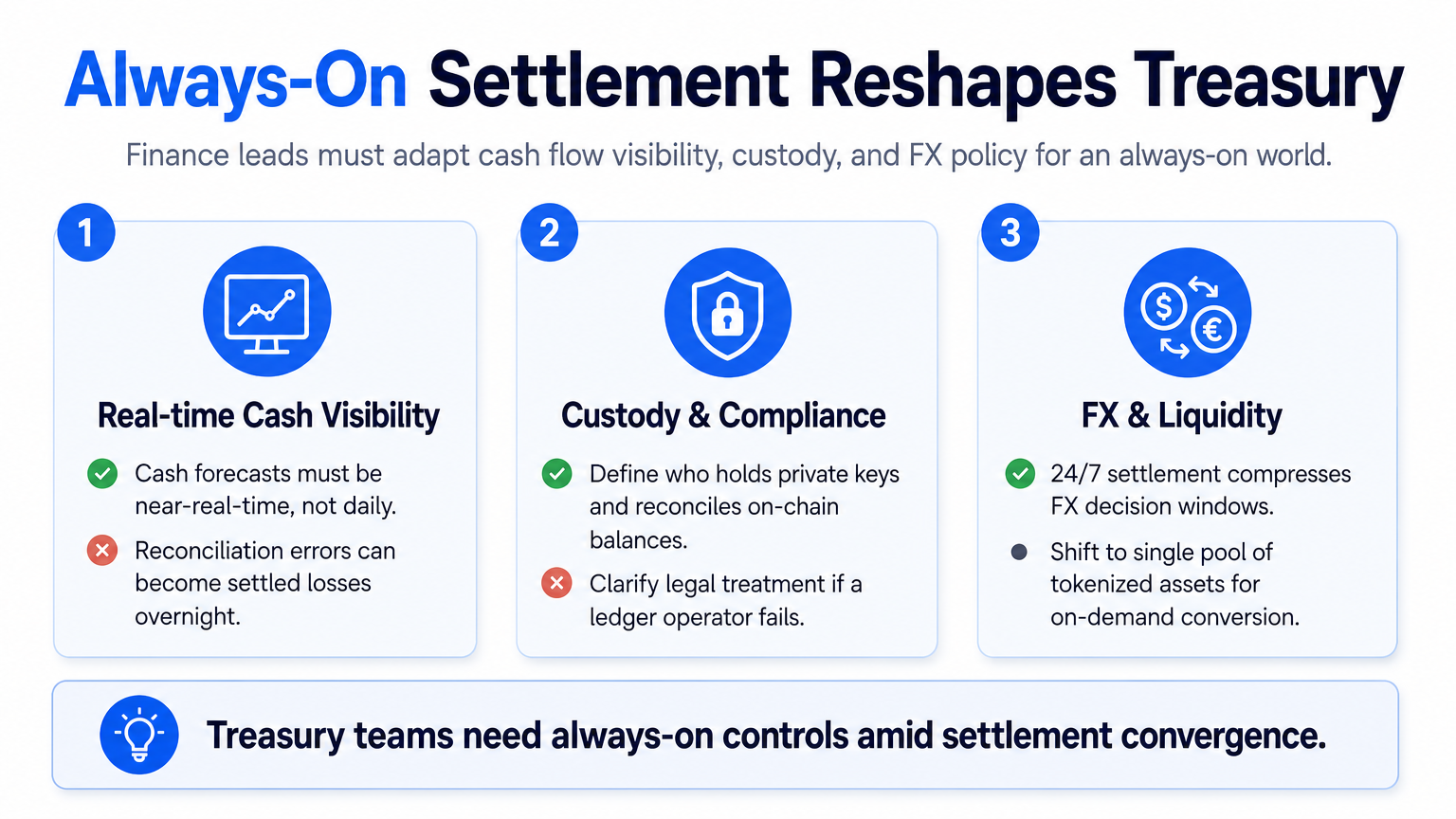
Always-on settlement demands near-real-time visibility into both fiat and token balances. A cash forecast cannot be a once-a-day artifact. For companies running a fiat-crypto bridge — converting stablecoin receipts for payroll or fiat into USDC for supplier payouts — the feedback loop shortens dramatically. A reconciliation error can become a settled loss overnight, placing a premium on treasury risk management controls that work around the clock.
Custody and compliance in a converged world
When a bank can hold or settle tokenized assets, treasury teams must ask: who holds the private keys, who reconciles the on-chain balance, and what happens if the ledger operator fails? A bank deposit’s legal treatment may differ from a tokenized asset in an insolvency scenario. A corporate treasury crypto framework must define custody and compliance boundaries explicitly, not rely on assumptions.
New FX and liquidity challenges
Tokenized cross-border payments accelerate FX exposure. If settlement is 24/7, the window for currency conversion decisions compresses just as much. Liquidity shifts from pre-funding each correspondent leg to holding a single pool of tokenized dollars, euros, or stablecoins and converting on demand. That requires clear policy on which assets qualify for working capital, how much can sit in stablecoins overnight, and who can authorize a weekend conversion.
Actions you can take now

Audit your current treasury stack for crypto readiness
A five-point check before any integration:
- Inventory payment rails — ACH, domestic and international wire, card, crypto on/off-ramps.
- Map where value sits overnight — fiat, stablecoins, volatile assets.
- Document cut-off times and identify counterparties that would benefit most from 24/7 settlement.
- Check custody arrangements — who holds private keys, multsig controls, whether any fiat partner already handles tokenized assets.
- Review the escalation path for a failed or erroneous settlement — can the team stop a 2 a.m. payment?
Evaluate unified platforms that bridge fiat and crypto
Platforms that combine fiat accounts, ACH and wire transfers, bill payments, and crypto on/off-ramps become more valuable as settlement rails converge. OneSafe, a financial technology company (banking services provided by partners), offers multi-currency USD/Euro/CAD accounts, domestic and international wires, corporate cards, and instant crypto-to-fiat conversions with Fireblocks custody. It works as a fiat-crypto bridge; finance leads should verify partner-bank protections, jurisdiction coverage, and compliance fit. A comparison of neobank options for global fiat and crypto can help with the shortlist.
Pilot a tokenized payment corridor
Do not wait for full maturity. Pick one corridor with a two-day+ settlement delay, choose a stablecoin or tokenized fiat both parties accept, set a strict pilot amount and time window, execute through a platform that handles conversion and record-keeping, then measure time-to-settle, fees, reconciliation effort, and compliance friction.
What to watch next
Regulatory response to 24/7 settlement
Regulators will address capital requirements for overnight liquidity, cross-jurisdictional finality rules, and AML controls when transactions settle outside banking hours. The Inter-American Development Bank highlights that cross-border tokenized settlement needs legal coordination, not just technical interoperability.
Other traditional players entering tokenized infrastructure
Oracle is not the last. The crypto banking tipping point data shows how quickly U.S. banks are onboarding into crypto infrastructure. Watch whether the next wave comes from enterprise software vendors, card networks, or cloud providers, especially those with existing bank client bases.
Open questions
- Which banks go first, and will tokenized settlement be standard or premium?
- Which assets settle first — tokenized deposits, regulated stablecoins, or CBDCs?
- What is the failure mode if a 24/7 ledger cannot settle during a market disruption, and who bears settlement risk?
Treasury FAQs
What is crypto treasury management? Corporate treasury crypto management incorporates digital asset holdings into the traditional treasury mandate for payments, liquidity, and capital preservation, adding custody, on-chain settlement, and volatility controls.
How does treasury management for crypto differ from traditional? Settlement is typically final rather than reversible, custody relies on private keys and multisig, and asset prices can move continuously, requiring tighter rebalancing and working-capital policies.
What does the SWIFT blockchain payment system mean for crypto treasuries? It narrows the infrastructure gap between bank settlement and on-chain settlement, potentially letting corporate treasury crypto operations settle both fiat and tokenized flows through the same enterprise rails.
How can businesses integrate tokenized payments into their treasury? Start with a small corridor: audit rails, choose one cross-border flow, set a pilot limit, and use a bridge platform to handle conversion and recording; measure results before expanding.
What are the risks of 24/7 settlement for crypto holdings? Errors can become final before anyone intervenes; volatility can hit overnight; operational risk rises if internal controls still assume banking hours. Robust treasury risk management is essential.
How should finance leads build controls for hybrid fiat-crypto treasuries? Dual approval for payments above a threshold, real-time balance visibility, pre-approved wallet addresses, and a documented escalation path for off-hours settlements — shifting from batch review to pre-authorization.
What tools support both fiat and crypto treasury operations? Custody platforms (Fireblocks, BitGo), accounting tools (Bitwave), and unified platforms (OneSafe) that combine fiat accounts, wires, cards, and crypto on/off-ramps. The right mix depends on volume, asset mix, and need for bank-like services.
Key Takeaways
- Oracle’s reported connection of banks to SWIFT's blockchain ledger on September 29, 2026, signals that 24/7 tokenized cross-border payments are moving from pilot to mainstream banking infrastructure.
- Treasury teams should treat always-on settlement as a control issue first: the cut-off buffer that used to catch errors is disappearing.
- A small, bounded pilot on one cross-border corridor is the fastest way to learn what tokenized settlement changes for cash forecasting, FX, and reconciliation.
- Unified platforms that bridge fiat and crypto grow in utility as rails converge, but custody, partner-bank protections, and jurisdiction coverage still require direct verification.
- Watch for the next wave of traditional infrastructure players entering tokenized settlement, and for regulators to address finality and capital rules around 24/7 wholesale payments.
Open a fiat and crypto treasury account that fits a 24/7 settlement world.