Announcement date: September 29, 2026
African merchants may soon tap into a new form of web3 payments as pan‑African payments company Kora announced on September 29, 2026 that it will allow merchants to accept and settle transactions in stablecoins. The move, reported by Tech Labari, injects fresh momentum into the real‑world use of digital dollars and other pegged tokens in a region where cross-border payments Africa and financial access remain stubbornly expensive.
Table of Contents
- What Just Happened: Kora Stablecoin Payments Launch
- Why the Kora Stablecoin Launch Matters for Cross-Border Payments Africa
- Web3 Payments Background: A Quick Primer for Businesses
- Implications for Global Businesses and DAOs
- What This Means for Your Web3 Payment Strategy
- What to Watch Next: The Future of Stablecoin Remittances and Regulation
- Key Takeaways
What Just Happened: Kora Stablecoin Payments Launch
On September 29, 2026, Kora revealed a new Kora stablecoin product designed to let merchants across its pan‑African network accept payments and settle them in stablecoins (Tech Labari, September 29, 2026). The announcement directly targets the friction that businesses face when receiving money from abroad: high correspondent‑banking fees, multi‑day settlement windows, and volatile local currencies. By introducing stablecoin settlement, Kora is giving merchants a way to receive value that stays pegged to a major fiat currency and can be converted into local cash or held on‑chain.
Kora already operates as a payments gateway connecting businesses, banks, and mobile‑money platforms across Africa. Adding stablecoin acceptance means the company is now merging traditional payment rails with blockchain payment infrastructure. While the exact rollout timeline and supported stablecoins were not detailed in the initial report, the announcement itself signals a commitment to stablecoin payments as a core part of Kora’s merchant offering.
Why the Kora Stablecoin Launch Matters for Cross-Border Payments Africa
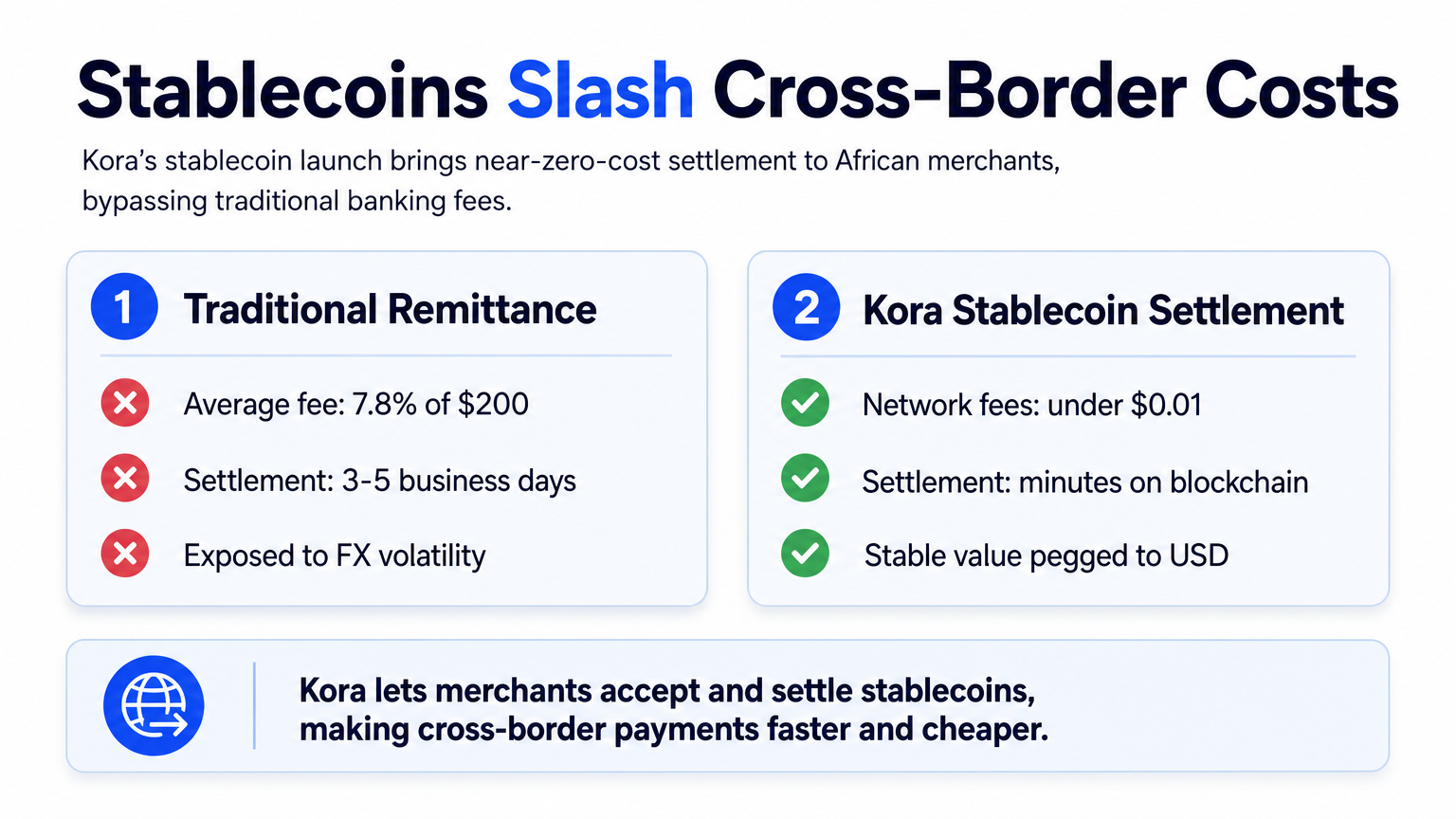
The significance sits at the intersection of three forces: high demand for cheaper cross-border payments Africa, the maturation of web3 payment solutions, and the search for practical stablecoin use cases beyond speculation. Africa is home to some of the world’s most expensive remittance corridors; sending $200 to the region costs an average of 7.8% in fees (World Bank data). Merchants importing goods or exporting services feel that pain in every transaction.
Stablecoins—digital tokens designed to hold a steady value against a reference asset—can cut through that cost structure. A payment settled on a public blockchain can clear in minutes for a fraction of a cent in network fees, without the chain of intermediary banks that inflate traditional cross‑border payments Africa. Kora’s move brings that capability directly into the merchant checkout flow, making crypto payments for businesses a practical, everyday tool rather than a niche experiment.
For the web3 industry, this is a concrete signal that stablecoin adoption is moving from trading‑desk infrastructure to point‑of‑sale terminals. It follows other institutional steps, such as the Citi‑Coinbase partnership that brought stablecoin settlement to corporate treasuries (as we covered in Stablecoin Payments: Citi-Coinbase Deal Shifts Landscape), and the Volante‑Circle deal that made stablecoin rails bank‑ready (Volante-Circle Deal Makes Stablecoin Payments Bank-Ready). Kora is now pulling that thread into emerging‑market retail commerce.
Web3 Payments Background: A Quick Primer for Businesses
What are Web3 payments?
Web3 payments use blockchain networks to transfer value directly between parties without a traditional financial intermediary. Instead of relying on ACH or SWIFT, they move tokenized assets—often stablecoins—across decentralized ledgers. Because the settlement layer is open and programmable, web3 payment solutions can offer near‑instant finality, lower fees, and full auditability on‑chain.
Stablecoins function as the bridge that makes these payments practical for everyday commerce. By pegging value to a fiat currency (e.g., USDC to the U.S. dollar), they remove the volatility that makes Bitcoin or Ether unsuitable for most invoices. The Deloitte US article on stablecoin payments notes that stablecoins blend the efficiency of digital assets with the price stability needed for business operations.
The most common use cases—cross‑border remittances, merchant payments, and B2B settlements—all benefit from removing multiple layers of correspondent banking. Yet adoption has been held back by regulatory uncertainty and the operational complexity of managing crypto alongside fiat. Platforms that natively handle both sides, such as neo‑banking interfaces built for fiat and crypto, are closing that gap.
Implications for Global Businesses and DAOs
How does this development affect global businesses and DAOs?
Kora’s stablecoin launch opens a door for any company—or decentralized autonomous organization—that wants to transact with African counterparties without touching the legacy banking system. A global startup sourcing materials from Nigeria can now explore paying suppliers in USDC, knowing that Kora’s merchant network can accept and settle the stablecoin domestically. Likewise, a DAO with a treasury denominated in stablecoins can pay African contributors, service providers, or grant recipients directly, without first converting to fiat and losing value to forex spreads.
This distribution model is especially relevant for web3‑native entities. DAO payments currently suffer from a last‑mile problem: the DAO might hold ample stablecoin liquidity, but the recipient often needs local currency. Kora’s infrastructure effectively creates an off‑ramp that sits behind the merchant’s acceptance terminal, making the entire flow web3 financial services‑friendly. Platforms like OneSafe—a neo-banking platform that unifies fiat accounts and crypto wallets in a single interface—can then help the DAO manage those outflows alongside traditional operational expenses, with segregated global accounts and on‑chain asset custody secured by Fireblocks.
The broader storyline is that stablecoin adoption is carving new channels for economic activity that bypass the high‑cost corridors that have long defined emerging markets.
Cross-Border Payments Africa: Stablecoins Make It Easier
The promise of stablecoins for cross-border payments Africa lies in speed and cost. The Federal Reserve’s March 2026 note on payment stablecoins and cross‑border transactions highlights that stablecoins can “significantly reduce both the cost and time required to send payments across borders” (The Fed - Payment Stablecoins and Cross Border Payments). Kora is turning that theory into a merchant‑facing product.
For businesses, this means an alternative to maintaining multiple local bank accounts, paying wire fees, and waiting days for settlement. A payment in USDC can be routed on‑chain in seconds, and the merchant’s integration with Kora can handle the conversion to local currency through existing mobile‑money or bank networks. The blockchain payment infrastructure underlying this flow is transparent, auditable, and available 24/7—unlike traditional banking systems that observe holidays and cut‑off times.
Can stablecoins effectively bridge traditional and crypto financial systems?
Yes—and the Kora launch is the latest proof. When a merchant accepts a stablecoin, they’re receiving a digital IOU that trades 1:1 (or nearly so) with the underlying fiat currency. That stablecoin can later be redeemed for bank‑issued fiat through an exchange or a neo-banking platform that offers on‑ and off‑ramps. The merchant never needs to hold volatile crypto; they simply interact with a tokenized representation of value that can slot into existing accounting systems.
McKinsey’s piece on stablecoin payments infrastructure notes that tokenized cash serves as “the connective tissue between today’s financial infrastructure and tomorrow’s” (McKinsey). The bridge works because stablecoins combine the settlement efficiency of blockchains with the unit‑of‑account familiarity of fiat. However, stablecoin adoption still requires careful attention to counterparty risk, custody, and regulatory compliance. The peg must be maintained by the issuer and supported by robust reserves, and the on‑off ramps must comply with local AML/KYC rules. When those pieces are in place, the bridge is structurally sound.
What This Means for Your Web3 Payment Strategy
What should businesses do now to prepare for stablecoin payment adoption?
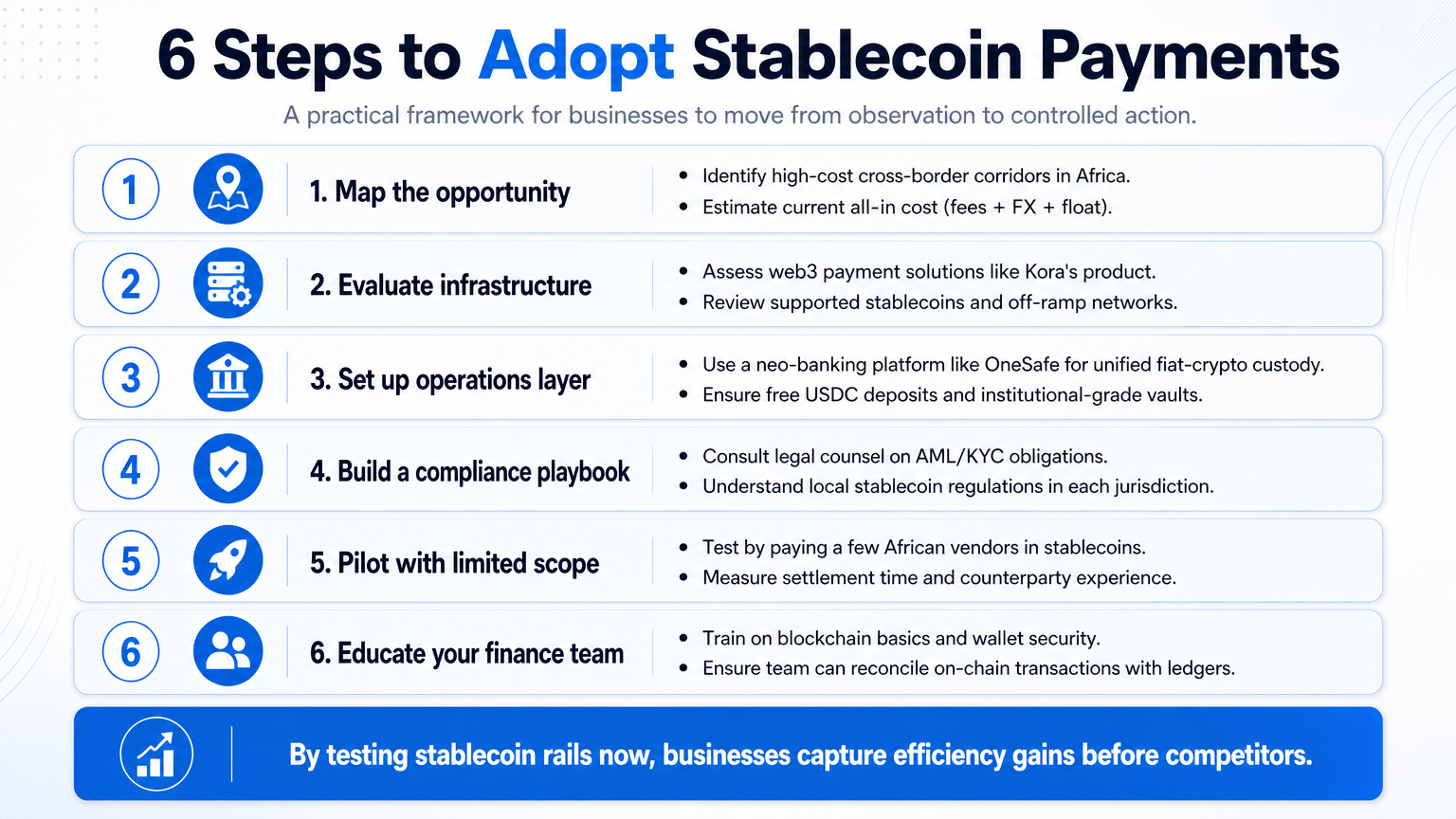
The Kora announcement is a tangible signal that stablecoin payments are moving into mainstream commerce in growth markets. For global businesses and DAOs, preparing now means moving from observation to controlled action. Below is a concise framework that distills the immediate steps.
| Step | Action | Key Consideration |
|---|---|---|
| 1. Map the opportunity | Identify cross-border payments Africa corridors where stablecoin settlement could lower costs. Focus on African markets where mobile‑money penetration is high but banking rails are thin. | Estimate current all‑in cost (transfer fees + forex markup + float time) for each corridor to quantify the potential saving. |
| 2. Evaluate infrastructure | Assess web3 payment solutions that integrate stablecoin acceptance, such as Kora’s new product or gateways that already serve your target region. Review criteria like supported stablecoins, off‑ramp networks, and settlement finality. | Use a structured evaluation guide; for a checklist, see Web3 Payments Companies: How to Evaluate and Choose in 2026. |
| 3. Set up a fiat‑crypto operations layer | Use a neo-banking platform that handles both fiat and crypto natively, like OneSafe, to receive stablecoins, convert to fiat when needed, and manage treasury. Such platforms provide segregated accounts, corporate cards, and automated workflows. | Ensure the platform offers free USDC deposits/withdrawals (as OneSafe does), built‑in compliance tools, and custody through institutional‑grade vaults like Fireblocks. |
| 4. Build a compliance playbook | Consult legal counsel on the AML/KYC implications of receiving or paying stablecoins in each jurisdiction. Understand local stablecoin adoption rules and the treatment of stablecoins as a payment asset versus a security. | Stay updated on regulatory shifts; the U.S. push to export stablecoin standards abroad is one factor to watch (US Stablecoin Regulation Push Abroad). |
| 5. Pilot with a limited scope | Run a small‑scale test: pay a handful of African vendors or accept stablecoin payments from a subset of customers. Measure settlement time, hidden costs, and counterparty experience. | Start with high‑volume, low‑value transactions, and use a platform that shows unified reporting for crypto and fiat flows. |
| 6. Educate your finance team | Train treasury and accounting staff on blockchain basics, wallet security, and stablecoin mechanics. Make sure they understand how to reconcile on‑chain transactions with internal ledgers. | Many platforms, including OneSafe, automate accounting integration, but human familiarity with the fundamentals remains critical for exception handling. |
By methodically testing stablecoin rails now, businesses position themselves to capture the efficiency gains before competitors do. The stablecoin payments landscape is maturing quickly; the Boston Consulting Group’s 2026 white paper on stablecoin payments underscores that volumes are scaling and enterprise‑grade infrastructure is becoming the norm (BCG White Paper).
What to Watch Next: The Future of Stablecoin Remittances and Regulation
Kora’s move is unlikely to be an isolated event. Other pan‑African and emerging‑market payment providers will face pressure to add stablecoin settlement or risk losing merchants that want lower fees. Meanwhile, global remittance companies may integrate stablecoin rails to stay competitive against mobile‑money operators that are already experimenting with blockchain.
Regulatory clarity will be the swing factor. The European Union’s Markets in Crypto‑Assets (MiCA) framework is now in force, setting a precedent for stablecoin licensing. In the U.S., legislative proposals are circulating, and the joint venture activity—such as Citi and Coinbase building infrastructure for institutional payments—is shaping what compliance looks like. In Africa, regulators in Nigeria, Kenya, and South Africa are drafting crypto payment guidelines that will directly affect how Kora and its peers operate.
Businesses should watch for interoperability standards that allow stablecoins from different issuers to move seamlessly across payment networks. The Volante‑Circle deal demonstrated how banking‑grade integration can connect stablecoin rails with existing treasury systems. Similar plug‑and‑play models could appear in African markets, further lowering the barrier for global companies.
Open questions remain: Will Kora support only dollar‑pegged stablecoins, or also Euro or local‑currency pegged tokens? How will settlement finality work across different blockchain networks? And how will the company manage the liquidity needed for real‑time conversion? Answers to these will determine whether stablecoin acceptance scales from a niche feature to a universal payment rail.
Key Takeaways
- Kora’s September 29, 2026 announcement brings stablecoin settlement to African merchants, turning web3 payments into a practical business tool rather than a speculative concept.
- Global businesses and DAOs can now explore direct stablecoin corridors into Africa, potentially slashing cross-border payments Africa costs and settlement times.
- Stablecoins bridge fiat and crypto systems effectively, but their safe use requires compliant on/off‑ramps and secure custody—services that neo-banking platforms like OneSafe are designed to provide.
- To prepare, map your highest‑cost payment corridors, evaluate stablecoin‑enabled gateways, set up a unified fiat‑crypto operations layer, and pilot a controlled rollout.
- Regulatory developments across Africa and major economies will dictate how quickly stablecoin payments move from early adoption to mainstream infrastructure.
To start managing fiat and crypto payments in one platform built for global businesses, sign up at OneSafe.