For treasury teams, crypto treasury management has, until recently, mostly meant holding speculative assets on a balance sheet. That narrative shifted on October 31, 2026, when CoinDesk reported that Uber, HSBC, and Franklin Templeton tested a tokenization pilot that puts idle corporate cash to work in money market products—while still allowing the company to access funds for payments, even on weekends. The pilot reframes on-chain treasury operations as a practical cash management discipline, not a gamble on coin prices. This analysis unpacks what the test actually changes for finance leads, where the risks sit, and when a treasury team should act.
Table of Contents
- What just happened
- Why it matters now
- Crypto treasury management: the background you need
- What tokenized treasury products actually change
- A decision framework for treasury teams
- The DAO treasury angle
- What to watch next
- Key Takeaways
What just happened
The Uber tokenization pilot: facts and source
According to a CoinDesk report on October 31, 2026, Uber ran a pilot with HSBC and Franklin Templeton to test how tokenization could put idle cash to work. In the test, Uber kept funds invested in a money market product—a tokenized money market fund—while retaining the ability to access cash for payments at any time. The pilot explicitly included weekend settlement, which traditional money market fund redemptions do not support. Details on the size or duration of the pilot were not disclosed. This was a controlled test of an end-to-end tokenized liquidity workflow for a global corporate treasury.
Idle cash, money market products, and weekend access
Large enterprises like Uber hold billions in cash across subsidiaries. Much of that sits idle in operating accounts, earning next to nothing, because it must be instantly available for payroll, driver payouts, and vendor payments. Traditional money market funds can offer a yield pickup but come with a critical limitation: redemptions settle T+1 during bank business hours, leaving cash trapped over weekends and holidays. The Uber pilot aimed to break that trade-off by using blockchain-based fund shares that can be redeemed and settled in near real-time, any day of the week.
Who was involved and what they tested
HSBC, a global banking giant with its own digital-asset platform (HSBC Orion), likely provided the tokenization infrastructure and fiat on/off-ramp. Franklin Templeton manages the Franklin OnChain U.S. Government Money Fund, one of the largest tokenized money market funds. Uber acted as the treasury end-user, testing whether it could hold tokenized fund shares, then redeem them for stablecoins or fiat to meet payment obligations—including on a Saturday or Sunday. The pilot therefore stress-tested the full chain: token creation, custody, redemption, and real-time payment execution using tokenized instruments.
Why it matters now
The shift from theory to operational treasury
Crypto treasury discussions have been dominated by corporate Bitcoin holdings and yield farming experiments. This pilot demonstrates something different: blockchain technology applied to the mundane but massive problem of managing working capital. For operators, it establishes a plausible blueprint where crypto rails are not a separate exotic asset class but an upgrade to the plumbing of cash management. As A Token For Your Thoughts: Crypto Treasury Management notes, treasury teams are increasingly treating digital assets as a core operational concern rather than a speculative side bet.
What tokenized idle cash means for founders and finance leads
For any company with meaningful cash reserves, the ability to earn a money market yield while maintaining 24/7 access to funds changes the treasury equation. A startup that needs to pay contractors in multiple time zones, or a marketplace that settles payouts on weekends, can now consider keeping its cash in a yield-bearing instrument without losing the ability to meet those obligations instantly. The pilot suggests that tokenization can reduce the “dead cash” that sits in non-interest-bearing accounts merely because of banking-hours constraints—a core problem in idle cash management.
The difference between yield chasing and liquidity
It’s tempting to frame this as a yield optimization story. That would be a mistake. The core value in the Uber test is liquidity, not yield. The pilot’s headline feature—weekend access—solves a working-capital constraint. Yield is a welcome byproduct, but treasury managers prioritize principal preservation and immediate liquidity above all else. Treating tokenized money market funds as a yield-chasing tool would misread the signal.
Does the future of treasury management require support for crypto assets?
Yes, but the definition of “crypto assets” is expanding. The case isn’t about holding Bitcoin on the balance sheet; it’s about the operational layer that tokenized instruments bring. As more regulated funds and money market products become tokenized, treasury platforms that cannot handle both fiat and crypto-native assets will become a bottleneck. The ability to move seamlessly between a fiat and crypto unified platform—ideally from a single dashboard—will separate modern treasury operations from legacy ones. This is where neo-banking solutions that offer multi-currency accounts and crypto on/off-ramps alongside institutional-grade custody start to look less like a niche option and more like a necessity.
Crypto treasury management: the background you need
What is a crypto treasury?
A crypto treasury is the framework a company uses to hold, safeguard, and manage digital assets—cryptocurrencies, stablecoins, and tokenized securities. It’s not just a wallet; it encompasses custody arrangements, reconciliation, FX conversions between crypto and fiat, liquidity monitoring, and internal controls.
What is crypto treasury management?
Crypto treasury management is the ongoing discipline of overseeing those digital assets to meet business obligations, manage risk, and optimize liquidity. It involves setting allocation policies, implementing multi-signature authorizations, monitoring on-chain positions, executing payments, and integrating with fiat banking rails. Navigating the Crypto Treasury: Strategies for Secure & Efficient Management emphasizes that secure custody and clear governance are foundational to any crypto treasury strategy.
How is treasury management for crypto different from traditional treasury management?
The differences are structural:
- Settlement: Crypto settles in minutes or seconds, not days; traditional settlement is T+1 or T+2.
- Custody: Private keys and wallet security replace bank-account controls; loss of keys means loss of assets.
- Volatility: Cryptocurrencies can fluctuate violently; stablecoins and tokenized MMFs are less volatile but still carry different risk profiles than bank deposits.
- Banking integration: Fiat on- and off-ramps are fragmented, requiring careful management of banking partners and compliance.
- Compliance: On-chain transaction monitoring, sanctions screening, and know-your-transaction obligations add layers that traditional treasuries don’t face.
These differences mean that a company adopting tokenized instruments needs infrastructure that can handle both worlds without creating new operational silos.
What tokenized treasury products actually change
What does tokenizing idle cash actually change for a finance team?
Three operational changes stand out:
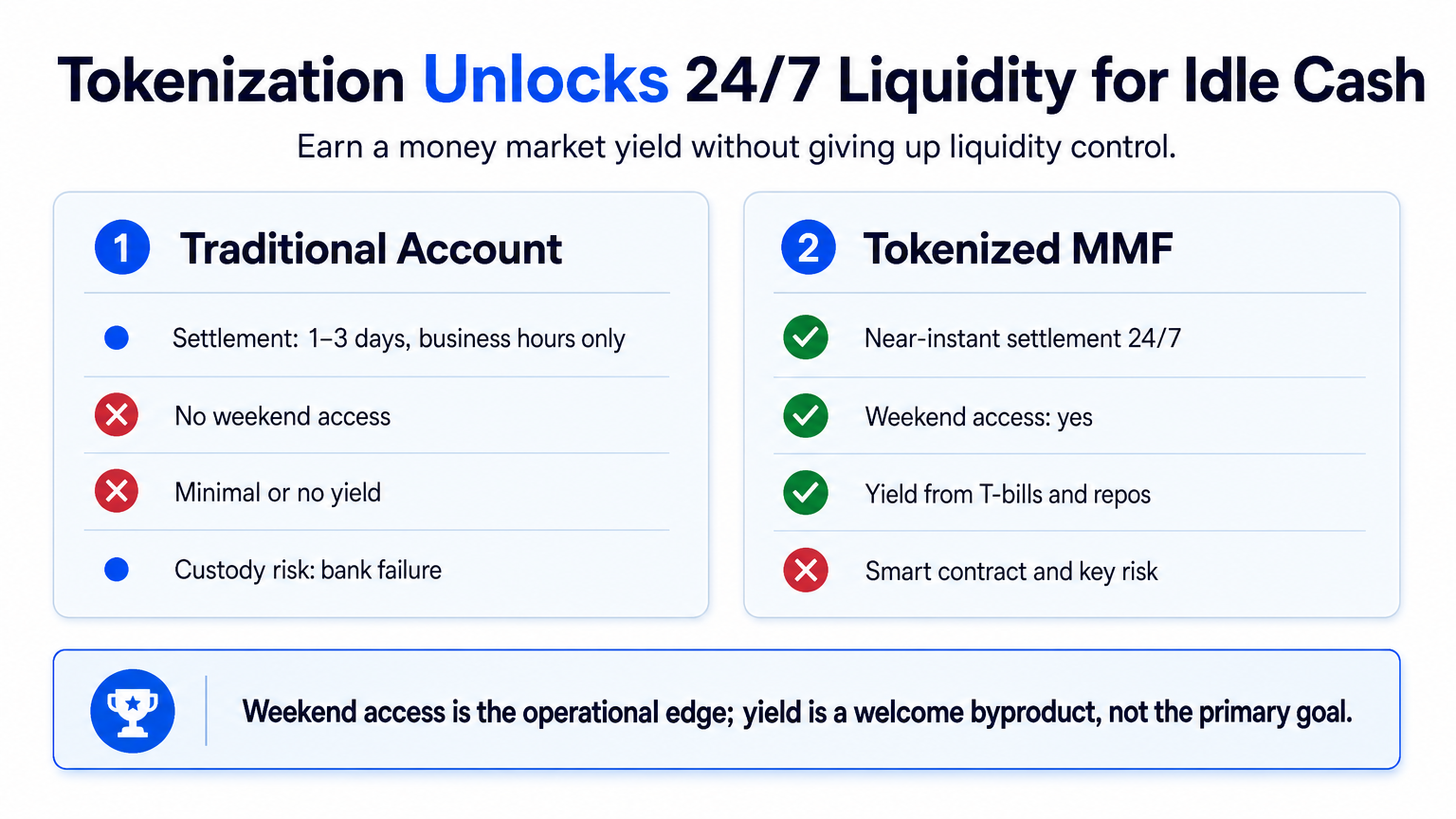
- Dormant cash becomes working capital that is always accessible. A tokenized money market fund share can be transferred or redeemed on-chain at any hour, including weekends. For treasury analysts, that eliminates the scramble to prefund accounts before a bank holiday.
- Yield is earned without giving up liquidity control. Instead of segmenting cash into a yield-bearing tranche and an operating cash tranche, a company can keep most of its balance in a single tokenized instrument and redeem as needed. The cash does not sit idle; it works continuously.
- Automated treasury sweeps become programmable. Because the instruments are on-chain, smart contracts or APIs can automatically move excess balances into the tokenized fund and pull them back when an operating threshold is hit. This reduces manual treasury work and idle cash inertia.
The Uber pilot’s demonstration of weekend settlement is a direct example of the first change; it’s an operational edge that previously required costly credit lines or pre-positioned cash.
What are the counterparty and cost risks of tokenized treasury products?
Tokenized money market funds are not risk-free. Even though the underlying assets are usually short-term government securities, the token itself introduces layers:
- Counterparty risk: Redemption ultimately depends on the fund manager (e.g., Franklin Templeton) and the tokenization platform (e.g., HSBC) honoring the token’s claim. If the fund suspends redemptions—rare, but possible in extreme market stress—the token’s liquidity evaporates. Smart-contract bugs could also trap funds. Still, the managers involved in the pilot are large, regulated institutions, which reduces but does not eliminate this risk.
- Cost structure: Tokenized MMFs carry management fees (often 0.15%–0.50% annually). On-chain transactions incur gas fees that vary by network. When moving between tokenized funds and fiat, FX and conversion costs apply. Over small cash positions, net returns could be thin.
- Regulatory uncertainty: Tokenized money market products are still a new category. While major jurisdictions are providing frameworks, the rules are evolving. Any change in regulatory treatment could affect liquidity or holding eligibility.
Table 1 summarizes the key differences between a traditional business account and a tokenized money market fund.
| Factor | Traditional Business Account | Tokenized Money Market Fund |
|---|---|---|
| Settlement | 1–3 business days (ACH), same day during bank hours | Near-instant 24/7, including weekends |
| Weekend access | No | Yes (as tested in the Uber pilot) |
| Yield | Minimal or none | From underlying T-bills/repos (varies) |
| Principal risk | Deposits may be insured (varies by jurisdiction) | Fund may “break the buck” (low probability) |
| Custody risk | Bank failure, fraud | Smart contract bugs, key compromise |
| Cost | Account fees, wire fees | Management fee + gas costs + conversion fees |
| Regulatory clarity | Well-established | Emerging, varies by jurisdiction |
A decision framework for treasury teams
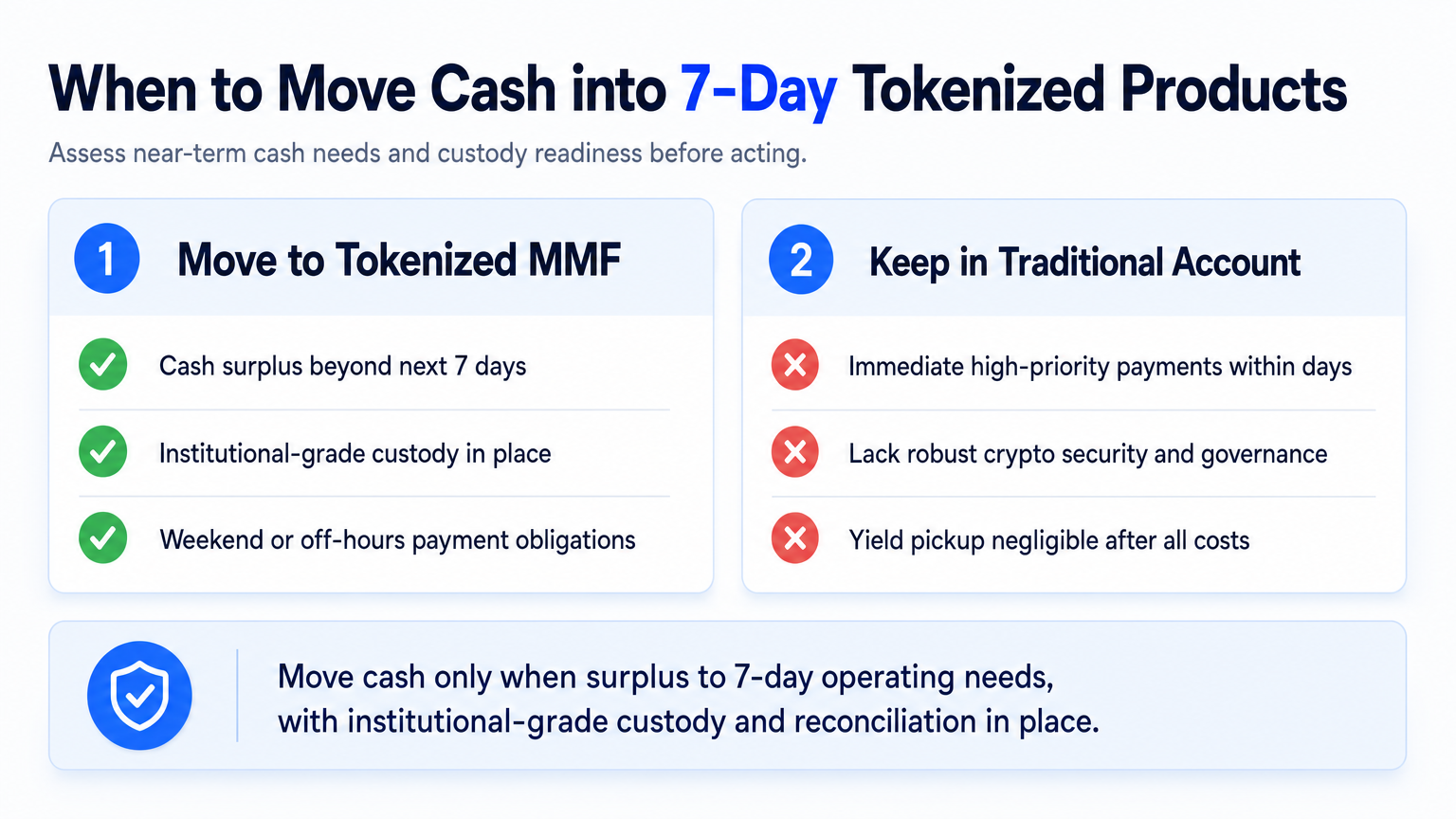
When should a company move treasury cash into tokenized products instead of keeping it in a business account?
The answer lies in the cash’s employment horizon and the company’s operational infrastructure.
Move cash into tokenized money market funds when:
- The cash is not required for operating liquidity within the next 7 days. If forecasted outflows show a surplus beyond the immediate working-capital buffer, that surplus is a candidate.
- The treasury already has secure custody practices in place—multi-signature wallets, institutional-grade key management, and policy-based approval workflows.
- The company has weekend or off-hours payment obligations that currently force it to hold extra idle cash. Tokenization can release that trapped liquidity.
Keep cash in a traditional business account when:
- The funds will be used for high-priority, immediate payments within a few days and any redemption delay—even minutes—is unacceptable.
- The company lacks robust crypto security and governance. Holding tokenized assets without proper custody exposes the organization to irreversible loss.
- The yield pickup after netting all costs (management fees, gas, FX spreads) is negligible relative to the additional complexity.
The decision rule: Move idle cash into tokenized products only when the cash is not needed for operating liquidity within the next 7 days, and the treasury has implemented institutional-grade custody, multi-sig controls, and reconciliation workflows.
The role of a unified fiat and crypto platform
Pulling this off requires more than a crypto custody provider. Treasury teams need a platform that shows fiat accounts, crypto wallets, and tokenized fund positions in one view. A neo-banking platform that combines multi-currency business accounts, ACH and wire payments, crypto on/off-ramps, and institutional-grade custody can serve as that operating system. Without that unification, finance teams must juggle separate logins, reconcile across systems, and manually move funds—erasing the speed advantage tokenization provides. This is the core promise of liquidity management for crypto: one operational layer for both asset classes.
The DAO treasury angle
Can DAOs use tokenized money market products without breaking on-chain governance?
Yes, with careful structuring. Tokenized money market funds issue on-chain tokens (often ERC-20) that represent fund shares. A DAO could vote through its governance process to deposit idle stablecoin holdings into such a fund and receive the share tokens in its treasury. Those tokens remain under the control of the DAO’s multi-signature wallet or governance contract, preserving the principle that no funds move without on-chain approval.
However, the underlying fund is managed off-chain by a regulated asset manager. The DAO does not control the fund’s investment decisions. This introduces a counterparty dependency that some DAOs may accept if the manager is transparent and the fund is highly liquid, but it’s a departure from full decentralization. The DAO must ensure that the tokenized fund’s smart contract does not grant the manager unilateral withdrawal rights over the DAO’s position. So, DAOs must include interactions with tokenized MMFs in on-chain proposals and confirm that the fund’s contract governance does not overrule the DAO’s own. Digital Assets Treasury Management from Ripple Treasury highlights how institutional-grade custody and settlement infrastructure supports exactly these kinds of DAO treasury management workflows.
Automation, permissions, and custody
For DAOs, permissioning is critical. Platforms that offer customizable roles—for example, the ability to separate proposal initiation, approval, and execution—can map on-chain governance rules onto the custody layer. Automated sweep rules could be programmed so that when the DAO’s stablecoin balance exceeds a threshold, the surplus is directed into a tokenized MMF, subject to multi-sig approval. Secure custody adds another layer of protection for the DAO’s treasury while keeping assets accessible for proposals.
What to watch next
Open questions from the Uber pilot
- What were the actual redemption volumes and latency during the test? The report didn’t disclose whether any redemption failed under stress.
- How did HSBC custody the tokenized shares, and what was the legal structure linking the token to the underlying fund? This matters for bankruptcy remoteness.
- Will Uber expand the pilot to a material portion of its cash? A full-scale rollout would be a much stronger signal.
When this becomes a routine treasury workflow
For tokenized cash management to move from pilot to standard practice, several things must converge: more asset managers launching tokenized fund products with proven liquidity; treasury management systems that natively support tokenized instruments; regulatory certainty that tokenized securities and stablecoins are treated predictably; and, crucially, an on-chain payment infrastructure that scales cost-effectively. What are tokenized money market funds? from BlackRock explains how these instruments bridge traditional cash management and blockchain settlement, while Tokenized money market funds: The bridge to a new financial infrastructure from Franklin Templeton details the operational mechanics that make 24/7 liquidity possible.
If the Uber pilot’s outcomes are positive and no major operational failures emerge, 2027 could see a wave of large corporates testing similar setups. For treasury practitioners, that means building the foundational capabilities now: a unified platform, hardened custody, and a clear internal policy framework for tokenized instruments. Following crypto treasury best practices means staying current as tokenization matures. Tools like Joyrise, which plans, writes, and publishes illustrated SEO articles to your Webflow blog every day, can help treasury teams track developments as they unfold, but the real difference will come from operational readiness rather than information monitoring. The shift already underway in institutional stablecoin payments provides the settlement rails that make tokenized treasury operations viable. Those changes, combined with Uber’s proof-of-concept, turn tokenized cash management from an idea into a near-term operational decision.
Key Takeaways
- The Uber pilot, first reported by CoinDesk on October 31, 2026, demonstrates that tokenized money market funds can deliver 24/7 liquidity, including weekend settlement, for corporate treasuries.
- The primary value for treasury teams is not chasing incremental yield but unlocking idle cash that would otherwise be trapped by banking-hours constraints.
- Tokenized treasury products introduce counterparty and cost risks—smart contract bugs, redemption suspensions, and fee structures—that must be weighed against the liquidity benefit.
- A clear decision rule applies: move cash into tokenized products only when it is surplus to near-term operating needs and the treasury has secure custody and governance controls in place.
- DAOs can incorporate tokenized money market funds without breaking on-chain governance, provided fund interactions are embedded in proposals and the token’s smart contract respects DAO control.
Ready to put this into practice? Get started with onesafe.io.