
The corporate crypto treasury management playbook has rarely been rewritten from a boardroom vote. That changed on November 1, 2026, when Next Technology Holding Inc. authorized the sale of its 5,833 bitcoin—none of which sat on the breached Binance exchange—citing security fears ignited by the latest Binance hack, AI-driven cyberattacks, and the looming threat of quantum computing.
Table of Contents
- What just happened
- Why this matters now for crypto treasuries
- The background every operator needs
- What the Binance hack changes for your treasury
- Concrete actions for finance leads
- What to watch next
- Key Takeaways
- Further reading
What just happened
The board decision
On October 30, 2026, Next Technology Holding Inc. (Nasdaq: NXTT) announced that its board had unanimously approved selling or pledging its bitcoin holdings in one or more tranches. The firm, which develops AI-powered software and manages digital assets, made the disclosure after a review that explicitly pointed to the Binance security incident, the rising specter of AI-enabled cyberattacks, and the future risk quantum computing poses to cryptographic security. (The news was reported by cryptonews.net on November 1, 2026, citing news.bitcoin.com.)
The trigger: a Binance security incident
The board’s rationale centered on Binance’s latest security breach—an event that has already forced the industry to rethink operational resilience. (Our earlier analysis of the crypto banking security fallout from the $6.3B Binance hack covers the immediate damage in detail.) Yet the unusual twist here is that not a single bitcoin in Next Technology’s treasury was held at Binance. The board did not react to a direct loss; it responded to a breakdown in confidence. The combination of the Binance hack, the acceleration of AI-driven threats, and the long-term quantum computing risk was enough to prompt a portfolio-level reassessment.
The assets in question
Next Technology held approximately 5,833 BTC as of October 30, 2026, ranking 18th among publicly traded corporate bitcoin holders at that time, according to the report. That ranking is consistent with data tracked by Bitcoin Treasuries, which aggregates corporate bitcoin treasury data. The holdings represented a material corporate bitcoin treasury, and the decision to sell or pledge them signals that even sizable, well-capitalized players are now re-underwriting their exposure.
| Fact | Detail |
|---|---|
| Company | Next Technology Holding Inc. (Nasdaq: NXTT) |
| Decision | Unanimous board approval to sell or pledge BTC in tranches |
| Announcement date | October 30, 2026 |
| BTC holdings at announcement | ~5,833 BTC |
| Ranking among public corporate holders | 18th |
| BTC custody at Binance | None |
| Cited reasons | Binance security incident, AI cyberattacks, quantum computing risk |
| Source | cryptonews.net, citing news.bitcoin.com |
Why this matters now for crypto treasuries
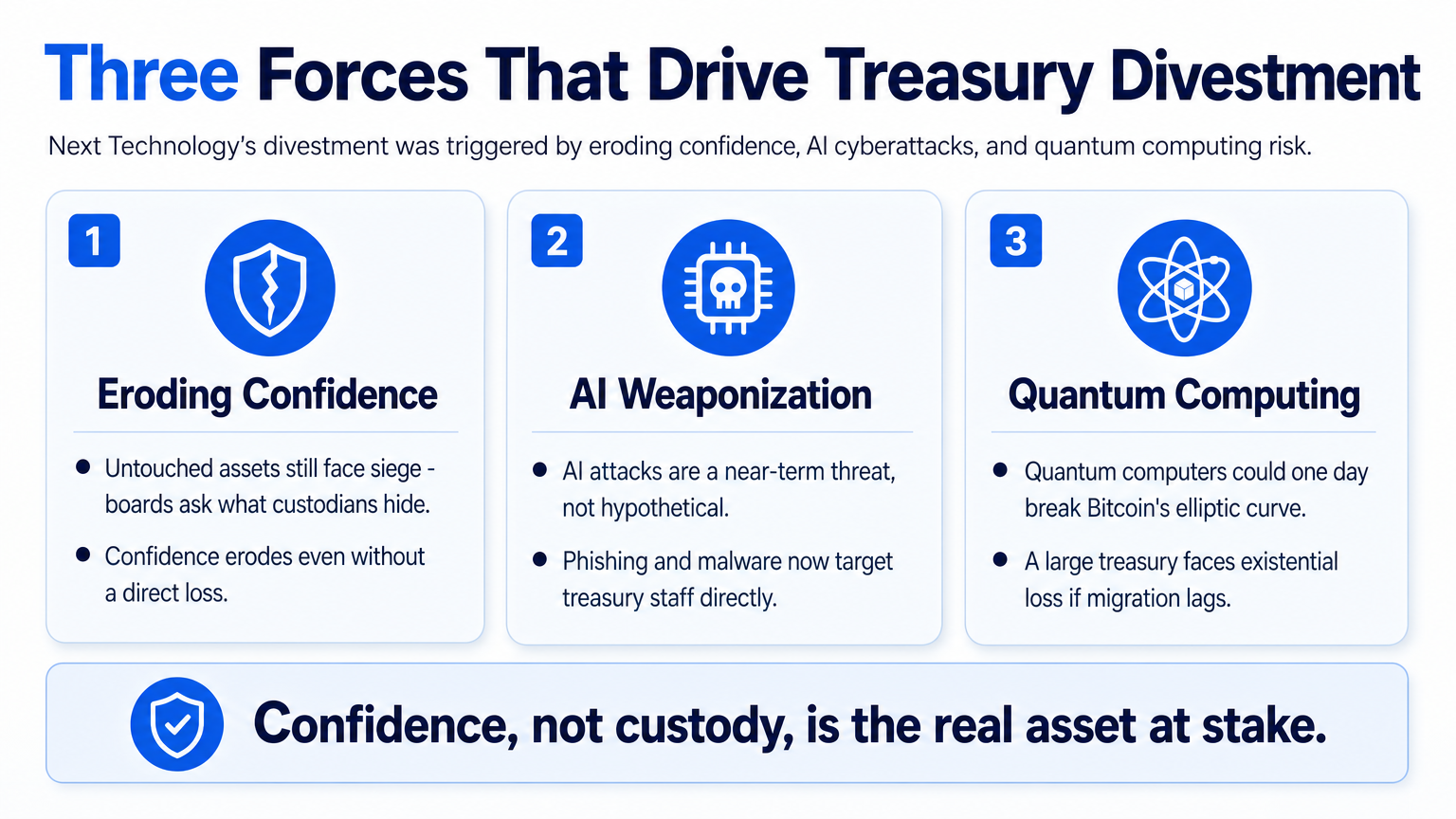
What factors drive a board to sell or pledge bitcoin holdings?
A crypto treasury board decision of this magnitude rarely happens because of a single event. The Next Technology case shows that three interrelated factors are now in play:
- Eroding confidence in the broader custody ecosystem. Even if a hack does not touch your assets, it demonstrates that the infrastructure holding the industry’s value is under constant, state-level siege. When one major exchange is compromised, board members ask: What do our custodians know that they haven’t disclosed?
- The weaponization of AI. Boards are beginning to price in AI cyberattacks as a near-term threat—not a distant hypothetical. Sophisticated phishing, automated vulnerability discovery, and AI-generated malware can target treasury management systems, custodial interfaces, and the people who control them.
- Quantum computing as a long-term solvency risk. While still years away from practical key-breaking, quantum computing threatens the elliptic curve cryptography that secures Bitcoin. A treasury holding 5,833 BTC could face an existential loss if quantum advances faster than the protocol’s own upgrades.
The decision also cracks open a distinction between operational response—lock down systems, verify balances, move assets—and portfolio response: the outright reduction of crypto holdings. This shift is the core of the new crypto treasury security calculus. While firms like Uber are exploring tokenized treasury instruments—as we reported in our analysis of Uber’s tokenization test for crypto treasury management, a subject also explored in A Token For Your Thoughts: Crypto Treasury Management—Next Technology chose the opposite path. The takeaway: confidence, not custody, is the real asset at stake.
The background every operator needs
What is crypto treasury management?
Crypto treasury management is the practice of stewarding a company’s digital assets—typically bitcoin, stablecoins, and other tokens—through secure custody, liquidity planning, risk policy, and financial reporting. Unlike holding cash at a bank, it involves managing private keys, choosing between self‑custody and third‑party custodians, and navigating 24/7 settlement that can trigger margin calls or liquidity crunches in minutes. For a deeper dive into strategic frameworks, the guide Navigating the Crypto Treasury: Strategies for Secure & Efficient Management provides a thorough grounding.
How is treasury management for crypto different from traditional treasury management?
Four differences define the space:
- Bearer instruments. Control of a private key equals ownership. There is no trusted intermediary who can reverse a fraudulent transfer.
- Irreversible transactions. Once broadcast, a blockchain transaction is final. Errors or theft cannot be clawed back through normal banking channels.
- Custodial risk as the primary risk. In traditional finance, counterparty and market risks dominate; in crypto, custody risk crypto often overshadows everything else.
- Regulatory fragmentation. A corporate bitcoin treasury operates across jurisdictions with different rules on custody, capital treatment, and reporting—often without clear guidance.
These differences mean that traditional treasury policies must be rebuilt from the ground up, not merely adapted.
Historical responses to exchange failures and the custody evolution
When Mt. Gox collapsed in 2014, many corporate holders moved to cold storage and self‑custody. After FTX imploded in 2022, the pendulum swung toward qualified custodians and multi‑party computation (MPC) wallets. Each major exchange failure triggered a custody evolution, but until now, those reactions were largely confined to the assets directly affected. Next Technology’s action marks the first time a public company has cited someone else’s exchange breach as the reason to divest its entire bitcoin treasury.
What the Binance hack changes for your treasury
What does secure treasury management look like for crypto?
Secure treasury management in a post‑Binance world requires more than cold storage. It demands a layered architecture:
- Segregated custody. Trading wallets and long‑term holdings must live on separate infrastructure. A platform that combines fiat and crypto treasury management, like OneSafe—which secures digital assets on Fireblocks—illustrates how to separate the trading plane from the asset plane while keeping operations unified.
- Multi‑sig governance. No single individual should be able to move funds. Thresholds and time locks should be written into the crypto treasury policy.
- Insurance and legal clarity. Custodial agreements must spell out what happens in a breach, who bears the loss, and whether insurance covers smart‑contract failure or cyber theft.
- Real‑time monitoring and settlement rails. Using stablecoin payment rails that are battle‑tested—such as those now available on Solana for businesses and DAOs—can isolate operational settlement from custody risk.
What custody risks exist even when assets are not held on a hacked exchange?
This is the central lesson of the Binance hack crypto treasury moment. Custody risk crypto is systemic, not bilateral. Even if your bitcoin sits with a top‑tier qualified custodian, these risks persist:
- Counterparty contagion. If a large hack prompts a wave of withdrawals across the ecosystem, custodians can face liquidity crunches or operational bottlenecks that delay your own ability to move funds.
- Operational and governance failures. A custodian’s internal controls—no matter how “institutional-grade”—can still be compromised through social engineering, rogue employees, or software bugs. The Binance breach shows that even well‑resourced platforms are targets.
- Insurance gaps. Policies often exclude losses from quantum attacks, protocol-level exploits, or acts of state-sponsored cyberwarfare. Reading the fine print is a treasury function, not an IT task.
- Legal and regulatory risk. If a custodian is caught in a sanctions quagmire or loses its license, your assets could be frozen—however indirectly.
Custody risk crypto is not binary—it’s systemic. Next Technology’s board understood this.
What threat do AI and quantum computing pose to corporate crypto treasuries?
The board explicitly cited AI‑driven cyberattacks and quantum computing as reasons for divestment. Here’s why those fears are now being priced into treasury decisions:
- AI cyberattacks crypto are already shifting the threat landscape. Attackers use generative AI to craft near‑perfect phishing lures aimed at treasury staff, automate smart‑contract vulnerability discovery, and run real‑time adaptive malware that can sidestep legacy defenses. While AI can also improve security—something we saw in Polygon’s AI agent controls for stablecoin payments—the offense is racing ahead.
- Quantum computing bitcoin treasury risk is longer‑term but existential. A sufficiently powerful quantum computer could break the elliptic curve digital signature algorithm (ECDSA) that secures Bitcoin addresses. For a corporate holder with 5,833 BTC, that means the keys protecting the treasury could become worthless if the quantum‑safe migration isn’t complete before the threat materializes. Boards are being forced to ask: What is the half‑life of our private keys?
Concrete actions for finance leads
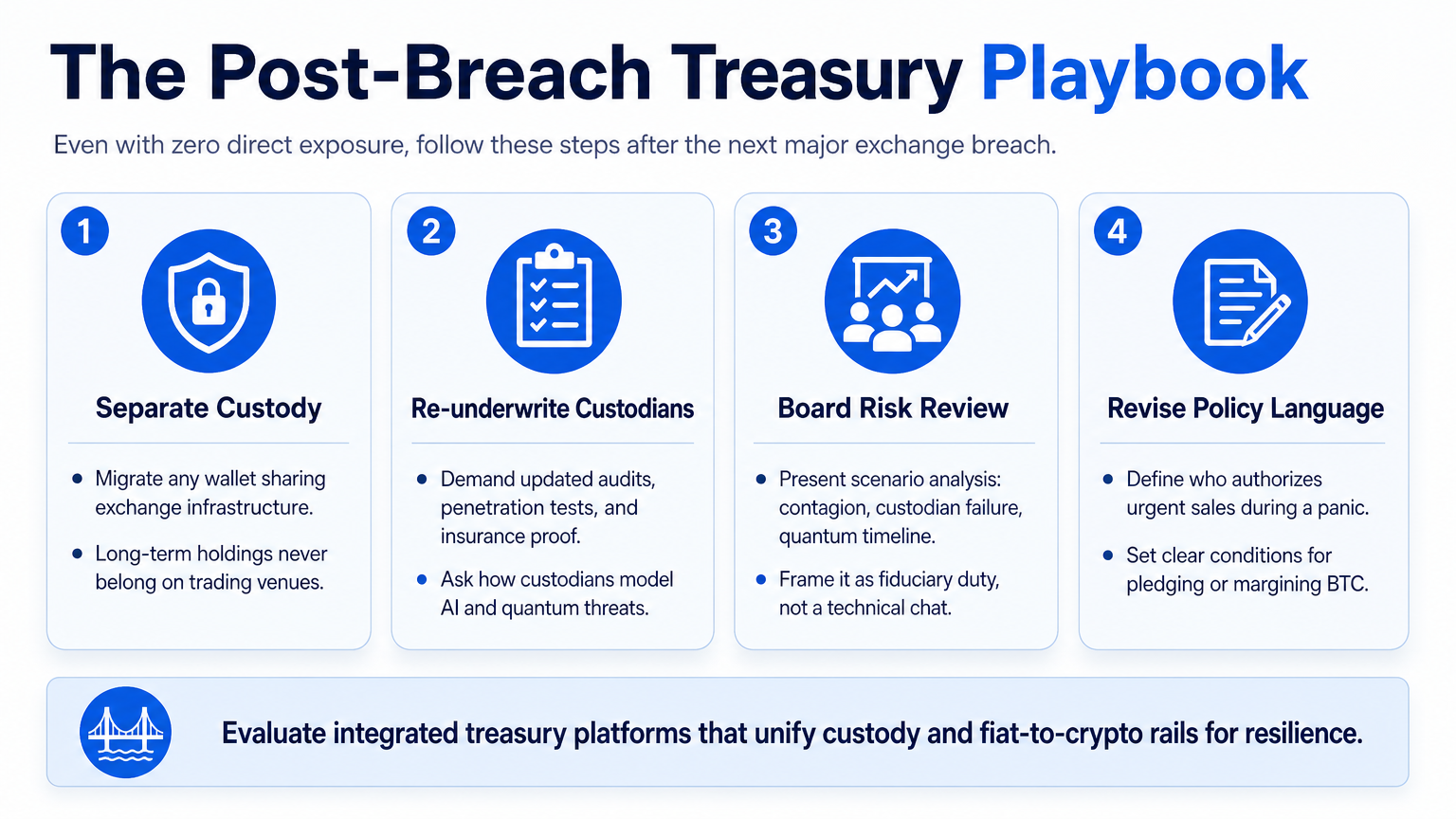
How should a corporate treasury respond to an exchange hack?
The Next Technology decision offers a template, but every treasury should follow a structured playbook when a major exchange is breached—even if the company has no direct exposure:
1. Separate custody from trading venues immediately. If any operational wallet shares infrastructure with an exchange, migrate it. Long‑term holdings should never sit where trading occurs.
2. Re‑underwrite the entire custody stack. Demand updated security audits, penetration tests, and proof of insurance from every custodian. Ask what threat models they now consider (AI, quantum) and how they’re stress‑tested.
3. Run a board‑level treasury risk review. Present the board with a scenario analysis that includes exchange failure contagion, custodian failure, and the quantum threat timeline. Frame it as a fiduciary duty, not a technical conversation.
4. Revise crypto treasury policy language around emergency liquidity. Specify who can authorize asset sales during a market panic, under what conditions pledged BTC can be sold or margined, and how communication will be handled—before the next incident.
5. Evaluate integrated treasury platforms. A platform that provides segregated global accounts, fiat‑to‑crypto rails, and secure custody under one audit trail can reduce the operational complexity that creates security gaps. The goal is crypto treasury best practices that bake in resilience from day one. To keep your board and treasury team continuously updated on shifting best practices, you might consider a service like Joyrise, which plans, writes and publishes illustrated SEO articles to your Webflow blog every day, delivering fresh insights without adding to your team’s workload.
What to watch next
Will other public holders follow?
Next Technology’s move may pressure other bitcoin treasury companies to disclose updated risk assessments. If even one more top‑20 holder authorizes a sale or pledge, it could reshape market expectations around corporate bitcoin treasury duration.
Regulatory reaction to the Binance incident
The hack will almost certainly accelerate regulatory scrutiny on exchange security, custodial standards, and stablecoin safeguards—a trajectory we examined in our post on stablecoin regulation after the SEC’s crypto shift. Expect new proposals around mandatory insurance, third‑party audits, and board‑level cybersecurity accountability.
Open questions on custodian liability and insurance
The Binance breach has revived questions that the FTX collapse left unresolved: who bears the loss when a custodian is compromised? Does commercial crime insurance cover quantum‑enabled theft? Until these questions are settled, treasury committees will continue to treat any large custodial failure as a threat to their own solvency—even if they bank elsewhere.
Key Takeaways
- Next Technology Holding’s board authorized selling or pledging 5,833 BTC solely because of second‑hand security fears, proving that confidence contagion now drives crypto treasury board decisions.
- Custody risk is systemic, not binary: even assets held with top custodians are exposed to liquidity, insurance, and operational gaps after a major exchange hack.
- The board’s explicit citation of AI cyberattacks and quantum computing marks a new chapter where treasury risk models must include offensive‑AI and cryptographic‑decay assumptions.
- Finance leads should immediately separate custody from trading, re‑underwrite custodial relationships, and update crypto treasury policy language to cover emergency liquidity events.
- Regulatory and insurance frameworks are still lagging, so the safest treasury posture today is proactive—built on independent custody, multi‑sig governance, and a board‑approved threat model.
For a treasury platform that pairs fiat and crypto custody without exposing assets to exchange risk, explore OneSafe.
Further reading