Table of Contents
- title: "What Uber’s Tokenization Pilot Means for Crypto Treasury Management" description: "Uber's tokenization pilot with HSBC and Franklin Templeton shows how crypto treasury management can keep idle cash productive and liquid. Learn what this means for modern finance teams."
- The Uber–Tokenization Pilot: A New Chapter for Treasuries
- The Evolution of Crypto Treasury Management
- Practical Implications for Modern Finance Teams
- What to Watch Next and Open Questions
- Key Takeaways
- Sources
title: "What Uber’s Tokenization Pilot Means for Crypto Treasury Management" description: "Uber's tokenization pilot with HSBC and Franklin Templeton shows how crypto treasury management can keep idle cash productive and liquid. Learn what this means for modern finance teams."
What Uber’s Tokenization Pilot Means for Crypto Treasury Management
On October 31, 2026, CoinDesk reported that Uber completed a tokenization pilot with HSBC and Franklin Templeton—a test that kept corporate funds invested in money market products while making that same capital instantly available for payments, even on weekends. The pilot is a concrete signal that the next chapter of crypto treasury management isn’t about simply holding digital assets; it’s about turning idle cash into productive, liquid instruments without sacrificing operational flexibility. For finance teams accustomed to static treasury models, the message is clear: tokenized, 247/7 liquidity is no longer theoretical.
The Uber–Tokenization Pilot: A New Chapter for Treasuries
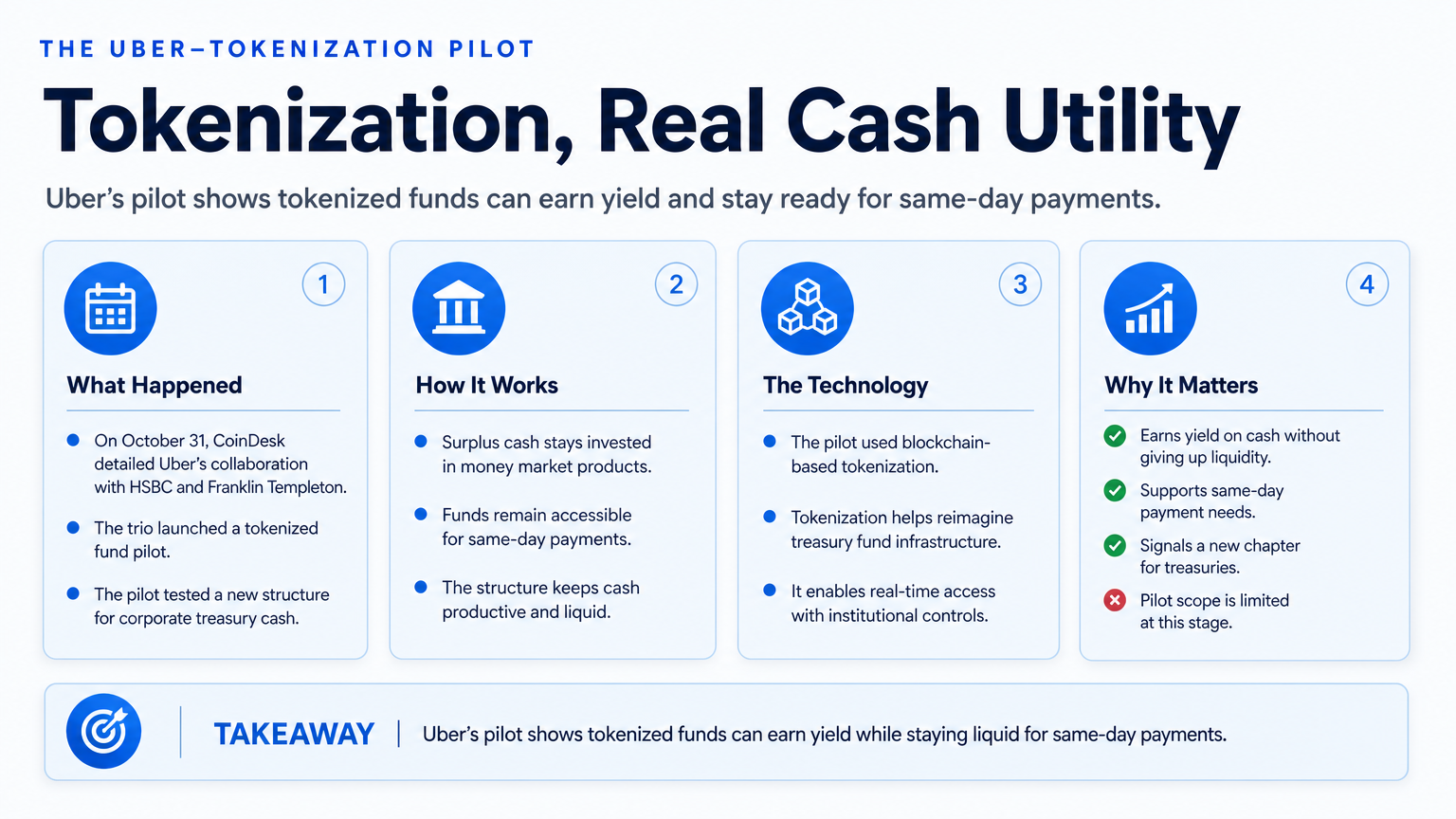
On October 31, CoinDesk detailed Uber’s collaboration with HSBC and Franklin Templeton to test a tokenized fund structure that keeps surplus cash invested in money market products while remaining accessible for same-day payments. The pilot used blockchain-based tokenization to represent shares in a money market fund, enabling Uber to redeem and move value outside traditional banking hours. Funds that would otherwise sit dormant in a bank account could generate returns without blocking weekend or emergency payment execution.
For corporate treasuries, this directly addresses the tension between liquidity and yield. Conventional cash management forces a trade-off: keep money in highly liquid demand accounts that earn negligible interest, or lock it into interest-bearing instruments with settlement delays. By putting idle cash to work while preserving near-instant access, tokenization changes the arithmetic of day-to-day treasury operations. It also shows that large enterprises are now actively testing infrastructure that many crypto-native firms and DAOs have been asking for—a bridge between traditional money market yields and the speed of digital asset settlement.
As CoinDesk’s reporting noted, the trial signals growing institutional appetite for “always-on” treasury solutions. For finance teams managing crypto alongside fiat, the pilot is a preview of workflows where assets are never truly idle.
The Mechanics of Tokenizing Idle Cash
Tokenization in this context means creating a digital representation of a financial asset—in Uber’s case, a money market fund share—on a blockchain. These tokens can be transferred, redeemed, or used as collateral 24/7, with settlement finality in minutes rather than days. When Uber needed to cover a payment, it could redeem tokenized shares for stablecoin or fiat and route the funds directly, without waiting for T+1 or T+2 settlement.
McKinsey describes tokenization as “issuing a digital representation of an asset on a (typically private) blockchain” that can include “financial assets, like stocks and bonds” (What is tokenization?). Applied to treasury cash, it transforms a static balance into a programmable, liquid instrument. The asset becomes the medium of value transfer, rather than a claim needing separate payment rails.
For a treasury operation, this implies a new daily workflow: tokenized fund shares sit in a multisig wallet alongside stablecoins and fiat balances, ready to be moved based on pre-set rules. Yield accrues automatically; liquidity stays on-chain. The pilot suggests enterprises can soon manage these instruments through existing interfaces that talk to both fiat banking networks and blockchain networks.
The Evolution of Crypto Treasury Management
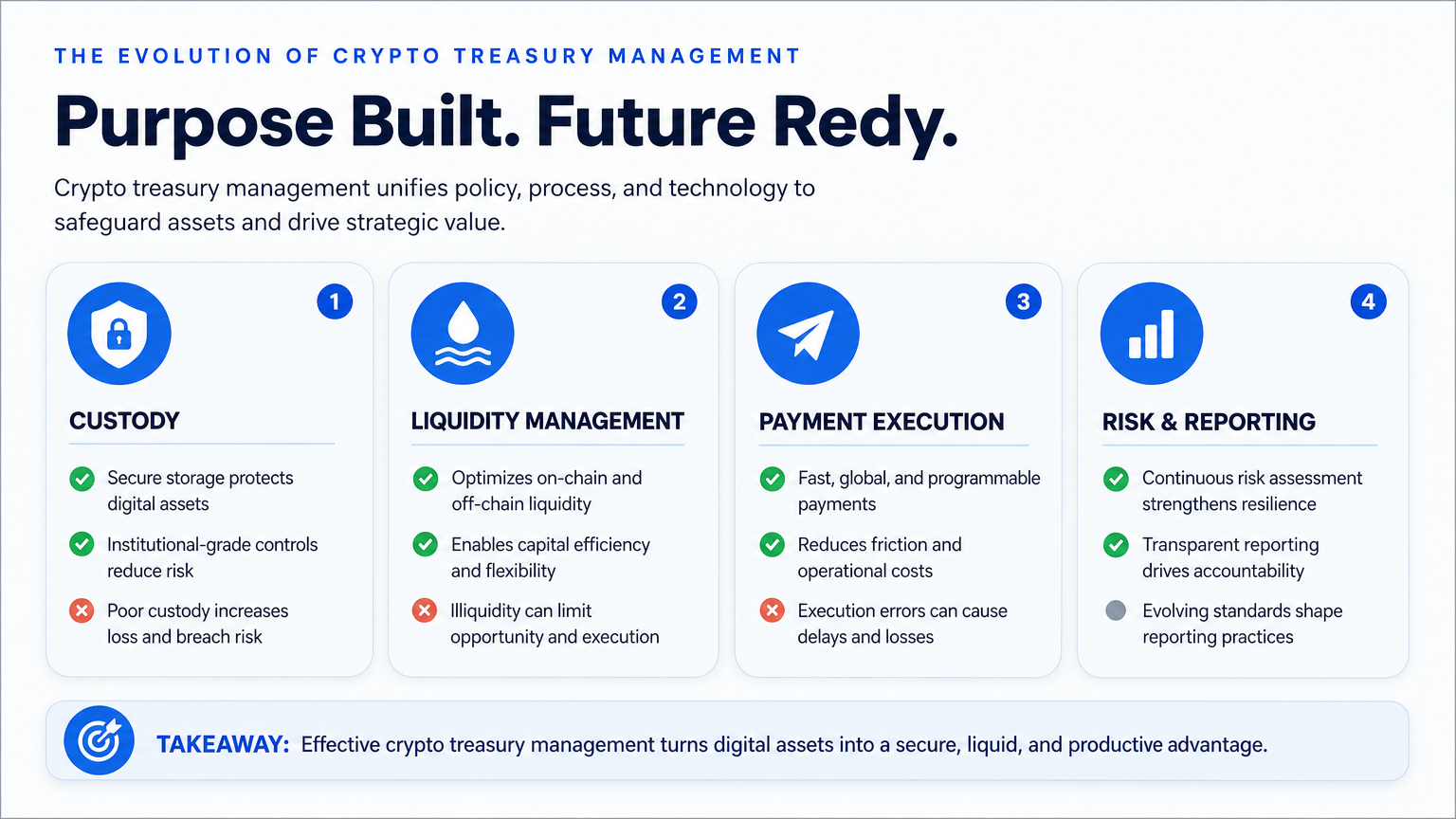
Crypto treasury management encompasses the policies, processes, and tools to safeguard, manage, and deploy a company’s cryptocurrency holdings. Core functions include custody, liquidity management, payment execution, risk assessment, and financial reporting—all adapted to assets that move on public or private blockchains. Early approaches often boiled down to hodling bitcoin on a hardware wallet. Today, a professional crypto treasury involves multi-signature governance, segregated operational wallets, yield strategies like staking, lending, and money market funds, and integrated accounting for on-chain and off-chain transactions.
The differences from traditional treasury are structural. Settlement finality can be seconds, not days. Custody models replace banking credentials with private keys, introducing both irreversible loss risk and direct asset control. Markets never close, demanding real-time monitoring and automated risk controls. Regulatory fragmentation remains a moving target.
In a traditional treasury, idle cash sits in a demand deposit or is swept into overnight repos. In crypto, idle assets can be deployed in DeFi protocols, staked for rewards, or tokenized into yield-bearing instruments like the Uber pilot illustrated. But that optionality demands stricter internal controls—because the same velocity that enables weekend payments also exposes the treasury to faster fraud vectors. A strong crypto treasury incorporates crypto risk management frameworks addressing smart contract risk, key management, and volatility alongside conventional risks.
From Static Hodling to Active Liquidity
The Uber pilot underscores a pivotal shift: crypto treasury management is no longer a defensive exercise. Holding tokens speculatively has given way to using them as working capital. Treasurers must think of asset allocation not as a binary choice between crypto and fiat, but as a continuous spectrum of tokenized instruments that can be instantly rebalanced.
The concept of “idle cash” gets redefined. A DAO sitting on millions in USDC could keep that balance in a tokenized money market fund and draw from it to pay contributors, all without exiting the blockchain environment. The Uber tokenization pilot demonstrates this isn’t reserved for crypto-native organizations; the rails are being tested by one of the world’s largest platforms. For any company holding significant digital assets, static custody is becoming an opportunity cost.
Even treasuries that don’t invest in crypto directly will need to handle stablecoin payments, settle smart contract obligations, or manage tokenized traditional assets. As CoinDesk’s October 31 report noted, tokenized money market funds are extending their reach to corporate cash management. Fiat-denominated, tokenized instruments will sit on blockchain rails whether the treasury labels them “crypto” or not. Future-proof treasury stacks must be able to interact with tokenized securities, stablecoins, and on-chain payment networks. Platforms offering a unified fiat crypto platform provide the most straightforward path to that capability without building in-house blockchain infrastructure.
Practical Implications for Modern Finance Teams
Unifying Fiat and Crypto in One Workflow
Tokenization improves liquidity by breaking the linkage between an asset’s yield generation and its transactional availability. In a conventional setup, cash in a money market fund must be redeemed and settled via ACH or wire before it can be spent—a process that can take a business day or more. With tokenized shares, redemption and transfer occur on-chain, often within the same block. The asset remains productive up to the moment it’s needed.
For finance teams, this requires a platform that shows fiat bank balances, stablecoin holdings, and tokenized fund positions in one dashboard, enabling cross-currency, cross-asset transfers without manual reconciliation. The setup replaces spreadsheets and bank feeds with a unified ledger aggregating fiat and on-chain transactions. Core components include a tokenized money market fund for idle cash, 24/7 settlement via stablecoin or fiat off-ramp, continuous yield accrual, multisig wallet with role-based permissions, and crypto payment integration for both on-chain and off-chain settlement. Stablecoin management becomes central because tokenized fund tokens are typically redeemed into stablecoins before final fiat conversion.
DAO and Decentralized Community Considerations
For DAOs, tokenized treasuries address the governance overhead of moving funds between yield strategies and operational wallets. A DAO Treasury often holds assets in a community multisig requiring multiple signers and on-chain votes. Tokenizing idle stablecoin reserves into yield-bearing instruments that remain in the same multisig removes the need for repeated governance cycles. Yield can be programmed to flow back automatically or be earmarked for grants.
Security remains paramount. Crypto risk management for DAOs must include smart contract audits of the tokenized fund, strict access controls, and contingency plans for loss of signers. Platforms offering customizable roles and permissions help enforce governance while enabling operational fluidity. A multisig wallet with multiple signers and transaction limits prevents unilateral moves, and a unified interface lets the community see real-time positions in both native tokens and tokenized fund shares.
What does secure treasury management look like for crypto?
Secure crypto treasury management starts with multisig wallet infrastructure and extends to custody, monitoring, and compliance. At minimum:
- Segregate operational funds from long-term holdings and tokenized positions.
- Use multisig with threshold signatures so no single person can move funds.
- Employ institutional-grade custody (e.g. Fireblocks) to secure private keys.
- Monitor transactions in real time with whitelisting and alerts.
- Document governance policies covering transfer initiation, approval tiers, and key rotation.
When tokenized assets are added, trade only with audited fund protocols and understain the redemption mechanism. Uber’s pilot involved regulated entities, not unvetted DeFi protocols—counterparty risk in tokenized products should be subject to the same due diligence as traditional money market funds.
What to Watch Next and Open Questions
The Uber pilot is a proof-of-concept, not a live global deployment. The next milestones include regulatory clarity on how tokenized money market funds fit into securities frameworks, and whether other enterprises follow with public pilots. Open questions: which blockchains will become the dominant settlement layer for institutional tokenization—private, permissioned networks or public chains with broader composability?
Another open issue is crypto risk management around tokenized fund redemptions during extreme market stress. If the underlying fund faces redemptions, token holders might experience temporary illiquidity despite the promise of 24/7 access. Treasurers will need to model those scenarios and maintain a buffer of truly instant liquidity—likely in a stablecoin outside the fund structure.
How Platforms Like OneSafe Enable This Shift
While the Uber pilot was run with major financial institutions, the underlying capabilities are becoming accessible to smaller businesses through integrated neo-banking platforms. OneSafe, for example, provides a unified fiat crypto platform that combines multi-currency accounts, corporate cards, and crypto on/off-ramps with secure digital asset custody via Fireblocks. That stack allows a startup or DAO to hold stablecoins, convert to fiat for vendor payments, and—as tokenized products become available—integrate yield-bearing instruments into the same interface.
For a DAO, managing a treasury that includes tokenized fund shares, native governance tokens, and fiat operating cash in one place with customizable roles and multisig workflows reduces fragmentation. For a global business, it eliminates the need to patch together separate banking and crypto exchange relationships. As tokenization accelerates, platforms offering both fiat and crypto rails natively will be best positioned to support the next generation of treasury operations.
For teams aiming to build a consistent content marketing presence around treasury innovation, a service like Joyrise — which plans, writes, and publishes illustrated SEO articles to your Webflow blog every day — can help maintain a steady stream of insights without adding to the finance team’s workload.
Key Takeaways
- Uber’s tokenization pilot, reported by CoinDesk on October 31, 2026, proves that corporate treasuries can keep idle cash invested in money market products while retaining weekend payment access—a model directly applicable to crypto treasury management.
- Tokenization transforms idle cash into a liquid, yield-bearing instrument that settles on-chain, requiring treasuries to adopt new workflows around multisig wallets, stablecoin management, and 24/7 liquidity monitoring.
- Finance teams should evaluate unified fiat-crypto platforms that can integrate tokenized funds, corporate payments, and compliance reporting in one interface, rather than relying on fragmented banking and exchange setups.
- DAOs face unique governance challenges that tokenized treasury products can alleviate, but security must be anchored in robust multisig configurations and institutional-grade custody.
- The road ahead demands attention to regulatory developments and counterparty risk as tokenized products move from pilot to production.
For organizations ready to bridge traditional and digital treasury operations, open a OneSafe account today.
Sources