In late October 2026, Ripple’s network hit a claimed $16 trillion in cumulative payment volume, yet the Ripple payment volume XRP price disconnect has never been sharper. The XRP token gained only 2.3% in the same window and closed the month about 11% below September’s level. For teams evaluating stablecoin payments as a settlement rail, the message is stark: throughput no longer translates into token value, making stablecoins the default for anyone who needs predictable unit economics over speculative upside.
Table of Contents
- Why It Matters for Teams Evaluating Stablecoin Payments
- The Background: Stablecoin Payments in 2026
- Concrete Implications for Founders and Finance Leads
- Recommended Actions for 2026
- What to Watch Next
- Key Takeaways
- Sources
Why It Matters for Teams Evaluating Stablecoin Payments
When payment flow cannot lift a native token, businesses that route working capital through volatile crypto take on risk without return. The only way to capture on-chain settlement’s speed is to use a vehicle whose value doesn’t swing with sentiment. The stablecoin vs XRP payments debate is settled by one metric: settlement certainty. A $10,000 payment that stays $10,000 on delivery—regardless of market moves—eliminates the float and volatility drag that plagues token-based rails.
This milestone crystallizes the split between payment utility and an investable asset. A blockchain can be busy and profitable for its operator while the native token languishes. For a CFO, the rail and the investment position must be kept separate. Stablecoins accomplish this by carrying fast, programmable settlement without speculative baggage.
The Background: Stablecoin Payments in 2026
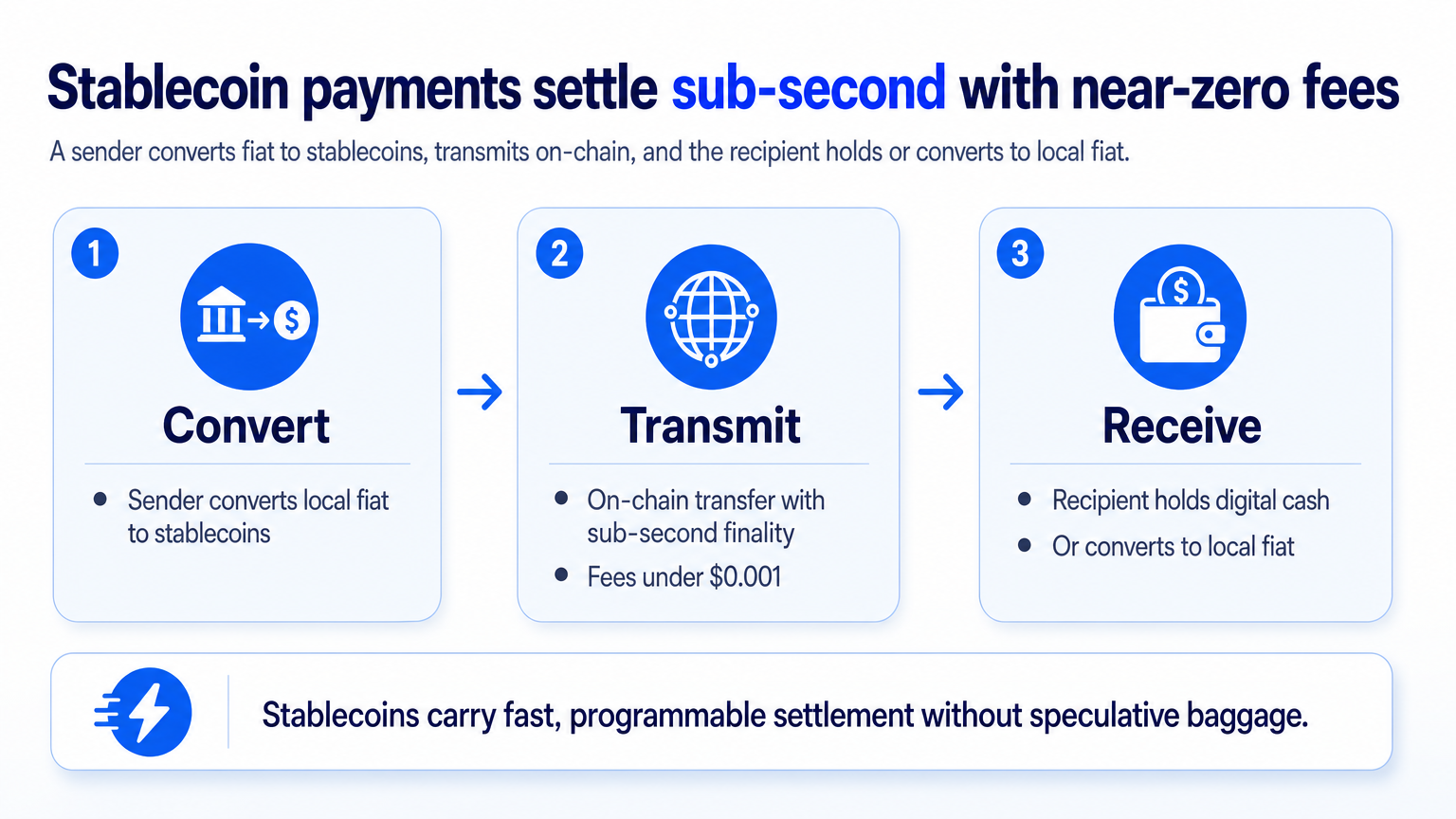
How they work — Fiat-pegged tokens like USDC move on public blockchains. A sender converts local fiat to stablecoins, transmits on-chain in seconds, and the recipient holds digital cash or converts to local fiat. On high-throughput chains, stablecoin payments settle with sub-second finality and fees under $0.001, as detailed in Solana’s Stablecoin Payment Rails: What Businesses and DAOs Need Now. Platforms like OneSafe streamline OneSafe stablecoin payments by offering multi-currency accounts, zero deposit/withdrawal fees for USDC, and built-in compliance.
Regulatory clarity — The GENIUS Act (2026) treats payment stablecoins as money for settlement, not securities. Issuers must be regulated and fully backed. Recent surplus disclosures, such as Tether’s $7.95B cushion examined in Tether’s $7.95B Surplus: What Stablecoin Regulation Means Now, reinforce the strength of well-capitalized instruments and accelerate enterprise adoption.
Why businesses switch — Traditional cross-border wires take days and cost 2–3% in fees and spreads. A stablecoin transfer settles in under a minute with near-zero on-chain cost. Float is eliminated, and liquidity is immediate.
Concrete Implications for Founders and Finance Leads
Stablecoin treasury management: working capital in stablecoins, not volatile tokens
Holding XRP for operations exposes a treasury to intraday swings. Startups and DAOs increasingly park operating reserves in USDC inside segregated, institutionally secured accounts. This aligns with the principle that operational liquidity must be ring-fenced from token exposure—as seen in Uber Tokenization Pilot Redefines Crypto Treasury Management.
Removing price slippage from cross-border settlement
With USDC, neither sender nor recipient faces price movement during the transfer window. A $50,000 payment to a supplier arrives as the exact fiat equivalent, minus an agreed FX spread. Token-based routes can lose 1–2% from an adverse price move in minutes.
What a healthy stablecoin payment stack looks like
- Multi-currency fiat & crypto account with segregated sub-accounts.
- On-/off-ramp with transparent USDC conversion rates.
- Compliance layer handling KYB/transaction monitoring out of the box.
- Automated workflows for payroll, vendor payouts, and reimbursements.
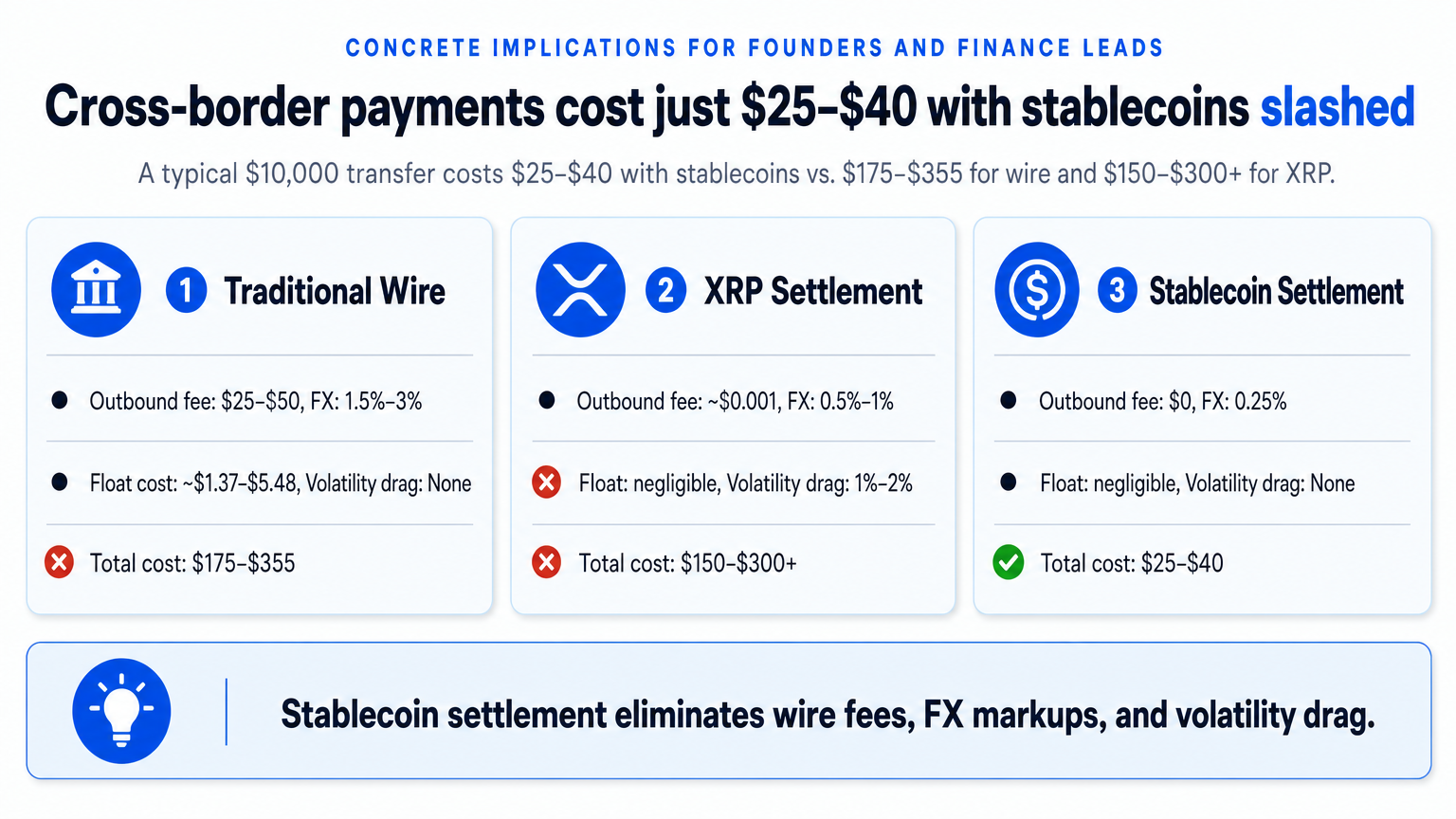
The table below shows a typical $10,000 cross-border payment under three rails, assuming a platform with 0.15% deposit fee, 0.25% FX, and zero USDC chain fees:
| Cost Component | Traditional Wire (USD→MXN) | XRP Settlement (USD→XRP→MXN) | Stablecoin Settlement (USD→USDC→MXN) |
|---|---|---|---|
| Outbound transfer fee | $25–$50 | ~$0.001 | $0 |
| FX markup | 1.5%–3% | 0.5%–1% | 0.25% |
| Float cost (2 days) | ~$1.37–$5.48 | Negligible | Negligible |
| Volatility drag | None | 1%–2% adverse move | None |
| Total estimated cost | $175–$355 | $150–$300+ | $25–$40 |
Recommended Actions for 2026
Audit for token volatility exposure — Map every cross-border leg. A 2–5% adverse price move on the average transaction often costs more than the avoided wire fees.
Set up segregated stablecoin accounts for cross-border stablecoin payments — Keep a dedicated USDC account for vendor and payroll rails, separate from investment reserves. Instant fiat off-ramps remove settlement risk.
Pick a stablecoin on-ramp business that treats stablecoin settlement as first-class — The best stablecoin on-ramp business models, like OneSafe, charge zero USDC deposit/withdrawal fees and publish FX rates (e.g., 0.25%). This aligns the platform’s incentives with stablecoin usage, not speculation.
What to Watch Next
The GENIUS Act draw a clear line for payment stablecoins. Hacks, such as the Binance incident covered in Stablecoin Regulation Under Microscope After Binance Hack, show how quickly regulators tighten rules for unbacked crypto. Expect enforcement that raises compliance costs for volatile-token rails while stablecoins get favorable treatment.
Yield-bearing stablecoins are emerging, but any mechanism that delays redemption or adds credit exposure risks breaking the 1:1 peg. Watch for products that separate the payment token from a yield wrapper.
A Fortune 500 company could announce a supplier-flow shift to USDC before year-end, forcing treasury system integrations. For daily analysis without dedicated headcount, services like Joyrise can publish crypto treasury updates to your own blog.
Key Takeaways
- The $16T Ripple milestone proves that high payment volume does not lift native token prices—stablecoin payments are the rational settlement rail.
- Stablecoin treasury management isolates working capital from market swings, while cross-border stablecoin payments cut costs to a fraction of wire and token-based routes.
- A practical stack combines segregated USDC accounts, transparent FX, zero fees, and automated compliance.
- The stablecoin vs XRP payments choice is clear: settlement certainty without speculation.
- Regulatory tailwinds under the GENIUS Act make payment stablecoins the low-friction path for global business flows.
To put this framework into practice with a unified fiat and stablecoin platform, explore OneSafe.
Sources