DeFi Compliance Gets a Permissioned Model: What the Zhibao Pilot Means
On October 12, 2026, Zhibao Technology Inc. (NASDAQ: ZBAO) announced a partnership with Bedrock to tokenize its SEC-registered Class A Ordinary Shares on-chain and deploy part of its 2,380 BTC treasury into liquid restaking. This crystallizes defi compliance shifting from risk to design — built on permissioned architectures, known-identity pools, and tokenized regulated assets. For Web3 businesses, it previews a comply-by-design model connecting treasury, equity tokenization, and fiat settlement in one verifiable workflow.Zhibao’s On-Chain Shares: A Defi Compliance Preview
Table of Contents
- What just happened: Permissioned DeFi goes live with real Nasdaq equity
- DeFi compliance challenges in brief
- How permissioned DeFi rewrites the compliance playbook
- The practical path for Web3 businesses: fiat, custody, and insurance
- Open questions and what to watch next
- Defi Compliance Key Facts Summary
- Your 30-day compliance checklist for DeFi operations
- Key Takeaways
- Sources
What just happened: Permissioned DeFi goes live with real Nasdaq equity
The Zhibao-Bedrock pilot: tokenized shares and bitcoin treasury restaking
Zhibao will study a transfer-agent-level tokenization model for its Class A ordinary shares, creating a native real-world asset (RWA) equity. Simultaneously, a portion of its 2,380 BTC will enter Bedrock’s uniBTC restaking for yield, while exploring permissioned DeFi composability. A third pillar involves InsurTech risk-transfer products for custody, smart contract, oracle, and operational risks across BTCfi. This moves from white papers to a live, SEC-registered equity on a permissioned rail.
Why permissioned matters for compliance
Permissioned architectures enforce KYC and institutional checks at the protocol layer, so only verified entities interact. That provides an auditable identity chain from issuance to on-chain yield, enabling pre-transaction AML checks and post-trade reporting without losing atomic settlement. It’s evidence that a permissioned DeFi architecture can satisfy securities and banking rules — building for real-world legality.
DeFi compliance challenges in brief
 Why does DeFi collide with regulation? Open, borderless protocols lack identity checks, automatic execution removes central control, and composability spans jurisdictions. In 2025, hacks and exploits caused over $3 billion in losses, while mixers and cross-chain bridges laundered illicit funds. For a startup, the real danger is unknowingly interacting with a sanctioned address, freezing funds and inviting enforcement. This is where blockchain analytics DeFi tools become essential, screening wallets pre-trade.
DeFi regulation 2026: what’s coming
EU policy experts expect a 2026 clarification extending MiCA to DeFi, likely mandating identity verification or restricting unverified access. FATF guidance and U.S. Treasury reports keep signaling that on-chain apps will face BSA/AML standards when they exert control. The Zhibao pilot is a direct response: DeFi regulation 2026 is already shaping compliant, permissioned rails. INTERPOL focus
DeFi vs. CeFi: what’s the difference?
CeFi platforms hold funds, execute orders internally, and are licensed MSBs with clear reporting. DeFi protocols are software without custody or a legal entity. CeFi applies KYC at onboarding; DeFi must embed compliance in smart contracts or front-end gatekeepers. Permissioned DeFi bridges the gap, keeping settlement efficiency while adding identity-aware access controls.
Managing DeFi compliance risk: the four-layer model
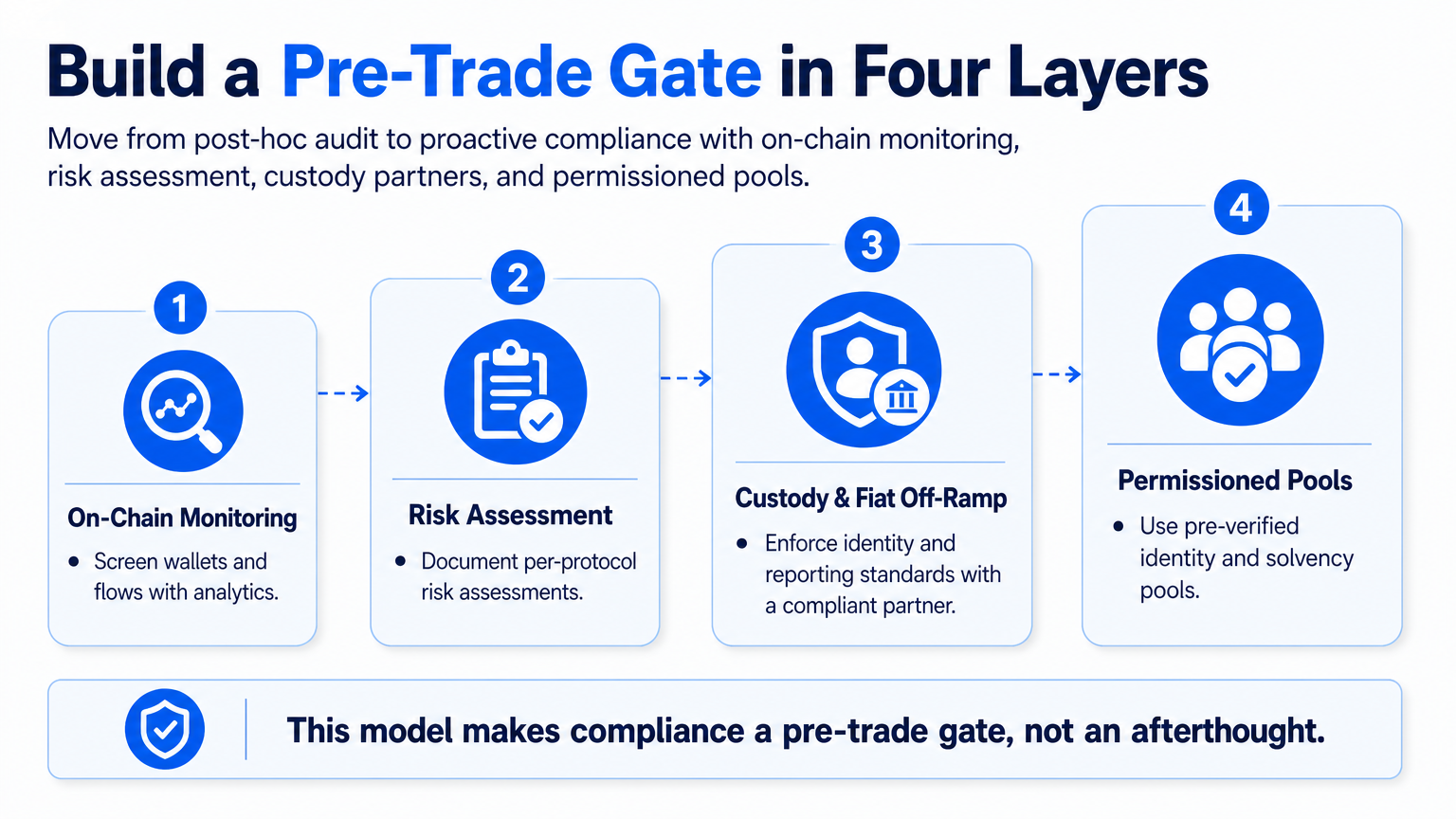
(1) On-chain monitoring with analytics to screen wallets and flows, (2) a documented risk assessment per protocol interaction, (3) a custody and fiat off-ramp partner enforcing identity/reporting standards, and (4) choosing permissioned liquidity pools where identity and solvency are pre-verified. This moves compliance from post-hoc audit to a pre-trade gate.
How permissioned DeFi rewrites the compliance playbook
Permissioned DeFi requires whitelisted participants before contract interaction, using identity oracles or on-chain registries. BCG notes this preserves atomic settlement with counterparty certainty. Standards like ERC-3643 enforce transfer restrictions on-chain; dedicated L2s integrate identity providers (see Fireblocks Academy and Conduit’s guides). In the Zhibao model, tokenized shares will be tied to a KYC-verified entity via a transfer-agent-level design, creating a cryptographic link between on-chain transactions and a known legal person. That enables real-time sanctions screening and automated reporting.
KYC for DeFi protocols: a stack that works now
A KYC for DeFi protocols stack combines: (1) a KYB/KYC provider (Sumsub, Persona) issuing an on-chain attestation, (2) a permissioned smart contract checking attestation before any value transfer (as documented by Chainlink), and (3) continuous post-trade analytics monitoring. This stack is deployable today on Ethereum or L2s. Zhibao’s inclusion of an SEC-registered equity proves it works for regulated securities, not just utility tokens.
Tokenized asset compliance: reporting, custody, settlement
Tokenized shares carry securities law obligations — ownership disclosure, transfer restrictions, capital events — with near-instant settlement. When used as collateral in DeFi, margin calls and shareholder actions must trigger off-chain filings. The tokenized asset compliance linchpin is a dual-register architecture: the transfer agent maintains the authoritative record, while the on-chain token represents the beneficial interest. This satisfies SEC record-keeping and enables 24/7 DeFi composability.
The practical path for Web3 businesses: fiat, custody, and insurance
Crypto fiat onramp compliance: why it’s the missing piece
Every DeFi yield strategy eventually needs fiat conversion for payroll, vendors, or taxes, triggering banking AML obligations. A compliant crypto fiat onramp compliance platform must KYB the business, segregate accounts, and support stablecoin/crypto deposits natively. Without it, a DAO’s compliant DeFi work ends at an unbankable wallet.
DeFi for DAOs banking: one interface, full audit trail
A unified platform should offer multi-currency fiat accounts, stablecoin on/off-ramps, corporate cards, and segregated digital asset custody with DAO-friendly role permissions. OneSafe compliant platform, serving over 1,000 Web3 businesses and processing $800M+ in volume, provides ACH/wire payments, crypto conversions, and Fireblocks-secured custody within a single interface. It also includes automated invoicing and multi-factor authentication, merging fiat and crypto flows under one compliance umbrella — critical for web3 business compliance. Web3 business finance guide
Insurance: covering smart contract and operational risk
Zhibao’s InsurTech arm will design embedded protection for BTCfi risks. For startups, specialty cover for protocol hacks and slashing events is becoming available, turning risk mitigation into risk transfer that strengthens audits and regulatory standing.
Open questions and what to watch next
Will real-world asset tokenization accelerate regulatory clarity?
The Zhibao pilot will be closely watched. If the transfer-agent model works, it could become a template for any public company wanting to issue tokenized equity, forcing regulators to publish explicit guidance within 12 months.
Are we heading toward a bifurcated market: permissioned vs. fully open DeFi?
Likely yes. Permissioned DeFi will attract regulated capital, tokenized RWAs, and institutional yield, while permissionless DeFi will face increasing AML pressure. Startups should assume a permissioned lane for balance-sheet-critical activity.
When might insurance products for DeFi risk become standard?
With a licensed reinsurance subsidiary backing protocol-risk cover, products could move from bespoke to off-the-shelf within 18–24 months. Parametric insurance paying automatically on verified exploits may become a compliance framework staple.
Defi Compliance Key Facts Summary
| Aspect | Detail |
|---|---|
| Zhibao Pilot | Tokenized SEC-registered Class A shares, 2,380 BTC restaking on Bedrock, InsurTech coverage. |
| Permissioned DeFi Model | Whitelisted participants, identity oracles, ERC-3643 standards; pre-trade KYC/KYB with full audit trails. |
| Compliance Stack | 1. Blockchain analytics screening, 2. Permissioned smart contracts with identity attestation, 3. Continuous monitoring, 4. Compliant fiat on/off-ramp. |
| Fiat On/Off-Ramp | Multi-currency accounts, stablecoin/crypto conversion, segregated custody, DAO roles, integrated invoicing. |
| Regulatory Trends | DeFi regulation 2026 (MiCA expansion), FATF/BSA expectations, SEC focus on tokenized equities. |
| Insurance | Embedded protection for smart contract, oracle, and operational risks; growing specialty cover for DeFi exploits. |
Your 30-day compliance checklist for DeFi operations

Audit existing DeFi exposure and counterparty risk
- Map all DeFi positions and smart contracts across wallets.
- Screen counterparty addresses with a blockchain analytics tool for sanctions/mixer exposure.
- Document exposure to unverified liquidity pools and bridges.
- Flag protocols lacking a front-end KYC gate or known legal entity.
Pilot a permissioned DeFi integration
Choose a yield strategy and replicate it on a KYC-gated vault (e.g., ERC-3643 pool). Whitelist your treasury wallet via an identity oracle, run a test settlement. This proves on-chain activity with full auditability.
Onboard with a banking platform for dual fiat-crypto workflows
Open an account with a platform like OneSafe that consolidates fiat accounts, crypto custody, and on/off-ramps, supporting DAO roles and automated invoicing. Complete KYB and link it to your permissioned DeFi strategy to keep yields conversion and reporting seamless.
Key Takeaways
- DeFi compliance is a design choice: The Zhibao-Bedrock pilot (Oct 12, 2026) demonstrates SEC-registered equity and BTC yield on permissioned rails.
- Permissioned DeFi architecture with KYC/KYB at the contract gate and identity-aware pools meets securities and AML rules while keeping atomic settlement.
- A compliant fiat on/off-ramp is essential; a unified platform like OneSafe ties fiat and crypto flows into one audit trail.
- Tokenized asset compliance and insurance will become standard, with the transfer-agent model and parametric cover for operational risks.
Start building your permissioned DeFi compliance workflow today — open a OneSafe account and bring fiat, crypto, and on-chain operations under one verifiable umbrella.
Sources