Meta: FNB launches crypto services via VALR exchange, reshaping crypto treasury management. Learn how bank-backed crypto treasury solutions affect risk management and corporate finance.
Crypto Treasury Management Evolves as FNB Launches Crypto Services
On October 12, 2026, FNB—one of Africa’s largest banks—rolled out its FNB crypto services for business clients, powered by VALR exchange infrastructure. The move compresses the gap between fiat and digital assets, forcing finance leads to rethink their crypto treasury management immediately.
Table of Contents
- What Just Happened: FNB Partners with VALR Exchange
- Why It Matters for Corporate Treasury
- Crypto Treasury Management Base Camp
- How to Assess Bank-Backed Services
- Building a Hybrid Fiat-Crypto Operation
- Risks and Controls: What Not to Overlook
- What to Watch Next
- Key Takeaways
What Just Happened: FNB Partners with VALR Exchange
FNB now offers custody, stablecoin payments, and integrated treasury via VALR’s institutional-grade platform, which handles derivatives, trading APIs, and stablecoin rails (TechBullion, October 12, 2026). VALR, Africa’s highest-volume exchange, has moved from retail brokerage to full-stack financial infrastructure, and FNB’s rollout proves banks see this as ready for enterprise use. Business customers can now manage both ZAR balances and USDT liquidity from a single bank dashboard—without a separate crypto-native provider.
Why It Matters for Corporate Treasury
This is a legitimacy signal. Earlier in 2026, Fibank activated crypto banking through Bitpanda (Fibank’s Crypto Banking Move Impacts Businesses), and Mastercard acquired stablecoin infrastructure firm BVNK (Mastercard Buys BVNK: Stablecoin Payments Just Went Mainstream). FNB confirms crypto treasury management is becoming a core competency, not a niche experiment. For businesses already holding stablecoins, direct bank conduits compress FX spreads and eliminate intermediary exchanges, collapsing the speed gap between on-chain and legacy finance.
Crypto Treasury Management Base Camp
Crypto treasury management is the systematic oversight of digital assets to maintain liquidity, mitigate risks, and support operational payments—often alongside fiat. It’s defined as managing crypto to meet obligations while preserving capital (Banxa). In practice, it links on-chain positions to the general ledger and payment factory.
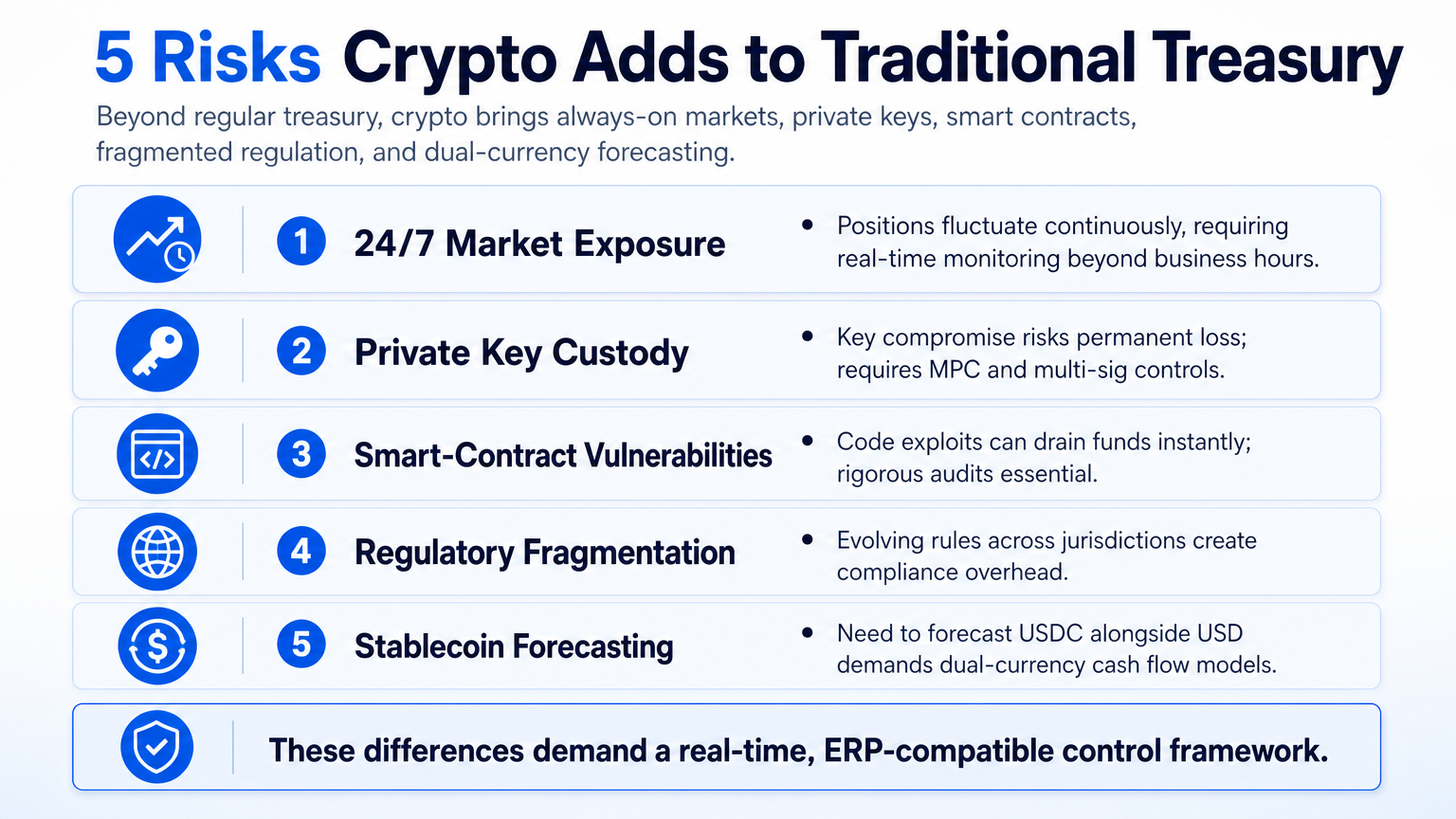
Compared to traditional treasury, crypto risk management adds 24/7 market exposure, private key custody, smart-contract vulnerabilities, regulatory fragmentation, and the need to forecast USDC alongside USD. Bitwave’s analysis stresses that these differences demand a real-time, ERP-compatible control framework (Bitwave).
How to Assess Bank-Backed Services
Before adding FNB-like services, run an audit: custody model (trust structure, segregated wallets, insurance), stablecoin support, fiat-crypto integration depth, reconciliation data, and all-in cost (spread vs. fees). Only proceed if stablecoin rails cut real FX costs for your corridors—test with a pilot payment.
DAO Treasuries: Balancing Autonomy and Operations
DAOs often hold assets on-chain but pay contributors in fiat. The FNB launch forces a question: is routing stablecoins through a bank rail acceptable? The governance tension is real, but operational costs of full self-custody are rising. Crypto treasury solutions like OneSafe bridge this gap, providing a unified fiat-crypto interface with Fireblocks custody and multi-signature policies, preserving governance while enabling efficient payouts.
Building a Hybrid Fiat-Crypto Operation

Not every firm needs an institutional stack immediately. Match infrastructure to risk appetite and volume.
| Stage | What to Implement | Typical Tools | When to Trigger |
|---|---|---|---|
| 1. Consolidate | Single platform for fiat + stablecoin on/off-ramp; multi-currency wallets | Hybrid platforms (OneSafe, bank offerings); one exchange | You hold >$50K in crypto or pay cross-border monthly |
| 2. Automate | Stablecoin payment flows, auto-conversion, reconciled feeds | Stablecoin management APIs, treasury suites (Bitwave) | Monthly stablecoin volume >$250K |
| 3. Optimize | On-chain yield strategies, multi-custodian, real-time dashboards | Institutional custody (Anchorage, Fireblocks), yield aggregators | Treasury exceeds $2M in crypto |
Crypto-Native vs. Bank-Hybrid Platforms
| Dimension | Crypto-Native (e.g., Fireblocks) | Bank-Hybrid (e.g., FNB via VALR) |
|---|---|---|
| Control | Full keys, no institutional freeze | Custodial; bank holds keys |
| Security | MPC, hardware isolation, optional insurance | Sub-custodian; insurance via bank |
| Fiat integration | Separate bank partner needed | Native fiat ledger |
| Regulatory | You own KYC/AML | Bank shoulders compliance |
| Cost | Per-txn fees, blockchain engineering | Spread + service fees |
A crypto-native platform with MPC and audited policies can match a bank’s security, but without a dedicated security team, the bank-hybrid model reduces operational risks like misconfigured keys (Anchorage, Galaxy). For mid-market firms that just move stablecoins, a bank-hybrid or fintech crypto treasury solution usually hits the convenience–control sweet spot.
Risks and Controls: What Not to Overlook
Crypto risk management centers on private key compromise, irreversible errors, smart-contract exploits, and de-pegging events. Even with a bank partner, you own transaction authorization: mandate multi-factor auth and multi-approval workflows for any material outflow. Segregate funds in named on-chain accounts, not omnibuses, and enforce a “four-eyes” rule logged immutably.
Your control environment should extend existing treasury policy: document authorized assets and counterparties, generate daily marked-to-market valuations, and ensure no single person can initiate, approve, and reconcile a transaction. Use on-chain data to build an auditor-ready reconciliation file (Fidelity). Diversify stablecoin issuers and monitor attestations, especially as ESMA’s EUR stablecoin rules come into effect (Stablecoin Regulation: ESMA’s New Compliance Deadline).
What to Watch Next
The FNB launch won’t be isolated. Expect at least two more emerging-market banks to announce similar services by Q1 2027. The U.S. Bitcoin Reserve Bill could further accelerate adoption (What the U.S. Bitcoin Reserve Bill Means for Crypto Treasury Management). Monitor whether VALR’s treasury API gets exposed directly to FNB clients and how Basel standards treat stablecoin deposits. DAO treasurers should clarify whether bank-custodied assets satisfy governance and reporting rules.
Key Takeaways
- FNB now delivers crypto services via VALR exchange, proving major banks have operationalized crypto treasury management for business.
- Crypto risk management demands 24/7 oversight, key discipline, and real-time fiat-crypto reconciliation.
- Before adopting bank-backed services, audit custody models, stablecoin support, and total conversion costs.
- Hybrid fiat-crypto platforms strike the best balance for most mid-market firms, reducing the need for in-house blockchain engineers while maintaining control.
- DAO treasuries can preserve governance with permissioned roles and transparent asset segregation when using crypto treasury solutions.
For a unified fiat-crypto treasury experience with institutional-grade security, explore OneSafe at onesafe.io.