Stablecoin Regulation’s Next Flashpoint: Yield
Stablecoin regulation’s focus has pivoted from reserve adequacy to a far more contentious issue: yield. On October 12, 2026, Trace Finance CEO Bernardo Brites’s op‑ed in The Fintech Times framed the debate bluntly—yield, not issuance, is where the next wave of compliance risk will break. For Web3 startups, DAOs, and any business using dollar‑pegged tokens for payroll, vendor payments, or cross‑border settlements, the immediate question is stark: are your stablecoins generating a return, and if so, who regulates that return?
Table of Contents
- The Yield Flashpoint
- Why It Matters: Crypto Treasury Management at Risk
- Today’s Stablecoin Compliance Patchwork
- The Core Disagreement: Security, Deposit, or Payment?
- Neo‑Banking Stablecoin Platforms: Keeping Payments Clean
- Protecting Your Business: Immediate Steps
- What to Watch Next
- Frequently Asked Questions
- Key Takeaways
The Yield Flashpoint
Brites’s central argument: “Policymakers must separate the payment token from the financial product built around it.” A stablecoin that simply redeems 1:1 and holds liquid reserves presents a contained risk. Add a yield—whether labeled staking rewards, revenue share, or “earn” interest—and it triggers multiple regulatory triggers. It could be deposit‑taking, a lending arrangement, an investment contract, or a derivative. No major framework, from the GENIUS Act stablecoin provisions to MiCA, explicitly classifies a yield‑bearing stablecoin. DeFi models are already exploring yield‑bearing stablecoins, and the lack of clear stablecoin yield regulation leaves both issuers and businesses in a legal vacuum.
Why It Matters: Crypto Treasury Management at Risk
Many DAOs and startups treat stablecoins as working capital. If your USDC balance sits in a non‑interest‑bearing custodial wallet and you convert to fiat only for payments, you are not in a yield product—your exposure is limited to money‑transmitter compliance. But if the same wallet sweeps idle balances into a lending pool that generates even a fraction of a percent, you may have inadvertently acquired a security. The line between crypto treasury management and chasing yield determines whether you are managing a payment float or buying an unregistered financial product. This stablecoin payment vs security ambiguity threatens adoption; regulators may restrict yield‑bearing stablecoins, chilling the cross‑border settlement flexibility businesses rely on. The chilling effect is real: if yield‑bearing stablecoins are banned, businesses lose a tool that made holding large balances economically viable.
Today’s Stablecoin Compliance Patchwork
In the US, payment stablecoins fall under state money transmitter licensing, a fragmented system. The GENIUS Act stablecoin draft aims for a federal framework but, as presently written, primarily addresses payment system risk—not the securities‑law overlay that yield triggers. State regulators like NYDFS have BitLicense authority only for money transmission. Internationally, the EU’s MiCA sets strict reserve rules for e‑money tokens but avoids classifying interest‑bearing variants. The BIS’s review of yield approaches shows most jurisdictions treat the payment token as a neutral utility; yield is a separate layer to be regulated as banking, securities, or e‑money. Singapore’s Payment Services Act and the UK’s proposed regime are similarly silent on yield within the token. This patchwork means a business can hold stablecoins for cross‑border payments in one country without issue, then face an enforcement action at home because the same token offers a reward. Cross‑border stablecoin payment regulation is an unpredictable minefield when yield is involved, and stablecoin compliance demands constant vigilance.
The Core Disagreement: Security, Deposit, or Payment?
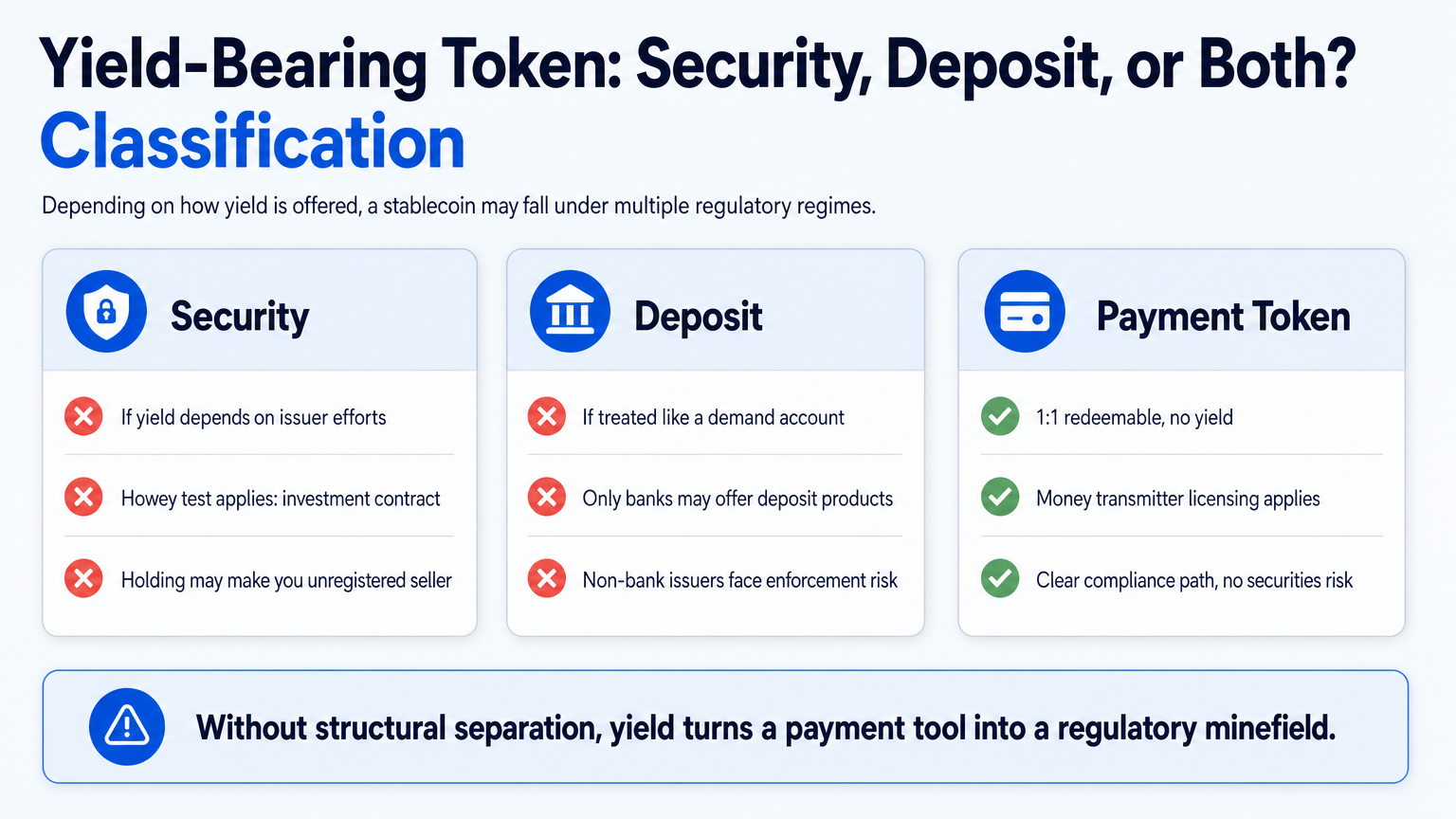
Conflicting signals from the SEC, CFTC, and OCC create a classification free‑for‑all. The SEC has signaled that tokens offering a beneficial return can be investment contracts. Ripple’s RLUSD documentation clarifies that the CFTC does not directly regulate stablecoins, making commodity pool treatment a stretch. The OCC has allowed national banks to hold stablecoin reserves but hasn’t addressed yield. A yield‑bearing stablecoin could be regulated as a security (if marketed as an investment), a deposit (if the issuer treats it like a demand account), or both. This determines everything for your business: if it’s a security, holding it for appreciation may turn you into an unregistered seller. If it’s a deposit, only a bank may offer it. Brites’s structural separation—keeping the token a payment instrument and any return a separate, regulated product—is the emerging industry consensus.
Neo‑Banking Stablecoin Platforms: Keeping Payments Clean
A neo‑banking stablecoin platform like OneSafe simplifies compliance by providing fiat and crypto accounts without any yield features. OneSafe offers multi‑currency accounts (USD, Euro, CAD) and USDC wallets purely as transactional gateways; it does not offer interest, staking rewards, or any yield product. Stablecoin custody is handled via Fireblocks, ensuring client assets are segregated and never commingled with lending pools. Users can convert USDC to fiat instantly for payroll, vendor payments, or cross‑border wires, maintaining a clean audit trail. With over 1,000 businesses across 30+ countries and $800 million in processed volume, OneSafe demonstrates that operational scale does not require yield products. By using a platform that never sweeps funds into yield schemes, businesses stay squarely in money‑transmission territory.
Protecting Your Business: Immediate Steps
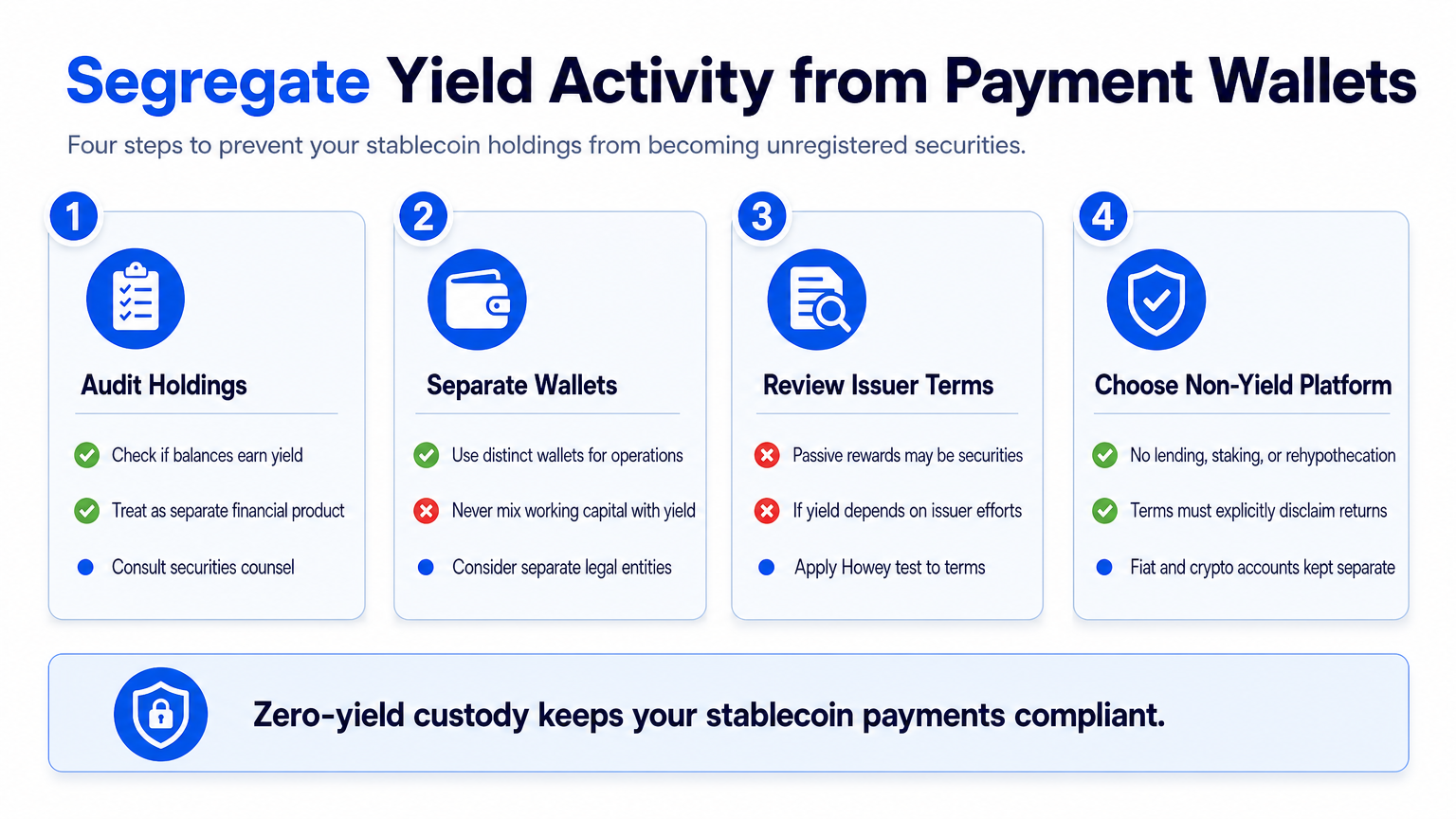
- Audit stablecoin holdings. If any balance generates a return—even automatically—treat it as a separate financial product and consult securities counsel.
- Separate operational wallets from yield‑seeking treasury activity. For DAO stablecoin treasury management, use distinct wallets or legal entities; never mix working‑capital tokens with yield product tokens.
- Review issuer terms. Passive rewards that depend on the issuer’s managerial efforts may trigger securities classification under the Howey test.
- Choose a non‑yield platform. Verify that the platform does not lend, stake, or rehypothecate client crypto; that its terms explicitly disclaim any return; and that fiat and crypto are held in separate, clearly identified accounts. A platform that offers yield on the side—even in a separate tab—introduces risk.
What to Watch Next
- Federal legislation: In May 2026, senators reportedly reached a deal on stablecoin yield as part of the GENIUS Act negotiations, signaling that a bill could drop by early 2027. The White House’s analysis of yield prohibition impacts and advancing GENIUS Act regulations indicate rulemaking appetite.
- Joint SEC‑CFTC guidance: Expect a framework that treats yield‑bearing stablecoins as securities if they involve passive income. Enforcement sweeps could follow within 90 days; DAOs holding yield in their treasuries will be early targets.
- State sandboxes and DAO risk: Several states are exploring fintech sandboxes, but none have addressed the DAO treasury problem. International DeFi compliance discussions show coordination is accelerating. A DAO that accepts yield from a stablecoin product may inadvertently create an unregistered investment fund, especially if token holders share in the return.
Frequently Asked Questions
Are yield‑bearing stablecoins securities? Likely yes if the return depends on the issuer’s efforts, triggering the Howey test. Business holders must evaluate whether they are dealing in unregistered securities.
Can I use stablecoins for payroll without risk? Yes, by holding USDC in a non‑yield custodial wallet and converting to fiat only for payments. This remains a money‑transmitter activity, provided the wallet does not sweep into yield programs.
What’s the safest way to hold stablecoins for my DAO? Use a segregated, zero‑yield platform like OneSafe. Split operational tokens from any yield‑seeking treasury positions to avoid commingling and accidental investment‑contract exposure.
Key Takeaways
- Stablecoin yield regulation is the next flashpoint; yield transforms a payment token into a potential security or deposit, and no current framework cleanly addresses it.
- Any business using stablecoins must audit whether its holdings generate a return and separate operational wallets from yield‑seeking activity—especially for crypto treasury management.
- A neo‑banking stablecoin platform that provides zero‑yield accounts and institutional‑grade custody (e.g., Fireblocks) keeps payments in money‑transmitter territory.
- Watch for GENIUS Act stablecoin legislation and joint SEC‑CFTC action in the next 6‑12 months; DAO stablecoin treasury positions are a likely enforcement priority.
Start managing your business’s stablecoin payments through a platform that keeps yield out of the equation—open a OneSafe account today.