Table of Contents
- title: "Web3 Payments: Why Instant Crypto Withdrawals Are Now Table Stakes" meta_description: "Kudo.com's automated crypto withdrawals signal a new standard: instant settlement is now baseline for web3 payments platforms. Here's what that means for your business."
- What Just Happened: Kudo Automates Crypto Withdrawals
- Why Instant Withdrawals Are a Watershed for Web3 Payments
- Web3 Payments 101: Infrastructure Businesses Actually Need
- What This Means for Your Business
- How Instant Crypto Withdrawals Work
- Why Automation Matters for Web3 Payments
- What to Look for in a Web3 Payments Platform
- How OneSafe Handles Crypto-Fiat Operations
- What to Watch Next in Web3 Financial Infrastructure
- Key Takeaways
- Sources
title: "Web3 Payments: Why Instant Crypto Withdrawals Are Now Table Stakes" meta_description: "Kudo.com's automated crypto withdrawals signal a new standard: instant settlement is now baseline for web3 payments platforms. Here's what that means for your business."
The infrastructure supporting web3 payments hit a milestone on October 12, 2026, when multi-asset broker Kudo.com announced fully automated cryptocurrency withdrawals for its global client base. The move eliminates manual processing delays that have long frustrated businesses moving between crypto and fiat. The signal is unmistakable: instant settlement is becoming the baseline expectation, and every platform touching web3 payments is now measured against it.
What Just Happened: Kudo Automates Crypto Withdrawals
Kudo.com introduced automated cryptocurrency withdrawals that process immediately, without manual intervention. The feature is live worldwide, according to The Paypers. Clients face no administrative waits; they move digital assets on their own timeline. Speed hasn’t come by stripping compliance—withdrawals still undergo regulatory checks and verification. Kudo’s COO, Finley Wilkinson, called withdrawal delays “one of the most fundamental frustrations for crypto traders,” framing the update as part of a broader tech roadmap.
This is part of a pattern: stablecoin payments maturing and mainstream infrastructure absorbing crypto-native expectations, accelerated when Mastercard acquired BVNK.
Why Instant Withdrawals Are a Watershed for Web3 Payments
Blockchain-based payments promised near-instant finality, but the promise broke where crypto meets fiat. Businesses could transact on-chain in seconds, then wait hours for manual review when converting to dollars. Kudo’s automation removes that queue. Compliance checks execute programmatically and funds move immediately. That sets a new operational benchmark: businesses that rely on crypto treasury management can’t afford capital parked in a manual review queue. The same holds for DAOs managing contributor payouts or startups running multi-currency payroll from a stablecoin position.
Instant withdrawals are no longer a premium feature—they are table stakes. Any web3 payments platform still routing withdrawals through manual approval is visibly behind.
Web3 Payments 101: Infrastructure Businesses Actually Need
Web3 payments use blockchain networks to transfer value peer-to-peer without intermediaries. Settlement occurs on-chain, often in seconds, and is cryptographically verifiable. For a business, that means accepting stablecoin invoices, paying contractors in USDC, and moving funds between crypto and fiat without days-long settlement windows.
Traditional cross-border payments route through correspondent banks, taking 1–5 business days and costing $25–$50 in fees plus FX markups. Web3 payments can settle in under a minute for cents. Stablecoins like USDC eliminate volatility while preserving speed and cost advantages. The quality of on- and off-ramps determines whether the system works operationally. Platforms integrating ramps with custody, compliance, and automation reduce the cycle to something comparable to a same-day domestic wire.
What This Means for Your Business
If you hold working capital in stablecoins—for contractor payments, supplier invoices, or a DAO treasury—the time to convert to fiat is a direct liquidity cost. Manual queues add friction. Automation removes it. A startup receiving a large USDC payment can convert $50,000 to USD for payroll immediately, then wire or ACH the same day. That’s a full business day of float reclaimed.
Platforms with crypto payment automation reduce idle balances and improve cash forecasting. Kudo’s move confirms that even trading platforms see automated settlement as a competitive necessity.
Choosing a Platform That Bridges Crypto and Fiat
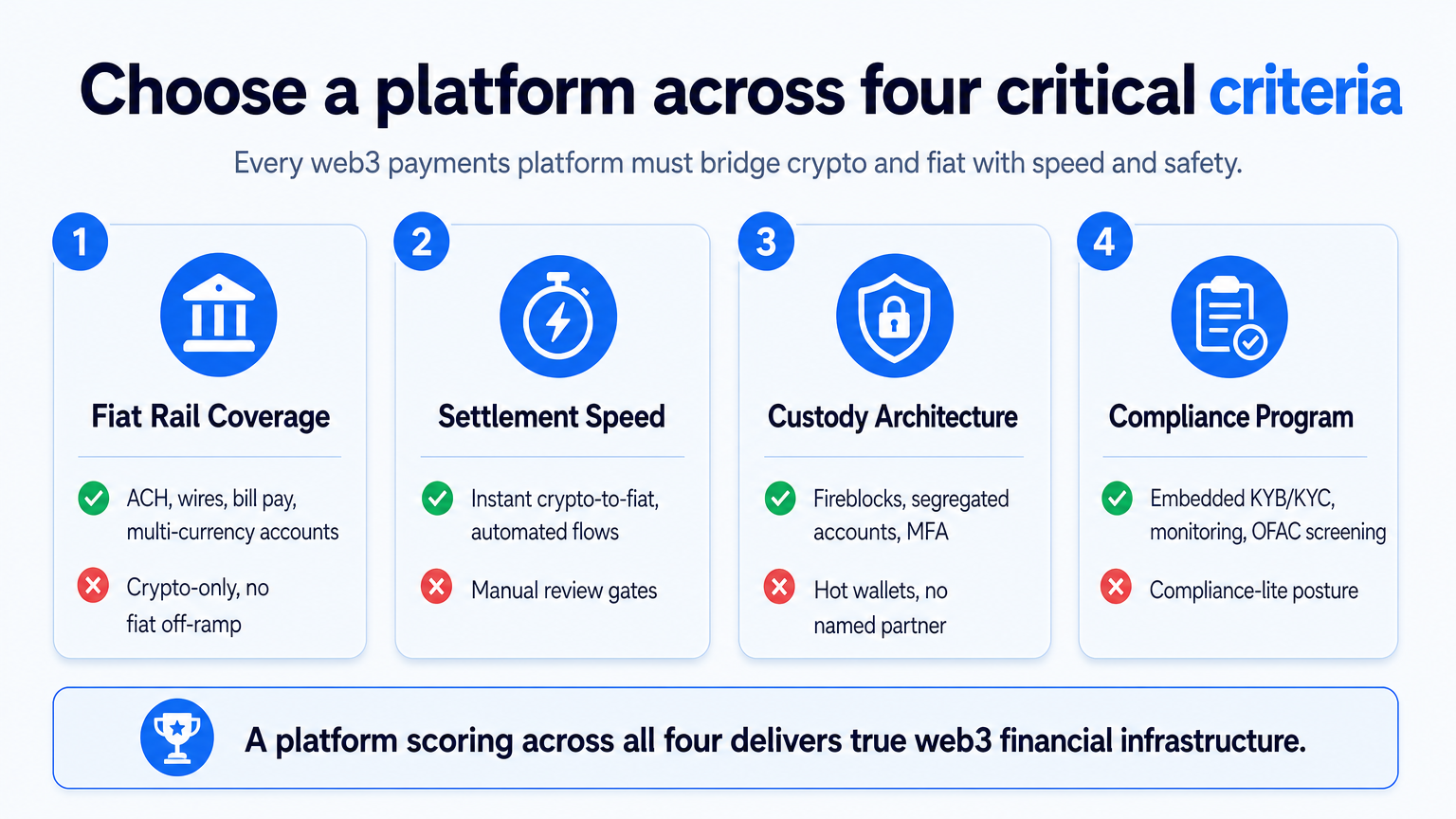
Selection criteria come down to four questions:
| Criterion | What to Look For | Red Flag |
|---|---|---|
| Fiat rail coverage | ACH, wires, bill pay, multi-currency accounts | Crypto-only, no fiat off-ramp |
| Settlement speed | Instant crypto-to-fiat conversion, automated withdrawal flows | Manual review gates |
| Custody architecture | Institutional-grade custody (e.g., Fireblocks), segregated accounts, MFA | Hot wallets, no named partner |
| Compliance program | Embedded KYB/KYC, transaction monitoring, OFAC screening | Compliance-lite posture |
A platform scoring across all four delivers web3 financial infrastructure, not a wallet with a bank logo.
Security and Compliance Are Non-Negotiable
Automating withdrawals requires transaction monitoring, sanctions screening, and anomaly detection running inside the pipeline—not after the fact. Automation without embedded compliance is a liability. For DAOs, custody architecture and mandatory MFA ensure a compromised machine can’t approve a fraudulent request. Permissioned DeFi models now formalize these controls.
How Instant Crypto Withdrawals Work
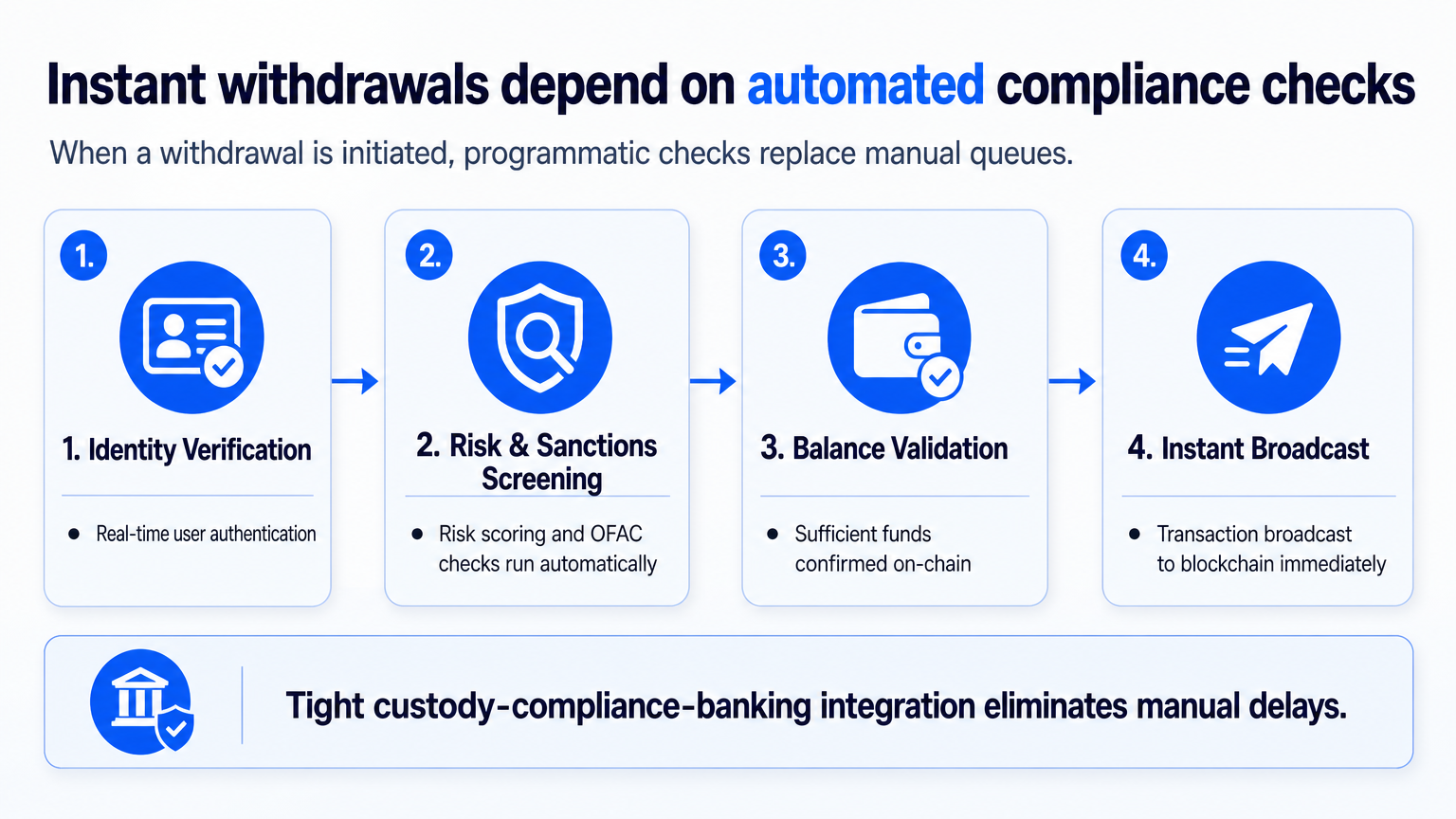
When a withdrawal is initiated, the platform runs real-time identity verification, risk scoring, sanctions screening, and balance validation. If checks pass, the withdrawal is broadcast immediately to the blockchain, never queued manually. This requires tight integration between custody, compliance middleware, and fiat banking. Platforms built with these components integrated have an architectural advantage.
Why Automation Matters for Web3 Payments
Manual processing creates three problems: unpredictable settlement timing (Friday night withdrawals held until Monday), operational overhead, and a scalability ceiling where more volume means more cost and delay. Crypto payment automation makes timing deterministic, reduces support tickets, and drives marginal processing cost toward zero. For DAOs or global businesses, it’s the difference between operations that scale and ones that don’t.
What to Look for in a Web3 Payments Platform
- Native fiat and crypto support under one roof—ACH, wires, bill pay alongside crypto.
- Automated, real-time conversion between crypto and fiat with no manual gate.
- Institutional-grade custody (Fireblocks or equivalent) with named partners.
- Compliance embedded in the transaction pipeline—sanctions screening and monitoring run automatically.
- Multi-currency accounts in the currencies you actually operate in.
These apply whether you’re a DAO setting up treasury workflows or a startup paying contractors across five countries.
How OneSafe Handles Crypto-Fiat Operations
OneSafe provides a unified interface for fiat and cryptocurrency transactions through banking partners. Instant crypto-to-fiat conversions and automated payments are built in. Crypto deposits and withdrawals in USDC are free; fiat operations carry transparent fees (0.15% on deposits/withdrawals, domestic wires $10–$25, SWIFT 0.35% + $50). Custody is via Fireblocks, MFA is mandatory. The platform supports ACH, wires, bill payments, and multi-currency USD, EUR, CAD accounts. For DAOs, customizable roles, permissions, and automated payment workflows address treasury management without fragmented tools. Onboarding takes about a week. OneSafe reports over $800 million in transaction volume from 1,000+ businesses across 30+ countries as of 2026.
What to Watch Next in Web3 Financial Infrastructure
- Mainstream adoption: Competitors will match instant settlement or justify delays—expect a wave in Q4 2026.
- Regulatory scrutiny: Programmatic withdrawals will draw focus on compliance engines. Transparent, auditable pipelines gain advantage, as the stablecoin regulation landscape evolves.
- Enterprise requirements: Next come integrated reporting, tax lot tracking, and treasury analytics spanning fiat and crypto.
- DAO and Web3 business consolidation: Single platforms handling stablecoin on-ramp and off-ramp, payroll, and treasury may replace three-tool stacks.
- Consumer expectations: Retail impatience with settlement delays now shapes what finance teams demand.
Key Takeaways
- Kudo.com’s automated, instantly settling crypto withdrawals signal that manual processing is a competitive liability for any web3 payments platform.
- Businesses holding stablecoins can now expect same-day fiat liquidity, removing a major argument against integrating crypto into treasury.
- Automation without embedded compliance is dangerous; instant settlement must include sanctions screening and risk checks inside the pipeline.
- Selection criteria for a web3 payments platform: native fiat rails, instant crypto-fiat conversion, institutional custody, embedded compliance, multi-currency accounts.
- The next 12 months will separate platforms with safely architected instant settlement from those with marketing claims and manual queues.
For businesses ready to move beyond fragmented banking and crypto tools, OneSafe provides a single platform that handles fiat and crypto operations—including instant USDC conversions and automated payment workflows—without the manual delays that are now officially obsolete.
Sources