Hi crypto draws in millions with its sleek mobile app, but founders and DAO treasury managers quickly discover it’s built for consumers, not organizations.
Table of Contents
- Executive Summary: Hi Crypto at a Glance
- The Hi Ecosystem: Token, App, and Features
- Where Hi Crypto Hits the Ceiling for Businesses and DAOs
- The Shrinking Watchman: CFTC Cuts While Crypto Expands
- OneSafe: A Crypto-Fiat Operating System Built for Teams
- Common Mistakes When Evaluating a Web3 Neobank
- What’s Next for Hi Crypto and the Neo-banking Landscape
- Key Takeaways
Executive Summary: Hi Crypto at a Glance
What Hi crypto is and who it serves
Hi is a web3 neobank that combines a crypto wallet, trading, and savings into a single mobile interface. It targets retail users who want a simple on-ramp to digital assets without managing separate exchanges and private keys. The hi app is available on iOS and Android, and onboarding leans hard into mobile-first, social sign-up flows. From day one, it was a consumer product, not a treasury platform for businesses or decentralized organizations.
The HI token’s role in the ecosystem
The native hi token powers rewards, staking, and tiered feature access. Users earn HI on deposits, referrals, and spend behavior, then lock it to unlock higher membership levels. That loyalty engine works for individuals but adds friction for anyone trying to reconcile token volatility against operating balances. As of October 2026, the hi dollar spot price reflects the speculative dynamics common to exchange-style utility tokens without a clear non-speculative demand driver.
Why 2026’s regulatory climate changes the conversation
With CFTC staffing and enforcement actions dropping precipitously during the second Trump administration (NPR, October 8, 2026), the oversight umbrella that web3 neobanks once pointed to as implicit validation is thinning. A platform that relied on regulatory ambiguity now faces more questions – especially from teams that need to demonstrate compliance to counterparties and auditors.
The Hi Ecosystem: Token, App, and Features
What is Hi crypto and how does it work?
Hi crypto is the brand umbrella for the hi neobank app and its token. The platform combines a non-custodial wallet with exchange-like functionality: buy, sell, swap, send, and earn crypto, then spend through a linked card. Most interactions happen inside the hi app, with the hi token serving as the in-app loyalty and staking unit. Two features dominate marketing: “Earn” (flexible and fixed savings goals denominated in crypto) and “Spend” (card-based payments). Despite the neobank label, Hi holds no banking license; fiat services run through third-party partners.
How is the HI token secured?
The HI token is an ERC-20 asset on Ethereum (and a BEp-20 on BSC), so base-layer security relies on those blockchains. Hi’s own security model for user wallets uses standard mobile cryptography with optional biometrics, but the platform doesn’t publicly detail independent custody audits, SOC reports, or institutional-grade key management. For a consumer with modest amounts, that’s typical; for a team managing a treasury, it’s a gap you can’t ignore.
HI token utility and market performance
Holding and staking HI unlocks membership tiers that influence earn rates, withdrawal limits, and card rewards. Market data from Forbes Digital Assets and CoinGecko shows the hi token has lost nearly all value from its 2021 highs, following the pattern of tokens whose primary utility is platform rewards rather than external demand. When a token falls 99% from its peak, the staking incentive structure breaks down for anyone needing stable working capital.
Core app features: wallet, spend, and savings goals
The hi app (Google Play listing) bundles a self-custody wallet with buying, selling, and swapping across dozens of assets. Users set crypto savings “Goals” to earn yield, and the hi Card lets them spend crypto balances anywhere major card networks are accepted. Everything is designed for a single user making personal transactions. There are no sub-accounts, spending controls, or approval workflows – the architecture assumes one person, one wallet, one phone.
What can I actually use Hi for—investing, spending, or saving?
For an individual, you can dollar-cost average into Bitcoin, park stablecoins in a goal, or pay a subscription with the card. But for anything beyond personal use – paying contractors in USDC, managing a grant program, moving fiat across borders for a team – the feature set stops dead. There’s no joint account, multi-signature flow, or way to give an accountant view-only access.
User experience: onboarding and daily use
Onboarding is fast: download the app, sign up with a phone number or email, complete KYC, and fund the wallet. Daily navigation is familiar if you’ve used a mobile bank app. However, the experience is entirely self-service. Customer support is chat-based and sorted by bots first – fine for a small balance, less fine when a time-sensitive wire is stuck and your DAO’s contributor payment is late.
Where Hi Crypto Hits the Ceiling for Businesses and DAOs
No multi-user access, roles, or spending controls
Hi has no concept of team accounts. You cannot create a role that views balances without initiating wires, or set a policy requiring two approvals for any transfer above a threshold. If your organization needs more than one person to touch the money, hi crypto is structurally the wrong tool. This one limitation alone pushes founders toward a crypto fiat banking platform built for teams.
Limited fiat on/off-ramp and cross-border speed
Hi’s fiat rails are regional and dependent on third parties. Users report delays of several business days for wire settlements and opaque FX mark-ups. A globally distributed startup paying a developer in Vietnam with USDC converted to local fiat will find no straight-line path inside the hi app. Compare that with platforms offering instant crypto-to-fiat conversions, multi-currency accounts, and domestic payment networks – the treasury velocity gap is measured in days, not minutes.
Custody transparency: what Hi says and what enterprises need to see
Hi describes its wallet infrastructure as non-custodial on the blockchain, but fiat balances and operational custody during swaps sit with Hi’s partners. There’s no publicly posted security audit of their key management or third-party custodian arrangements. Enterprise buyers should insist on a named, regulated digital asset custodian, not an opaque “partnership” model. Without a Fireblocks, BitGo, or equivalent name on the page, a DAO committee can’t satisfy its own security review.
Is Hi crypto suitable for a DAO or globally distributed startup?
No. A DAO with multiple signers, contributor payrolls in stablecoins, and fiat operating expenses will exhaust Hi’s capabilities within the first treasury cycle. You could jury-rig it by having one person hold all credentials, but that’s a governance failure waiting to happen. The operational overhead of forcing a consumer app into business workflows erodes any savings from the free tier.
The Shrinking Watchman: CFTC Cuts While Crypto Expands
What the Oct 2026 enforcement drop means for neo-banks
As crypto and prediction markets expand, the CFTC – the agency responsible for drawing up new rules for those markets – has seen its staffing and enforcement actions drop precipitously during the second Trump administration (NPR, October 8, 2026). A lighter touch might sound like good news, but the real effect is the opposite: fewer enforcement teeth reduce the incentive for platforms to invest in deep compliance infrastructure. Buyers can’t assume that a “regulatory-compliant” claim means the same thing in 2026 that it did two years ago.
Questions every team should ask about compliance depth
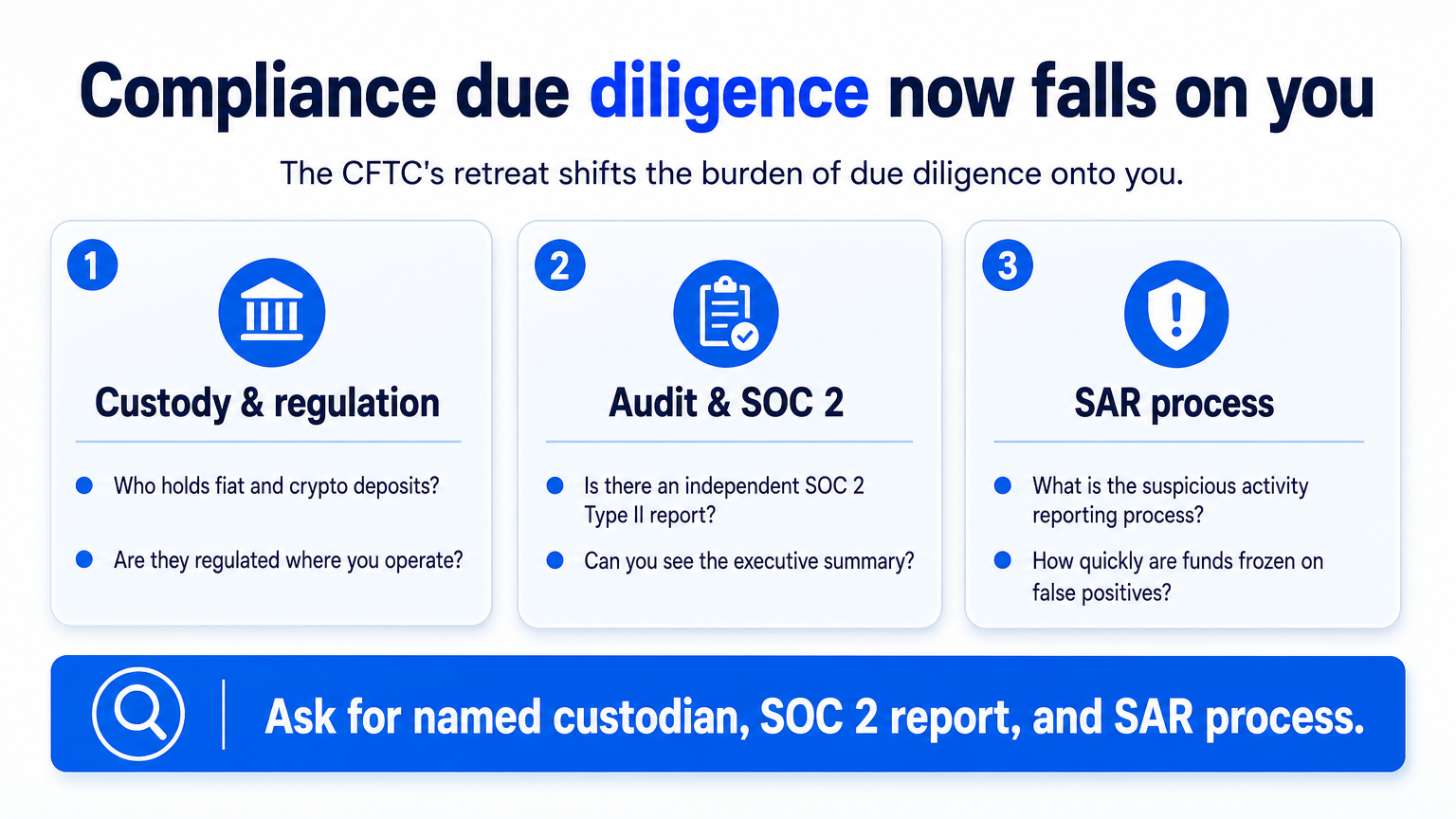
When you evaluate a web3 neobank now, push for more than a compliance page. Ask:
- Who holds the fiat and crypto deposits, and are they regulated in the jurisdictions where your entity operates?
- Is there an independent SOC 2 Type II report, and can you see the executive summary?
- What is the suspicious activity reporting process, and how quickly are funds frozen if there’s a false positive? The CFTC’s retreat shifts the burden of due diligence onto you. For a deeper look at how reusable KYC is reshaping DeFi compliance, read our DeFi Compliance Gets a Reusable KYC Reset analysis.
What does the shrinking CFTC mean for Hi and similar platforms?
A thinner regulator means fewer surprises, but also fewer guardrails. For Hi, it may delay any requirement to register as a swap execution facility or DCO, but it also erodes the external credibility that sophisticated counterparties look for. As prediction markets and crypto converge, the line between consumer app and trading venue blurs – and a consumer app with no institutional custody or treasury controls is exactly the type of platform that gets caught in a gray zone.
OneSafe: A Crypto-Fiat Operating System Built for Teams
Unified accounts, multi-currency, and global wires
OneSafe gives a startup or DAO a single dashboard where fiat and crypto balances sit alongside each other. You hold segregated accounts in USD, Euro, CAD (with more currencies coming), send international wires, settle ACH, and convert crypto to fiat instantly – all with role-based permissions. That’s the difference between a personal wallet and a financial operations platform.
Security architecture: Fireblocks custody, MFA, and audit trails
Where Hi’s custody model is opaque, OneSafe secures digital assets on Fireblocks, the same institutional custodian used by hedge funds and exchanges. Mandatory Multi-Factor Authentication (MFA) is on from signup, and the platform provides an audit trail for every transaction – non-negotiable for any organization answering to token holders or investors.
How onboarding works for a startup or DAO—documents, timeline, and states
Onboarding is fully digital and typically completes within a week. You’ll need business formation papers, a government-issued photo ID for authorized signers, and an EIN for US entities. OneSafe accepts clients in 30+ countries, excluding OFAC-sanctioned nations and some US states. The process is built to satisfy KYB standards without the paperwork marathon of a legacy bank.
How does Hi compare to other Web3 banking alternatives like OneSafe?
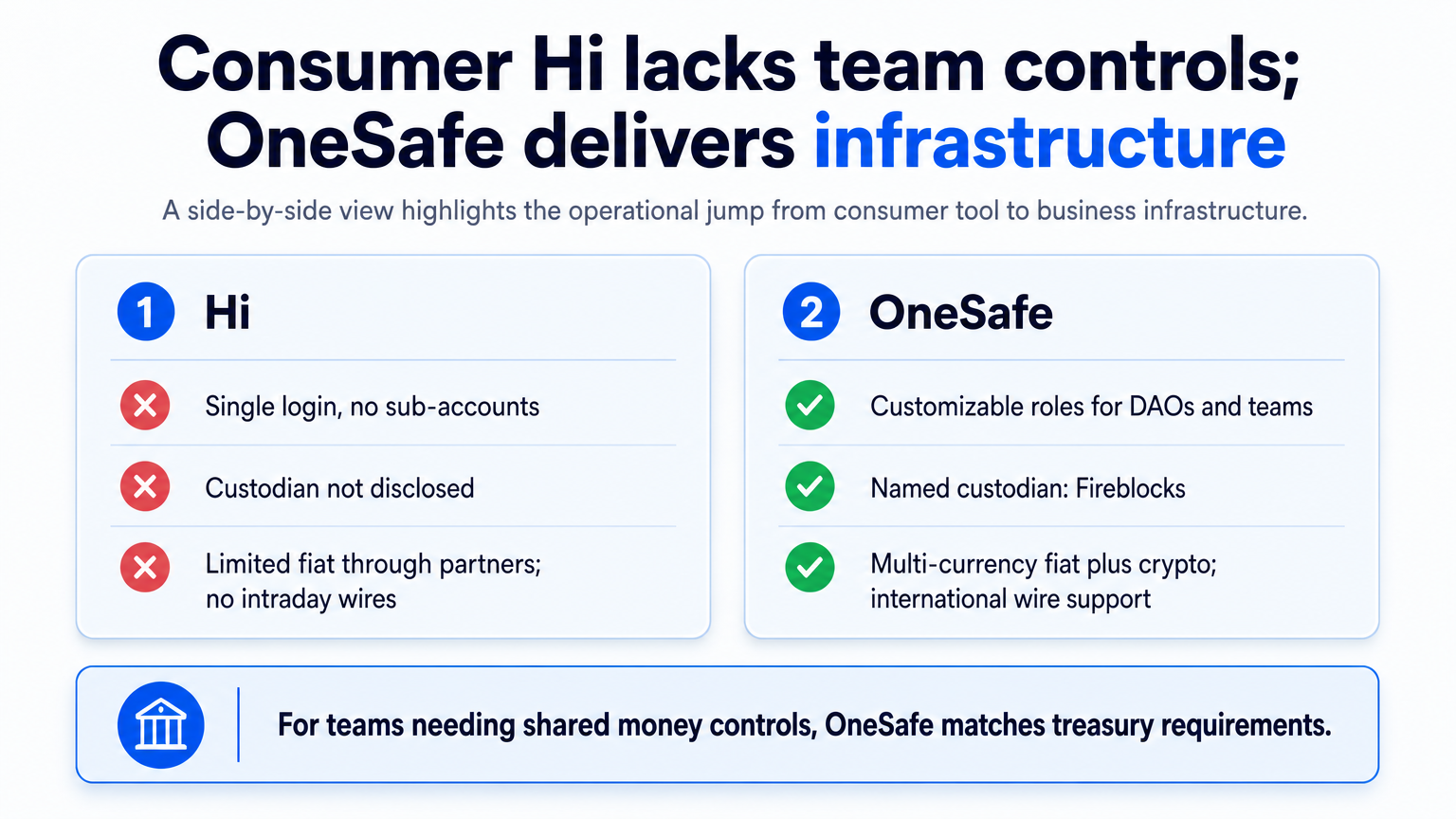
A side-by-side view highlights the operational jump from consumer tool to business infrastructure:
| Capability | Hi (consumer web3 neobank) | OneSafe (crypto-fiat platform for teams) |
|---|---|---|
| Multi-user with role permissions | No – single login, no sub-accounts | Yes – customizable roles and permissions for DAOs and teams |
| Named institutional custodian | Not disclosed | Fireblocks |
| Fiat accounts + crypto in same dashboard | Limited fiat through partners | Yes – multi-currency fiat + crypto |
| Intraday cross-border wires | No | Yes – domestic and international wire support |
| Onboarding designed for DAOs | No | Yes – DAO-native permission structures |
| Audit log and compliance trail | Minimal | Full transaction history with audit export |
For a team that needs more than one person touching the money, the hi alternative that matches treasury requirements is a platform like OneSafe built from the ground up for organizations, not individuals.
Common Mistakes When Evaluating a Web3 Neobank
Equating consumer-grade security with treasury-grade safety
A well-reviewed app does not mean your DAO’s $2M runway is safe. Consumer apps are built for speed, not for layered access controls, hardware security module-backed signings, and chain-of-custody reporting. If the platform cannot name its custodian and publish an audit, treat it as a wallet, not a treasury.
Ignoring state-level restrictions and SWIFT opaque costs
Even when a crypto neobank claims “available worldwide,” fiat rails often hit US state-level stop signs and SWIFT intermediary fees that only surface after the transfer. On OneSafe, SWIFT transactions cost 0.35% + $50 – a concrete number you can model. Most consumer apps bury that in a variable spread.
Assuming all neobanks support DAOs out of the box
Nearly every fintech built before 2023 was designed around the individual user. A platform must have role-based access controls, policy engines, and an understanding of multi-signature governance to serve a DAO. If the sign-up flow starts with a selfie, you’re already in consumer territory.
What should a business look for in a crypto-friendly financial partner?
A practical evaluation framework:
- Custody: Demand a named, regulated digital asset custodian (Fireblocks, BitGo, or equivalent).
- Permissions: Verify multi-user support with customizable roles – view-only, initiator, approver, admin.
- Fiat rails: Check which currencies can be held natively, wire timelines, and fee schedules.
- Compliance depth: Ask for the latest SOC 2 Type II report and the suspicious activity reporting process.
- Onboarding: The process should accommodate business entity documents, not just a personal ID.
This checklist alone eliminates most consumer-grade fintechs, including the hi neobank, from enterprise or DAO consideration.
What’s Next for Hi Crypto and the Neo-banking Landscape
What key events have shaped Hi’s trajectory?
Hi launched amid the 2021 bull market with heavy token incentives that drove rapid user growth. The collapse of Terra, FTX, and successive crypto winters evaporated the yield narrative that had fueled demand for the hi token. In 2025–2026, the platform pivoted toward a simpler, card-linked spend-and-save model, but the token’s value never recovered – a reminder that a rewards token detached from cash flows follows user sentiment, not fundamentals.
Possible Hi road map updates
Public roadmaps suggest Hi will deepen card integrations and savings products, but there is no indication of business accounts, API access, or multi-user functionality. The strategy remains fixed on monetizing individuals, not on building a crypto fiat banking stack for organizations.
The convergence of prediction markets, crypto, and banking
As prediction markets expand while the CFTC shrinks, platforms that blur trading, payments, and prediction are likely to emerge, but they’ll need the custody, multi-entity controls, and compliance infrastructure that consumer apps lack. The next evolutionary step isn’t a better consumer wallet – it’s an operating system that handles fiat and crypto natively for teams.
Why the best option may not look like a bank at all
The most functional treasury solution for a web3 startup or DAO doesn’t mimic a bank branch; it merges bank-grade fiat handling with on-chain custody and permissions that respect distributed governance. That’s exactly what modern platforms like OneSafe deliver. As the regulatory climate shifts again, the organizations that survive will be the ones that picked infrastructure partners, not marketing-led apps.
Key Takeaways
- Hi crypto is a consumer web3 neobank that excels at simple wallet and card spend but lacks every feature a team needs to manage money together.
- The hi token’s utility is tied to platform rewards, and its market performance reflects the risk of holding a volatile loyalty token in a treasury.
- For any organization with more than one person touching funds, the missing multi-user controls, opaque custody, and limited fiat rails make Hi a non-starter.
- The CFTC’s shrinking enforcement capacity (NPR, Oct 2026) means the compliance burden shifts onto buyers – ask for the SOC report, named custodian, and role-based permissions.
- A business-grade alternative like OneSafe for DAOs provides Fireblocks custody, segregated fiat accounts, instant crypto-fiat conversions, and the permission structure that governance demands.
If your team is ready for a financial platform that treats crypto and fiat as equal citizens and was built for organizations, not solo users, open an account with OneSafe today.