Table of Contents
- Executive summary
- What a crypto neobank is (and what it is not)
- Core concepts you can’t afford to blur
- How a crypto neobank works
- Options, approaches, and tradeoffs
- Practical implementation framework
- Mistakes, myths, limitations, and next steps
- Key Takeaways
Executive summary
The neobank crypto sector is consolidating fast. On October 6, 2026, Ether.fi deployed MoonPay’s full payments infrastructure inside its self-custodial neobank without taking custody. Stablecoin card volume exceeded $4.3 billion in Q3, up 33% quarter-over-quarter (CryptoRank, October 9, 2026), while Haven opened private neobank accounts on Starknet, depositing from six chains that settle on a single L2 (TradingView, October 5, 2026).
These signals matter for founders and finance leads: the pipes for a unified fiat and crypto banking operating system are being built now. This guide provides operational tradeoffs, real fee schedules, DAO treasury workflows, onboarding timelines, and jurisdiction checks that ranking pages omit—using OneSafe’s publicly listed fees and Fireblocks-backed custody as a concrete reference. It’s a decision layer, not a product tour.
What a crypto neobank is (and what it is not)
A crypto neobank is a Web3 financial platform that combines fiat accounts, crypto wallets, corporate cards, and cross-border payments in a single interface. It is not a bank—banking services come via licensed partners, while crypto custody sits on a separate technology layer. The core value: you can pay a supplier in USD via ACH, receive a client payment in USDC, and convert between the two without logging into three different services.
How it differs from a traditional bank
A traditional bank holds your fiat on its balance sheet and might offer crypto exposure through a side channel. A crypto neobank treats a USDC balance as a first-class asset, making it account-native to both ledgers. That means:
- Fiat and crypto in one ledger view with real-time settlement visibility.
- No need to pre-fund a trading account; on-ramp and off-ramp sit inside the same interface.
- Digital-first business KYB, not personal consumer checks.
- No FDIC insurance on any deposits. Fiat may have pass-through protection at partner banks, but the neobank itself does not insure funds.
The neobank is a treasury and payments workhorse, not a lender. For a comparison of crypto-friendly banks and neobanks, see Best Crypto Neobanks and Crypto-Friendly Banks for 2026. If you’re weighing a traditional bank that supports crypto, Crypto-Friendly Bank Accounts: Which Banks Support Bitcoin? maps the landscape.
Neobank vs crypto exchange vs self-custodial wallet
A crypto exchange is a marketplace. A self-custodial wallet gives you sole control of keys. A crypto neobank sits in the middle: it’s the operational layer that connects trading, custody, and fiat payments so a business can run payroll, settle invoices, and manage treasury without fragmentation.
Core concepts you can’t afford to blur
On-chain balances vs fiat ledger balances
Your USDC on Ethereum is an on-chain token; your dollar balance inside a neobank is a fiat liability of a partner bank. The dashboard shows both, but conversion triggers off-chain and on-chain instructions—not a single atomic transfer. Understand this for audit trails.
Stablecoin on-ramp and off-ramp
- On-ramp: Fiat → crypto (deposit USD, receive USDC).
- Off-ramp: Crypto → fiat (sell USDC, receive USD). In a crypto neobank, these conversions happen through integrated liquidity providers, collapsing settlement from days to near-instant for major pairs.
Self-custody vs custodian neobank (and Fireblocks-backed institutional custody)
Three custody models dominate:
- Self-custody: You hold keys. The Ether.fi–MoonPay deal shows infrastructure can operate without the platform taking custody.
- Custodial (exchange-style): The neobank holds assets in omnibus wallets—you carry counterparty risk.
- Institutional partner custody: Assets sit with a third-party custodian like Fireblocks, using MPC-based key management, insurance-grade security, and audit trails.
For operating businesses—those assigning financial roles, running payroll, and producing audit reports—institutional partner custody is usually the safer, more practical choice. Self-custody excels for protocol-native treasuries or individuals demanding full key control. But a growing startup with a CFO and a DAO multisig council needs permission layers, transaction policies, and the ability to revoke access without losing funds. A Fireblocks-backed setup delivers that while preserving cryptographic segregation.
KYB, segregated accounts, and safety
KYB (Know Your Business) requires formation documents, director photo ID, and for US entities, an EIN. Segregated accounts mean your fiat funds are held in pooled accounts at a partner bank, tracked on the neobank’s ledger. A well-designed crypto neobank employs state-of-the-art encryption, mandatory MFA, and institutional-grade custody. Still, no crypto neobank is FDIC insured. The fiat portion might benefit from pass-through coverage, but the neobank itself doesn’t guarantee your funds. Crypto assets are never insured against value decline.
How a crypto neobank works
Who can open a crypto business account?
Crypto neobanks serve registered businesses—C-corps, LLCs, DAOs with a legal wrapper, and global startups transacting in both fiat and crypto. Sole proprietors and unregistered collectives usually fall outside scope. OneSafe, for instance, onboards businesses worldwide with standard formation papers and government ID, with over 1,000 companies across 30+ countries.
How quickly can I open a crypto neobank account?
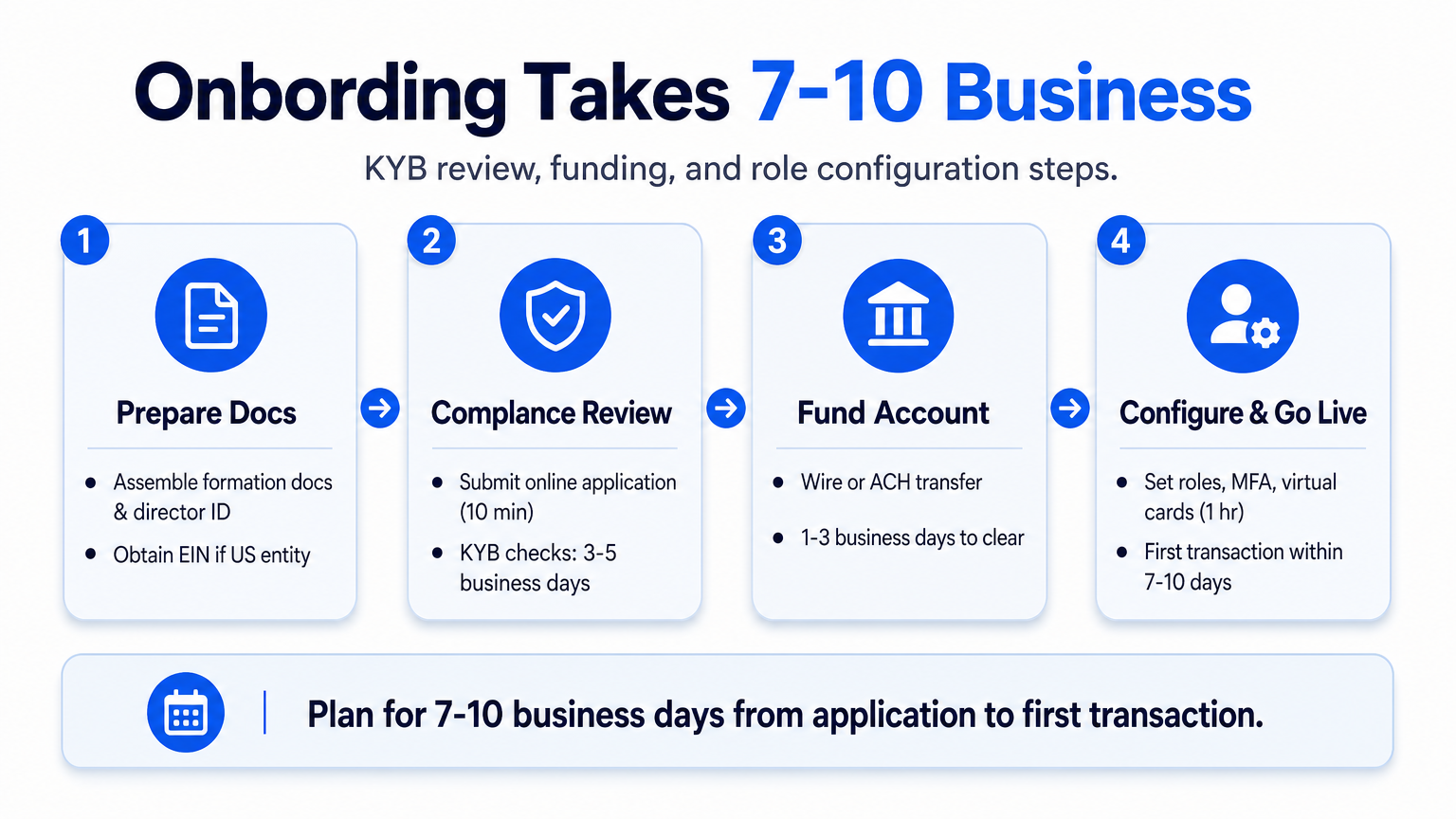
Onboarding is fully digital but not instant. Expect a 7–10 business-day window from application to first operational transaction. The process:
- Submit business details, director ID, and (for US entities) EIN.
- Automated KYB checks against sanctions lists and registries (3–5 business days).
- Fund the fiat account via wire or ACH pull (1–3 business days).
- Configure roles, MFA, and virtual cards (1 hour).
Transactions, cards, and multi-currency support
A mature platform offers ACH, wire, SWIFT, bill payments, invoicing, crypto send/receive, on-ramp/off-ramp, and unlimited virtual crypto corporate cards topped up in 8+ tokens with per-card spend limits. Multi-currency accounts (USD, EUR, CAD) let you hold and spend in different fiat buckets without forced conversion. Both fiat and crypto activity flow through a single ledger, giving real-time reconciliation—a material operational win over juggling a bank, an exchange, and a block explorer.
Options, approaches, and tradeoffs
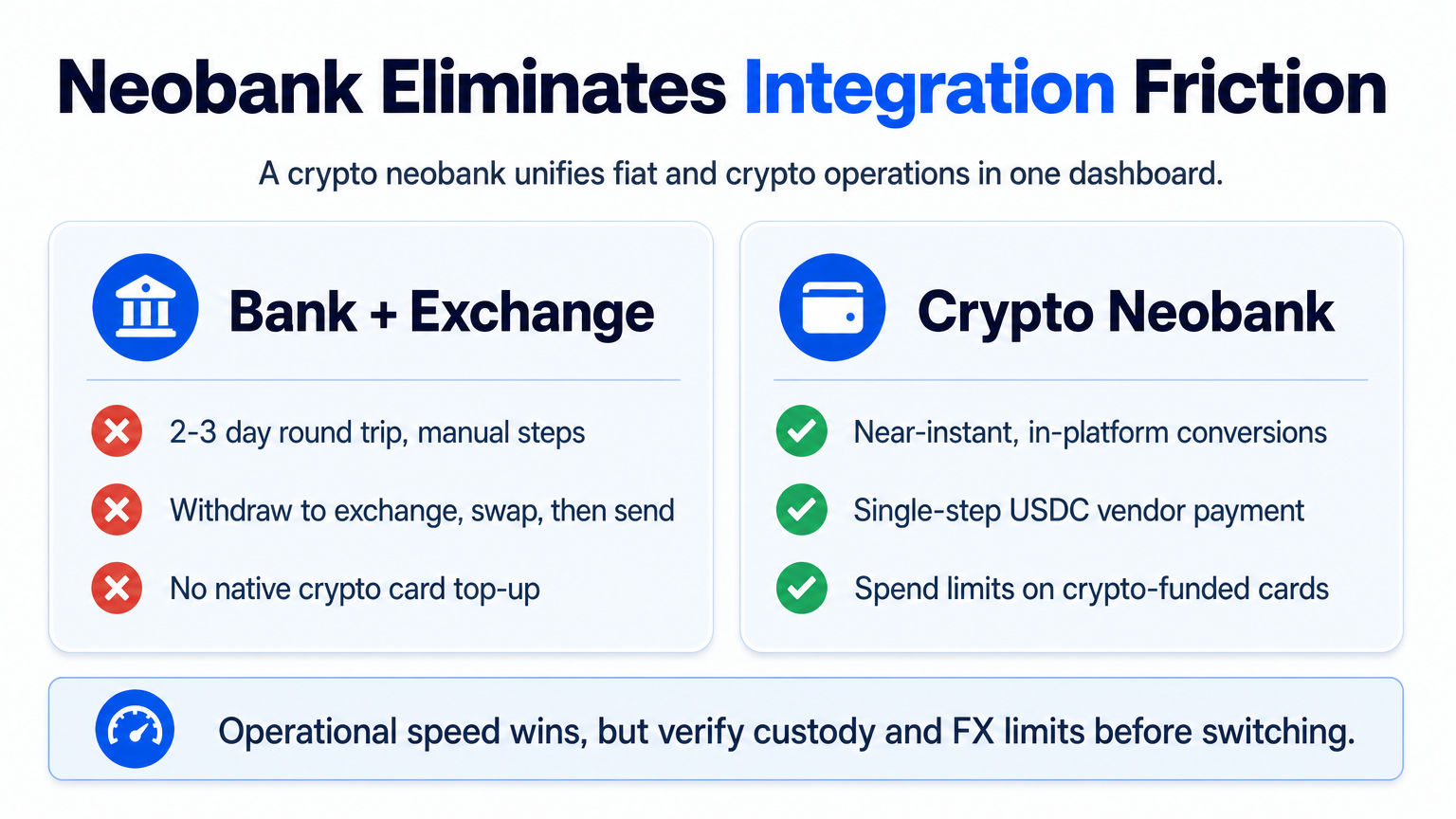
Crypto neobank vs. a traditional bank plus exchange stack
Many startups default to a bank + Coinbase/Kraken combo. The hidden costs:
| Factor | Bank + Exchange Stack | Crypto Neobank |
|---|---|---|
| Fiat-crypto round trip | 2–3 business days, manual | Near-instant, in-platform |
| Vendor payments in USDC | Withdraw fiat to exchange, swap, send | Single-step from dashboard |
| Role-based permissions for crypto | Exchange admin panel only | Granular roles across fiat and crypto |
| Consolidted reporting | Manual spreadsheet combination | Single ledger |
| Corporate card crypto top-up | Not possible natively | Supported with spend limits |
The neobank model eliminates integration friction but relies on its partner bank and custody infrastructure; it rarely offers deep FX hedging or lending.
Reading the actual fee schedule
Below is OneSafe’s published pricing—use it as a benchmark:
| Transaction Type | Fee |
|---|---|
| Fiat deposit / withdrawal | 0.15% |
| Wire withdrawal | $25 |
| Wire deposit | $10 |
| SWIFT deposit / withdrawal | 0.35% + $50 |
| Corporate card FX | 3% |
| Crypto deposits / withdrawals (USDC) | Free |
| Monthly subscription (free tier) | $0 |
| Premium plan | $29+/month |
A business receiving one international SWIFT wire ($10,000) and making two domestic wire payroll payments ($25 each) would pay roughly $85 in fees plus 0.35% on the incoming SWIFT—about $120 total—before the0.15% fiat withdrawal charge. Heavy stablecoin users pay less: USDC on/off-ramps are free, shifting the economics toward stablecoin settlement.
Global availability
Coverage is global but excludes OFAC-sanctioned nations and some US states. Verify your jurisdiction with support before committing.
Practical implementation framework
DAO banking and crypto treasury management
DAOs map cleanly onto a crypto neobank’s permission architecture. A typical DA O banking workflow:
- Define roles (Treasury Manager, Payment Approver, Auditor) with customizable permissions.
- Align the DAO’s on-chain multisig with the neobank’s fiat interface; stablecoin off-ramp requests respect the multisig threshold.
- Schedule recurring contributor payments in USDC or fiat, with invoices tracked against on-chain references.
- Segregate assets: Fireblocks-backed custody for treasury reserves, operational cash for payments—programmatic separation reduces risk if front-end permissions are compromised.
Neobank for startups: treasury workflow
A Web3 startup with 12 employees, fiat and USDC salaries, and overseas contractors:
- Payroll: Run fiat payroll via ACH; send USDC salaries directly from the crypto balance to employee wallets—no exchange intermediary.
- Vendor payments: Issue virtual cards with per-vendor spend limits for SaaS; use wire or USDC for larger invoices.
- Crypto on/off-ramps: Off-ramp a portion of USDC funding to fiat for opex, keeping the rest in stablecoins for yield or future use—all settled same-day in-platform.
This turns a crypto treasury management headache into a single dashboard. Instant crypto withdrawals are now table stakes (see Web3 Payments: Why Instant Crypto Withdrawals Are Now Table Stakes).
Onboarding checklist and timeline
| Step | Action | Time Estimate |
|---|---|---|
| 1 | Assemble formation docs and director IDs | Day0 |
| 2 | Obtain EIN (US entities) | Day0–1 |
| 3 | Submit online application | 10 minutes |
| 4 | KYB review and approval | 3–5 business days |
| 5 | Fund fiat account via wire/ACH | 1–3 business days |
| 6 | Configure roles, MFA, and virtual cards | 1 hour |
| 7 | First transaction | Within7–10 business days |
Controls day-one setup
Enable mandatory MFA, create a read-only auditor role, and issue virtual cards for each recurring expense category with hard limits equal to the monthly cost. This single move prevents surprise charges and simplifies expense tracking.
Mistakes, myths, limitations, and next steps
Myths
- “Instant onbording”: KYB takes days. Promises of “5 minutes” usually skip compliance.
- “All free”: Wire, SWIFT, and card FX fees are real. Read the fine print.
- “FDIC insured”: No crypto neobank is FDIC insured. Fiat may have pass-through protection, crypto never does.
- “No KYB”: Regulated neobanks must verify business identity.
When a crypto neobank is not the right fit
Reconsider if you need business credit, lines of credit, or interest-bearing accounts; your treasury is entirely on-chain with no fiat leg; you’re a sole proprietor seeking a personal account; or your jurisdiction is excluded.
5-question evaluation checklist
- What portion of my treasury is fiat vs. crypto? (I f90%+ fiat, a bank + OTC desk may be cheaper.)
- Do I need role-based permissions across both fiat and crypto? (I fyes, institutional partner custody is likely the right model.)
- Is my business incorporated in a supported jurisdiction?
- What is my realistic monthly transaction volume? Map it against the fee table.
- How important is audit readiness with consolidated reporting? A neobank’s single ledger wins here.
Key Takeaways
- Crypto neobanks are fintech companies, not banks, that unite fiat and crypto under one ledger—FDIC insurance does not apply.
- For businesses with delegated financial roles, Fireblocks-backed institutional custody balances security, recoverability, and compliance; self-custody suits protocol-native treasuries.
- Actual fees include wire, SWIFT, card FX, and fiat deposit percentages—USDC rails are often free, making stablecoin settlement cheaper.
- Onboarding takes7–10 business days from application to first transaction; it’s not instant.
- Global availability excludes OFAC-sanctioned countries and some US states—verify with the provider.
If you’re ready to unify your fiat and crypto finances on a platform built for global businesses and DAOs, open a OneSafe account to explore the full feature set.