On October 12, 2026, DeFi compliance shifted from a recurring cost center toward a growth lever. In a proposal published by a16z crypto, authors Maggie Hsu and Michele Korver argue that Know Your Customer checks—long the dullest part of institutional onchain adoption—can be rebuilt as reusable, onchain identity tools that satisfy the Bank Secrecy Act without forcing institutions to re-verify the same entity every time it touches a new protocol (Hsu and Korver, a16z crypto, 2026-10-12). The vision: portable identity credentials that a DAO, fund, or vendor completes once, then carries across dApps. This article unpacks what that means for Web3 compliance, DAO compliance, and blockchain identity verification, where OneSafe already bridges the gap, and which moves to make now.
Table of Contents
- What just happened: a16z KYC proposal
- Why this matters right now for your business
- The DeFi compliance knot: pseudonymity, cross-border chaos, and no gatekeeper
- How reusable KYC can unblock institutional DeFi — and what it means for DAOs
- What you should do now: a 3-step compliance playbook
- Why does DeFi create compliance challenges?
- How can businesses manage DeFi compliance risk?
- What is the a16z proposal for rethinking KYC?
- How does reusable KYC work for DeFi?
- What are the implications for DAOs and Web3 startups?
- Is DeFi compliance possible without sacrificing decentralization?
- Open questions we’re tracking
- Key Takeaways
What just happened: a16z KYC proposal
On October 12, 2026, a16z crypto released “The key to getting more institutions onchain: Rethinking KYC.” The core insight is that current KYC processes force each covered institution to perform its own identity verification on every counterparty. A bank bringing tokenized assets onchain must identify customers, liquidity providers, and smart-contract operators—even if another institution verified those parties days earlier. The a16z KYC proposal imagines onchain KYC credentials that are cryptographically signed, privacy-respecting, and reusable across multiple DeFi protocols. An issuer verifies a user once, then issues a non-transferable verifiable credential that other dApps can trust without redoing the check. This aligns with Bank Secrecy Act obligations while cutting friction that has kept institutional liquidity out of permissionless lending markets, DEXs, and tokenized treasury products.
Every repeated KYC check adds days to onboarding and raises legal risk if siloed data gets stale. A DAO treasurer paying 50 contractors or a protocol onboarding hundreds of liquidity providers would face an unworkable burden. The a16z team notes that traditional KYC’s inconsistency—different standards, formats, and no shared trust—prevents the instant capital flows onchain markets could otherwise offer. Institutions often fall back to permissioned sidechains that replicate those inefficiencies.
Why this matters right now for your business
For Web3 startups, DAOs, and finance leads, the timing is critical. On September 25, 2026, the European Securities and Markets Authority (ESMA) set a hard compliance deadline for stablecoin issuers under MiCA, according to OneSafe’s Stablecoin Regulation update. That signals DeFi regulation is no longer “coming soon”—it is present-tense operational pressure. Meanwhile, the a16z proposal arrives as Mastercard’s acquisition of BVNK (2026) brings stablecoin rails deeper into mainstream payments, tightening the link between DeFi’s permissionless infrastructure and regulated entities.
If your team still treats KYC as a checkbox bolted on when a counterparty demands it, you are building technical debt in a regulatory environment that will soon demand reusable, auditable identity. Businesses that structure KYB/KYC for reusability now will onboard partners and capital faster, avoid frozen funds, and keep banking relationships intact.
The DeFi compliance knot: pseudonymity, cross-border chaos, and no gatekeeper
Decentralized protocols lack a central entity that can collect identity documents, run sanction checks, and maintain a customer risk score. When a DAO interacts with a lending pool, there is no “bank” to bear the regulatory obligation, yet fiat on/off ramps remain legally responsible for KYC/AML. This mismatch creates a persistent gap: onchain activity is pseudonymous and global, while offchain banking partners need verified entity information to stay within the law. Gating each smart-contract interaction with a separate KYC prompt breaks user experience and conflicts with cross-border data privacy rules, a tension examined in ACAMS’s DeFi Compliance: A Galaxy Not Far Away and sanctions.io’s step-by-step AML Compliance for DeFi Projects.
The price of non-compliance includes frozen funds, lost banking access, and personal liability if regulators determine willful blindness facilitated money laundering. OFAC sanctions are enforced on fiat rails: a platform that off-ramps stablecoins for a sanctioned address can lose its entire banking relationship. That’s why OneSafe built KYB into core onboarding—each business is verified once, then gets access to both fiat and crypto services through a compliance-approved dashboard. This mirrors the logic a16z now advocates.
How reusable KYC can unblock institutional DeFi — and what it means for DAOs

The a16z model envisions a credential that a DAO, venture fund, or service provider produces once—through a regulated onchain identity provider—then presents to any dApp. The credential can attest to “natural person,” “accredited investor,” “non-sanctioned entity,” or “registered business” without revealing underlying data unless a regulator requests it. For DAO compliance, onboarding time drops from weeks to minutes per person, and under-the-radar payments become less likely. This is blockchain identity verification applied to institutional access, not consumer surveillance.
OneSafe already gives Web3 businesses and DAOs a pragmatic bridge. It performs a KYB check once during onboarding—typically within a week—then provides multi-currency accounts, corporate cards, instant crypto-to-fiat conversions, and on/off-ramps governed by customizable roles. A DAO can approve vendor payments in USDC through one role and handle fiat payroll in euros through another, all under one verified corporate identity. OneSafe is a fintech platform, not a bank; it partners with regulated banking institutions and uses Fireblocks for custody, so the single identity verification meets both traditional banking and crypto-native needs.
| Feature | Traditional bank + separate exchange | OneSafe’s unified model (KYB once) | a16z reusable KYC vision |
|---|---|---|---|
| Identity verify count | 2+ separate KYCs | 1 at onboarding | 1 credential used anywhere |
| Onboarding speed | 2–4 weeks, often paper-heavy | Fully digital, typically <1 week | Instant after initial credential issuance |
| Fiat-crypto bridge | Manual swap across platforms | Instant conversion inside dashboard | At protocol level, with compliance credential |
| DAO role control | Not designed for DAOs | Customizable roles & permissions | Programmable credential attributes for governance |
| Cost of FX & wires | Multiple fees, opaque FX | 0.25% FX fee, $25 wire withdrawal | Not yet determined; gas + attestation fee |
This table illustrates that the most practical step toward reusable compliance is selecting a banking partner that treats KYB as a single, unified process across fiat and crypto.
What you should do now: a 3-step compliance playbook
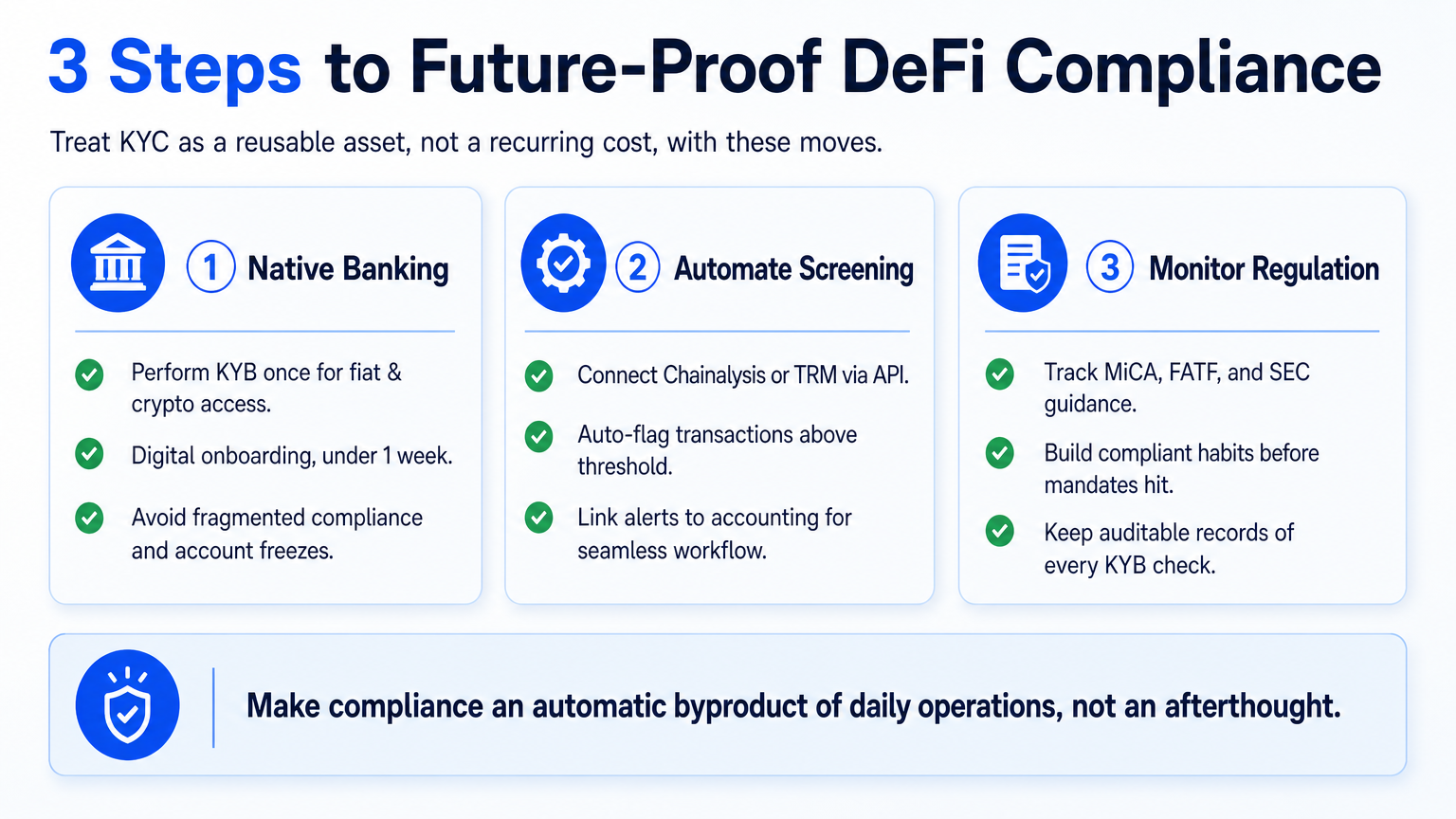
1. Choose banking partners that understand crypto compliance natively
Don’t pair a traditional bank that treats every crypto transaction as suspect with a separate, unverified wallet. Sign up for a platform like OneSafe that performs KYB once and gives compliant access to both fiat and crypto rails. This ensures contractor payments in USDC or stablecoin revenue have a clear, auditable identity attached. Onboarding takes less than a week, requires business formation papers and a government ID, and includes multi-factor authentication. Crypto deposits and withdrawals in USDC are free, with segregated accounts in USD, Euro, and CAD. Consolidating avoids the compliance fragmentation that triggers account freezes.
2. Integrate on-chain analytics without breaking your workflow
Tools like Chainalysis and TRM can scan transactions for sanction risk, but if using them feels like an extra step, compliance will collapse under daily pressure. Set up API-connected monitoring that automatically flags inbound and outbound stablecoin transfers above a threshold, and link those alerts to your accounting system. OneSafe already tracks fiat and crypto payments in a single ledger, and its invoicing and bill-pay features can be automated for recurring DAO expenses. The point is to make compliance a byproduct of normal operations.
3. Monitor regulatory signals—don’t wait for a mandate to build compliant habits
The a16z proposal doesn’t change law, but it aligns with the trajectory of FATF recommendations, the EU’s MiCA, and the SEC’s ongoing insistence that DeFi protocols cannot escape securities regulation by calling themselves “decentralized.” The SEC’s 2021 statement on DeFi risks still shapes enforcement philosophy (Crenshaw, Statement on DeFi Risks, Regulations, and Opportunities, 2021-11-09). Adding permissioned identity layers—like the Zhibao-Bedrock pilot (2026)—gives a template. The more your financial records demonstrate consistent KYB/AML checks, the less likely you become a target.
Why does DeFi create compliance challenges?
DeFi’s compliance challenges stem from architecture: protocols run on public blockchains without a central identification gatekeeper. Users interact pseudonymously, often across borders, complicating obligations to determine beneficial ownership, perform sanctions screening, and file suspicious-activity reports. Traditional KYC frameworks assume a financial institution with a direct customer relationship; in DeFi, the user may interact with a smart contract, not a legal entity. That leaves fiat on/off ramps holding compliance responsibility for activities they can’t fully monitor onchain. This is the core tension that DeFi regulation is trying to resolve.
How can businesses manage DeFi compliance risk?
Businesses can manage DeFi compliance risk by front-loading KYB and KYC before any crypto exposure begins. Choose a banking platform that verifies the business identity once, then applies that verified status across all subsequent fiat and crypto operations—exactly how OneSafe operates. Use blockchain analytics to screen wallet addresses before sending or receiving funds, ideally automated. Finally, maintain clear, linkable records showing that every onchain transaction maps to a verified entity and a legitimate business purpose. Unified identity, automated screening, and audit records turn compliance from a reactive panic into a systematic process.
What is the a16z proposal for rethinking KYC?
The a16z proposal, published October 12, 2026, suggests that KYC can become reusable, blockchain-native credentials that a party completes once and then carries across the DeFi ecosystem. The credentials would be cryptographically signed by a regulated verifier and could include attestations such as “not on sanctions list,” “accredited investor,” or “registered business.” Protocols and institutions could consume these credentials without re-verifying the underlying data, reducing onboarding time while strengthening Bank Secrecy Act compliance. It’s a shift from “check the customer every time” to “trust but verify the credential.”
How does reusable KYC work for DeFi?
Reusable KYC separates identity verification from identity usage. A user provides personal or organization data to a trusted issuer once. The issuer confirms the information, then issues a non-transferable digital credential—usually a verifiable presentation—that a DeFi protocol can check against a trusted registry or public-key infrastructure. The credential can reveal nothing except that the holder meets a specific requirement, such as “not a sanctioned entity.” The a16z vision applies this blockchain identity verification layer to the onchain world, allowing institutional liquidity to flow without repeated invasive checks.
What are the implications for DAOs and Web3 startups?
DAOs and Web3 startups stand to gain the most. Reusable onchain KYC would let a DAO onboard dozens of contributors, vendors, and liquidity providers through a single identity verification, rather than re-running KYC for every new protocol. It would simplify cross-border payroll because the DAO’s compliance posture would be portable. In the nearer term, startups should partner with a banking platform that mirrors this principle. OneSafe gives a DAO customizable roles so a treasurer can approve a USDC payroll run while a separate signer handles fiat rent payments, all under one verified corporate identity. This operational pattern trains organizations to treat DAO compliance as a single, reusable asset.
Is DeFi compliance possible without sacrificing decentralization?
The tension is real, but a synthesis is emerging: permissioned identity layers that run on public blockchains without centralizing control of the protocol itself. Reusable KYC credentials don’t mandate that a dApp refuse service to uncredentialed users; they provide a voluntary mechanism for regulated institutions and compliance-conscious DAOs to prove they’ve done their KYC obligation. Decentralization advocates can still interact permissionlessly, while those who must comply can do so on the same rails. The a16z proposal, combined with permissioned pilots like Zhibao and OneSafe’s integrated KYB, shows that open infrastructure and verifiable identity can coexist if the identity layer remains separate from consensus and doesn’t gate the base protocol.
Open questions we’re tracking
Privacy vs. auditability: who holds the keys to your reusable ID?
A compliance credential must not become a surveillance panopticon. While the a16z proposal mentions privacy-preserving designs such as zero-knowledge proofs, the technical standard has yet to settle. Will users control their own keys and selectively disclose, or will a central registry hold them? The answer will determine cross-jurisdictional adoption.
Will regulators buy in—and on what timeline?
No U.S. regulator has yet endorsed reusable onchain credentials. Europe’s eIDAS 2.0 moves toward cross-border digital identity, but it doesn’t explicitly cover onchain credentials. Expect pilot programs to influence regulatory appetite, with U.S. and EU guidance likely 12-24 months away.
Can DAOs and self-sovereign identity coexist?
A DAO without a legal wrapper may struggle to get a KYC credential because no legal entity exists to verify. Many DAOs now use a foundation or LLC. Self-sovereign identity could eventually allow a DAO’s multisig to collectively assert its identity, but the credential must still tie back to natural persons with verified documentation to satisfy bank KYB. Until that interlock matures, the hybrid model OneSafe uses—KYB for the corporate entity, role-based access for DAO members—is the most practical path.
Key Takeaways
- The a16z proposal of October 12, 2026 turns KYC from repeated friction into a single, reusable onchain credential, removing a bottleneck for institutional DeFi.
- Businesses that consolidate KYB into a single fiat-crypto platform now—like OneSafe—are already applying the reusable-KYC principle, cutting onboarding time, compliance cost, and account-freeze risk.
- DAOs should structure treasury and payroll with role-based permissions and a unified compliance record, even before protocol-level identity standards arrive.
- DeFi regulation is escalating on multiple fronts (ESMA deadline, SEC posture), and waiting for certainty is riskier than building compliant habits today.
- The balance between privacy and auditability remains unresolved, but pragmatic compliance without full centralization is being tested now.
Open an account that treats compliance as a single, frictionless step across both fiat and crypto: get started with OneSafe today.